Till skillnad från resten av befolkningen ökar självmorden bland flickor. Störst är ökningen i åldern 10–14 år, visar unik analys. ”Ett totalt misslyckande”, säger Gergö Hadlaczky, docent i psykologi.
https://t.co/h6vg0iJvm3
Australian nikotiinipolitiikan epäonnistumisista on tullut varoittava esimerkki Euroopalle. Miljardien menetetyt verotulot, valtavat kustannukset, jengisotia ja markkinoiden sääntelyn loppuminen.
Kieltolain tuloksiin päästään liian kovalla verotuksella.
https://t.co/IJuOP3Ymxz.
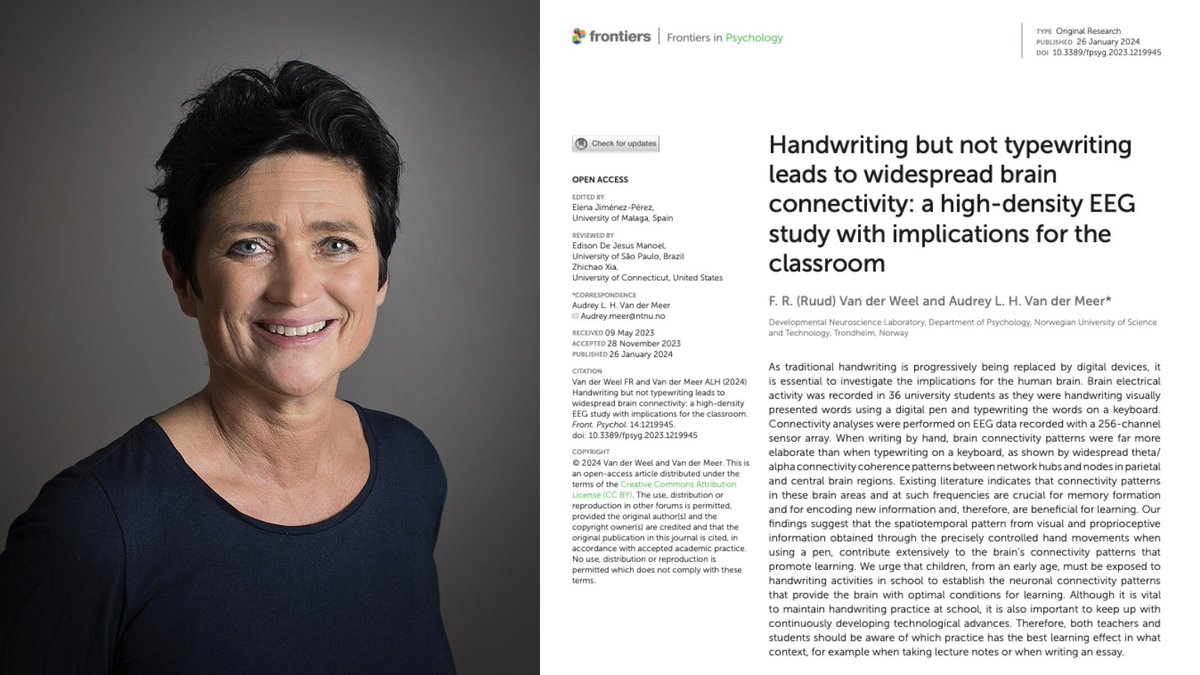
A Norwegian neuroscientist spent 20 years proving that the act of writing by hand changes the human brain in ways typing physically cannot, and almost nobody outside her field has read the paper.
Her name is Audrey van der Meer.
She runs a brain research lab in Trondheim, and the paper that closed the argument was published in 2024 in a journal called Frontiers in Psychology. The finding is brutal enough that it should have changed every classroom on Earth.
The experiment was simple. She recruited 36 university students and put each one in a cap with 256 sensors pressed against their scalp to record brain activity. Words flashed on a screen one at a time.
Sometimes the students wrote the word by hand on a touchscreen using a digital pen, and sometimes they typed the same word on a keyboard. Every neural response was recorded for the full five seconds the word stayed on screen.
Then her team looked at the part of the data most researchers had ignored for years, which is how different parts of the brain were communicating with each other during the task.
When the students wrote by hand, the brain lit up everywhere at once.
The regions responsible for memory, sensory integration, and the encoding of new information were all firing together in a coordinated pattern that spread across the entire cortex. The whole network was awake and connected.
When the same students typed the same word, that pattern collapsed almost completely.
Most of the brain went quiet, and the connections between regions that had been alive seconds earlier were nowhere to be found on the EEG.
Same word, same brain, same person, and two completely different neurological events.
The reason turned out to be something nobody had really paid attention to before her work. Writing by hand is not one motion but a sequence of thousands of tiny micro-movements coordinated with your eyes in real time, where each letter is a different shape that requires the brain to solve a slightly different spatial problem.
Your fingers, wrist, vision, and the parts of your brain that track position in space are all working together to produce one letter, then the next, then the next.
Typing throws all of that away. Every key on a keyboard requires the exact same finger motion regardless of which letter you are pressing, which means the brain has almost nothing to integrate and almost no problem to solve.
Van der Meer said it plainly in her interviews.
Pressing the same key with the same finger over and over does not stimulate the brain in any meaningful way, and she pointed out something that should scare every parent who handed their kid an iPad.
Children who learn to read and write on tablets often cannot tell letters like b and d apart, because they have never physically felt with their bodies what it takes to actually produce those letters on a page.
A decade before her, two researchers at Princeton ran the same fight using a completely different method and ended up at the same answer. Pam Mueller and Daniel Oppenheimer tested 327 students across three experiments, where half took notes on laptops with the internet disabled and half took notes by hand, before testing everyone on what they actually understood from the lectures they had watched.
The handwriting group won by a wide margin on every question that required real understanding rather than surface recall.
The reason was hiding in the transcripts of what the two groups had actually written down.
The laptop students typed almost word for word, capturing more total content but processing almost none of it as they went, while the handwriting students physically could not write fast enough to transcribe a lecture in real time, which forced them to listen carefully, decide what actually mattered, and put it in their own words on the page.
That single act of choosing what to keep was the learning itself, and the keyboard had quietly skipped the choosing and skipped the learning along with it.
Two studies. Two countries. Same answer.
Handwriting makes the brain work. Typing lets it coast.
Every note you have ever typed instead of written went into your brain through a thinner pipe. Every meeting, every book highlight, every idea you captured on your phone instead of on paper was processed at half depth.
You did not forget those things because your memory is bad. You forgot them because typing never woke the part of the brain that would have made them stick.
The fix is the thing your grandmother already knew.
Pick up a pen. Write the thing down. The slower road is the faster one.
I rusreform debatten fikk dette for lite plass. Vi klarer ikke strupe smuglingen inn til Norge før vi statlig regulerer salget. Det er ingen vei utenom. https://t.co/ErD06SeGPr
I went to the Swedish alcohol monopoly with my fiance and carrying our 5 week old baby. Was checking out two nice bottles of wine when the cashier asked me how old I was.
My brother. If I am 17 years old, have gray hair, a wife and a newborn baby, please let me have the wine
@lille56n @Bysheriffen vakuumet kan tas over av enda verre aktører også, samt at det generelt skapes grobunn for uro, vold, tvang, pengeinnkreving, slaveri og utnyttelse
@lille56n @Bysheriffen Så hvordan begrunne "viktig beslag" lurer jeg på. Mengdene er store, men det er også lett å la seg lure av. Grunnbildet er vel fortsatt at langt mer blir ført inn, omsatt og brukt enn det som blir tatt, og at prisene holder seg stabile, folk blir satt i gjeld og bruker fortsatt
@lille56n @Bysheriffen Med mindre heroin og amfetaminen er produsert innenlands så er det fortsatt mulig bare et nettverk som gjør det både stort og smått gjør: tar inn i landet og distribuerer det. Dette endrer ikke priser eller bruk i min analyse. Og nye folk står klare enten frivillig eller ikke
Gigantbeslag i Bergen – 35 kilo bort fra gata. Bra politiarbeid. Men ærlig talt: påvirker det pris eller tilgang? Neppe. Nettverkene står. Tenk hvor mye godt rusforebyggende arbeid vi kunne fått for de titalls millioner "beslaget" kostet. https://t.co/7joxsqFJAs
Så meget er 80 gram oksekød. Det er den mængde oksekød plejehjemsbeboere i København må få. Ikke om dagen, men om ugen. For klimaets skyld. Det har Københavns Kommune bestemt.
Når man kommer på plejehjem, har man typisk et år tilbage at leve i. Men Københavns Kommune mener, at dette er det helt rigtige tidspunkt at påtvinge borgerne nye spisevaner. Danskerne spiser typisk 300 gram oksekød om ugen – altså næsten 4 gange mere end den ration, plejehjemsbeboerne bliver tilkendt.
Dette formynderi bør stoppe.
Plejehjemsbeboere har typisk betalt skat hele deres liv ud fra den forventning, at velfærdsstaten tager sig dem, når de får brug for de. De fortjener pleje og omsorg, ikke formynderi.
50 mill. på narko-scanner i en svensk havn. Ja, flere beslag – selvsagt. Men pris og tilgjengelighet? Neppe. Symboltiltak. Hva om pengene gikk til forebygging som faktisk virker? Det er på tide med nytenkning i narko-bekjempelse. Start kunnskapsbasert 🙏 https://t.co/7gulE0IsQN