I stand by my position: The video should be taken down.
Let me make this clear: I am not asking anyone to be shielded from accountability. If he committed an offence, let the authorities investigate, follow due process and punish him if found guilty.
My concern is simple: Why should innocent family members, especially his wife and children, suffer the consequences of something they had no involvement in? Why publish the video on social media instead of submitting it to the appropriate authorities as evidence?
Seeking the removal of the video does not mean defending alleged wrongdoing. It means protecting innocent people from unnecessary public humiliation.
NIGERIAN LAWS RELATING TO PRIVACY:
1. Section 37 of the Constitution of the Federal Republic of Nigeria 1999 (as amended): Guarantees and protects the privacy of citizens.
2. Section 24(1) of the Nigeria Data Protection Act 2023: Requires personal data to be processed fairly, lawfully and transparently, and protected against unauthorised or unlawful processing.
3. Section 34 of the Nigeria Data Protection Act 2023: Provides data subjects with rights relating to access, erasure and restriction of the processing of their personal data, subject to the law.
4. Section 36 of the Nigeria Data Protection Act 2023: Provides the right to object to the processing of personal data, subject to legitimate grounds and public interest considerations.
These laws highlight the importance of privacy and responsible handling of personal information. Their application depends on the circumstances of each case.
Let the law take its course. Let justice be served, but innocent people should not have to pay the price for someone else's alleged wrongdoing.
PRIVACY IS A RIGHT. JUSTICE MUST BE SERVED.
That's why I don't want to do this activist gimmick. I would definitely collect this land and sell it if possible, and after weeks I will continue my activism. The governor can sue me.
I have formally declined an offer of a 750-square-metre plot of land made to me by the Kaduna State Government and handed to me last Thursday through a friend.
For the avoidance of doubt, I never applied for the allocation. While I appreciate the gesture, the timing and circumstances surrounding the offer do not sit well with me.
It is particularly important that Kaduna State is one of the places where our Movement the TMG and its members have faced serious challenges, including arrests and alleged acts of intimidation and persecution. Even the printing of our branded campaign shirts has proved difficult, with printers facing obstacles that we do not encounter in other states.
In these circumstances, accepting a personal land allocation from the same government at a moment like this would create an unacceptable conflict of interest and potentially compromise my ability to speak and act freely on these issues.
I thank the governor and pray that going forward, opposition activities in the state, and especially freedom of expression and dissent, would be given treatment comparable to that of the ruling political party.
This man is a father and grandfather to all Nigerians. No foreign tourist should be allowed to tarnish his reputation in our eyes. We believe in respect, dignity and the protection of our cultural heritage. 🇳🇬❤️
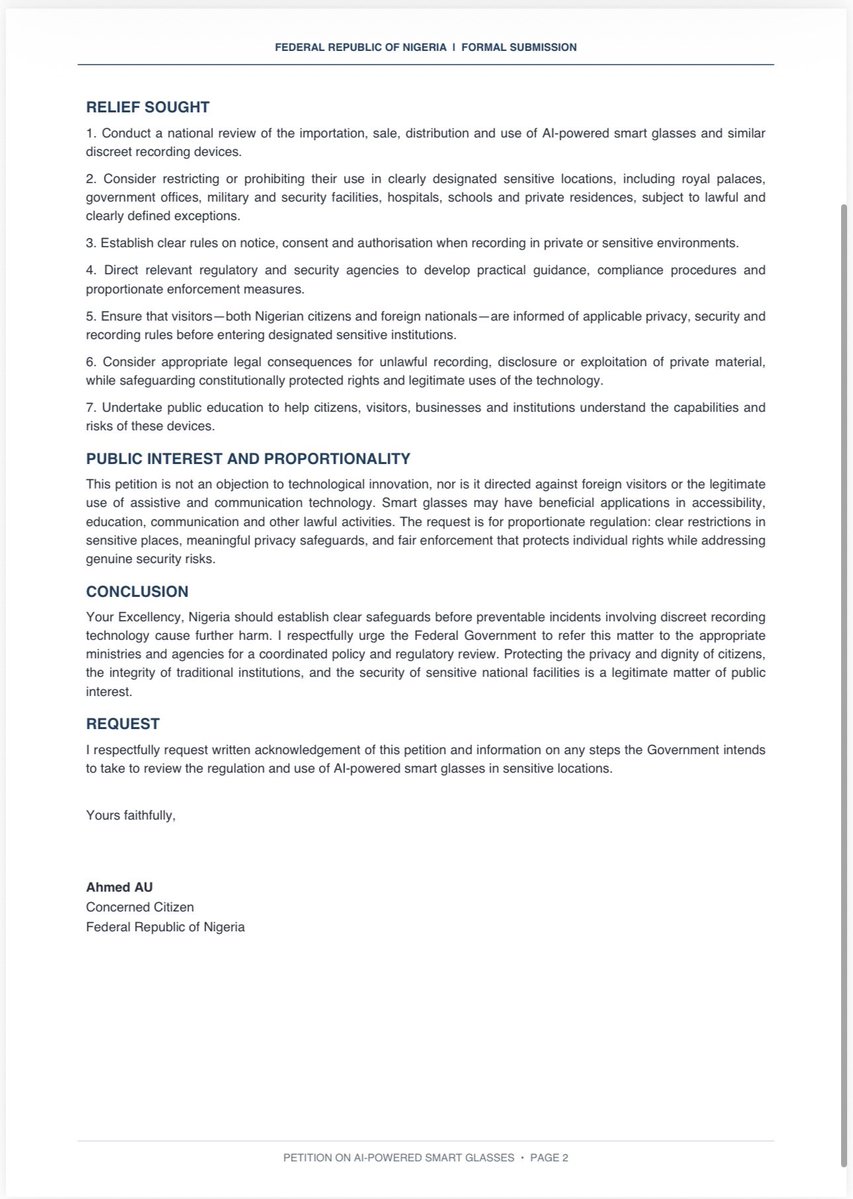
A FORMAL PETITION TO THE FEDERAL GOVERNMENT OF NIGERIA FOR THE REGULATION, RESTRICTION OR POSSIBLE BAN OF AI-POWERED SMART GLASSES IN SENSITIVE LOCATIONS ACROSS THE COUNTRY
To:
The President and Commander-in-Chief of the Armed Forces, @officialABAT
Federal Republic of Nigeria,
Through the Federal Ministry of Information and National Orientation, the Federal Ministry of Communications, Innovation and Digital Economy, the Federal Ministry of Interior, and relevant national security agencies.
Subject: Urgent Call for Stronger Regulations and Restrictions on AI-Powered Smart Glasses to Protect Privacy, Dignity, Cultural Heritage and National Security
Your Excellency,
I respectfully write to draw the attention of the Federal Government of Nigeria to the growing privacy, security and cultural concerns associated with AI-powered smart glasses, particularly devices equipped with discreet cameras, microphones, audio recording and artificial intelligence capabilities.
Recent public controversy surrounding a foreign tourist’s visit to the palace of the Emir of Daura has brought these concerns into sharper focus. Questions surrounding the recording and circulation of content allegedly connected to that visit have generated public debate about privacy, consent, the dignity of traditional institutions and the protection of sensitive cultural spaces.
Regardless of the outcome of any investigation into that particular incident, it has highlighted an important gap that deserves urgent government attention: the potential misuse of wearable recording technology in places where people reasonably expect privacy and where unauthorised recording could have serious consequences.
WHY THIS MATTER REQUIRES URGENT ATTENTION
AI-powered smart glasses can look like ordinary eyeglasses while carrying cameras and microphones capable of recording people, conversations and surroundings, sometimes without those nearby immediately realising that recording is taking place.
This creates several concerns:
1. Violation of Privacy and Personal Dignity
Individuals may be recorded without their knowledge or consent in private or sensitive environments. Such recordings can subsequently be edited, shared or circulated online, potentially exposing people to embarrassment, harassment, reputational damage or other forms of harm.
2. Threats to National Security
Unauthorised recording around government buildings, military installations, security facilities, the Presidential Villa, critical infrastructure and other protected locations could expose sensitive information. Criminals or individuals with malicious intentions could potentially exploit such technology for surveillance, intelligence gathering or other unlawful activities.
3. Threats to Traditional Institutions and Cultural Heritage
Nigeria’s traditional institutions, palaces, royal residences and cultural gatherings deserve appropriate protection. These places are not ordinary entertainment locations. They represent our history, identity, customs and heritage.
Unauthorised recording in such environments can expose private interactions, create misunderstandings and damage the reputations of respected traditional institutions and individuals.
4. Misinformation, Manipulation and Reputational Damage
Recorded footage can be taken out of context, selectively edited or combined with misleading narratives. As AI technology develops, the possibility of manipulated audio and visual content also creates additional challenges for verifying what is authentic.
False or misleading content can spread rapidly online, damage reputations and create unnecessary tension within communities and across the country.
5. Risks to Women, Children and Vulnerable Individuals
I sincerely apologise to my followers, friends, and colleagues who were offended by my earlier submission on this issue.
I have since been informed that the Emir reportedly suffers from Frontotemporal Dementia, a condition that can affect impulse control and social judgment, sometimes resulting in inappropriate behaviour.
This has given me a different perspective on the incident. However, I still believe his security personnel and staff failed in their responsibility by leaving him alone with a visitor without adequate supervision.
Once again, I sincerely apologise to everyone who felt offended by my earlier comments. Sometimes, having the full picture makes all the difference.
I wanted to do tahajjud for 7 days straight i only managed to do it for 3 days straight. Wallahi, my life has completely overpedri from my life last month, i am in a totally different position, Alhamdulillah.
We are fully prepared to pursue legal action over the allegations made by this foreign tourist concerning the Emir of Daura.
We will not take lightly any claims that are false, defamatory or intended to damage the reputation of the Emir, our cultural heritage and the traditions of Northern Nigeria.
We believe in truth, accountability and due process. If the allegations are proven to be fabricated, those responsible should be held accountable through the appropriate legal channels.
Our culture deserves respect, and justice must prevail.