🇲🇽 La Bolsa Mexicana de Valores en picada, ya ha rebasado el -6%. Ni en 2008 se vio tal crisis, tampoco en la pandemia. 😱Es el peor desempeño desde 1997. 📉📊
5 pasos para utilizar la Inteligencia Artificial en tu empresa.
Todas las empresas pueden, y deben, comenzar a experimentar con estas nuevas tecnologías. El quedarse atrás será un descalificador automático el mercado.
Mi columna en @ElFinanciero_Mx 🚀
https://t.co/VmowUTfy0C
El tipo de cambio peso-dólar sigue bajando y apunta a que podría cerrar el 2023 debajo de 17 pesos por dólar. Increíble.
La debilidad del dólar es lo que ha fortalecido al peso.
How do you figure out what to build for your MVP?
First, let's define MVP: It's the smallest version of a product needed to prove that you've solved a user's or customer's problem.
So what do you do?
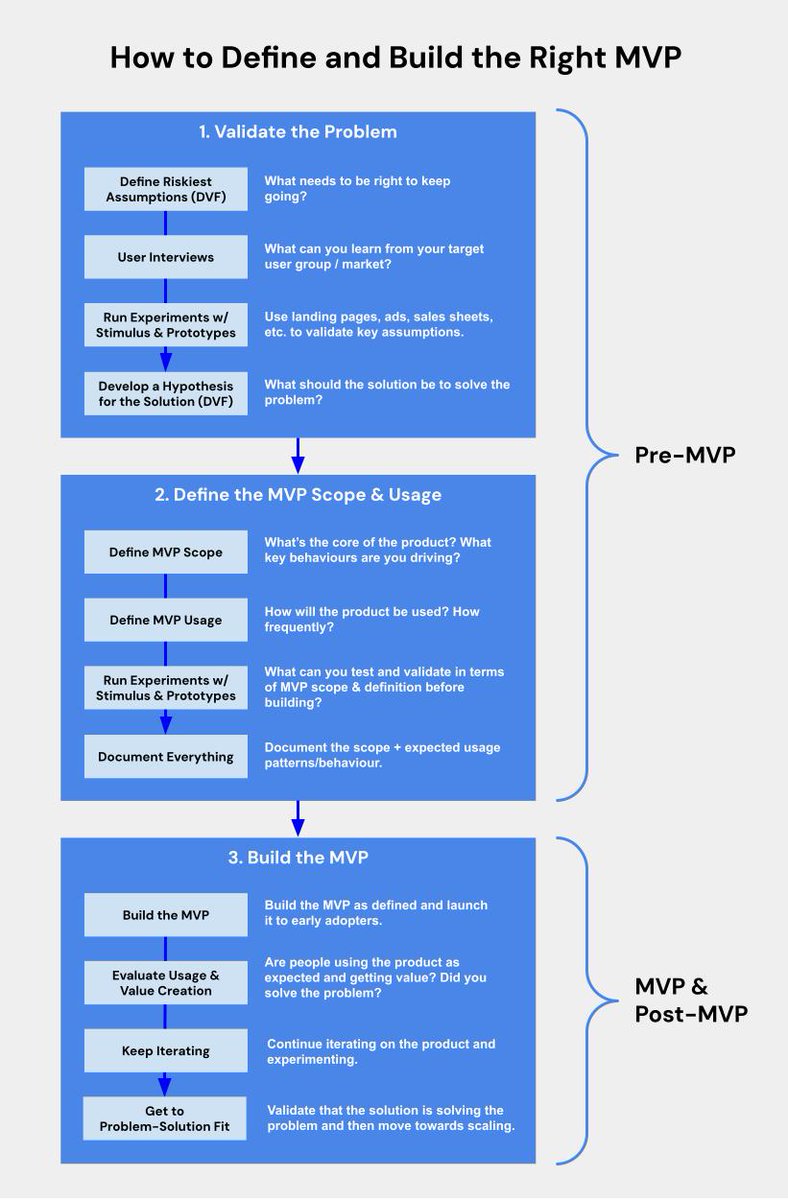
1. Start by validating the problem
If you don't understand the problem intimately, it's tough to build an MVP that's going to work. While validating the problem you're not building the MVP. You're doing user research and using stimulus / prototypes to test key assumptions.
A landing page is NOT an MVP.
The concept RAT (Riskiest Assumption Test) is valuable at this stage. Identify your riskiest assumptions & test them, without building a product.
Use DVF (Desirability - Viability - Feasibility) from Design Thinking as a guide for identifying the riskiest assumptions. Generally, you should start with Desirability.
2. Next, define how you'll prove that you've solved the problem
Before building anything you need to define "good usage" for your product. Is it a daily use app? Weekly use? Frequency of usage is about proving Stickiness, which is critical for proving your MVP (when you build it) is creating value.
Along with how you'll measure usage, you define the scope of the MVP. What is the core functionality? What's at the heart of the product? What's the simplest behavioural loop you need to prove?
I like @nireyal's Hooked model for this.
Use a PRD (Product Requirements Doc) to really define scope and how you'll measure traction / usage.
With the scope + usage expectations defined, you've basically mapped out the MVP.
Minimum = you know the smallest scope you believe will create value
Viable = your definition of usage
Product = it has to be a real thing people use to solve a problem
3. Now it's time to build the MVP
Once built, you put it into people's hands to see what will happen. You're looking to prove Stickiness (users adopt, keep using and "pay" for the MVP). Pay = with $, attention and/or data. The combination of these three things represents the V (viable) in MVP.
Proving Stickiness is tantamount to achieving Problem-Solution Fit. You've validated a problem and built a solution that fixes it. You know the solution fixes the problem because you have a set of customers that use the product, tell you they get value, pay for it & churn is low. This is with early adopters, and now you have to acquire more users/customers to prove you can scale customer acquisition and achieve PMF.
I've included a flowchart that walks through the steps from validating the problem, to scoping the MVP (and its expected usage) to building the MVP (which btw, usually takes lots of iteration). I hope this helps!
Si necesitas inspiración para comenzar a emprender, el séptimo arte te ayudará a motivarte. Aquí películas que seguro te impulsarán. https://t.co/JZMyxrl8jH
La inteligencia artificial está impactando todos los sectores. Aquí mi opinión sobre su rol en el sector fintech y bancario, publicada por @Milenio
🚀https://t.co/9sQIW814hW
@Atomic_32 #fintech#InteligenciaArtificial
El libro "Cómo fracasar en casi todo y aun así triunfar" es una guía increíble para tener éxito en la vida.
Tiene algunas frases brutales.
Éstas son las 20 que más me han gustado:
El riesgo de crisis no está ahora en el tipo de cambio, como solía ocurrir antes al final de cada sexenio. El riesgo está ahora en las finanzas públicas y en la posibilidad de que suba súbitamente la aversión al riesgo sobre México.
Si dominas el tema, no sentirás miedo pues habrás reducido los riesgos. Vuélvete competente en eso que te da miedo.
Estudia, practica, atrévete, aprende.