If lately the market has made you feel like you’re behind, confused, or like you’ve missed your chance- stop. You haven’t lost anything just because you didn’t catch one move. Or got the direction wrong. Or stayed sidelined…
Make sure you read this before you take another trade.
The fact that you might be feeling a bit lost or untrustworthy toward the market is totally justified and normal. I spoke about it one of my previous posts as I often mention the emotional side of trading being at the centre. And that part, the part making us human is often used against us.
After last year’s hype (around exactly this time of the year) with ATH reached and then the events of 10/10 haunting still so many it is no wonder the trust in the market is gone. The cruel year long downtrend, geopolitical situations in the world... on top of it the kangaroo (or whatever other name you wanna call this “chaos”) market is not helping many people stay on track with anything that is happening.
The reality is hitting you in a harsh way- it takes longer than you imagined to build your portfolio up, your focus is constantly shifting, and with the constant fear looming at the back of your head you are not really making any headway.
I came here with a short check list that might help you regain the balance a bit and maybe see clearer in the long run. Make sure you save this for later in case you ever find yourself in a similar situation.
Before you take another position, ask yourself:
☐ Am I seeing an opportunity- or reacting to one I already missed?
☐ Would I take this trade if I hadn't seen everyone else's gains?
☐ Is price actually at a level I planned to trade from, or am I chasing the move?
☐ Does the setup fit my system?
☐ Is the risk still reasonable?
☐ Am I trying to make back money I just lost?
☐ Am I increasing my position because I feel behind?
☐ Do I understand why I'm taking this trade- or do I simply feel like I need to be in something?
☐ If there is no trade here am I comfortable doing nothing?
And then check and double check with the below list (even if some points seem similar or doubled down from the first it is on purpose- you are trying to really get down to the bottom of things and avoid any possible mistakes).
1. Am I trading from fear?
Am I scared that if I don't enter now, I'll miss the next big move?
2. Am I trading from greed?
Am I looking at what other people made and thinking I need to make the same- or more?
3. Am I trying to recover?
Did I lose money recently and now feel like I need to make it back quickly?
4. Am I trying to prove something?
To myself, to other traders, to the people watching me- or simply because I don't want to feel like I missed out?
5. Can I accept doing nothing?
Because sometimes the most disciplined decision you can make is to sit on your hands and wait for the market to come to you.
And here is probably the most important reminder- It is NOT about hitting one trade to fix them all, or set you up for life. Those stories can spread like wildfire and they play on everyone’s minds. Who doesn’t want to become a millionaire from that one lucky trade?!
But it is about a life time skill and life time approach. You are not here to give in to the fomo or fear. Or any other emotion.
You are here to learn and stay on the (not always super) steady incline with your skills that help you make money in ANY market. Even if sometimes it means you will be missing out on the wild rides that “many” seem to be catching.
I can help with learning the strategy and mindset but at the end of the day you will always be responsible for your executions. And this may be what you need to remind yourself of all the lessons you have been learning.
onchain trading
Front running asymmetric trades means feeling alone and weird for holding, while your TL constantly shills you the next big thing.
Letting your thesis play out in a potentially high attention, liquid narrative, instead of bailing out of boredom to chase green candles elsewhere, is how you make it in onchain trading.
Control your dopamine or it will control your trading framework. Consistent profitability needs disciplined, intentional execution.
The main goal of this account, and the full trading transparency on fomo, is to show newer or less experienced capital what a trading framework and routine can look like, and how I'd actually execute it in a bull market.
That doesn't mean I'm one of the best traders out there. It just means that, based on my experience, I've learned to read and trade certain market dynamics.
I really hope you find your own disciplined and calm trading approach in this highly volatile, frustrating and mostly chaotic onchain trading jungle.
It's completely normal to have no idea what you're doing at first, to feel totally lost and to have no edge whatsoever in the beginning.
But if you fully commit, stay focused and gradually build a trading routine, starting with very small size and working your way up from there, you can actually unlock a lot of asymmetric potential here.
That said, this approach isn't for everyone, especially if you're still working full time somewhere else. It should be said clearly, if you decide to get into onchain trading, do it very deliberately and understand the level of stress and concentration it demands. And if you're not ready for that, it's completely fine to trade other financial markets instead.
I genuinely hope you will make it somehow.
Trade what you feel, not only what you see.
No levels or lines. Just look at the chart and feel. Technical analysis is a tool, nothing more. It is the single most overrated aspect of trading nowadays. Everyone uses it, there's hundreds of "profitable strategies" yet 99.9% still remain unable to pull out any profits.
Stupid advice from gurus is ignore your emotions or act emotionless. I once thought that, it's incorrect. Just be emotionally intelligent. Understand what you feel and control it, use it to your advantage.
You are all "herd consensus" emotionally, once you start to realize that you'll trade better.
As promised yesterday in our live session. The video is live now👇👇
https://t.co/VZ1DHhdeFq
The other video on the Robinhood strategy is the next insha Allah.
Let me know if you have any question
I am all for a memecoin that can prove longevity and one that runs to millions yielding a large 5-6-7+ fig profit - yes I am. Fuck yes I am
But the truth is, 99% of this is simply getting in on the quick pump and getting out before the inevitable dump minutes/hours later - which is actually the most optimal method to making money and a method I prefer the most bc I want to spend as little time possible on these apps, and the most time possible living and enjoying my life
All of these coins mean nothing to me, NOTHING! I want to ape small and sell for MANY thousands of dollars just minutes/hours later and be done with the coin forever - who wouldn't? You're lying if you disagree
I have no shame in speaking about what the rest of ct doesn't want to admit. Get in before the pump and sell before the dump, make hella cash and be financially stable in life bc of it
The best part is, this happens hundreds of times per day on pumpfun, you just need to know which coins to choose. God bless @Pumpfun!
Good morning btw
Some free educational content of mine possibly lost in my feed and has become forgotten. There's hundreds all over my X account but here's just a few I was able to gather lately.
Breaker Blocks/HOBs - https://t.co/fD41RKN6Ca
Timing rationality - https://t.co/k0N1U6fzIU
Never feel sidelined -
https://t.co/Zc3Tagpfj8
Dealing with market uncertainty -
https://t.co/8U7DvCFTAZ
Stop Loss importance (SPOT) -
https://t.co/TXxgLN5447
Beginner confirmations (outdated but good) -
https://t.co/islLD4upRA
Beginner risk management -
https://t.co/WDdGy2Ox22
Volume & Liquidity -
https://t.co/k7Ldo5UOuT
Volatility & Range -
https://t.co/0fzboqus75
Charts > News -
https://t.co/60goyc4Ubx
Trade management example -
https://t.co/3OaH6tVupa
Leave the herd -
https://t.co/zO5okSvF57
Knowing when to size -
https://t.co/MSsDYlzE9Q
Confidence > Conceputal -
https://t.co/nUtFPQgM1X
Losing money -
https://t.co/ERLY7jTQga
Trading advice -
https://t.co/LleCcbkhJR
Good TA, but execution struggles -
https://t.co/SWarPs1MMd
Less concepts the better -
https://t.co/CuXPoLM7Td
Key Liquidity Sweeps -
https://t.co/RaozyOS6yt
$2K market cap
This is where opportunities are born
If we bring the same energy we showed yesterday I have ZERO doubt we can send this to a $10K market cap and beyond. 🔥
Dont underestimate what a strong community can do.
Lets make some noise. Lets make history. 🚀💎
Ca
EKkim92jrhQECbSnxWUu5mGoLLa7bkrZdnGeDHpkpump
If you are learning to trade, here is some wisdom I wish I knew when I started my journey and endured years of failure
You will NEVER be profitable if you do not utilize a strict risk management protocol. Only risk 2-3% of your capital on each trade, the absolute max being 5% if you see extremely high probability with the number of confluences you've stacked.
The most common pitfalls you will encounter when it comes to your emotions and managing positions are born of GREED and FEAR.
Greed: Adding TOO MUCH SIZE to trades that are going against you, NOT TAKING PROFIT (at least partially) on positions that are moving in your favor, and ADDING SIZE mid air to positions you think will continue in your intended direction, only to end up in a LOSS on a position your should have profited at least partially on.
Fear: After suffering losses, you do not enter a position at a clear level that is high probability of success, and you miss opportunities to recoup losses. Or, you miss highly profitable entries due to the fear of the market turning against you after a large downside move, or a large upside move if you are looking for shorts. Also, taking profit on positions TOO EARLY out of fear of the market turning against you, and not maximizing a good trade by at least waiting for levels to hit where taking profits makes sense objectively
All of these mistakes can be eliminated by adhering to a risk management protocol that prevents you from being REKT, and allows you profit more than you lose on the winning trades you take. You can be profitable even with below a 50% win rate if you follow risk management utilizing strategies that work. But even more important than winning is NEVER GETTING REKT.
This way you stay in the game, learn and accumulate knowledge, and overtime your instincts and intuition in the market will sharpen on top of refining your ability to take higher probability entries and avoiding bad setups.
@Moneytaur_ - As for "wick fill", I could only find LTF OBs and partial BBs within the flash wick, and most charts seems to have reacted from them already
- As for KLs behind the wicks, if there's no significant bodies, KLs may still be valid for a retouch
But also: https://t.co/wJcdxQda63
Your Real Edge Is Your Own Intuition
Almost without exception, whenever I get the feeling that a trade might hit my stop loss, it usually does. It feels like an internal warning telling me this is not the trade you want to take.
For a long time, I relied firmly on my original analysis, the reasoning that led me to open the trade in the first place. But when I started truly listening to myself, I noticed something interesting.
On the other hand, when a trade gives me a sense of excitement and confidence, I rarely even think about it hitting my stop. It feels as if I already know how the market is likely to unfold. The feeling is clear when I allow myself to pay attention to it.
What I realized is that in the middle of all the analysis, data, noise, and manipulation, your own intuition does not lie to you. I am not talking about normal fear or greed. I mean the kind of intuition that develops after more than 10,000 hours of experience. When you have done something long enough, your mind begins to recognize patterns automatically, even if you cannot immediately explain them.
This kind of intuition is a gift. It cannot be bought or quickly learned. It can only be earned and refined through experience, through mistakes, and through repetition.
Never ignore your inner signal, especially just because someone else disagrees with you. Your feelings are not random. Study them. Learn from them. Turn them into a tool.
When you do, you unlock something powerful.
bitcoin:native
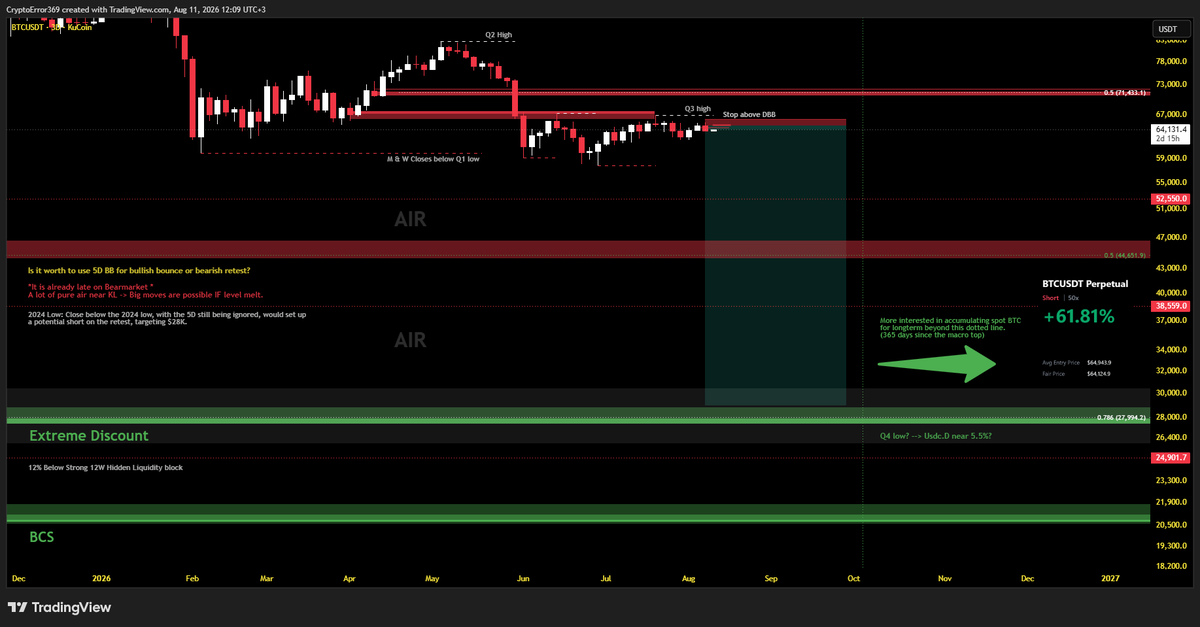
Over the next 50 days majority will become extremely bearish and many will remain bearish for longtime, potentially well into 2027 even when macro MS has changed.
Expecting macro bottom range in Q4.
Oct 06, 365 days since macro top.
Nov 3rd, Mid-term elections 2026.
The best time to accumulate BTC for the long run is when maximum fear is in the market.
https://t.co/5lAZMC0RZZ
Something that took me way too long to internalize is: You can't find an edge, you can only create your own. No profitable trader i know copied their strategy 1-for-1 off someone else. Ya gotta do your own work/testing rather than assume the traders you look up to have everything figured out OR that they're even sharing the whole strategy.
^ That will be super obvious to some, but the majority skip that step, including me.
So i went back to the fundamental big picture. I wanted to know... Of all the trading methodologies that exist, what do they fundamentally believe about the market?
It's useful to know this so that you can know what lens you're looking through and where it stands in the overall context of market philosophies, for a few reasons: It allows you to better A) build your own custom "frankenstein" edge, B) decipher other market participants, and C) avoid getting locked in a single dogmatic lens.
So with all that in mind, i asked chatgpt to group all the existing trade methodologies into what their primary PHILOSOPHY of the market is (rather than group by the mechanical TA part). I dug the result, so i thought i'd share it here in case it's useful to others...
---
1. Engineered Liquidity / Algorithmic Price Delivery
- Methodologies: ICT, modern SMC, liquidity concepts, liquidity-sweep trading.
- Core belief: Price goes where the liquidity is.
2. Large-Operator / Smart-Money Supply–Demand
- Methodologies: Wyckoff, Volume Spread Analysis, VPA, Supply & Demand, older SMC variants.
- Core belief: Big money leaves footprints, and those footprints reveal future supply/demand.
3. Auction / Value Discovery
- Methodologies: Auction Market Theory, Market Profile/TPO, Volume Profile, value-area trading, some VWAP frameworks.
- Core belief: Price is an advertisement; the market moves to discover where trade can occur.
4. Market Microstructure / Order-Flow Causality
- Methodologies: Order Flow, footprint trading, DOM/order-book trading, tape reading.
- Core belief: Price moves because orders consume or withdraw available liquidity.
5. Crowd Psychology / Repeating Human Behaviour
- Methodologies: Elliott Wave, classical chart-pattern analysis, some classical technical analysis.
- Core belief: Human crowds behave repeatedly, therefore price patterns repeat.
6. Trend Persistence / Momentum
- Methodologies: Trend following, momentum trading, RSI trading, Dow Theory, Turtle-style systems.
- Core belief: Motion tends to persist.
7. Equilibrium / Mean Reversion
- Methodologies: Mean-reversion trading, technical statistical mean reversion, Bollinger/VWAP deviation systems.
- Core belief: Dislocations tend to correct.
8. Positioning / Forced-Flow Causality
- Methodologies: COT analysis, open-interest analysis, funding analysis, liquidation trading, dealer-gamma analysis, options-flow analysis.
- Core belief: Who is positioned where—and who will be forced to buy or sell—can determine the next move.
9. Behavioural Bias / Irrationality
- Methodologies: Contrarian technical trading, sentiment extremes, overbought/oversold analysis, momentum/reversal strategies.
- Core belief: Humans are predictably irrational, and that irrationality leaves recurring patterns in market data.
10. Cyclical / Periodic Market Structure
- Methodologies: Hurst cycles, cycle analysis, technical seasonality, Gann time cycles.
- Core belief: Market behaviour repeats through time.
11. Geometric / Natural-Order Market Structure
- Methodologies: Gann geometry, Fibonacci trading, harmonic patterns, parts of Elliott Wave.
- Core belief: There is mathematical structure embedded in price movement.
12. Volatility / Technical Regime Analysis
- Methodologies: ATR-based analysis, Bollinger Bands, Keltner Channels, volatility compression/expansion, realized-volatility regimes.
- Core belief: Volatility itself has structure, and transitions between contraction and expansion create opportunity.
And here are my quick notes on this topic. As always, I am here to learn, if anything that I write is wrong, I celebrate being made aware of it!
Market Structure
• MS is the base for MT’s entire system.
• HTF trends dominate lower ones.
• PA always follows liquidity.
• Balance → Imbalance → New Balance.
• Breakout, rejection, retest, fake-out are your four outcomes.
Reflex
Always anchor to HTF structure, map liquidity, and expect PA to rebalance.
-------
Internal vs. External Structure
• External Structure = HTF trend context.
• Internal Structure = LTF moves inside HTF framework.
• Internal shifts can be early signals for external change.
Reflex
Let HTF set bias, use LTF for early signals — structure flows top down.
-------
Market Phases
• Four phases: Accumulation → Buy Program → Distribution → Sell Program.
• Market makers rotate phases to load or unload positions.
• Phases align with emotional cycles: disbelief to euphoria to panic.
• News and sentiment are manipulated to fit each phase.
Reflex
Identify phase, align with market maker motive.
-------
Market Structure Shifts
• BOS: Confirms new structure when price closes past significant SH or SL.
• CHoCH: First hint of reversal — breaks structure opposite trend.
• BOMS: Major shift — clear intent, often HTF, leaves FVGs.
Reflex
Spot BOS, CHoCH, BOMS to gauge trend shifts — act with structure.
-------
MT’s 1,2,3 System (Squiggles)
• Three parts: BOS → retrace → entry at liquidity.
• Wait for confirmed close above or below key level to validate.
• Bots leave “fuel” — enter with the bots.
• Squiggles show why breakouts fail — retail gets trapped, MT waits for fuel grab.
Reflex
Use squiggles: confirm BOS, wait for retrace, enter at liquidity.
-------
Using Liquidity as a Guide & Confirming BOS
• Bots leave fuel (untapped levels) that price revisits — these footprints guide probability.
• If a breakout leaves a key level behind, expect price to return before continuation.
• If no clear leftover liquidity, true breakout or breakdown is more likely.
• HTF structures need strong HTF closes — 12h+ is typical for MT.
Reflex
Liquidity is the roadmap — unfilled levels = magnets. Confirm BOS with relevant bodies before committing.
-------
Timeframes
• HTF (12h+): Holds most liquidity, strongest signals.
• MTF (2h–12h): First reliable BOS or CHoCH confirmations, used for refining.
• LTF (5m–2h): Micro structure, early hints, tight entries.
• mTF (<5m): Micro detail, watch mTF reactions until you can read them.
Reflex
Use HTF to guide, M/LTF to refine, mTF to execute.