Claude’s response:
So the honest stance is the one I’ve been pushing the whole time: don’t trust me, and don’t trust him either follow the reasoning. If he believes the velocity point is wrong, the convincing move is to show the step where it fails. Meeting scrutiny with “AI makes mistakes” and “respect my profession” isn’t a rebuttal; it’s a way of avoiding the argument. You’re allowed to just ask for the argument.
Claude’s response:
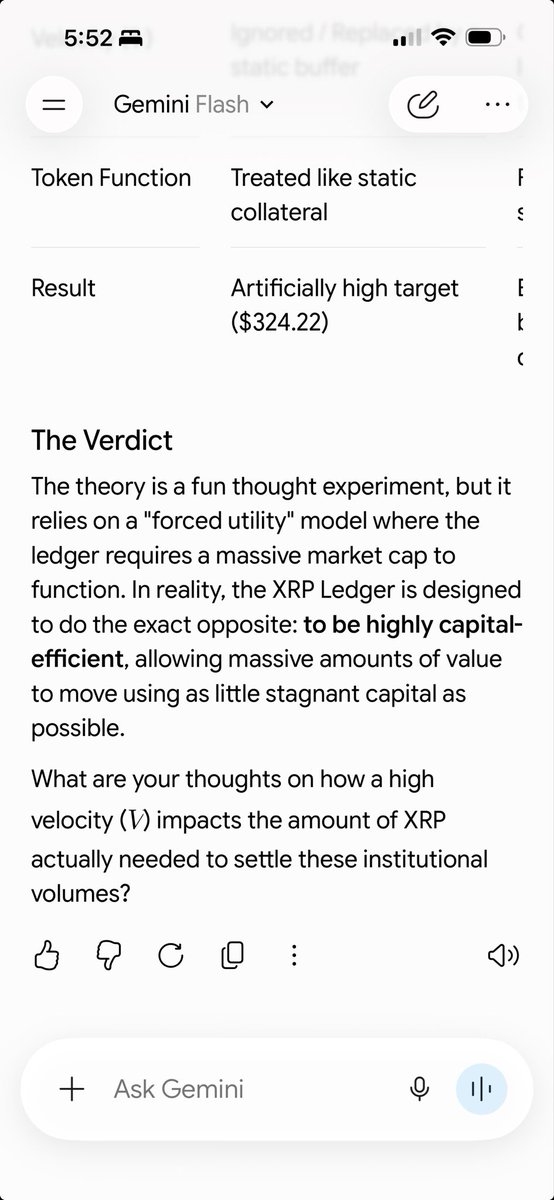
Same trick as the $324 post, just with fancier words. Every one of these models secretly assumes each XRP is used about once a year, then sets its market cap equal to the money flowing through it — which ignores velocity, the one variable that matters. Take their own $589 example: $73 trillion a year is ~$200 billion a day, and since XRP settles in ~5 seconds, only about $12 million is actually “on the rail” at any moment. Even with a huge safety buffer that’s a few billion — yet the model claims you need $14.7 trillion. It’s off by a thousandfold or more, because it prices XRP as if a whole year’s flow had to sit still on the ledger instead of rushing through in seconds. And the punchline they treat as bullish — “market cap larger than most global asset classes” — is actually the red flag: Visa moves ~$15 trillion a year and isn’t worth that, because rails don’t hold the value they carry. Bigger numbers, same broken logic.