Asst Prof of Economics @Trinity_U | health insurance, health policy, & health disparities. Abundance bro. Past: @vanderbiltecon @LGBTPolicyLabVU and @aysps
🚨🚨🚨 Hello, friends! I'm a labor/education economist and, after years of posting, I'm on the job market!
In my JMP, I ask: why are there so few Black teachers today?
Turns out we can trace it back to how schools desegregated in the 60s/70s. Join me for a thread adventure! 🧵
There’s something downright Sartrean about arch-libertarians concluding that democracy should be abandoned and an AI should make our decisions for us.
Freedom truly is a terrible burden.
Human disempowerment now.
It's time for the age of the folly and cruelty of human politics to end.
The median AI is so far above the median human voter in both knowledge and decency it's embarrassing.
Humanity should just take the L.
@jpmvbastos Is this intermediate micro or an advanced micro course? Did a very very very simplified version of the envelope theorem in Principles and it went far over students’ heads.
@MakeUSAVAT@kingofthecoastt The Dartmouth Atlas example we are talking about here is sourced from traditional Medicare claims data, so prices are mostly fixed. The main gradient we’re discussing is the quantity/quality one. About 20% maybe a little less is the prevailing wisdom.
@kingofthecoastt It’s exactly BECAUSE of the price control that you see higher volume. That’s my point. The sole power of the monopolist comes from the ability to withhold supply. But if prices are fixed, withholding supply is costly, so you have to optimize over different margins.
@kingofthecoastt It's the primary way market power would manifest when a monopolist faces a monopsonist, so it's surprising to see it not explored.
https://t.co/pvfIpbGNbV
Since that is a very non-obvious way for "market power" to manifest across areas, it makes sense to not center it as an explanation.
https://t.co/KKrCjh3BfC
@kingofthecoastt Lmao, you're exactly right: Medicare fixes prices, which eliminates traditional market power channel. FFS incentivizes volume, so you see MORE patients, not less. What's the only margin to exercise market power? "Deliberately upping the quantity of care, while reducing quality."
In bad taste to do two write ups on a Finkelstein paper in a row, so I won't deep dive this one, but would have loved to have seen Finkelstein and Skinner engage with market power as an explanation of the Dartmouth Atlas productivity puzzle.
Health economists will twist themselves in absolute knots before entertaining market power. But if prices are fixed and patients can’t easily switch, a provider’s only remaining margins are effort and quality. Low “productivity” may just be market power.
https://t.co/5APnPHPBgr
@ExtinguishedEng@bradchattergoon Counterpoint: there is also a version of higher ed that is purely credentialing: diploma mills. If the choice were only about getting a piece of paper, everyone should just buy their degrees wholesale. And some do! But clearly something else affects value beyond the signal.
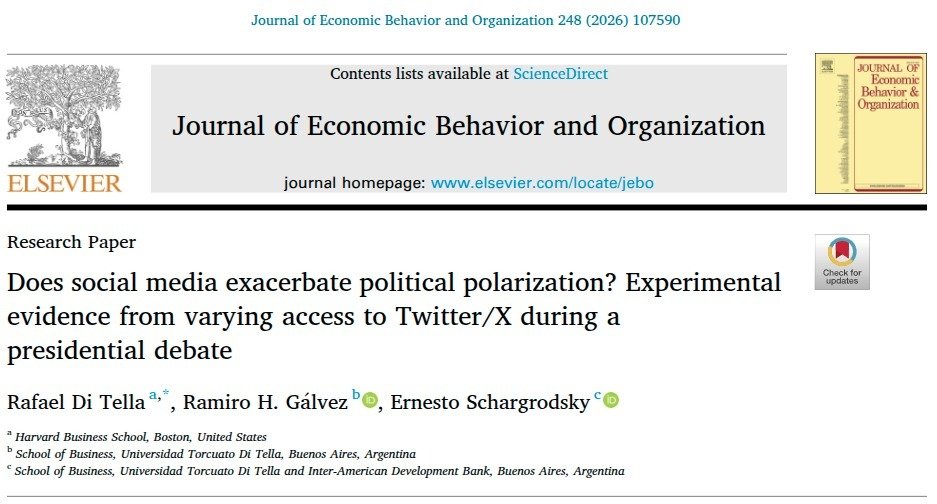
Very happy to share that our paper with Rafael Di Tella and Ramiro Gálvez (@RamiroHGalvez) has recently landed in JEBO!
In this paper, we study whether varying access to Twitter/X during a presidential debate affects political polarization.
@bradchattergoon People are absolutely buying a signal, I don't dispute that, but there's more in the cart than that, which is why I suspect most professors at big R1s tend to send their own kids to LACs. I think you have to engage with the other stuff in the cart.
https://t.co/8QEcQA3muS