Chair, Clark County Executive Committee, Independent American Party of Nevada. Fair maps, clean voter rolls, elections you can trust. #YourIndependentVoice
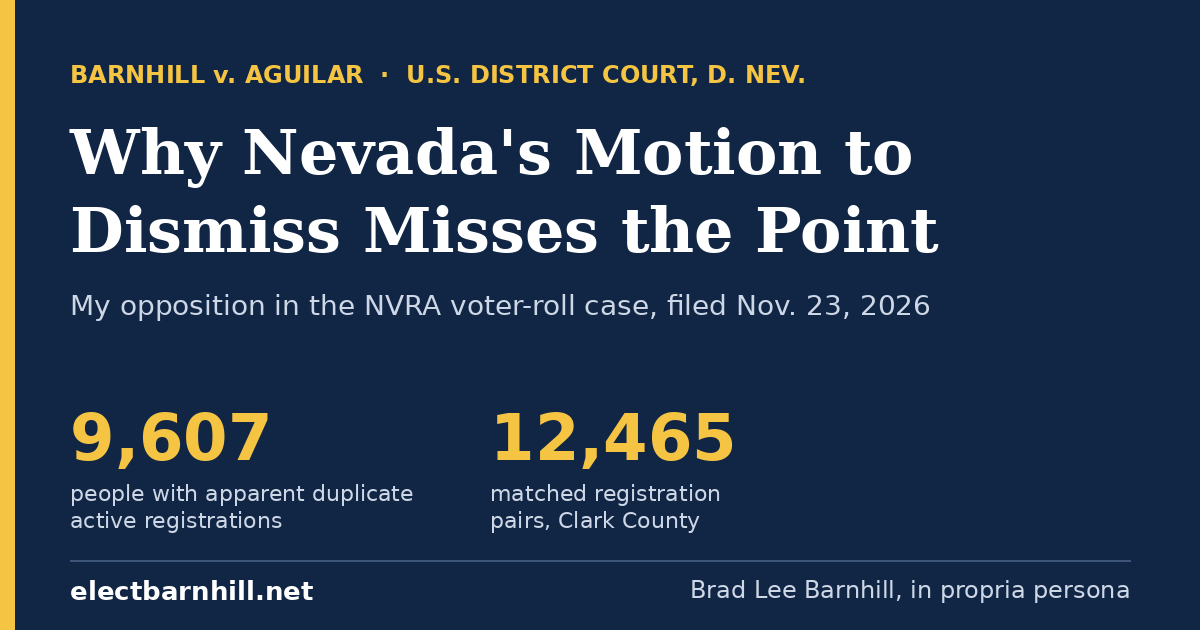
The State’s motion to dismiss my voter-roll case gets the date of its own letter wrong and leans on a citation no one can identify.
That’s not my argument.
This is:
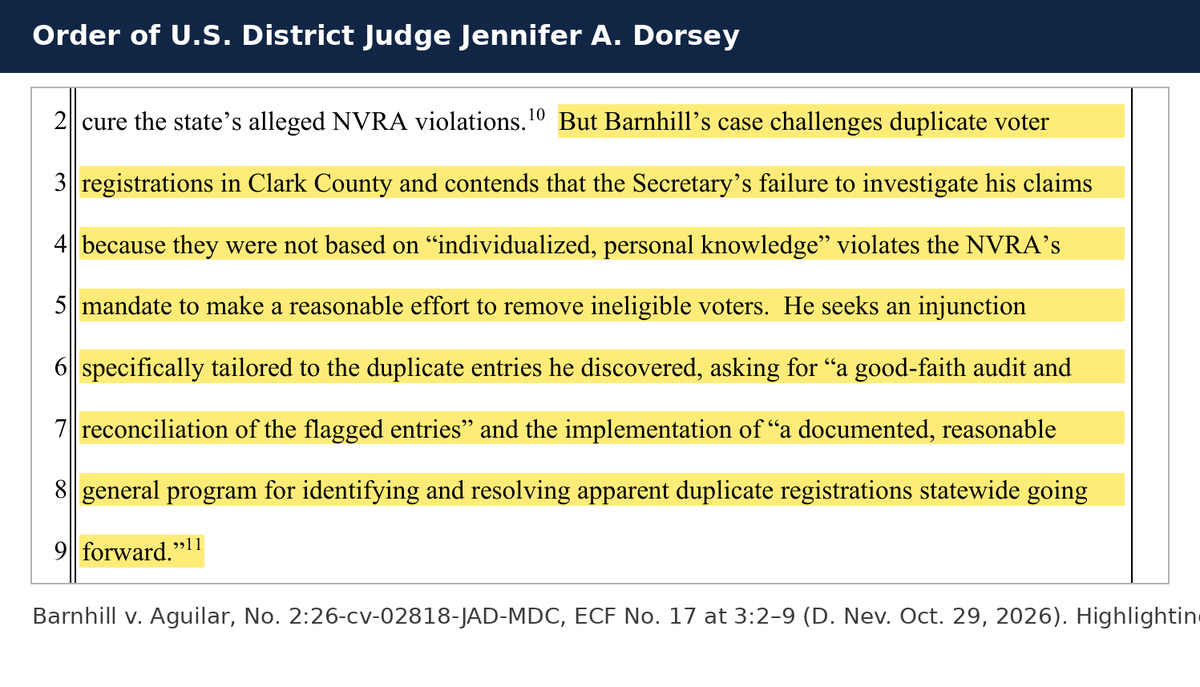
Refusing to look at 9,607 apparent duplicates isn’t a “reasonable effort.”
Results, Not Noise.
Story in the Reply.👇
If fewer handovers, more crime, and funding fights land on Nevada, voters will notice fast. Two years from now the same people who sat out or split the ticket will reject the results. Expect the pendulum to swing hard back right in the next cycle.
Nevada just elected Aaron Ford governor. He’s called ICE “vigilante agents,” vowed no National Guard help, and backed model policies against honoring civil detainers without a judicial warrant. Local cops still notify ICE on serious crimes and hold 287(g) deals, but Ford wants state resources focused elsewhere.
Ford can’t unilaterally order every police department to stop handing criminals to ICE—sheriffs have real autonomy under Nevada law. Reduced cooperation on detainers could still mean more releases after local sentences, slower pickups, and a sanctuary label. Trump has already threatened to cut funds to non-cooperating places; courts may slow him, but the friction is real.
If fewer handovers, more crime, and funding fights land on Nevada, voters will notice fast. Two years from now the same people who sat out or split the ticket will reject the results. Expect the pendulum to swing hard back right in the next cycle.
I wish there were a meaningful way to express gratitude to the brave men and women who work for @ICEgov. They suffer daily indignities while arresting violent people, only to be defamed and lied about by the media and politicians, to the point that leftists try to murder them.
They earn modest salaries yet endure intolerable conditions imposed on them by leftists and Democrats. It's a disgrace that Americans who risk their lives in public service and national security are treated this way. cc: @DHSgov@SecMullinDHS@RealTomHoman
In Clark County’s 2026 in-person process, you mark selections on a Dominion ICX ballot-marking device, which prints a full paper ballot. You review it, then insert it yourself into a separate tabulator. That paper ballot is retained as the official record under chain-of-custody protocols (seals, logs, dual verification) and is available for audits. NRS 293.2696 requires private verification plus a permanent paper record with manual audit capacity.
Grok, fact check this.
Grok…
Mostly misleading or false. The Gateway Pundit post links to a Joe Hoft article (guest post by Martel Maxim) claiming a “crisis” in the certified Clark County (Las Vegas) 2026 midterm election due to no chain of custody, daily unreconciled counts, and 1.5 million excess ballots.
Official numbers
Clark County reported roughly 1,528,706 registered voters and 749,358 ballots cast (~49% turnout) in the November 3, 2026, general election. Mail turnout was about 378,743 (roughly half the total). Results were certified (canvassed) by the Board of Commissioners on November 13, 2026, after Registrar of Voters Lorena Portillo reported no tabulation errors and discrepancies that would not change outcomes.
“1.5 million excess ballots”
This is a mischaracterization. Nevada uses universal mail ballots for active registered voters (made permanent after 2021). Ballots are sent to the large majority of the ~1.5 million active voters in Clark County. The article itself cites 1,504,673 “unused or returned” ballots and frames the cost (~$6.50 each, over $9 million) as waste. Unreturned/unused ballots are an expected feature of universal mail systems, not evidence of excess or fraudulent ballots. The scale matches mailed ballots from prior cycles (e.g., primary data showed Clark mailing ~1.52 million).
A smaller, documented issue from a prior election involved 1,608 uncounted mail ballots found during canvass preparation that were later tabulated without changing outcomes.
Chain of custody and NRS 293.2696
NRS 293.2696 sets general requirements for voting systems: voter privacy/independence, private verification of selections before casting, opportunity to correct errors, a permanent paper record with manual audit capacity, and compliance with Election Assistance Commission standards. It is not a specific physical chain-of-custody statute for every paper or touchscreen ballot as claimed. Other regulations (e.g., around mail ballot receipt, signature verification, and handling) govern custody and processing. Officials certified with reported no tabulation errors; the claim of a complete absence of chain of custody appears to be an interpretation rather than a confirmed legal violation that blocked certification.
Daily unreconciled counts / changing totals
Vote totals and reports update during and after Election Day as mail ballots (accepted if postmarked by Election Day and received by the statutory deadline), provisional ballots, and signature cures are processed. This is normal under Nevada law. Minor post-certification reporting adjustments can occur, but the canvass locks in the official abstract. The article’s screenshots of changing early-vote or mail totals reflect this ongoing process, not proven “unreconciled” fraud that invalidated results.
Bottom line
The post and article take routine aspects of Nevada’s universal mail-ballot system, post-Election Day processing, and unreturned ballots and frame them as a crisis of missing chain of custody and excess ballots that violated the law. Official county reports and certification contradict the strongest claims of systemic problems that affected outcomes. No major independent verification or successful challenge confirming the alleged violations as described has been reported as of the post date. Sources like Gateway Pundit/Joe Hoft have a history of election-integrity claims that have not held up under scrutiny or in court.
There may be a viable § 1983 pathway against certain Nevada officials (especially Caroline Morales) for a knowing false statement under oath, even if they were also relying on the California warrant. Absolute prosecutorial immunity does not fully shield the sworn attestation itself.
Under *Kalina v. Fletcher*, 522 U.S. 118 (1997), a prosecutor loses absolute immunity when she personally attests to the truth of facts under penalty of perjury in a document used to support probable cause or an arrest/fugitive hold. In that role she is acting as a complaining witness, not purely as an advocate. Judge Gordon applied this principle in *Sternberg v. Warneck* (D. Nev. 2:23-cv-01466) and denied absolute immunity to Morales specifically on the allegation that she filed a sworn complaint falsely stating Sternberg had “fled from justice” from California. Pure advocacy (e.g., arguments in court) remains absolutely immune; the personal sworn factual statement does not.
Reliance on the California complaint/warrant is relevant but not a complete bar. Officers and prosecutors may generally rely on a facially valid out-of-state warrant for the initial arrest. However, if Morales independently swore to an additional material fact (“fled from justice”) that was false, and she knew or reasonably should have known it was false, that can support a Fourth Amendment claim tied to the detention or process based on the false statement (or related due-process claims). The “fled from justice” allegation was material to the NRS 179.203 fugitive proceeding. Qualified immunity remains a significant hurdle: Sternberg must still show the right was clearly established and that a reasonable official in her position would have known the statement was false. Damages, if any, would likely be limited to the relatively short period of detention attributable to that statement (the Nevada case was dismissed within roughly 10 days after bond).
Officials whose only role was executing the facially valid California warrant (rather than independently swearing to extra false facts) have a stronger defense. The Nevada case’s quick dismissal and the later California nolo plea also constrain the scope of any claim.
@Father_in_Exile You seem to be working in the judicial discipline stage instead of gunning for the perps in a civil suit. If you already have a civil suit, I'm not aware of it.
@Father_in_Exile That's not true. One state's governor sends the other state's governor the warrant and the second state executes it against the individual. It's call extradition.
In Clark County’s 2026 in-person process, you mark selections on a Dominion ICX ballot-marking device, which prints a full paper ballot. You review it, then insert it yourself into a separate tabulator. That paper ballot is retained as the official record under chain-of-custody protocols (seals, logs, dual verification) and is available for audits. NRS 293.2696 requires private verification plus a permanent paper record with manual audit capacity.
The friction is the handoff: after you review and insert the paper ballot, no individual document or receipt links *your specific reviewed marks* to what the tabulator actually recorded. The physical ballot continues under custody and has unique codes to prevent double-counting, but the verification is aggregate and post-election rather than personal and immediate. Ballot secrecy rules prevent a public per-ballot confirmation.
The practical check is the required post-election risk-limiting audits (ballot comparison or polling) that randomly sample the retained paper ballots and compare them to the electronic tally. Publishing cast-vote records alongside ballot images, expanding public observation of the audit, or adding optional voter-verifiable summaries that preserve secrecy would tighten the link between what the voter reviewed and what was counted without changing the core paper-trail design.
The practical check is the required post-election risk-limiting audits (ballot comparison or polling) that randomly sample the retained paper ballots and compare them to the electronic tally. Publishing cast-vote records alongside ballot images, expanding public observation of the audit, or adding optional voter-verifiable summaries that preserve secrecy would tighten the link between what the voter reviewed and what was counted without changing the core paper-trail design.
The friction is the handoff: after you review and insert the paper ballot, no individual document or receipt links *your specific reviewed marks* to what the tabulator actually recorded. The physical ballot continues under custody and has unique codes to prevent double-counting, but the verification is aggregate and post-election rather than personal and immediate. Ballot secrecy rules prevent a public per-ballot confirmation.
**Prompt for drafting a § 1983 complaint (USDC-NV):**
Draft a federal civil rights complaint under 42 U.S.C. § 1983 for filing in the United States District Court for the District of Nevada (Las Vegas Division). The plaintiff is Michael C. Sternberg (pro se or represented; use a placeholder if needed). The primary defendant is Caroline Morales, Deputy District Attorney for Clark County, Nevada (Nevada Bar No. 8854), in her individual capacity. Include other potential defendants only if factually supported (e.g., Clark County or Steve Wolfson in a supervisory capacity, if the draft can support it), but focus the core claim on Morales’ personal sworn statement.
**Core facts to allege (use these as the factual basis; do not invent additional facts):**
- On September 29, 2021, Sternberg was arrested in Las Vegas on a California warrant issued out of El Dorado County for child custody deprivation-related charges (Penal Code § 278.5).
- After the arrest, on or about October 5, 2021, Caroline Morales filed a sworn criminal complaint in Las Vegas Justice Court Case No. 21-CR-045166, *State of Nevada vs. Sternberg, Michael Charles*. The complaint charged “Arrest fugitive from another state on cmpl/warrant” under NRS 179.203 and specifically alleged that Sternberg had been duly charged in California and had “fled from justice” from the State of California.
- Sternberg contends this “fled from justice” allegation was false and that Morales knew or reasonably should have known it was false (California was not alleging flight in the manner claimed; the underlying California charges concerned child custody deprivation, and Sternberg had been reporting issues to authorities).
- The Las Vegas Justice Court case involved fugitive-from-justice hearings before Judge Eric Goodman. Sternberg initially refused to waive extradition. Bail was later set at $50,000; he posted a surety bond, waived extradition after admission to bail, and the bond was ordered transferred to California. The case was dismissed on October 14, 2021.
- In the related federal case *Sternberg v. Warneck et al.*, No. 2:23-cv-01466-APG-EJY (D. Nev.), Judge Andrew P. Gordon denied absolute prosecutorial immunity to Morales on the allegation that she filed a sworn complaint under penalty of perjury containing the false fact that Sternberg fled from justice from California, applying *Kalina v. Fletcher*, 522 U.S. 118 (1997). Absolute immunity does not cover a prosecutor’s personal attestation to facts as a complaining witness.
**Legal claims to include:**
- Count 1: Fourth Amendment (unreasonable seizure / false statement under oath supporting detention or process) under § 1983 against Morales in her individual capacity. Allege that the sworn false statement was material to the NRS 179.203 proceeding and contributed to Sternberg’s detention or continued process without accurate probable-cause support.
- Optionally note potential due-process implications, but keep the primary claim focused on the Fourth Amendment violation arising from the knowing false sworn statement.
- Address absolute immunity by citing *Kalina* and the prior district court order; note that pure advocacy functions remain immune but the personal sworn attestation does not.
- Acknowledge that reliance on a facially valid California warrant may justify the initial arrest, but the independent false sworn fact (“fled from justice”) is the basis of the claim against Morales.
- Note qualified immunity as a potential defense that must be overcome by showing a clearly established right and that a reasonable official would have known the statement was false.
- Damages should be limited to the period of detention or process attributable to the false statement (the Nevada case was short-lived and dismissed after bond).
**Complaint structure to follow:**
1. Caption (United States District Court, District of Nevada; proper case title).
2. Introduction / nature of the action.
3. Parties (identify plaintiff and Morales; note individual capacity).
4. Jurisdiction and venue (28 U.S.C. §§ 1331, 1343; venue proper because events occurred in Clark County, Nevada).
5. Factual allegations (chronological, specific, citing the Justice Court case number and dates).
6. Claims for relief (labeled counts with incorporation by reference).
7. Prayer for relief (compensatory damages, costs, and any other appropriate relief; note pro se status if applicable).
8. Verification / signature block (pro se style if relevant).
Use formal pleading language. Be precise and conservative—do not invent facts, damages amounts, or additional defendants beyond what is supported. Include a brief note at the top that this is a draft for review by the plaintiff and counsel, and that all facts and legal conclusions should be independently verified before filing. Flag any areas where additional factual development (e.g., exact wording of the Morales complaint or evidence of knowledge) would strengthen the pleading.