In the learning domain, AI can tell an incredible story, make a beautiful battle animation and can even give a very convincing answer.
But there is one question I keep coming back to:
How do we know the outcome is actually legitimate?
This is the thing we are trying to solve at Owster Labs.
In our Ravenna battle module, students submit their own strategy. We do not simply ask AI who wins.
Their decisions go through a maths engine with defined rules around troop strength, terrain, fatigue, fortifications, timing, river crossings, reserves, casualties and enemy behaviour.
The maths engine produces the outcome.
Then AI helps us turn that outcome into something a student can actually experience: a story, an assessment and a cinematic battle simulation.
AI makes learning more immersive, and Maths gives the simulation its legitimacy.
I think game-based learning will become very big. But if the outcome is random, or just an AI-generated story that sounds convincing, then it does not really teach anything.
There has to be a model underneath it.
That is the gap we are trying to work on.
With this, @Owsterlabs is also opening applications for its initial cohort.
We will select students and take them through a set of modules based on the Eastern Roman Empire, while teaching fundamental mathematics through simulations.
More information soon. DM me if you would like to know more.
Well.. first of all, it's damn fun.
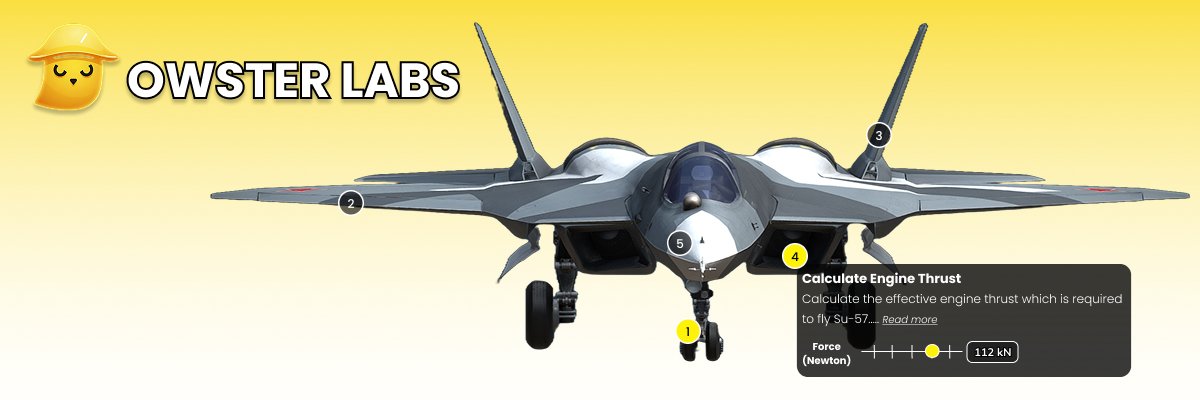
Sometimes while building Owster Labs, I forget that I'm building a simulation to teach maths, not an aerospace simulator. The aim was always to make something where maths gets used, not just learned.. but this is turning out to be way too much fun.
With this update, you can work on the aircraft basics yourself. Change the wing area, the size, where the wing sits. So you're free to calculate, make your own plan, and decide how YOUR aircraft lands.
That's the whole idea: every student solves the challenge their own way and picks the approach they think is best. That's real learning.
See you all at IGDC Chennai, 28–29 Oct.
#GDAI #IGDC2026 @theindiagdc@Owsterlabs
@airwarmedd This is my second visa in the last 6 months, and yet they were strict as hell. Last time, I applied through Austria. Maybe next time I will apply through France.. It's too much hassle to apply for a visa each time :(
Thrilled to share that Eagle in the Sky is nominated for Game of the Year (Serious/Applied) at the India Game Awards 2026!
Students write a flight plan. Physics decides what happens. No joystick. No luck. Just learn, adjust, fly again.
I'll be at #IGDC2026 in Chennai, Oct 28–29. Let's meet!
@jarredgeller That's true. At the end of the day, it's about implementation of the learning. Implementation of the lesson is one of best way to retain the knowledge.
@jarredgeller That's true. Afterall, at the end of the day.. education is implementation after all.
If we can provide them a way to implement their learning and watch it in action, the curiousity will rise only.
With Claude and GPT, the time required to create simulations is gonna go down significantly.
We are looking at a world where education will be powered by the might of these simulations.
Especially maths.
I think it's time to change approach. While product building phase taught me so much but it is time for it to go away.
I need to learn the art of distribution and selling.
Owster Labs needs harder push now.
Let's see.
Presenting Owster Labs’ new simulation module.
This simulation is based on a UAV landing theme. But what makes it different from a normal game?
Unlike a regular game, this module is built around strict maths and physics models. We have run the design analysis through OpenVSP as well as our own maths engine, making the simulation as realistic as possible.
The module is designed for students to learn maths by actually working on a real design problem. Their aim is simple: design the best landing approach and land the UAV in the shortest distance possible.
Once again, Owster Labs is working towards building state-of-the-art simulations that can teach maths while connecting it with real-world applications.