@Tommasocerno Gli ultimi attentati furoni fatti dai palestinesi amici della sinistra. Se c'era dubbio è stato chiarito: I problemi psichici ce li hanno i politici europei
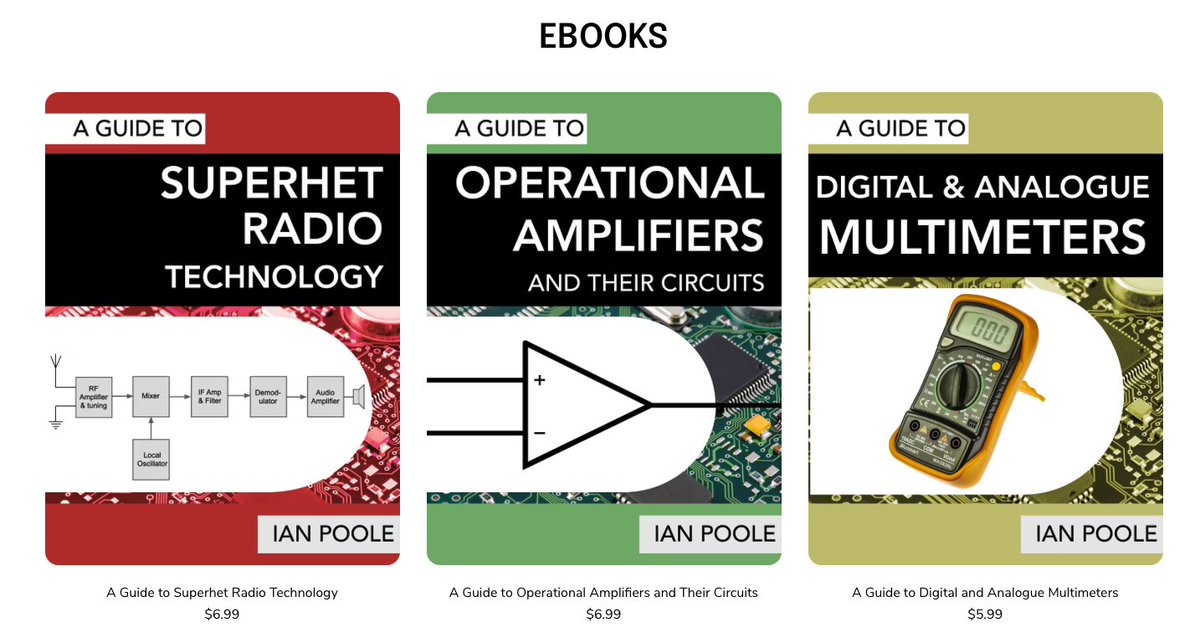
Don't forget to check out my ebooks.
Some great topics are covered: Op-Amps, Superhet radio & Multimeters.
They are longer than my Concise Guides (which are also available) and they also offer great value.
Check them out: https://t.co/JD1Uo2svvk
Supercapacitors vs. Batteries: Understanding the Nuances for Modern Electronics
Let's investigate a topic that's sparking a lot of interest in the world of electronics design - Supercapacitors vs. Batteries.
What Are They?
- Batteries: They store energy chemically, providing a high energy density which is great for long-term power needs. Think of them as the marathon runners of energy storage.
- Supercapacitors: These are the sprinters. They store energy electrostatically, offering quick charge/discharge cycles, high power density, and an incredibly long lifespan.
Energy Density vs. Power Density
- Energy Density: Batteries win here hands down. They can store more energy per unit mass, making them ideal for applications where energy needs to be stored for long periods (like your smartphone or EV).
- Power Density: Supercapacitors excel, delivering power much faster than batteries. This makes them perfect for applications requiring quick bursts of energy, like regenerative braking in cars or power backup systems.
- Charge & Discharge Times: Batteries take longer to charge and discharge but can sustain power output over hours.
Supercapacitors charge and discharge in seconds, ideal for applications where rapid energy transfer is crucial.
- Lifespan: Batteries have a finite cycle life, degrading over time. Typical lithium-ion batteries might last around 300-500 cycles before significant degradation.
Supercapacitors can handle millions of cycles with little degradation, offering a much longer operational life.
Safety & Environmental Impact
Batteries, particularly lithium-ion, can be hazardous if not handled correctly (think thermal runaway). They also pose recycling challenges due to their chemical composition.
Supercapacitors use materials that are generally less harmful and easier to recycle, but they do have a higher initial cost.
Applications
Batteries are your go-to for consumer electronics, electric vehicles, and anything requiring long-term energy storage.
Supercapacitors shine in applications needing rapid charge-discharge cycles, like in regenerative systems, short-term power backup, or as a complement to batteries in hybrid systems.
Why Not Both?
Hybrid systems combining batteries and supercapacitors can leverage the strengths of both: the high energy density of batteries and the high power density of supercapacitors. This approach is becoming popular in automotive and renewable energy sectors for peak shaving and load leveling.
The Future
Research is ongoing to close the gap in energy density between supercapacitors and batteries, potentially leading to supercapacitors with battery-like energy storage but with the speed and longevity of traditional supercapacitors.
For those of you delving into electronics or considering energy solutions for your projects, understanding these differences is key. Check out more details on my Electronics Notes website for a deeper dive into how you might leverage these technologies in your designs.
The article can be found under Electronics >> Components >> Capacitors >> Supercaps vs batteries
Should you use an Op-Amp as a Comparator?
It is often tempting to use an op-amp as a comparator. They are easy to come by, and easy to use. There may also be a spare on one the PCB as these chips often come with several options-amps in a package.
But it may not be the best solution.
The op amp may not always function correctly, or it may not give the optimum performance. That said, when the application is not demanding, it is always tempting to use these electronic components because they may already be available.
The performance of comparator chips and op amps is quite different in a number of aspects:
•Op amp latch-up: Under some conditions, especially when an op amp is being driven hard it is possible for it to latch up, i.e. even when the input changes, the output remains the same. Comparators are designed to operate in this mode and should never latch up. This is one key area where using a comparator rather than an op amp can be a distinct advantage.
•Open loop operation: Operational amplifiers are designed to be used in a closed loop mode and their circuit is optimised for this type of scenario. Their operation is not characterised in open loop mode.
•Digital vs analogue: Operational amplifiers are essential analogue components and their internal circuitry is designed to operate in this region. Comparators are designed to be operated as a logic function, i.e. in a digital mode. This means that operational amplifiers are best when they are operating in an analogue mode with the output not hitting the rails, whereas comparators are not so good at operating in a linear mode, and are far better at operating with logic levels.
•Output stages: The output stages of operational amplifiers and comparators are very different. Typically operational amplifiers have a linear output, often operating in a complementary symmetry fashion to give optimum linear performance for the output. Comparators often have an open collector output suitable for driving into digital interfaces. They are designed to interface with logic circuitry, providing a logic input from a comparison of analogue voltages.
•Response times: Comparators are optimised to provide very fast response and switching times. Slew rates are fast and provide optimum performance. Operational amplifiers are not optimised for these characteristics. They tend to be much slower electronic components optimised for linear operation rather than speed.
•Output voltage & saturation voltage: Comparators are typically able to drive to within small limits of the rail voltages. This is required for good switching of logic circuits. Op amps will not be able to drive hard to the rails as they have a certain saturation voltage - this may lead to poor switching of logic circuits.
In view of these factors, it is always preferable to utilise a comparator chip where this type of operation is envisaged, but many of us use op amps as comparators and get away with it.