30,000 hours of footage, equivalent to 3 years and 7 months, were filmed to capture the blooming of 77 types of flowers, and the result is spectacular.
One of the rarest moons of the decade is rising over Earth tonight.
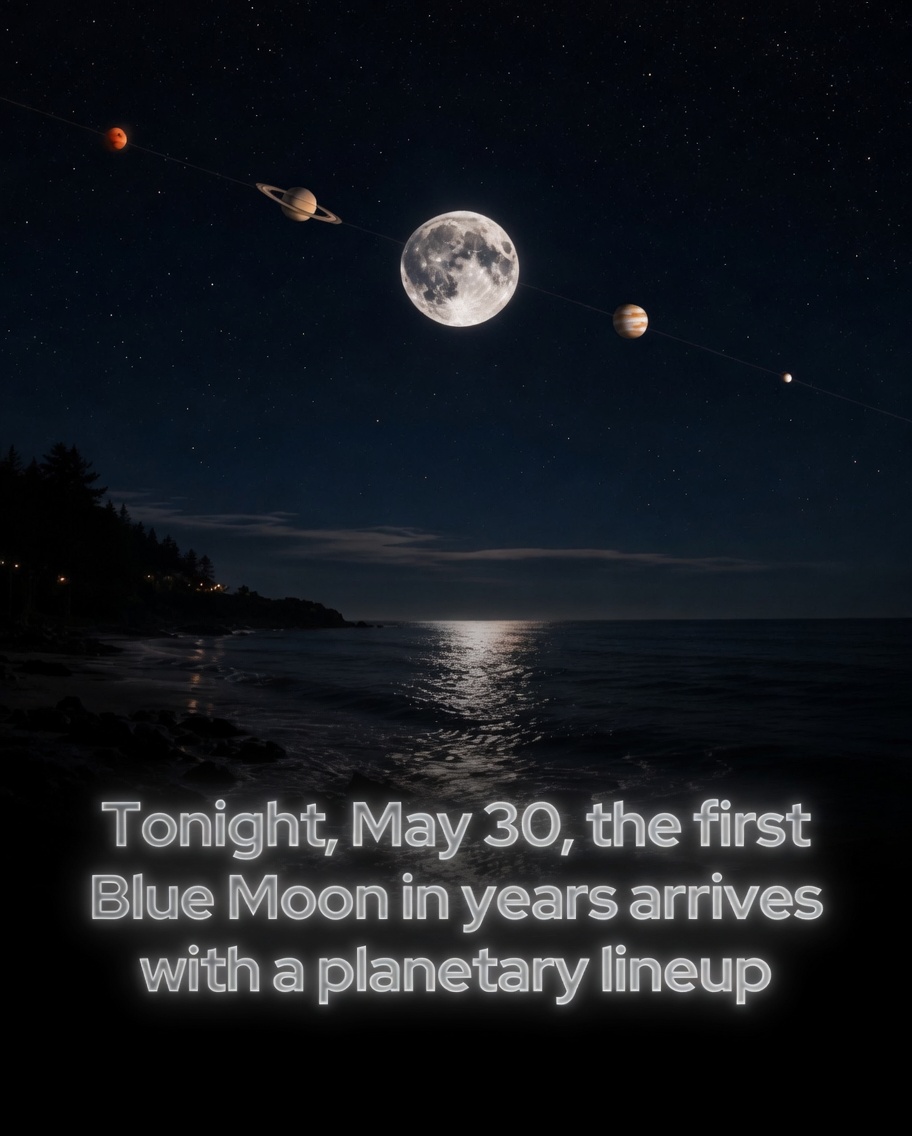
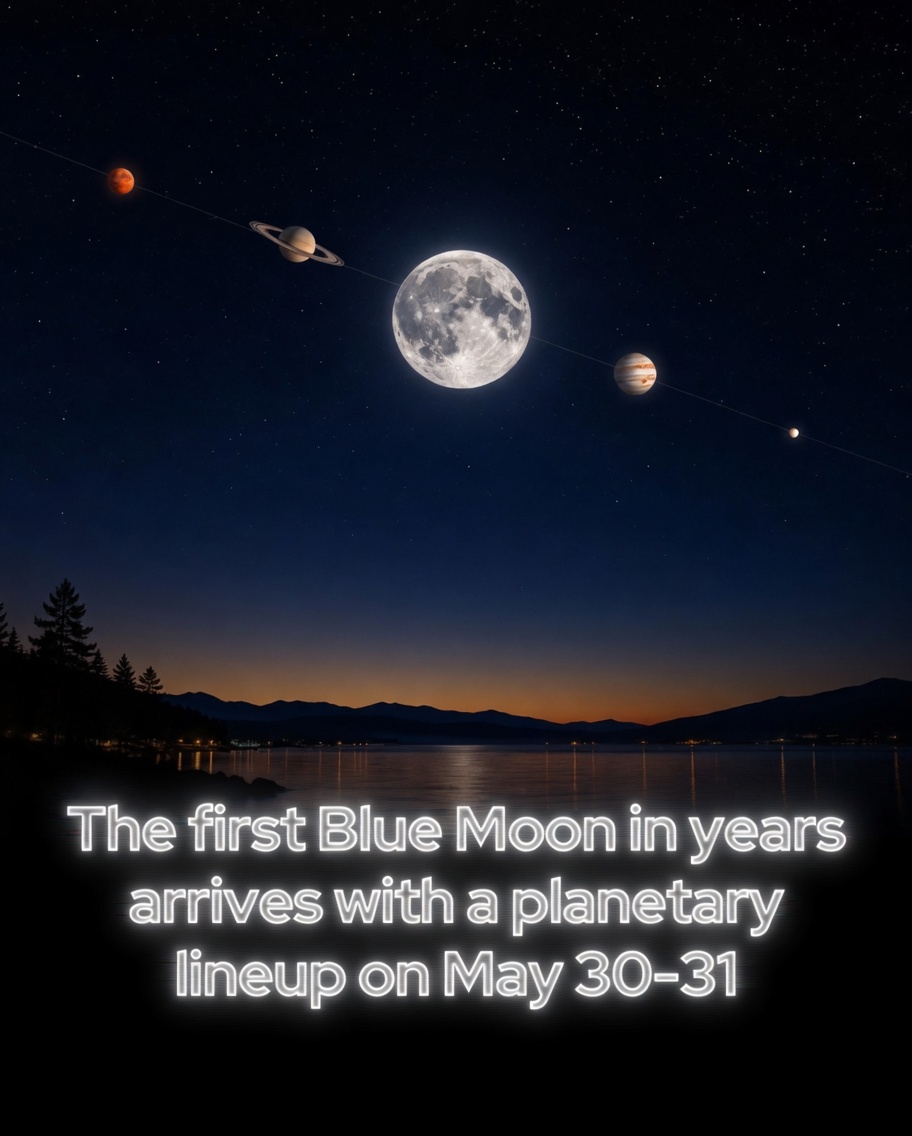
On May 30–31, the second full moon of the month will grace the sky, creating what is known as a Blue Moon. This uncommon event occurs only about once every two and a half years. After this weekend, the next monthly Blue Moon will not appear until December 2028.
This year’s Blue Moon is especially spectacular because it coincides with a beautiful planetary lineup. Before sunrise, Mars and Saturn will shine low in the eastern sky. After sunset, Venus and Jupiter will glow brightly in the west as the full moon dominates the night.
Despite its name, a Blue Moon is not actually blue. The term simply describes the second full moon to occur within a single calendar month. Since the Moon takes roughly 29.5 days to orbit Earth, squeezing two full moons into one month is unusual but not impossible.
The best time to view this Blue Moon may surprise you. Although it reaches peak fullness in the early hours of May 31, many skywatchers prefer to observe it rising on the evening of May 30. As it lifts above the horizon near sunset, the Moon often appears larger and takes on striking deep orange and golden hues.
This warm coloring is caused by the same atmospheric effect that creates colorful sunsets. Near the horizon, moonlight travels through more of Earth’s atmosphere, scattering shorter blue wavelengths and allowing longer red and orange wavelengths to reach our eyes.
The four bright planets sharing the sky with the Blue Moon are not actually close to one another. Jupiter, for example, is currently about 365 million miles (588 million km) from Earth. They only appear grouped together from our perspective here on the ground.
May is closing with one of the most captivating celestial events visible to the naked eye. On the night of May 30–31, the second full moon of the month will rise, creating what is known as a Blue Moon.
This will be the first Blue Moon since August 2023, with the next not occurring until December 2028. But this year’s event is especially memorable because it coincides with a beautiful alignment of planets.
As the Blue Moon shines, all four of the brightest planets visible from Earth, Venus, Jupiter, Mars, and Saturn, will also be on display. Before sunrise on May 31, Mars and Saturn will glow low in the eastern sky. After sunset, Venus and Jupiter will shine brightly in the western sky, with the full moon dominating the night.
Despite the name, a Blue Moon is not actually blue in color. The term simply describes the second full moon within a single calendar month. Because the lunar cycle is approximately 29.5 days, two full moons rarely fit inside the same month. On average, a Blue Moon occurs only once every 2.5 years.
The planetary “lineup” is an impressive sight created by perspective. While the planets are separated by hundreds of millions of miles in space, from our viewpoint on Earth they appear to line up across the sky alongside the brilliant Blue Moon.
A perfect opportunity to look up this weekend and enjoy one of nature’s rarest sky shows.
There will be no AI jobpocalypse.
The story that AI will lead to massive unemployment is stoking unnecessary fear. AI — like any other technology — does affect jobs, but telling overblown stories of large-scale unemployment is irresponsible and damaging. Let’s put a stop to it.
I’ve expressed skepticism about the jobpocalypse in previous posts. I’m glad to see that the popular press is now pushing back on this narrative. The image below features some recent headlines.
Software engineering is the sector most affected by AI tools, as coding agents race ahead. Yet hiring of software engineers remains strong! So while there are examples of AI taking away jobs, the trends strongly suggest the net job creation is vastly greater than the job destruction — just like earlier waves of technology. Further, despite all the exciting progress in AI, the U.S. unemployment rate remains a healthy 4.3%.
Why is the AI jobpocalypse narrative so popular? For one thing, frontier AI labs have a strong incentive to tell stories that make AI technology sound more powerful. At their most extreme, they promote science-fiction scenarios of AI “taking over” and causing human extinction. If a technology can replace many employees, surely that technology must be very valuable!
Also, a lot of SaaS software companies charge around $100-$1000 per user/year. But if an AI company can replace an employee who makes $100,000 — or make them 50% more productive — then charging even $10,000 starts to look reasonable. By anchoring not to typical SaaS prices but to salaries of employees, AI companies can charge a lot more.
Additionally, businesses have a strong incentive to talk about layoffs as if they were caused by AI. After all, talking about how they’re using AI to be far more productive with fewer staff makes them look smart. This is a better message than admitting they overhired during the pandemic when capital was abundant due to low interest rates and a massive government financial stimulus.
To be clear, I recognize that AI is causing a lot of people’s work to change. This is hard. This is stressful. (And to some, it can be fun.) I empathize with everyone affected. At the same time, this is very different from predicting a collapse of the job market.
Societies are capable of telling themselves stories for years that have little basis in reality and lead to poor society-wide decision making. For example, fears over nuclear plant safety led to under-investment in nuclear power. Fears of the “population bomb” in the 1960s led countries to implement harsh policies to reduce their populations. And worries about dietary fat led governments to promote unhealthy high-sugar diets for decades.
Now that mainstream media is openly skeptical about the jobpocalypse, I hope these stories will start to lose their teeth (much like fears of AI-driven human extinction have).
Contrary to the predictions of an AI jobpocalypse, I predict the opposite: There will be an AI jobapalooza! AI will lead to a lot more good AI engineering jobs, and I’m also optimistic about the future of the overall job market. What AI engineers do will be different from traditional software engineering, and many of these jobs will be in businesses other than traditional large employers of developers. In non-AI roles, too, the skills needed will change because of AI. That makes this a good time to encourage more people to become proficient in AI, and make sure they’re ready for the different but plentiful jobs of the future!
[Original text in The Batch newsletter.]
Baby octopus.
You can find 3-month-old ones which are at the size of a quarter and some 1-week old at the size of a fingernail.
But when first born, an octopus is only about the size of a pea.
A new study shows that individuals with similar levels of autistic traits are naturally drawn to one another. Brain scans reveal they use alternative, highly effective neural strategies to connect, challenging traditional deficit-based models of autism. https://t.co/6YgJpV6iHU
Octopuses have been wandering in the oceans for 296 million years.
They have three hearts and blue blood and they can even be elegant in their magical underwater dance.
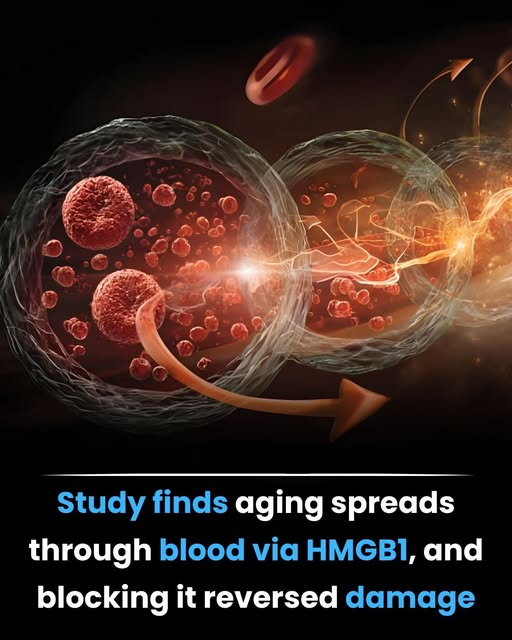
A groundbreaking medical study revealed that aging may be transmitted through the bloodstream via a protein called HMGB1. When researchers blocked this protein in animal tests, they observed remarkable results: damaged tissues began to repair themselves, and some age-related decline was reversed.
This discovery suggests that aging is not simply an inevitable process of cell breakdown but may be influenced by specific molecular signals. If these signals can be controlled, aging could be slowed — or even partially reversed.
Such treatments could revolutionize medicine, offering new ways to fight diseases like Alzheimer’s, arthritis, and organ failure, all of which are tied to aging. However, researchers caution that human trials are still far away.
The study fuels hope that one day aging itself might be treated as a medical condition, reshaping human health and longevity.
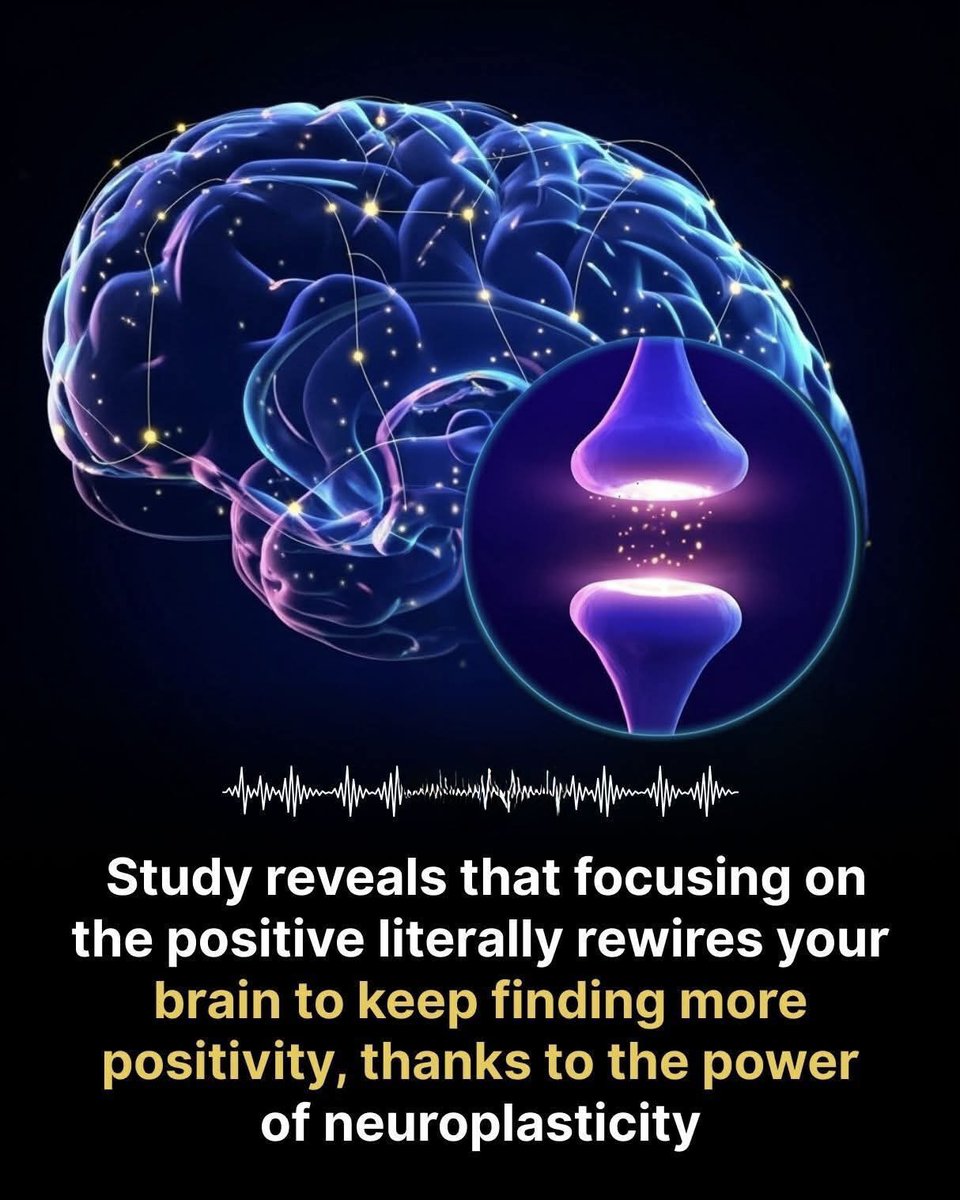
🧠 Did you know? Your brain doesn’t just feel happiness — it learns it
Imagine a happy moment, a small victory, or a fun interaction… and your brain lights up reward circuits, releasing dopamine & serotonin.Just a few seconds of positive imagining can rewire your brain to feel joy again and again!
Source: Neuroscience News, 2025 —
“Imagining positive experiences rewires the brain in seconds.”
- Just one dragonfly can consume over 100 mosquitos a day
- They can fly backwards
- They have nearly 360-degree vision
- Their wings inhibit bacterial growth due to their natural structures
- They're actually beautiful
[📹 malbafont_macrophotography]
@GaryMarcus Generative AI is basically what happens when Silicon Valley discovers a technology powerful enough to reshape society and immediately asks: “How can we monetize this before anyone understands the damage?”














![AndrewYNg's tweet photo. There will be no AI jobpocalypse.
The story that AI will lead to massive unemployment is stoking unnecessary fear. AI — like any other technology — does affect jobs, but telling overblown stories of large-scale unemployment is irresponsible and damaging. Let’s put a stop to it.
I’ve expressed skepticism about the jobpocalypse in previous posts. I’m glad to see that the popular press is now pushing back on this narrative. The image below features some recent headlines.
Software engineering is the sector most affected by AI tools, as coding agents race ahead. Yet hiring of software engineers remains strong! So while there are examples of AI taking away jobs, the trends strongly suggest the net job creation is vastly greater than the job destruction — just like earlier waves of technology. Further, despite all the exciting progress in AI, the U.S. unemployment rate remains a healthy 4.3%.
Why is the AI jobpocalypse narrative so popular? For one thing, frontier AI labs have a strong incentive to tell stories that make AI technology sound more powerful. At their most extreme, they promote science-fiction scenarios of AI “taking over” and causing human extinction. If a technology can replace many employees, surely that technology must be very valuable!
Also, a lot of SaaS software companies charge around $100-$1000 per user/year. But if an AI company can replace an employee who makes $100,000 — or make them 50% more productive — then charging even $10,000 starts to look reasonable. By anchoring not to typical SaaS prices but to salaries of employees, AI companies can charge a lot more.
Additionally, businesses have a strong incentive to talk about layoffs as if they were caused by AI. After all, talking about how they’re using AI to be far more productive with fewer staff makes them look smart. This is a better message than admitting they overhired during the pandemic when capital was abundant due to low interest rates and a massive government financial stimulus.
To be clear, I recognize that AI is causing a lot of people’s work to change. This is hard. This is stressful. (And to some, it can be fun.) I empathize with everyone affected. At the same time, this is very different from predicting a collapse of the job market.
Societies are capable of telling themselves stories for years that have little basis in reality and lead to poor society-wide decision making. For example, fears over nuclear plant safety led to under-investment in nuclear power. Fears of the “population bomb” in the 1960s led countries to implement harsh policies to reduce their populations. And worries about dietary fat led governments to promote unhealthy high-sugar diets for decades.
Now that mainstream media is openly skeptical about the jobpocalypse, I hope these stories will start to lose their teeth (much like fears of AI-driven human extinction have).
Contrary to the predictions of an AI jobpocalypse, I predict the opposite: There will be an AI jobapalooza! AI will lead to a lot more good AI engineering jobs, and I’m also optimistic about the future of the overall job market. What AI engineers do will be different from traditional software engineering, and many of these jobs will be in businesses other than traditional large employers of developers. In non-AI roles, too, the skills needed will change because of AI. That makes this a good time to encourage more people to become proficient in AI, and make sure they’re ready for the different but plentiful jobs of the future!
[Original text in The Batch newsletter.]](https://pbs.twimg.com/media/HIIb1VGaUAAZoAB.jpg)