Un laptop.
Une connexion.
Du temps.
C’est tout ce qu’il faut pour générer 500$/jour avec des produits numériques.
Le problème ?
La plupart des gens ne savent pas par où commencer: 👇
[ Ajoutez en signet 🔖 vous en aurez besoin]
YOU:
> "I feel this is going to hit"
> buy at 28%
> down 50%
> "the market is rigged"
THEM:
> 100+ AI agents in Random Forest
> √N feature filter
> Sigmoid threshold 70%
> price ≤ prob × 0.5 → buy
> price ≥ prob × 0.9 → sell
> Sharpe Ratio monitored 24/7
77% win rate. $20,000+ a week.
different leagues.
yoyoyooooo
COOKED this session, remixed my chart colors a bit which was clearly the solution to profitability
take notes boys - if you are losing it's prob bc you need a better gaming chair or a 3rd monitor
great way to end the week
trade review coming on sunday, otherwise hope you all enjoy your weekend <3
HOW DOES THIS QUANT BOT PRINT $21,389 IN PROFIT PER DAY
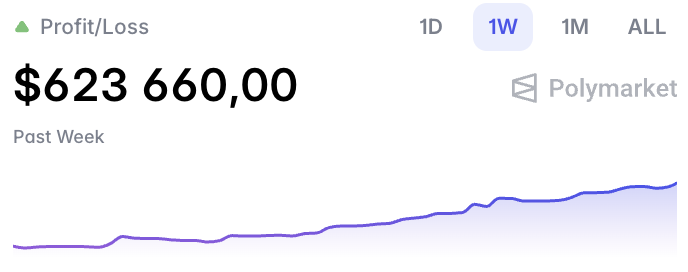
+$363,618 PnL in 17 days on Polymarket
Only on short crypto “Up / Down” markets
On Mar 15, this wallet switched to a high-frequency market-making style using Bayesian + Stoikov pricing rule
P(H|D) = P(D|H) · P(H) / P(D)
Bayesian lets the bot update its internal probability before the market fully reprices the odds
This Quant Bot's wallet:https://t.co/Fx6ZkdFpH0
Trader funded this account with $14,827 and now sits at roughly 24.5x on deposit (+2,452% ROI)
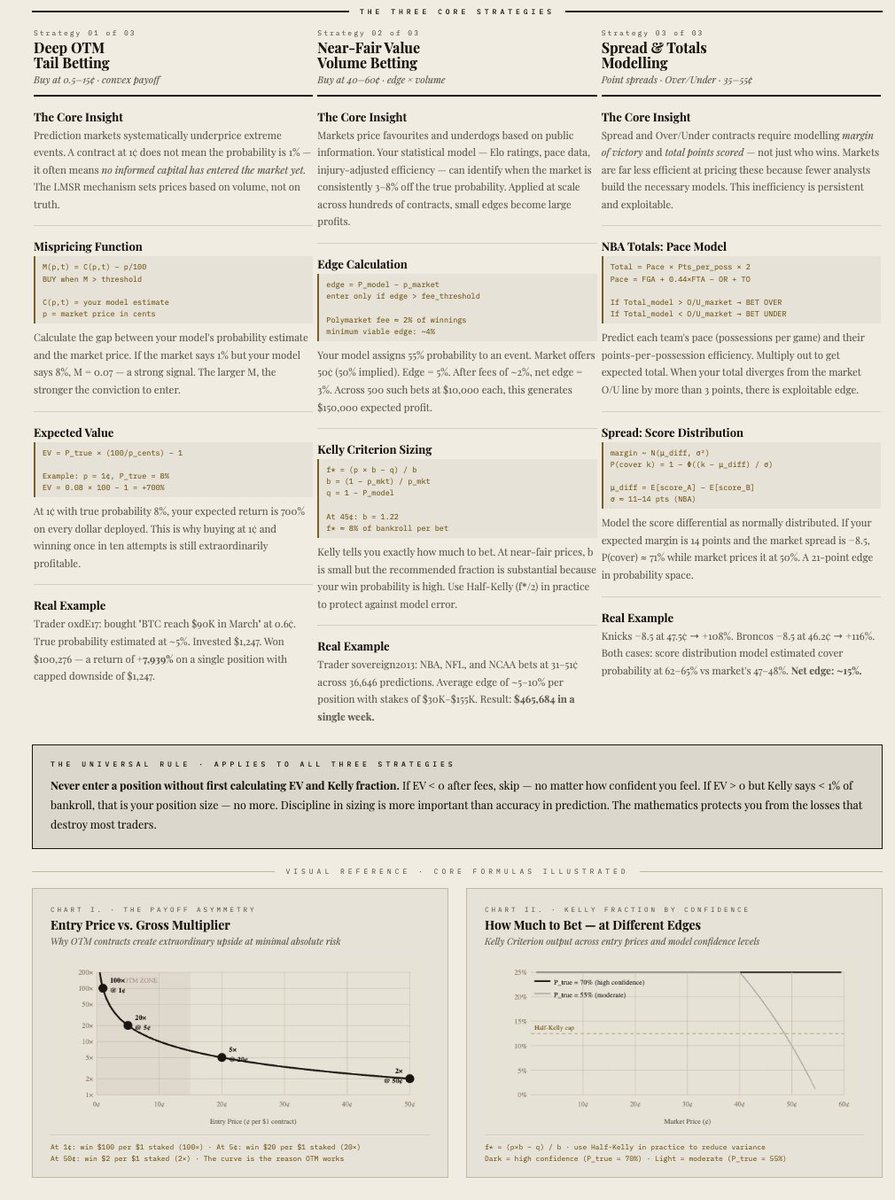
f = (bp - q) / b* - Kelly determines how large the position should be
r = s - qγσ²(T - t) - Stoikov handles quote placement and inventory risk
An arbitrage bot is not just buying both sides. It is a mathematical engine that detects mispricing, sizes the trade, and controls risk in real time
This is what that looks like in practice:
$17,839 → $36,318 (+103.58%)
$3,112 → $15,011 (+382.22%)
$10,676 → $22,178 (+107.74%)
The core logic is simple: YES + NO < 100¢
Claude Bot analyzed the top 1000 polymarket traders and found what generates them $5,000 a day
professional traders on prediction markets make +$70,000-$100,000 a month they're all united by simple math formulas and 5-8% spreads
These formulas clearly explain where to open a market and where not to where it's profitable and where it's not
prediction market has long stopped being gambling it's math and formulas
Copy trades: https://t.co/1lWgVWx0By
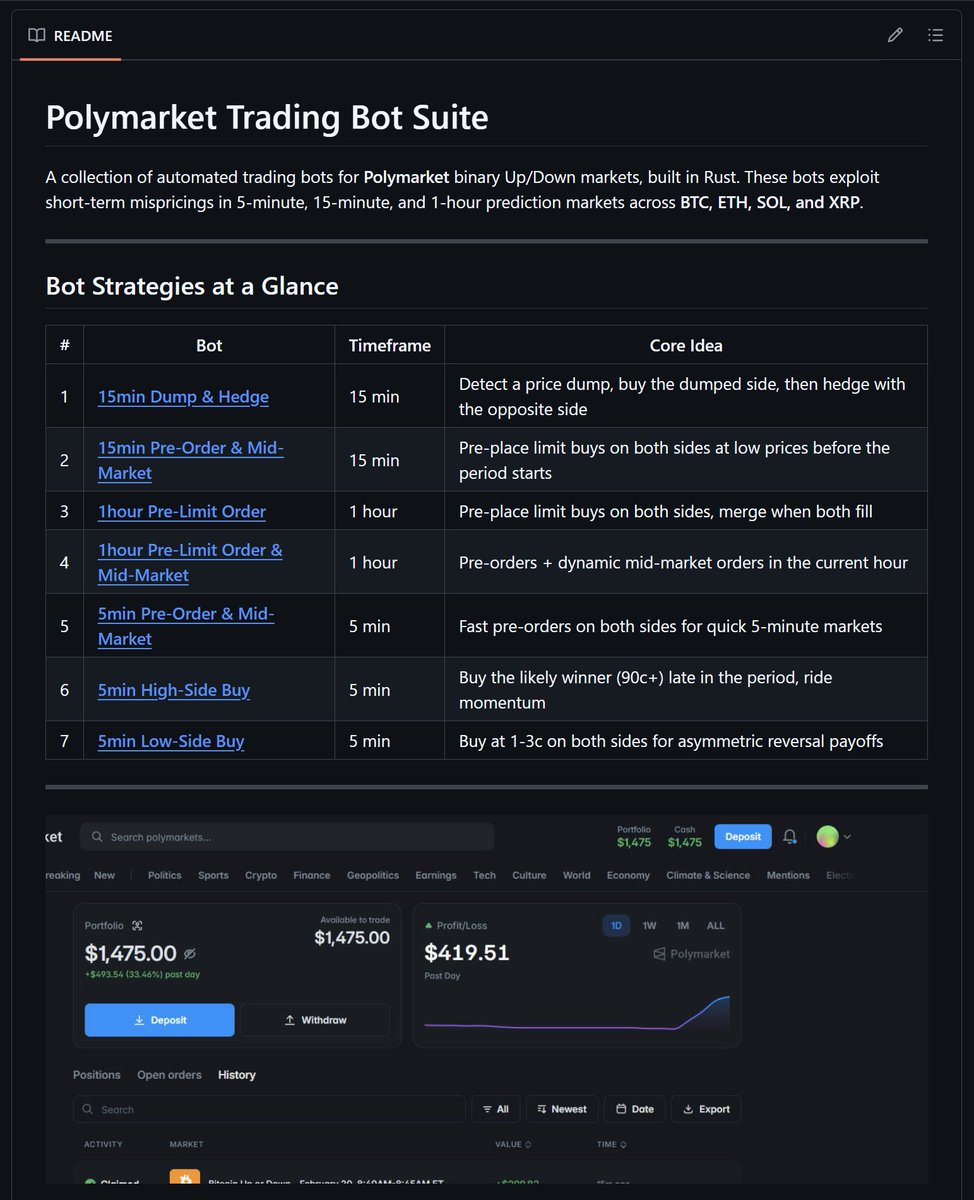
I found a fully functional Polymarket trading bot on GitHub that runs 7 different strategies at the same time and its completely free..
Thank God, it comes with a detailed step by step setup and usage guide, so for me it took around 15 min to get it running.
How this bot actually works:
The bot automatically scans hundreds of 5 min, 15 min and 1 hour markets per day using WebSocket and its own algos. Based on the market situation, bot decides which strategy to use for trading multiple markets at the same time.
I will describe 3 main strategies:
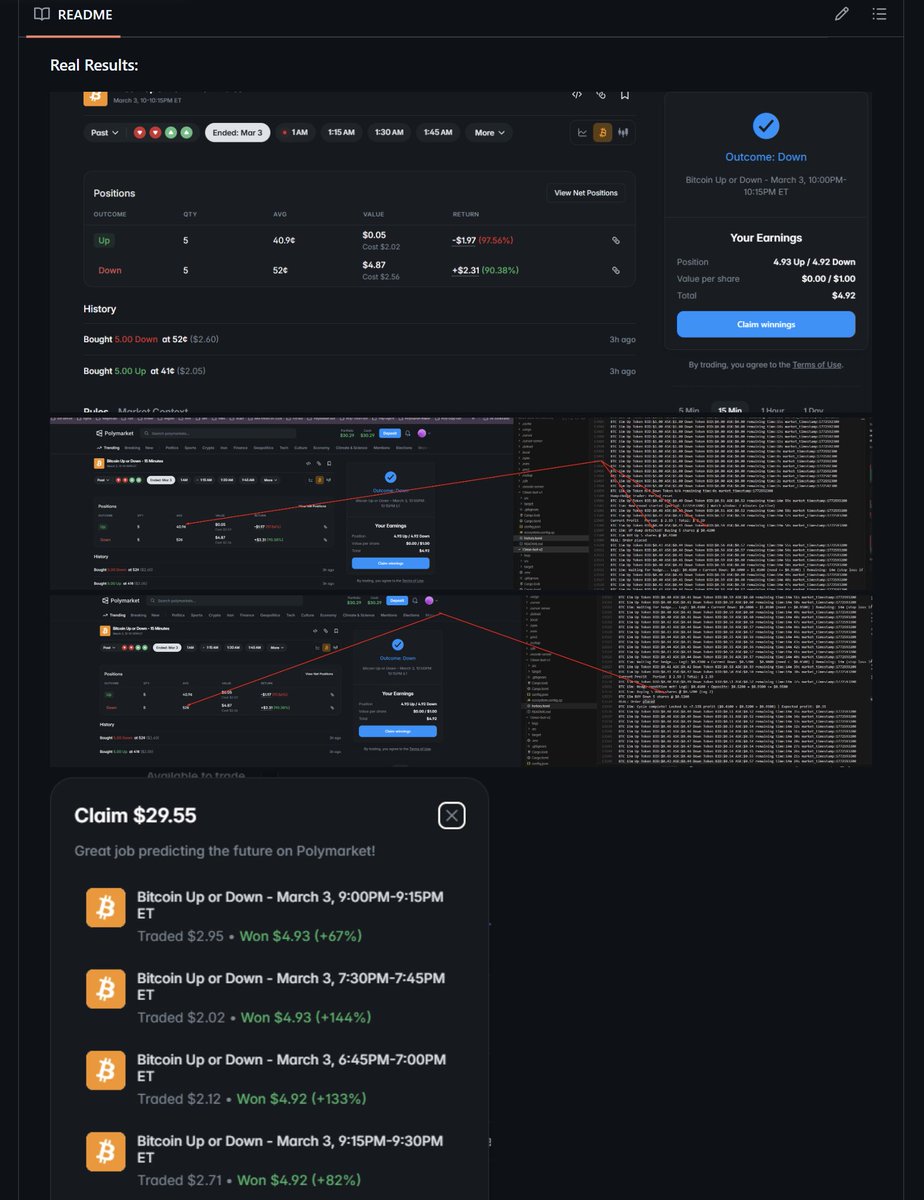
Dump and Hedge - based on the @the_smart_ape Two Leg catching strategy, this bot detects a sudden price drop, buys that side and then hedges it by buying the opposite side when the total cost is < $1.
PreOrder and MidMarket - places limit orders on both sides ($0.45 each) on the start of the market. If both get filled, the total price is $0.9 < $1 - $0.1 guaranteed profit.
HighSide and LowSide - if one side is already very close to winning (>$0.90) near the end, the bot simply buys it. On the other hand, it can also place very cheap orders 1-3c on both sides, which is basically the lottery - small risk, but big reward.
The most important thing - each of these strategies is protected by additional safe logics (like quick exits, stop-losses and hedging) to minimize losses if the market moves unpredictably.
One very useful feature this bot has - u can run these strategies in simulation mode (test mode). It executes real trades, but using fake money, so u can see how it performs without risking any funds at all.
87% of Polymarket wallets lose money
Not because they're wrong about the future.
Because they hit "market buy" instead of placing a limit order.
Takers lose -1.12% per trade.
Makers gain +1.12% per trade.
Same market. Same contract. Opposite result.
The edge isn't information. It's patience.
And here's what nobody's talking about: before Q4 2025, takers were actually winning. Then pro market makers showed up, flipped the equilibrium, and turned every impatient click into their paycheck.
The meta shifted. Most people didn't notice.
This breakdown has the receipts - 72M trades worth of them.
🚨 OIL IS ABOUT TO REPEAT 2008
And nobody is ready for what comes next.
2008:
Oil → $147.
Then the crash:
$147 → $30
Let me show you something most people ignore:
The global oil market trades 100 million barrels per day physically.
But in futures?
Over 1 BILLION barrels trade daily on paper.
THAT’S A X10 DISBALANCE.
But there is an issue... Who actually sets the price of oil:
The guy extracting it, or the one trading paper contracts in New York?
Here’s where it gets interesting:
Every major move in oil follows the same pattern:
– Thin liquidity (1:10 now)
– Aggressive market orders (the oil crisis is already in the headlines)
– Bears get wiped (happening)
– Then… reversal (next)
Now look at today:
2026:
– Iran war escalation
– Physical barrels trading at premiums (Bahrain, 2x premium)
– FED hikes rates
– Inflation is exploding worldwide
Market makers are telling the same story: “Supply is tight. Price has to go higher.”
But here’s what people ignore:
Market makers have already been caught:
- Vitol paid $160M+.
- Glencore paid over $1B.
Manipulating oil benchmarks.
Pushing price in thin windows.
Nothing has changed in years.
We’re getting close to that point again.
BTW, I’ve predicted all the market tops and bottoms for the last 15 years.
When I EXIT the markets completely, I’ll say it here publicly, like I always do.
Many people will wish they had followed me sooner.
my Claude built a trading system from 7 GitHub repos overnight
+$847 by morning. 47 trades executed. not one placed by me.
one article about polymarket bots.
Claude read it, picked 7 repos, connected them, deployed.
> poly_data - 86M+ trades. every wallet. every entry price
> polyterm - whale tracking + insider detection + arb vs Kalshi
> insider-tracker - ML flags wallets before the market moves
> py-clob - official SDK. executes trades
> poly-maker - both sides of the book. collects spread
Claude connected them into one pipeline.
poly_data scans → scores wallets → insider-tracker catches anomalies → decides BUY SELL SKIP → executes
412K scanned. 3 insider alerts. sharpe 2.36. P&L never dipped.
664 repos on github contain malware right now.
Claude didn't download random packages - read which repos are safe, built from those only.
what's on screen:
> polyterm whale 0x6ffb... detected
> insider alert: $35,000 unusual entry
> Claude: Sharpe 2.41 → COPY
> +$47.30 captured
every few seconds. new line. new capture.
copytrade: https://t.co/PTZuvewZE6
92.4% trade what they feel. this pipeline trades what the math says.
trader made over $300,000 on 5-min BTC thanks to claude.
- a $1,500 deposit turned into $3,040,000.
- +$54,200 today
- +$226,000 this week
he created the account on march 4th, threw in some pennies, and in less than a month printed 100 people's salaries. how?
he simply set up his claude the right way.
> installed MCP plugins and all necessary apis
> asked claude "build a terminal for 5-min BTC markets"
> AI sees the spread between spot BTC and poly BTC
> buys fast, sells fast
> massive profit with zero manual input
his profile: https://t.co/v1fMKuGzr2
while others are integrating AI into their lives, their work, and their income, you are missing out on profits.
dive into Claude today, read the articles, install MCP, and nothing will ever stop you.
100 YEARS
WE’VE BEEN WAITING FOR THIS YEAR
2026 IS A ONCE-IN-A-LIFETIME OPPORTUNITY!!
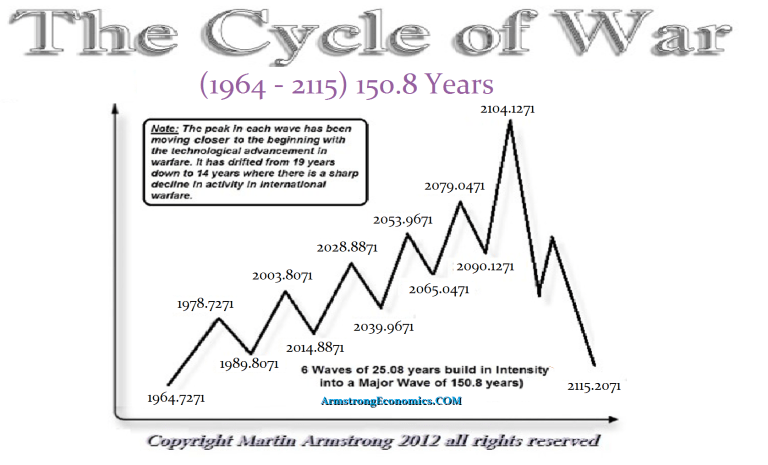
Samuel Benner predicted this in 1875. 150 years ago.
2026: Years of Good Times. High Prices. The time to sell stocks and assets of all kinds.
Every cycle since 1875 has followed this pattern.
1926. 1945. 1999. 2007. All confirmed.
2026 is next.
This is not a theory.
This is 150 years of data.
52 Trading Never-Dos: Lessons Every Trader Learns The Hard Way
1) Never oversize. That is when you start becoming irrational. Blowing up while still being right is the fastest way to ruin.
2) Never trade when tired or sleep-deprived. Decision fatigue has ended more traders than liquidation ever could.
3) Never trade without a defined edge. Entering without one is just gambling with extra steps. If you can’t explain your edge in a single sentence, you probably don’t have one.
4) Never enter a position out of boredom. The desire to always be in a trade leads to suboptimal returns. More often than not, doing nothing is the best move.If you find yourself taking trades just to feel busy or because you “haven’t traded in a while,” check yourself. Trading for action leads to sloppy decisions and losses.There’s no prize for the most trades – only for the most profitable trades. Sometimes the best trade is no trade
5) Never trade after a big loss. Tilt sets in, and you try to win it all back in one bad bet. Trying to recover everything at once is a guaranteed way to lose even more.
6) Never enter a position without an exit plan. Whether it’s a time-based stop, price stop, invalidation, or catalyst-driven exit—define it before you enter. Remember, the last moment of objectivity is before you place the trade.Once you’re in, it’s much harder to admit you’re wrong, so decide beforehand when to cut the loss.
7) Never marry your bags. The market doesn’t care about your conviction. Cut or be cut.
8) Never trade your PNL—trade the market. Chasing losses or fixating on past wins clouds judgment and distorts execution.
9) Not all views are meant to be traded. The best trade is often no trade. Preserving capital and mental bandwidth for when odds favor you is more important than forcing activity.
10) Never fight the trend. The wave is stronger than you. Adapt or get wiped out.
11) Never try to knife catch without reason. "Cheap" can always get cheaper.
12) Never break your trading rules or deviate from your plan in the heat of the moment. Your rules exist for a reason – usually learned from painful experience. The moment you convince yourself “just this once” to ignore a rule (like moving a stop, or doubling down, or trading too big), you open the door to chaos. Discipline is doing the right thing even when it’s hard. As one trading maxim goes, plan the trade and trade the plan.
13) Never fire all your bullets at once.
14) Never trade outside your comfort zone. If a position is too big, you’ll start making fear-based decisions, thinking that market or someone is trying to liquidate you seeing ghosts where none exists. Size your trades proportional to the quality of your sleep at night.
15) Never let ego keep you in a bad trade. Admit when you're wrong—cut, reset, move on.
16) Never underestimate market reflexivity. Strength can always go higher, weakness can always go lower.
17) Never assume liquidity will be there when you need it. The exit door is always smaller than you imagine—liquidity isn’t something you decide, the market does.
18) Never mistake randomness for strategy. Buying because price is going up or shorting because it “feels high” isn’t trading—it’s blind betting. Even with good risk management, you’ll bleed out over time if your entries are based on nothing.
19) Never make the same mistake twice. Trading mistakes are inevitable, repeating them is unacceptable. Never lose the same way twice
20) Never forget to play defense. Being wrong is acceptable, staying wrong is not. Protecting capital always comes first. "Don’t focus on making money; focus on protecting what you have.”
21) Never just focus on offense. Survival > everything. If you don’t bet, you can’t win. If you lose all your chips, you can’t bet.
22) Never fall into lifestyle creep after one big win. The problem starts when you begin forecasting annual income based on a single lucky trade.
23) Never forget to turn defensive after a hot streak. Big losses come after a series of wins when overconfidence sets in. Check your ego—your last big trade means nothing to the market.
24) Never let pride, ego, or overconfidence take over. Always stay humble.|
25) Never trade in situations where you don’t have control. for eg. FOMC events
26) Never get complacent. A strategy that worked in one regime may stop working in another. Trading is a craft that requires continuous self-improvement. Comfort Is Often the Enemy of your PNL. Never assume you know for sure what the market will do. “We have two classes of forecasters: those who don’t know — and those who don’t know that they don’t know.” Never assume your edge is permanent. Markets evolve, edges fade, and what worked last cycle may be useless in the next. Keep refining, keep testing—stagnation is death.
27) Never ever average losers after your reasoning has been invalidated
28) Never trade with certainty, trade with conviction.
29) Never assume the market “must” do something, especially based on recent patterns.The market doesn’t owe you continuity or logic. Just because a market has been rising (or falling) steadily doesn’t mean it can’t abruptly reverse. Avoid words like “surely” or “can’t possibly” in trading. Stay flexible – anything can happen. As a reminder: never say never about market behavior.
30) Never mistake win rate for everything. Maximizing winning trades for the sake of feeling good is a trap. Taking profits too early or avoiding necessary small losses ultimately hurts profitability.
31) Never underestimate discipline, patience, risk control, and execution over alpha generation. Plenty of traders have great alpha flow but don’t know how to use it.Good execution involves choosing not just what and how to trade, but when not to trade. Sometimes the best execution decision is no trade at all if conditions aren’t suitable. Always ask: “Do I have an edge here, or am I flipping coins?” If it’s the latter, save your capital for a better spot.
32) Never fall apart after a big loss or get euphoric after a big win. Emotional resilience is a trader’s strongest asset.
33)Never ignore price action after news. If the market reacts opposite to what you expected, get out. The market is telling you something you don’t see.
34) Never trade on borrowed conviction. If you buy on someone else’s tip, you’ll need them to call your exit too—and when they go silent, you’re stuck. As Livermore said: “Nobody makes big money on what someone else tells him to do.” Hone your own craft, build your own system. If you can’t trust your own decisions, you’re just a pawn in someone else’s trade.
35) Never go against your intuition. If something feels off, it usually is.
36) Never try to Catch Every Move It’s tempting to try to grab every up and down in the market, but that’s a fool’s errand. Always come from the mindset of abundance and not scarcity, markets will still be there and there are ample opportunities in the market to make you whole,
you don’t need to swing at every pitch.
37) Never underestimate the power of failure. Failing early and failing often—while staying in the game—is how you get better.
38) Never hold onto losers when your thesis is invalidated, especially after a massive drop. "I’ve lost too much to sell now" is how you go to zero.
39) Never let "getting back to break even" dictate your decisions. That mindset leads to overtrading and eventually, full liquidation.
40) Never focus only on entries. A trade isn’t over until you’ve exited. Knowing when to cash out is just as important as knowing when to enter.
41) Never ignore the “boring” part (position sizing, stops, risk/reward) – it’s what keeps you in business.Don’t wait for a catastrophic loss to teach you this lesson.
42) Never trade for the adrenaline rush, Trade for the win
43) Never fall into the illusion of strength—it’s often just lagging behind reality.
44) Never stay/enter in a position out of 'HOPE' and wishful thinking
45) Never underestimate risk management. Prioritize protecting capital over chasing profits. "Take care of your losses, and the profits will take care of themselves."
46) Never exit/enter a position recklessly. The same way you scale in, you should scale out—"all in, all out" is a recipe for disaster.
47) Never make a bet you can’t afford to lose. No single trade should ever be big enough to take you out of the game.“The most important advice is to never let a loser get out of hand.” You should be able to be wrong 20 or 30 times in a row and still have capital left. Never allow a single position to jeopardize your trading career
48) Never trade outside your edge. If it’s not there, sit out. Forcing trades outside your framework is how accounts erode.
49) Never assume your edge is permanent. Markets evolve, edges fade, and what worked last cycle may be useless in the next. Keep refining, keep testing—stagnation is death.
50) Never judge a trade solely by its outcome. Good trades lose money sometimes, and bad trades can get lucky. Focus on execution over results.
51) Never worry about looking stupid or staying in a position because of your public opinion. I have seen many a men die before their time because they were worried about getting publicly ashamed. Cut your losses without hesitation. The market doesn’t care about your pride—neither should you.
52) Never underestimate the power of stepping away. If you’re in a losing streak, liquidate everything and take a break. Mental capital is just as important as financial capital. The key is to break the negative emotional spiral
Once you come back keep your size small and increase exposure only when you gain back your confidence.
These lessons were learned thanks to the books I’ve read, the smart traders I’ve learned from, and the endless mistakes I’ve made along the way.
Trading is lonely. It hurts. It makes you question everything. But if I had to choose again? I’d still take this over everything.
You can make consistent money if you understand repeating patterns and participant behavior
Categories you need to know:
- Broker / Execution edges
- Factor edges (academic)
- Information edges
- Strategy / Process edges
- Time-based edges
The best traders don't use one edge - they combine them together and get a whole system that helps in trading.
This is literally me when I read this guide and found freedom - now trading is not just a job for me, but a hobby which bring money.
> Most traders have literally zero real edges and still dream of $10k/month.
> The pros don’t look for “the one edge”.
> They collect small, boring, reliable ones -and that becomes the actual moat.
> Trading stops being stressful gambling once you start stacking real, provable advantages.
M1 - you read news. You trade on gut feeling. Win rate 44%. Slow bleed.
M2 - three formulas. EV. Kelly. Base rate. Win rate 58%. You stop losing.
M3 - Random Forest. 100 trees. 38 features. Win rate 72%. First real edge.
M4 - 10,000 simulations. CI [87.3%, 91.8%]. Not luck. Proven edge.
M5 - XGBoost. 330 trees. Loss 0.891 → 0.094. Win rate 89.6%. Verified on 1,870 real trades.
M6 - RL agent. 50,000 iterations. Trades 24/7. Learns from every move.
You're no longer in the equation...
I found 10 free repositories for trading on Polymarket
From connecting Claude directly to your account to real-time market analysis and research automation - all free and open-source
1. polymarket-mcp-server: connect Claude directly to Polymarket. 45 tools: market search, analysis, portfolio management and live trading
GitHub: https://t.co/YjU736a84H
2. last30days-skill: analyzes everything happening on the internet over the last 30 days and finds patterns. Your AI research assistant that helps decide what to bet on based on the latest news
GitHub: https://t.co/O1JI2B2EDO
3. polymarket-assistant-tool: real-time data from Binance and Polymarket simultaneously. 11 indicators showing exactly where the market is heading right now
GitHub: https://t.co/P3Rq1ddQDs
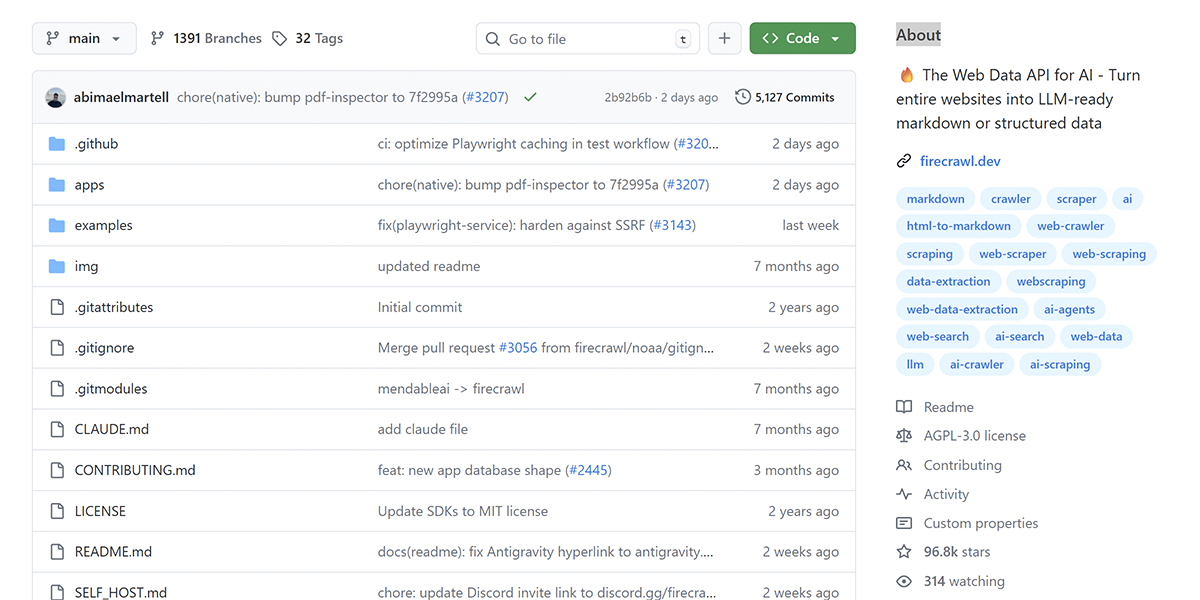
4. Firecrawl: turns any website into clean data. Useful for monitoring news that moves markets
GitHub: https://t.co/qVD3wMhR2z
5. Tavily MCP: search built specifically for AI agents. Structured data instead of HTML noise
GitHub: https://t.co/SMG66nUu7L
6. GPT Researcher: autonomous research on any topic with a final report. Useful before major event markets
GitHub: https://t.co/RzsaxnOkL1
7. n8n: 400+ integrations, AI nodes. Pipeline: news parsing → filtering → Telegram alert, no code required
GitHub: https://t.co/Xt51vkwQWP
8. Huginn: self-hosted monitoring and alerts. Watches your sources 24/7
GitHub: https://t.co/In2DQ8U8Hq
9. pydantic-ai: type-safe agent framework for building production bots
GitHub: https://t.co/sEc7J0RVhL
10. fastmcp: MCP server in Python in minutes. Want your own Polymarket integration - start here
GitHub: https://t.co/gZQBIVCOAU
Know something useful that's missing - drop it in the replies
RT/Like/Bookmark if this was helpful
Follow me for more!





![ia_level's tweet photo. Un laptop.
Une connexion.
Du temps.
C’est tout ce qu’il faut pour générer 500$/jour avec des produits numériques.
Le problème ?
La plupart des gens ne savent pas par où commencer: 👇
[ Ajoutez en signet 🔖 vous en aurez besoin] https://t.co/StatfZaxnV](https://pbs.twimg.com/media/HINYiZMXIAEslNu.jpg)