HHMI’s Janelia Research Campus will close two of its programs dedicated to rodent work, @_TheTransmitter has learned.
By @callimcflurry
https://t.co/reid2IoStq
🌍💉
This World Health Day, we celebrate the power of collaboration to protect the health of people, animals, and the planet. At @WeizmannScience, researchers like @AlejandroAgCa exemplify this approach
#WorldHealthDay
Don't just attend—CONNECT! Social and networking events for #IMMUNOLOGY2026™ are filling up fast! From the Gala to career roundtables, make sure you have your tickets secured before you arrive in Boston. Already registered? Just log back in to your profile to add events.
🔗 https://t.co/K6uPHwIXY3
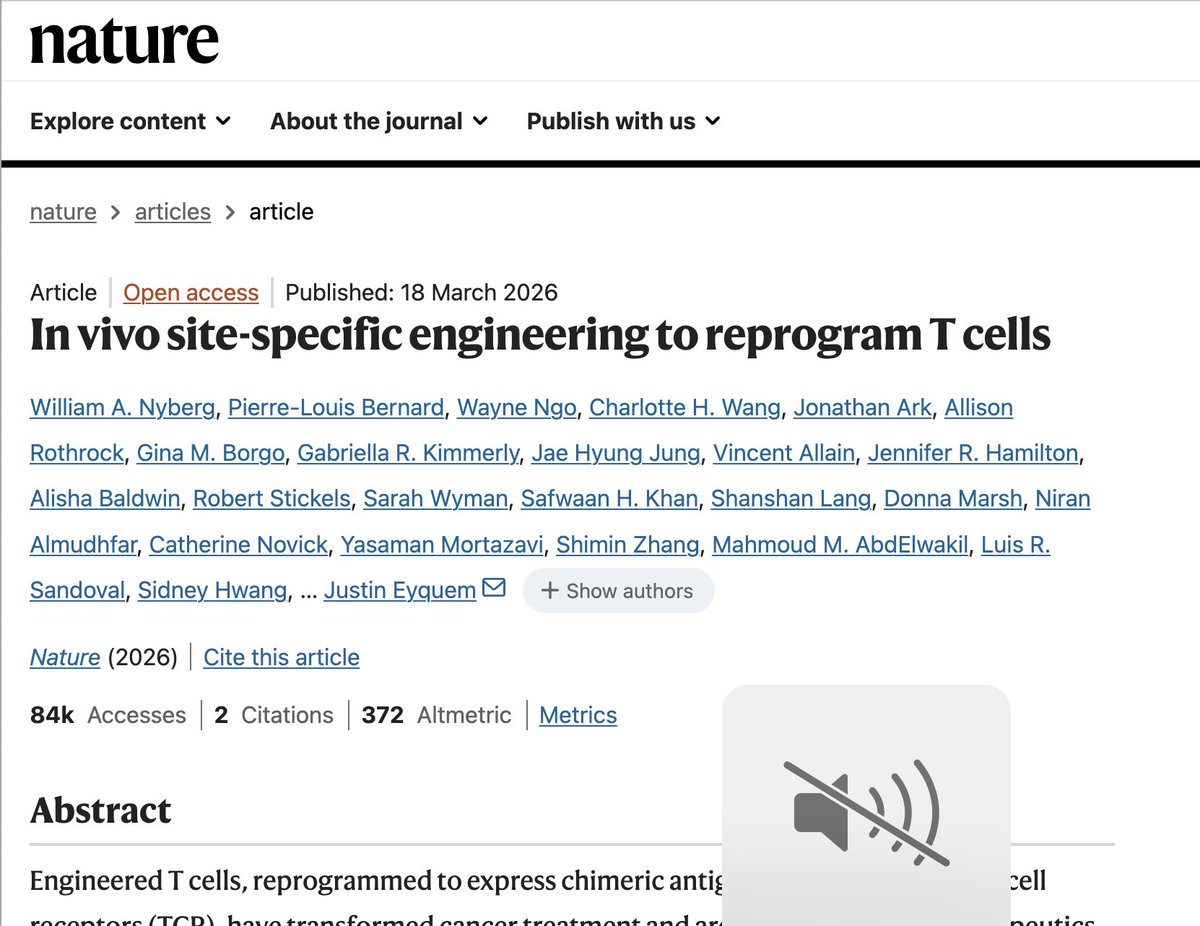
A new @Nature paper from Prof. Justin Eyquem of @UCSF has potentially made a big breakthrough in CAR-T therapy for cancer treatment!
CAR-T therapy is one of the most powerful cancer treatments ever developed. It's also one of the most inaccessible — weeks of wait time, $400,000–$500,000 per patient, chemotherapy required, available only at specialized centers.
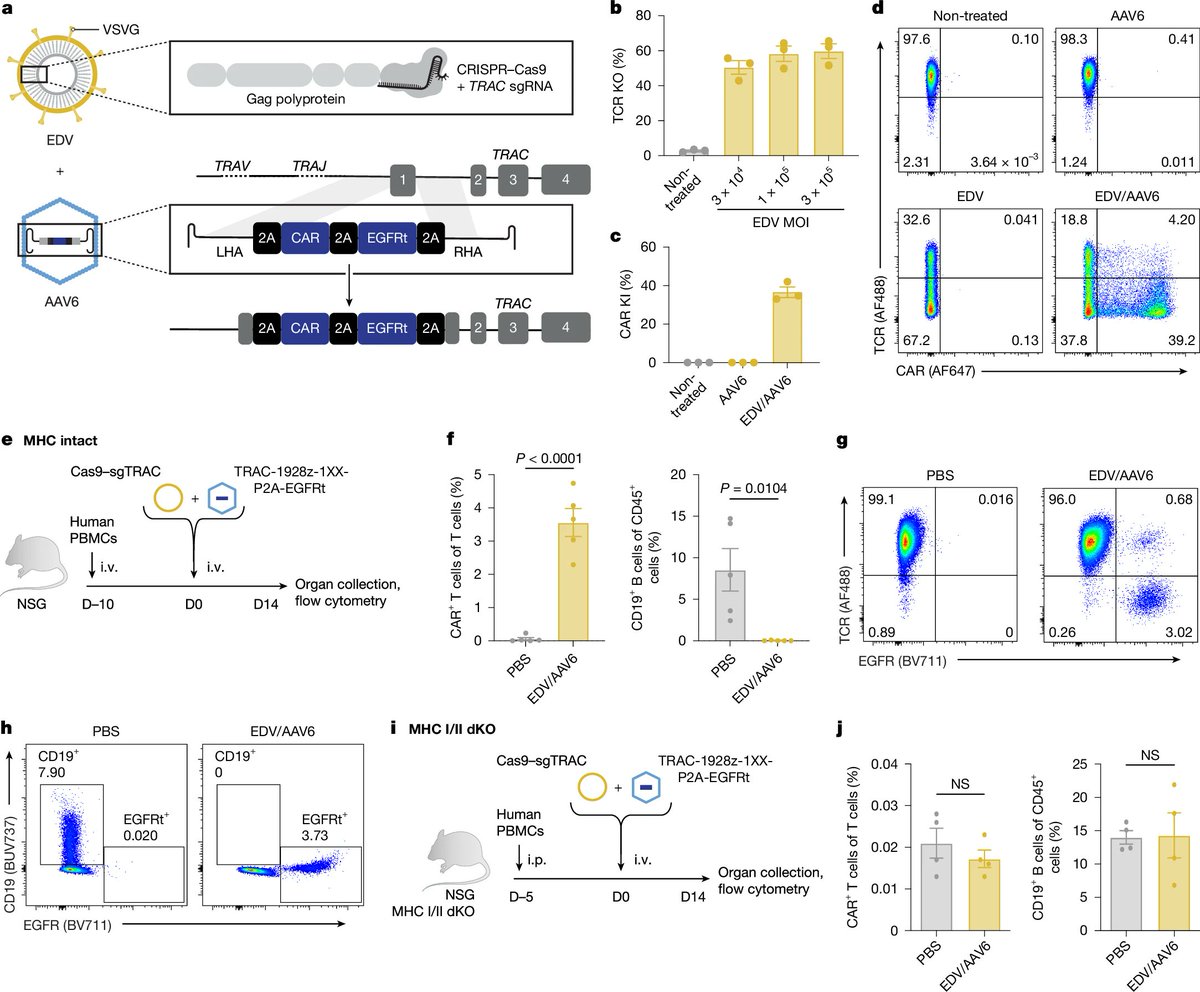
Justin Eyquem's lab developed a two-particle system that reprograms T cells directly inside the body. One particle delivers CRISPR-Cas9 machinery targeted specifically to T cells. The second carries the CAR gene and inserts it at a precise location — the TRAC locus — rather than randomly, which eliminates the insertional mutagenesis risk that has shadowed current lentiviral approaches.
The results in humanized mice: a single injection cleared all detectable leukemia within two weeks. It also worked against multiple myeloma. And then against a solid sarcoma tumor — which CAR-T has historically failed to treat.
The counterintuitive finding: the T cells engineered inside the body outperformed those made in the lab. When you extract cells and grow them ex vivo, they lose stemness and proliferative capacity. Left in their native environment, they don't.
This may be the first time large DNA has been integrated at a specific genomic site in human T cells without removing them from the body. It's a technical milestone independent of the cancer results.
Paper: https://t.co/wDDr3o4UsH
UCSF news:https://t.co/ZIcP3pRyvt
youtube Video: https://t.co/Fg9mLrnOtb
A @Nature study from @WeillCornell and Rockefeller has overcome a long-standing challenge—how to isolate and study elusive #HIV-infected cells called authentic reservoir clones that evade the immune system, making the disease difficult to cure.
https://t.co/76mCUDhPfY
El origen de la vida en la tierra podría haber ocurrido así,
con esta secuencia de tan solo 45 nucleótidos GGC AGG GCA GCG CAG UCG GAC AUU GAU AAC GGA AUC GAG CCC GCC
que se puede copiar a sí misma.
Impresionante!!
https://t.co/xBa4q5PnSw