Because I stopped posting you all think I stopped working 😂
My tasker made over $1k yesterday totaling the total amounts to almost $10k
And guess what … the account is less than 3 months.
I’ll be saying this again bring your handshakes and outlier accounts to me . We will max it out , safeguard the account and make you a multi millionaire.
Mark my words …….
Let’s milk all this platforms guys
So grateful for another year of growth, wins, peace, laughter, and all the moments that made it special.
Cheers to a new age and everything that comes with it. ❤️
Happy birthday to me❤️
A special thank you to everyone that wished me a happy birthday yesterday.
I really appreciate the love, message, gifts and kind words.
I’ve been thinking of a way to give back and make someone else happy too, so I decided to do this.
I'll be giving away an iPhone 12 Pro Max and iPhone XR to two people.
To participate in this giveaway:
Like, comment, tag a friend, Retweet this post & quote it with your reason why you need the phone.
Winners will be announced in 48 hours.
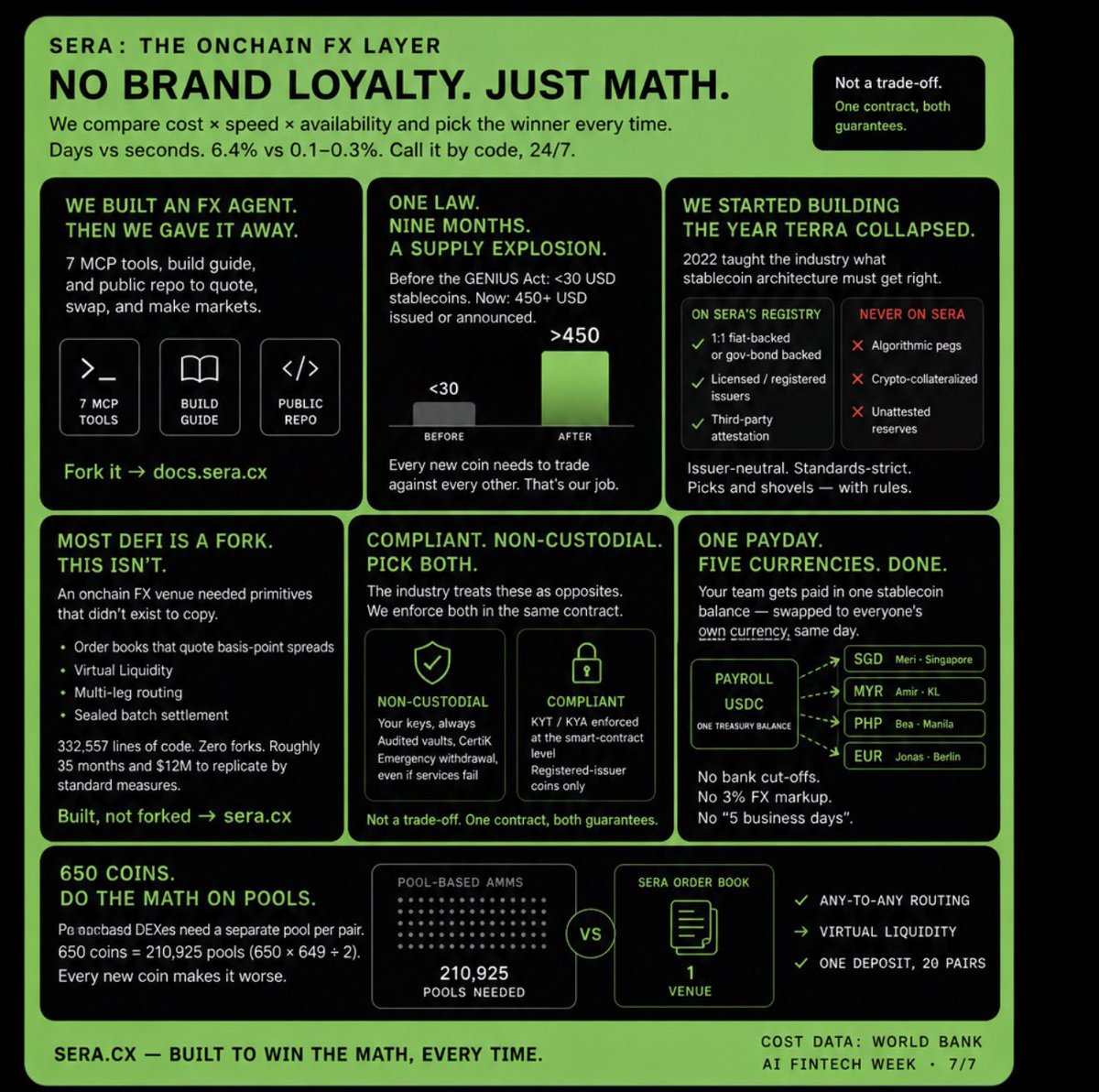
These are some of the recent updates on what @seraprotocol@DouglasGan is building.
Sera is building FX onchain, and a big part of the idea is simple: software does not care about brand loyalty. It looks at cost, speed and availability, then chooses the best route.
Traditional correspondent wires can take days and cost around 6.4%. Card networks are faster but can charge around 1–3% and come with chargeback risk. Sera’s onchain FX is designed to settle in seconds, cost around 0.1–0.3%, work 24/7 and be called directly by code.
Sera also built an FX agent and made it open for people to use. It comes with seven MCP tools that can get quotes, swap currencies, make markets, check balances and track spreads. There is also a full build guide and a public repo that developers can fork. Your keys stay on your own machine while the agent does the work.
The stablecoin market is also growing quickly. Before the GENIUS Act, there were fewer than 30 USD stablecoins and fewer than 7 non-USD stablecoins. Nine months later, Sera says more than 450 USD stablecoins and over 200 non-USD stablecoins had been issued or announced, with more than 10,000 projected by 2027.
Every new stablecoin needs a way to trade with other currencies, and Sera wants to be the FX layer connecting them.
Sera also says the lessons from the Terra collapse shaped how it built its system. Coins on its registry must be 1:1 backed by fiat or government bonds, come from licensed or registered issuers and have third-party reserve attestations.
That also means no algorithmic pegs, no crypto-collateralised experiments and no coins with unverified reserves. The goal is to stay neutral between issuers while keeping strict standards.
Another thing Sera is highlighting is that most DeFi projects are forks of something that already exists, but its FX infrastructure was built from scratch.
It says it created order books that can quote very small FX spreads, Virtual Liquidity, multi-leg routing and sealed batch settlement because those tools did not already exist in the form it needed.
According to Sera, this involved 332,557 lines of original code with zero forks, and it estimates that rebuilding it would take around 35 months and cost about $12 million using standard measures.
The idea is that normal AMM forks are not designed to quote FX at basis-point spreads, while Sera’s CLOB-based system is.
Sera is also trying to combine compliance with self-custody instead of making users choose one or the other.
Users keep their own keys, the vaults are CertiK-audited, and there is an emergency withdrawal option even if Sera’s services go offline.
At the same time, KYT and KYA rules are enforced at the smart-contract level, only registered-issuer coins are allowed, and every swap can be audited.
So the idea is: non-custodial and compliant at the same time, inside one contract.
Sera is also showing how this could work for global payroll.
A company with workers in Singapore, Kuala Lumpur, Manila and Berlin could fund payroll from one stablecoin balance. Sera would swap each salary into the employee’s local currency at interbank rates and pay everyone on the same day.
That means no bank cut-off times, no 3% FX markup and no waiting five business days for international payments.
Then there is the liquidity problem.
If you have 650 currencies and use a pool-based DEX that needs a separate liquidity pool for every possible pair, you would need about 210,925 pools. Each one would need its own locked capital, and every new currency makes the problem bigger.
Sera says an order-book model avoids that. Instead of creating thousands of separate pools, one venue can route between currencies, while Virtual Liquidity allows one deposit to quote multiple pairs.
So as more currencies and stablecoins come onchain, Sera believes its system becomes more useful instead of more complicated.
Overall, Sera is building an onchain FX system focused on faster swaps, lower costs, safer stablecoins, self-custody, compliance, global payroll, better liquidity and AI-powered tools.
The goal is basically to make moving between currencies onchain faster, cheaper and easier without depending on the old banking system.
These are some of the recent updates on what @seraprotocol@DouglasGan is building.
Sera is building FX onchain, and a big part of the idea is simple: software does not care about brand loyalty. It looks at cost, speed and availability, then chooses the best route.
Traditional correspondent wires can take days and cost around 6.4%. Card networks are faster but can charge around 1–3% and come with chargeback risk. Sera’s onchain FX is designed to settle in seconds, cost around 0.1–0.3%, work 24/7 and be called directly by code.
Sera also built an FX agent and made it open for people to use. It comes with seven MCP tools that can get quotes, swap currencies, make markets, check balances and track spreads. There is also a full build guide and a public repo that developers can fork. Your keys stay on your own machine while the agent does the work.
The stablecoin market is also growing quickly. Before the GENIUS Act, there were fewer than 30 USD stablecoins and fewer than 7 non-USD stablecoins. Nine months later, Sera says more than 450 USD stablecoins and over 200 non-USD stablecoins had been issued or announced, with more than 10,000 projected by 2027.
Every new stablecoin needs a way to trade with other currencies, and Sera wants to be the FX layer connecting them.
Sera also says the lessons from the Terra collapse shaped how it built its system. Coins on its registry must be 1:1 backed by fiat or government bonds, come from licensed or registered issuers and have third-party reserve attestations.
That also means no algorithmic pegs, no crypto-collateralised experiments and no coins with unverified reserves. The goal is to stay neutral between issuers while keeping strict standards.
Another thing Sera is highlighting is that most DeFi projects are forks of something that already exists, but its FX infrastructure was built from scratch.
It says it created order books that can quote very small FX spreads, Virtual Liquidity, multi-leg routing and sealed batch settlement because those tools did not already exist in the form it needed.
According to Sera, this involved 332,557 lines of original code with zero forks, and it estimates that rebuilding it would take around 35 months and cost about $12 million using standard measures.
The idea is that normal AMM forks are not designed to quote FX at basis-point spreads, while Sera’s CLOB-based system is.
Sera is also trying to combine compliance with self-custody instead of making users choose one or the other.
Users keep their own keys, the vaults are CertiK-audited, and there is an emergency withdrawal option even if Sera’s services go offline.
At the same time, KYT and KYA rules are enforced at the smart-contract level, only registered-issuer coins are allowed, and every swap can be audited.
So the idea is: non-custodial and compliant at the same time, inside one contract.
Sera is also showing how this could work for global payroll.
A company with workers in Singapore, Kuala Lumpur, Manila and Berlin could fund payroll from one stablecoin balance. Sera would swap each salary into the employee’s local currency at interbank rates and pay everyone on the same day.
That means no bank cut-off times, no 3% FX markup and no waiting five business days for international payments.
Then there is the liquidity problem.
If you have 650 currencies and use a pool-based DEX that needs a separate liquidity pool for every possible pair, you would need about 210,925 pools. Each one would need its own locked capital, and every new currency makes the problem bigger.
@cryptopluged it will really help me and make me very happy. To some people it may not be much, but to me right now it will mean everything. I will really see it as God answering my prayer.
I know many people are also praying
@cryptopluged it will really help me and make me very happy. To some people it may not be much, but to me right now it will mean everything. I will really see it as God answering my prayer.
I know many people are also praying
Passed another assessment ❤️
Enough proof that I’m the one for you when it comes to handshakes
Bring your accounts to me for tasking and handling.
If you want the answers too you can slide in my DMs too .