@solsticefi is changing the way people look at the market.
If you’re active in the market and Solstice isn’t on your radar yet, you might want to take a closer look because you’re missing something important.
Join Solstice.
They’ve just launched their first product, YieldVault.
Start using it, put your assets to work, and earn yield.
Opportunities like this don’t last forever.
Don’t miss it
You slept for 8 hours
Great
But here’s the better question
Did you actually recover?
Sleep isn’t just about duration
Your HRV relative to baseline matters
Your resting heart rate matters
Your sleep quality and continuity matter
You can spend 8 hours in bed
and still wake up under recovered
Sleep ↔️ Recovery
Don’t just count the hours
Understand what happened inside them
Follow @sleepagotchi for better comfort.
Privacy is not a luxury it is a right
Who knows where we are who we communicate with
what decisions we have made or what is happening in
our lives is not necessarily anyone else’s business
In crypto privacy is not just a choice it is part of security
In the crypto world a wallet address may look like
nothing more than a string of letters and numbers
but once it becomes linked to a real world identity
a significant part of a person’s financial activity can
become visible and subject to analysis
In the on chain world security begins with
understanding that every piece of information
has value.
@BeldexCoin aims to take privacy beyond being a feature of crypto transactions and turn it into a layer across the entire digital life
☑️Transactions should remain private
☑️Communications should remain private
☑️Web browsing should be less traceable
☑️Users’ identities and personal information
should be less exposed to data collection
☑️These capabilities should be connected
☑️ through a decentralized ecosystem
Privacy should not be something we give up for
convenience.
GN GN legends 💙
Let's @R3ORDR everything together! 🔁
Sleep quality hits different when you stop judging recovery by hours alone
@sleepagotchi
9 hours can still be a bad night
What matters is how well your body actually recovered
just came across @IronAllies_ through @NucleusCodes
been around for a bit, but somehow flew under my radar
gonna spend some time digging into this one
Stop saying I’m just not a morning
person like it’s a permanent thing.
Maybe you just never figured out
your chronotype.
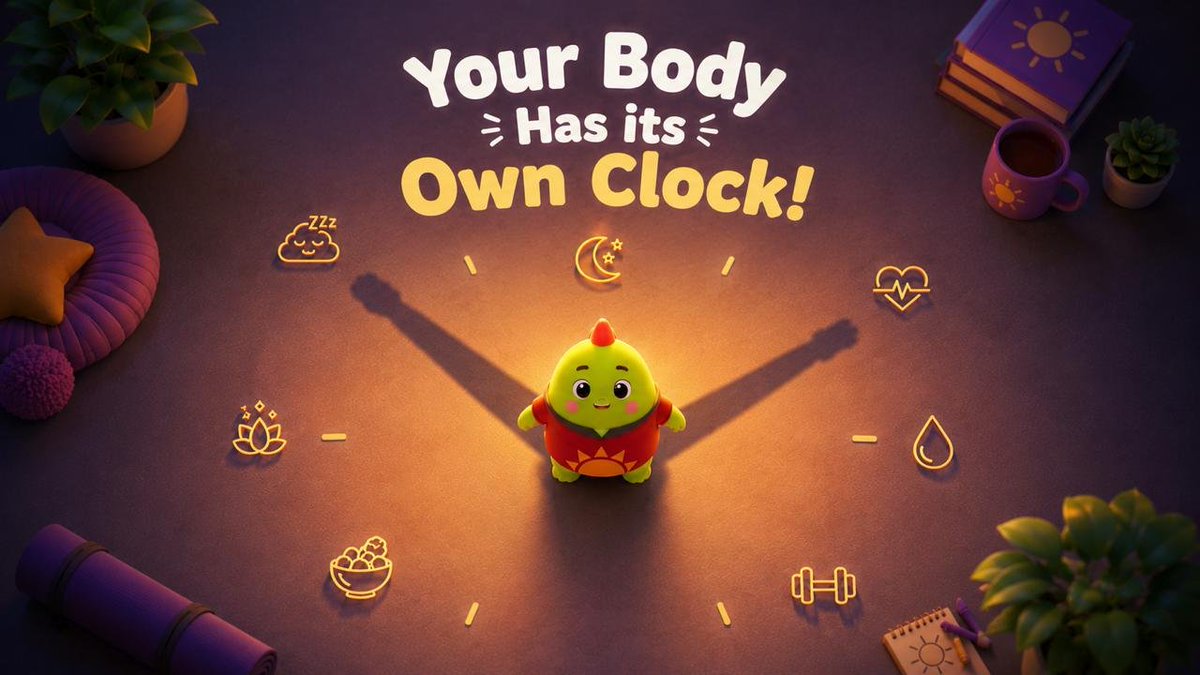
Your body has its own clock,
its own rhythm.
When you keep fighting it, you
waste so much energy every day.
You drag yourself out of bed, feel like crap till noon, then at night when you should sleep your brain finally wakes up.
That constant battle slowly burns you out and leaves you feeling like something’s always missing.
I used to do the exact same thing.
Once I actually paid attention to when my body wants to wake up and when it works best, everything got easier.
I stopped trying to force myself to be like everyone else and just went with my own flow. Sleep got better, focus came back.
Sleep Coach by @sleepagotchi helps you figure this out. It shows you your chronotype so you can stop fighting your body and start working with it.
Find your own rhythm.
Life feels a lot better when you
stop going against yourself.
Gsleep 💤🦖
Important issues in technical analysis: 📈📉
1. There is no support and resistance in the chart.
2. DCA strategy is the best for the beginners.
3. Don't use indicators.
4. Sell the asset when everyone talks about it.
5. Avoid FOMO and FUD.
#technical_analysis#cryptocurrency
Yesterday marked 3 years of @base .
$5B+ TVL, $46T in stablecoin volume, and 90% of all x402 transactions later… and Base still says day one.
But something else caught my attention.
Right after announcing a new Builder Program, someone asked a pretty fair question:
What about the community?
Base's answer?
Creator Program coming soon.👀
The timing is interesting.
Builders → creators → community.🤔
And when you put that next to everything Base has been building lately, I can't help but wonder if we're getting closer to a more decentralized Base and eventually, maybe $BASE.
Nothing confirmed, obviously.
But if Base is preparing something big for its community, I think the next chapter is very different from the last three years.
Still day one. 💙
Privacy is becoming one of the biggest conversations in Web3, but building a privacy-focused ecosystem is about more than just making a promise.
That's what I've been thinking about while exploring @BeldexCoin .
What I find interesting is the combination of privacy-focused technology with an ecosystem where the community can actually participate. The Loyalty Quest gives users a reason to explore, while @NucleusCodes adds another layer of engagement to the journey.
For me, the interesting part isn't simply earning rewards. It's discovering what the ecosystem is building, understanding the technology behind it, and seeing whether it can create something people genuinely want to use.
Still exploring Beldex, and definitely keeping an eye on what's coming next. 👀
#BeldexCoin #Nucleus #Privacy #Web3
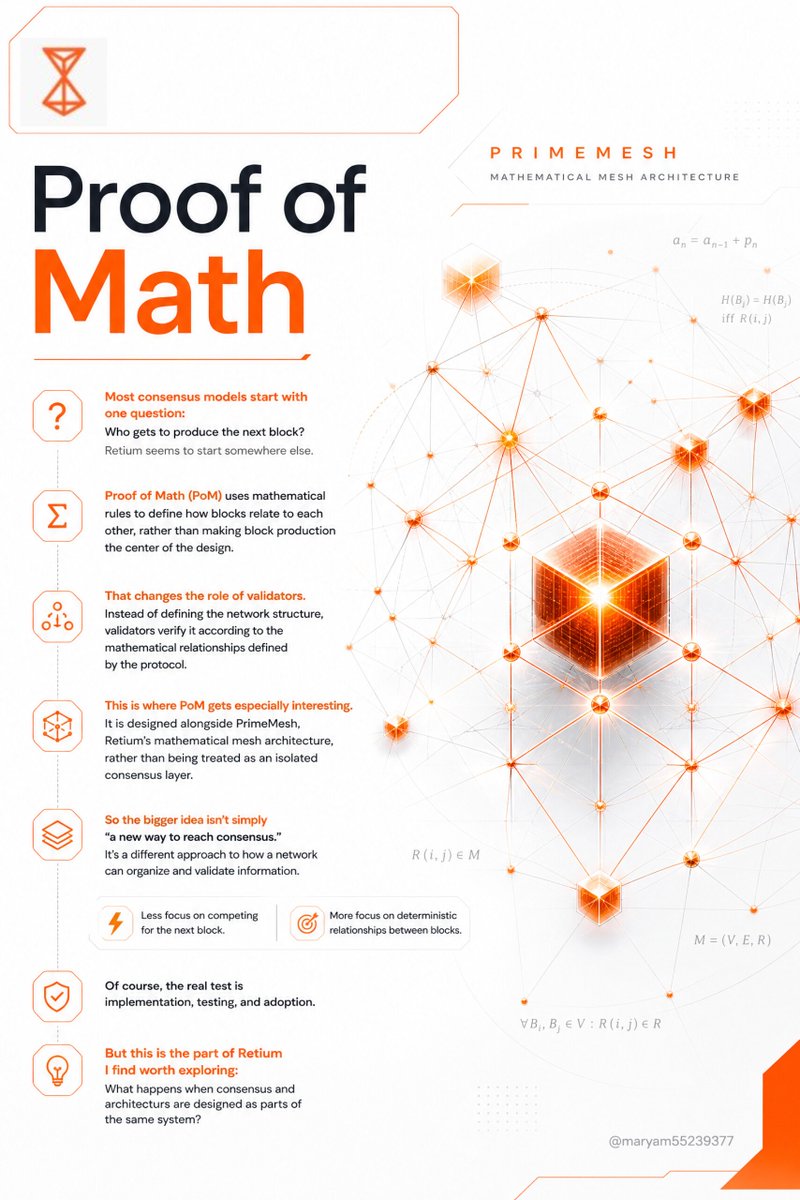
Why is Proof of Math more than just another consensus mechanism?
1/
Most consensus models start with one question:
Who gets to produce the next block?
@RetiumChain seems to start somewhere else.
2/
Proof of Math (PoM) uses mathematical rules to define how blocks relate to each other, rather than making block production the center of the design.
3/
That changes the role of validators.
Instead of defining the network structure, validators verify it according to the mathematical relationships defined by the protocol.
4/
This is where PoM gets especially interesting.
It is designed alongside PrimeMesh, Retium’s mathematical mesh architecture, rather than being treated as an isolated consensus layer.
5/
So the bigger idea isn't simply “a new way to reach consensus.”
It's a different approach to how a network can organize and validate information.
Less focus on competing for the next block.
More focus on deterministic relationships between blocks.
6/
Of course, the real test is implementation, testing, and adoption.
But this is the part of Retium I find worth exploring:
What happens when consensus and architecture are designed as parts of the same system?
#Retium #ProofOfMath
InterLink’s Early Vision for NIST-Standardized Post-Quantum Cryptography
Within the next five years, whether a digital asset is truly secure or not will have a much clearer answer. It will no longer be something complicated or difficult to understand. Ultimately, it will come down to one critical factor: whether it is quantum-resistant according to NIST standards.
Speaking of NIST, most InterLink users are probably already familiar with it. Our Human AI Model is currently ranked #51 globally, and NIST is one of the most important institutions under the U.S. Department of Commerce responsible for developing and evaluating standards related to post-quantum cryptography.
The rapid development of AI models today is raising serious concerns about their ability to discover and exploit vulnerabilities. At the same time, advances in quantum computing are bringing the potential threat of breaking today's cryptographic algorithms to a level of concern greater than ever before.
Recent experiments and research from Google have demonstrated that what was once considered practically impossible, using quantum computing to threaten the cryptographic security underlying networks such as Bitcoin, is increasingly becoming a risk that cannot simply be ignored.
This means that digital assets and blockchain networks that do not actively research, prepare for, and implement post-quantum cryptographic protection could eventually face serious security risks. In a future where sufficiently powerful quantum computers exist, vulnerabilities in existing cryptographic systems could potentially be exploited by attackers, putting assets stored on those networks at risk.
InterLink Foundation has been conducting research into digital signatures and cryptographic algorithms, and we have already achieved several important early results.
Our research includes mechanisms that allow new private keys to be generated from an existing seed phrase. At the same time, through the Address Alias mechanism, users can retain their existing wallet addresses together with all associated tokens and NFTs while migrating to a new cryptographic security architecture.
InterLink Foundation is also implementing SLH-DSA-SHA2-128s (FIPS 205) within IRC smart contracts to provide an additional layer of post-quantum protection for vaults and high-value digital assets.
We are currently conducting these experiments on the InterLink Taj Mahal Testnet, and so far, our experimental implementations have successfully passed the NIST-based simulation tests we are conducting.
Our goal is to fully integrate this architecture into the InterLink Open Mainnet in 2027, bringing InterLink closer to becoming one of the world's most secure blockchain networks built around post-quantum cryptographic standards established by the U.S. National Institute of Standards and Technology (NIST).
The future of digital asset security is becoming increasingly clear.
In the quantum era, security will not only be about protecting your private key. It will be about whether the cryptography protecting that key was built to survive quantum computing.
@FelineReserve is building its own financial universe on Robinhood Chain with only 3,000 founding seats 🐈⬛
The interesting part is you can’t just buy your way in you have to pass 7 stages to become a Reserve
There are already 5,000+ applications
Keeping an eye on this👀
Gmorning CT friends ☀️
@CNPYNetwork is not just a token, it’s infrastructure that gives shared security with CNPY. You can easily launch chains and later they become fully independent.
Stake, restake, earn both CNPY and the tokens of new chains. Real infrastructure matters more than hype.
The task you complete on @axisrobotics may look simple
But for a robotics company, the data behind that task can help solve one of the hardest problems in Physical AI: access to high-quality, diverse training data 🤖
WHY ROBOTICS COMPANIES NEED DATA
Robots cannot learn reliable manipulation from code alone
They need demonstrations across different objects, environments, positions and edge cases before they can generalize to real-world situations
Collecting that data only with physical robots is expensive, slow and difficult to scale
WHERE AXIS FITS IN
AXIS turns distributed human contributions into a scalable robotics data engine
Each accurate and verified task can generate structured trajectory data containing:
• Robot actions
• Object states
• Task context
• Human demonstrations
That data can then become useful training material for Physical AI models
WHO NEEDS THIS DATA
The potential users go far beyond one type of robotics company:
• Robot hardware manufacturers
• Vision-Language-Action model developers
• Robotics foundation-model teams
• Manufacturing companies
• Automotive systems
• Logistics and automation businesses
WHY YOUR CONTRIBUTION MATTERS
This is why quality matters more than simply completing as many tasks as possible
You are not doing random tasks just to collect points
Every useful trajectory can become another piece of the data foundation needed to train more capable robots
COMMUNITY MATTERS TOO
A distributed data engine becomes stronger when more skilled contributors participate
That is also why community education matters, and @iamlogtun, the Axis Nigeria Region Leader, has been helping contributors understand how their tasks connect to the bigger Physical AI vision 🇳🇬
One verified task may look small
Thousands of diverse, high-quality verified tasks can become a serious robotics dataset
Building the future of robotics, one verified contribution at a time
Learn more from the official AXIS documentation 👇
https://t.co/6ZPvQHMOic
That's it
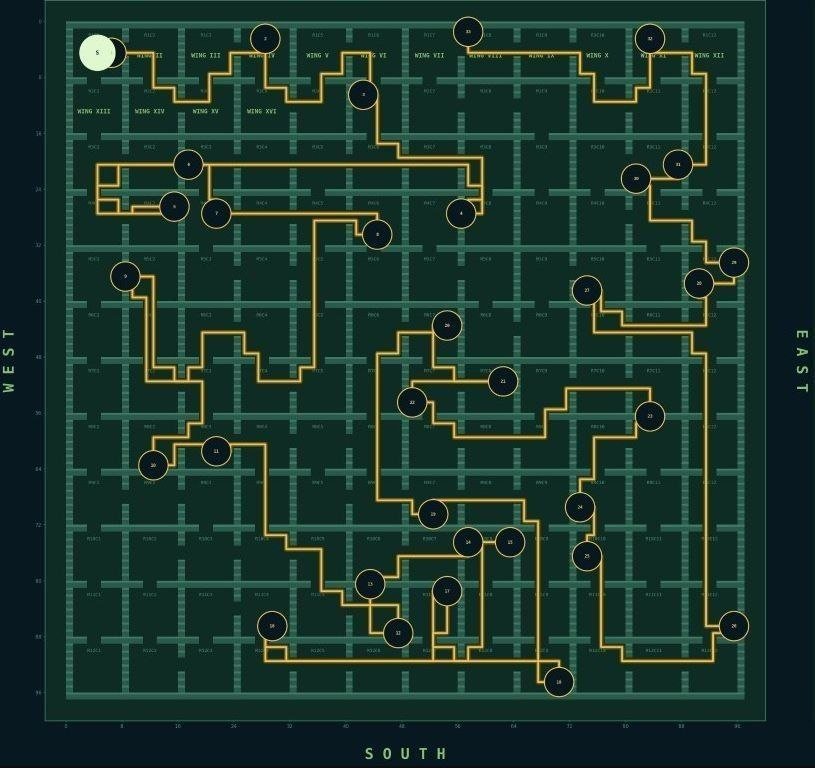
A really complicated maze solved in 4 minutes.
Or even better, a Python script to finish the game in 4 seconds!
Mira is really awesome. You just had to give her time to analyze
the best part is that you can access the best AI models in one place at the lowest price