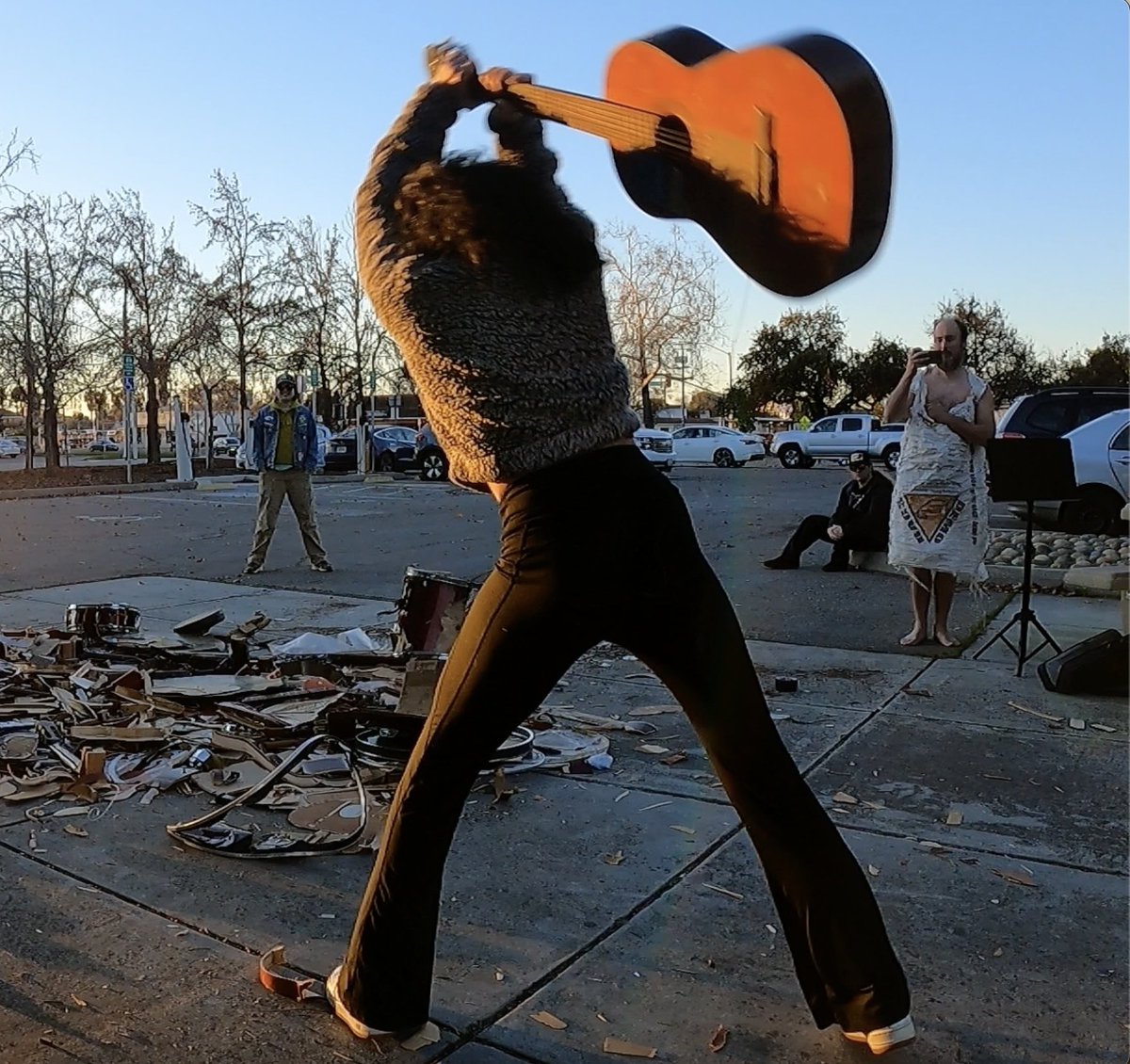
Orchestrations out today:
https://t.co/vNAxrIafYo
Please take a listen
It's a live recording of a concert which took place 10/20/2022, featuring performances by @therealbigpat1 & @pbbb_memory & more than 60 other people.
Album artwork by @WinterDiorHart
Seeing my more libbed-up YIMBY friends upset about the NYC rent freeze, predictably. But the arguments are not good.
I like and agree with my many liberal friends when they say "hey! There are tradeoffs! Let's be honest about them!" But the libs subsequently fail, almost always, to make a persuasive case about why we should always choose the efficiency-maximizing resolution to those tradeoffs.
Restrictive zoning is a bad tradeoff. It costs us new housing, and what we get in exchange *is also bad*. Concentration of wealth, segregation, and car-dependent single-family neighborhoods are the *benefits* in the eyes of the people advocating for that kind of zoning, and those things suck! That's why I'll always defend maximal upzoning.
Environmental review is a tradeoff that might seem appealing in principle, but in reality, as implemented, it's been a gigantic drag on construction without delivering meaningful environmental benefit--in fact, by hampering infill density, it has actively made environmental harm *worse* in many ways. Bad tradeoff.
But rent control *is* different. It offers stability in housing for residents, which is a genuine good. People really dislike feeling precarious in their ability to secure shelter, and rightly so. Shelter is actually a real, universal human need, and anxiety about its precarity is an unavoidable psychological response. If we actually care about hedonic utilitarianism or something like it, this is an intrinsic and unavoidable source of fear and despair *not* fully resolvable simply through increasing output.
The tradeoff of rent control is that it does dampen new supply, to a variable extent, heavily dependent on the specific implementation. There are ways to lessen or increase the costs of this tradeoff, and they may or may not correspond substantially to the benefit gotten in exchange--stability in housing access for rent-controlled tenants, freedom from the innate human fear of loss of the home.
This is a tradeoff that actually demands to be taken seriously. If there are other ways to resolve it that are more efficient than rent control, great, but what people like about it is that it allows them to anticipate the future in a way that market-rate housing does not.
Even in a healthy private housing market with lots of construction that keeps rents relatively low, that process only looks smooth when zoomed out. In the micro, it involves economic cycles of increasing rents, overbuilding, falling rents, underbuilding, repeat.
People dislike these cycles, for deep and innate reasons of human psychology. We like stability, predictability, and we really like it where it concerns our deep and innate needs, like for shelter. You can't just brush that off.
Is the point of policy just to always maximize output? Or is it to address human suffering, and secure human happiness? If the latter, we must pay attention to "irrational" features of human psychology, like strong preferences for predictability, when we craft policy.
Do third-worldists & other opponents of the US’s economic hegemony support these tariffs because of their potential to destabilize the USD to point of not being the global reserve currency?
ON SATURDAY JANUARY 11 2025 AT 3:30PM ELIOT BURK AND PATRICK TALESFORE, JR. WILL BE HOSTING A WORKSHOP ON MUSICAL IMPROVISATION AT LARRY J. MARSALLI PARK IN SANTA CLARA CALIFORNIA
The democratic petty bourgeois, far from wanting to transform the whole society in the interests of the revolutionary proletarians, only aspire to make the existing society as tolerable for themselves as possible.
Attending Brandon Becker’s memorial concert at calarts tonight, so I’m releasing this interview of him I conducted in 2021:
https://t.co/dWDFTrBR2q
also available on all podcast platforms.
For years, I’ve been referring to all orchestras as "ethnic orchestras" which decenters the idea that there is a "universal" kind (which invariably defaults to the European model).
https://t.co/NMS0DxPmAK