I'm releasing a new book: Supply Chain Analytics: A Data-Driven Approach! 📓
While teaching at @Columbia University (IEOR), I realized the literature was fragmented—either too lightweight or too technical. I decided to create the "middle ground" reference. 🧵👇
Back when I was preparing my Supply Chain Analytics class, as a trained economist I was surprised to see that there were not general equilibrium models in the existing OR literature.
On one hand, there is an extensive literature on optimal production and risk hedging (e.g. Newsvendor model). But on the other, there haven't been many structural advances in understanding systemic effects, such as the Bullwhip effect in a quantitative unified way when there is a network of producers, sellers and retailers.
Then, I took the challenge to combine the two ideas: individual production with optimal risk hedging and the structural machinery of fluid networks to describe what the optimal quantities are for all the supply chain network under perfect information. For example, there is a remarkable fact: even under perfect information, there is still a bullwhip effect propagation throughout the network.
Link: https://t.co/Pss3c5qDx4
#SCA #OperationsResearch #SupplyChainNetwork #OperationsManagement #OptimalProduction #OptimalInventory
This week I'm releasing the vehicle transportation problems of my book 🚎
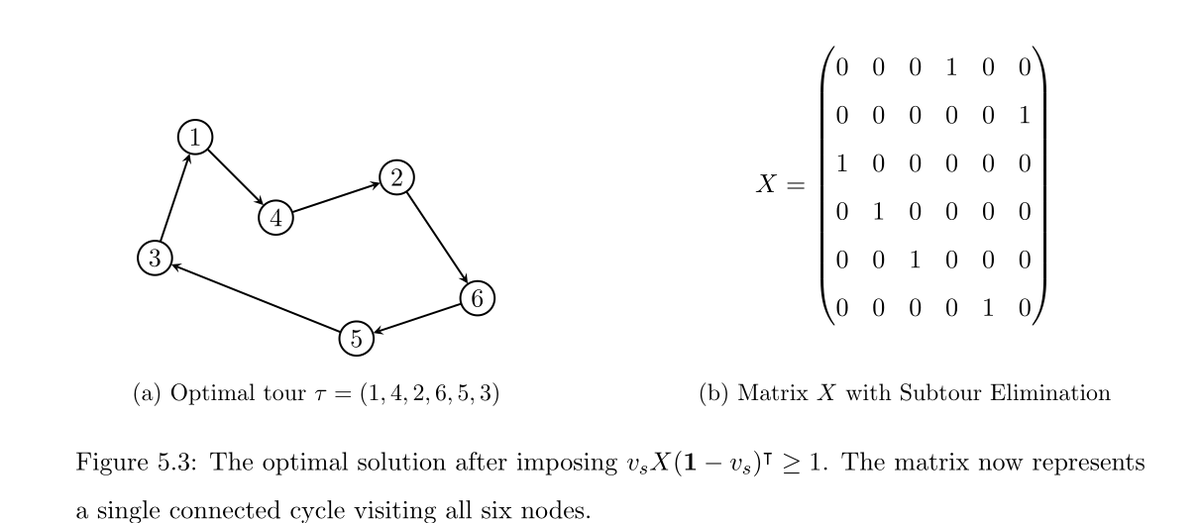
If you ever wondered how to do transportation optimization (imagine UPS or Fedex) this chapter goes through the modeling basics to more complex paradigms when vehicles have capacities or delivery time windows!
Chapter link: https://t.co/7Y50GEEQBi
#OperationsResearch #OperationsManagement #SupplyChainAnalytics #TSP #VRP #VRPTW #StochasticOptimization #Logistics
Many people are worried about losing their jobs to AI. I constantly think about what will be the real impact of AI on the workplace and in education.
So, I did an experiment: I let my students in my Supply Chain Analytics class to use AI for all assignments, midterms and final exam.
The surprising (and spoiler) result, is that the AI is not the doomsday technology some advocate, but a very useful enabling tool for students and professionals, read more on my blog post "Grade Inflation: or How I Learned to Stop Worrying and Love the AI"
https://t.co/CfHMDQwxIv
Ever wondered how to handle production scheduling when demand is all over the place? 📈 🏭
The latest chapter of my book on "Scheduling Models" tackles exactly that: how to efficiently schedule people and resources for productive activities under uncertain demand.
(And yes, my poor drawing attempt of the "ice-cream cone 🍦" looks way better in the actual chapter!)
Dive into the math and models here:
🔗 Download the Chapter: https://t.co/K2Q0X0euiA
📕 Full Book Repo: https://t.co/ohLIMYOoNP
#SupplyChain #OperationsResearch #Scheduling #DataScience #OperationsManagement
I broke down these algorithms and their connections to stochastic optimization in the latest chapter of my book.
Free for EMS and industry folks alike!
🔗 Read Chapter 3: [https://t.co/DmBEQ8BEvB] 💻 Full Repo: [https://t.co/O03w22t0Mr]
#OperationsResearch#SupplyChain #DataScience (4/4)
During the peak of COVID-19, I worked with @Columbia and @FDNY to solve a life-or-death puzzle:
How do you route ambulances in real-time to minimize travel while ensuring no hospital hits a breaking point? 🚑🚑
The math we used ended up revealing something surprising... (1/4)
The complexity is wild. You’re balancing: ✅ Random demand & travel time risk ✅ Distributionally robust optimization ✅ Combinatorial decision spaces
By changing where you place the "hub" (ambulance or warehouse), you fundamentally shift the entire cost structure. 🧠 (3/4)