OpenAI CEO, Sam Altman:
"You don't need to write prompts anymore."
In 38 minutes, he explains how to use LLMs better than 99% of people do.
This is the whole difference between using AI and having AI work for you.
Watch it, then read the guide below on how to build a system that prompts itself.
INSTEAD OF WATCHING NETFLIX TONIGHT.
Spend 1 hour with this.
Claude AI FULL COURSE that teaches you how to BUILD and AUTOMATE anything.
The people who watch this tonight will wake up tomorrow with a new skill.
Watch it and bookmark it now
El ingeniero que creó claude code acaba de soltar un video de 28 minutos donde te enseña a escribir prompts que realmente funcionan.
He visto cursos de 300 dólares que no llegan ni a la mitad de lo que explica en los primeros 10 minutos.
Archivos CLAUDE.md, atajos de memoria, sesiones paralelas y patrones de prompting que cambian el juego.
Todo en un solo video y completamente gratis.
Da igual si eres desarrollador, principiante o ya llevas meses usando Claude. Esto te va a volar la cabeza.
Stock Chart Stage Analysis:
Stage 1 (The Basing Area): The stock bottoms out and moves sideways as selling pressure dries up and investors start quietly accumulating shares.
Stage 2 (The Advancing Phase): The stock breaks out above its resistance and the 200-day moving average on above average volume, entering a sustained uptrend.
Stage 3 (The Top Area): Momentum stalls and the stock churns sideways in a volatile range as buyers and sellers battle for control. The stock can resume a stage 2 uptrend or drop into a stage 4 decline.
Stage 4 (The Declining Phase): The stock breaks down below its support levels and its flattening 200-day moving average, typically falling into a prolonged downtrend (this happens below a declining 200-day moving average).
The $WGS & $STAA Moats
“In business, I look for economic castles protected by unbreachable moats.”
-Warren Buffet
Below you can see my initial $STAA thesis. You’ll find some similarities with my thesis on $WGS in the sense that both have a big moat in a niche industry, that very few understand, especially not the analysts that where “forced” to cover these companies and in both cases specialized hedge funds that had been heavily invested in the business since the beginning were buying aggressively while analysts were confused and the market was selling.
The buying pattern is very similar to what we’re seeing in $WGS, although in $WGS it’s even more aggressive. The people with the deepest and most asymmetric understanding of the business are buying while the average analysts are completely lost and confused.
To the moats,
In the case of $STAA, the moat comes from trust built over 30 years of clinical data and more than 4 million implanted lenses worldwide. When it comes to elective eye surgery, both surgeons and patients are naturally conservative. Very few people want an implant inside their eye unless it has decades of proven safety and real world outcomes. That kind of trust is incredibly hard to replicate and creates a major barrier for new competitors.
For $WGS, the moat is its proprietary rare disease genomic database. GeneDx has performed more than 2.5 million genetic tests, including nearly 1 million exomes and genomes sequenced, creating one of the largest rare disease datasets in the world.
To explain this moat simply, imagine trying to solve a massive puzzle where every human has slightly different pieces. Anyone can look at DNA data, but the difficult part is understanding which mutations are actually dangerous, which are harmless, and which combinations together may cause disease.
The more patients you sequence over decades, the more patterns you begin to recognize. You start seeing that a mutation that looked random at first actually appeared in hundreds of children with the exact same symptoms. Over time, the database becomes smarter and smarter because every new patient improves the interpretation of future patients.
With more than 7,000 known rare diseases identified so far, interpretation accuracy depends heavily on historical genotype phenotype correlations and prior variant classifications. Without decades of accumulated sequencing and clinical interpretation data, no matter what AI you have, how much money you spent, many variants are misclassified or missed entirely.
This creates a powerful feedback loop where more tests lead to better interpretation, which attracts more physicians and patients, generating even more data over time.
What makes the moat even stronger is that the dataset is still compounding rapidly. GeneDx’s exome and genome test volume grew 30.5% year over year in 2025, with growth accelerating to 34.3% in Q4. Every incremental test improves the company’s interpretation engine and widens the gap versus competitors.
In both cases, the moat is not just the product itself. It is the decades of accumulated trust, data, and real world outcomes that competitors cannot easily recreate.
After my post, $STAA rallied 9%, and people were saying they were “selling the pop.” But the company then revised guidance twice afterward, and whoever sold that first 9% move missed the next 81% rise in the following two months.
The company had disappointed on earnings exactly like $WGS before sentiment completely reversed.
I don’t see why $WGS has to be any different.
Be patient
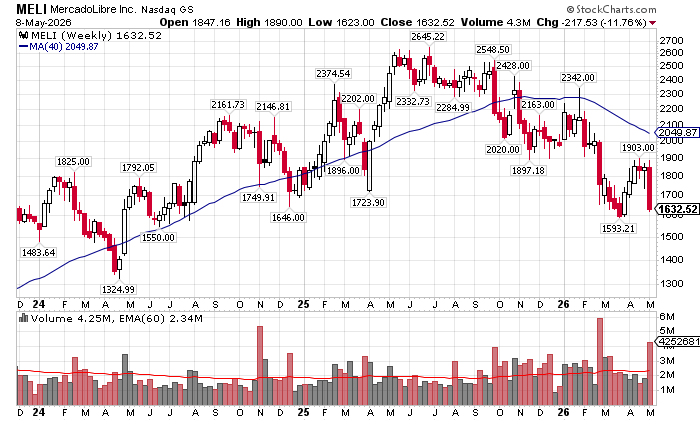
$MELI has been a great stock for so long but it's currently in a stage 4.
Why not wait until the stage 4 ends, a stage 1 forms, the down sloping 200d ma flattens out and the price gets back over the 200d ma?
Play the higher risk v reward odds vs trying to guess a bottom.
No position.
Instead of watching Netflix tonight.
Spend a day mastering Claude here: https://t.co/Vn60ElPZ2i
→ Level 1 - 24 min: The basics.
Claude For Dummies: https://t.co/HNa5MrCLVU
Claude Setup: https://t.co/jw2qdIcjnh
→ Level 2 - 1 hour: Real workflows.
Claude Cowork: https://t.co/uWTpOI3Woc
Claude for teams: https://t.co/qxlcqhf8bM
Claude Design: https://t.co/ZY8Fg5D2ea
Cowork + Projects: https://t.co/Q7AN9CZAbO
Claude for slides: https://t.co/L0bPMgXci6
Claude Skills: https://t.co/6cHYYfjXEA
→ Level 3 - 3.5 hours: The pro moves.
Avoid sycophancy: https://t.co/5i8xSJBGUl
Claude Code: https://t.co/UgE9xBXVbE
Claude 101: https://t.co/OvBmlvnVqL
Stop hitting Claude limits: https://t.co/j5fEzSH5br
Stop Prompting: https://t.co/j1LATSJiat
→ Level 4 - 8 hours: Expert mode.
Claude Computer: https://t.co/TxYuHPjgbV
Build with Claude API: https://t.co/RcCbfNjlzz
Pro tip: Don't binge it. Do one level per sitting.
Actually apply each guide before moving to the next
Why do people hold losers and cut winners quickly?
Closing a losing trade means admitting that you were wrong and that hurts the ego. Investors often prioritize protecting their ego over protecting their capital.
Learn to add to your winning investments or trades and not your losing investments or trades.
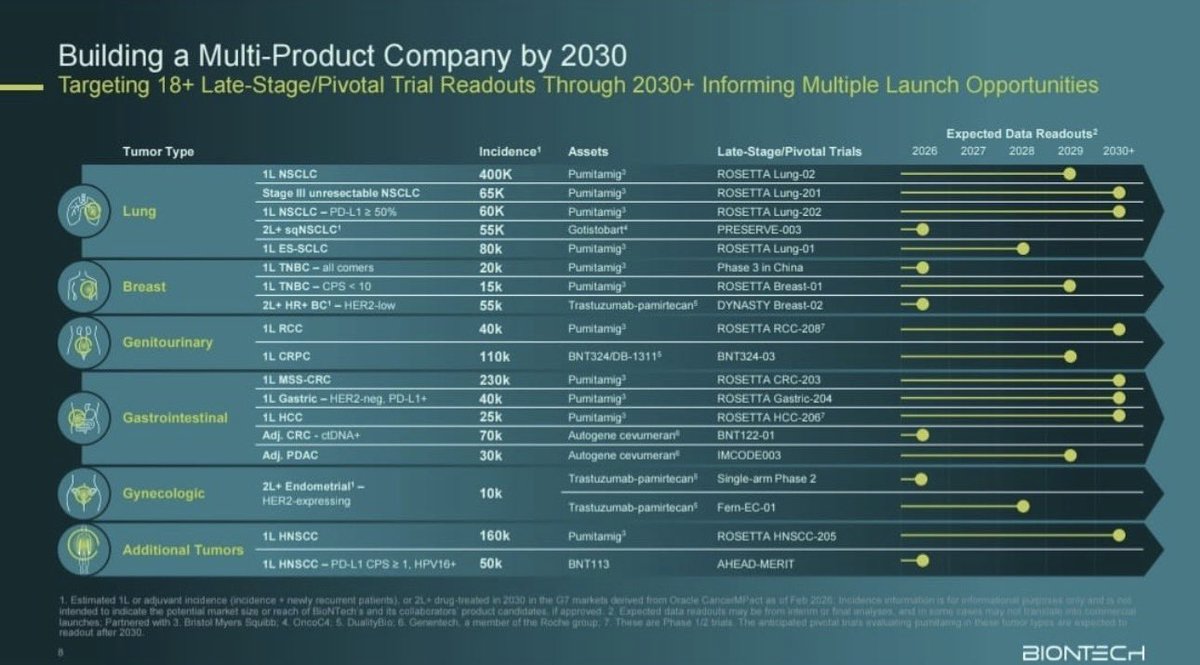
Biotech Corner- $BNTX
“Immediate offering – A giant biotech company, first-hand from a doctor, huge drug pipeline, collaboration with a major pharma company (Bristol Myers Squibb), and a proven ability to develop an FDA-approved blockbuster.
Please do not call on Saturday.
Today, $BNTX is crashing 21% for two reasons.
The first is the departure of the company’s founders, who are leaving to run a new company they are establishing. This new company will collaborate with $BNTX, which will hold a minority stake there in exchange for technology.
We are not particularly worried about this. The massive development of $BNTX’s leading product is in the hands of $BMY (Bristol Myers Squibb) under a 50/50 partnership on the drug.
The second reason is lower-than-expected guidance for the COVID vaccine in 2026. We are not worried about this either. The future of $BNTX lies in its enormous pipeline (mentioned above).
At the current share price, the company is trading at its cash value.
In effect, you are getting the company and its massive pipeline for free.
The company has enough cash to last an entire decade.”
Crazy.
Portfolio Allocation: 3%
אנטרופיק פרסמו מדריך מקיף על איך לבנות Skills נכון לקלוד קוד אז כמובן שמה שעשיתי זה להעלות את המסמך עצמו לקלוד קוד ולהגיד לו שיקרא את הקול ויעדכן לבד את כל הסקילים שיש כבר אצלי.
עבד אש ואפילו החמיא לי שלא הייתה שונות גדולה מידי.
הנה המדריך: https://t.co/RMOsxhvAx9
🚨 BREAKING: Google Gemini can now analyze any stock like a Wall Street analyst (for free).
Here are 10 insane Gemini prompts that replace $4,000/month Bloomberg terminals:
Save for later🔖
There are two things to look for at a market bottom:
• $SPX opens very low and then recovers
• $VIX goes from green to red
This won’t necessarily be THE BOTTOM, but it can be a time to buy equities and start shorting $VIX via $VXX & $UVXY
Until then, stay away.
If you want to survive long term as an investor:
1. Buy leading high quality stocks with accelerating earnings and profitability
2. Don't over diversify
3. Don't always be 100% invested
4. Cut losses quickly, do not let 10-15% losses become 50%+
5. Have some fun while doing it
BREAKING: AI can now build financial plans like Goldman Sachs wealth advisors (for free).
Here are 12 insane Claude prompts that replace $5,000/hour financial planners (Save for later)
Claude is the smartest Al right now.
But 90% of people prompt it like ChatGPT.
That's why I made the Claude Mastery Guide:
→ How Claude thinks differently
→ Prompts built for Claude
→ 2000+ Al Prompts
Comment "Claude" and I'll DM it free.
One of the most difficult concepts in investing is to finally reach a point where you are comfortable buying great stocks making higher highs vs buying stocks making lower lows.
Quality matters!