POSITIONING BEFORE THE MARKET WAKES UP-WHY QUANTUM-SAFE INFRASTRUCTURE MATTERS EARLY
🧵 1️⃣ One thing crypto keeps proving over and over:
Most people only pay attention AFTER the narrative explodes.
The real advantage usually comes earlier 👇
$CELL #Cellframe#QuantumSafe
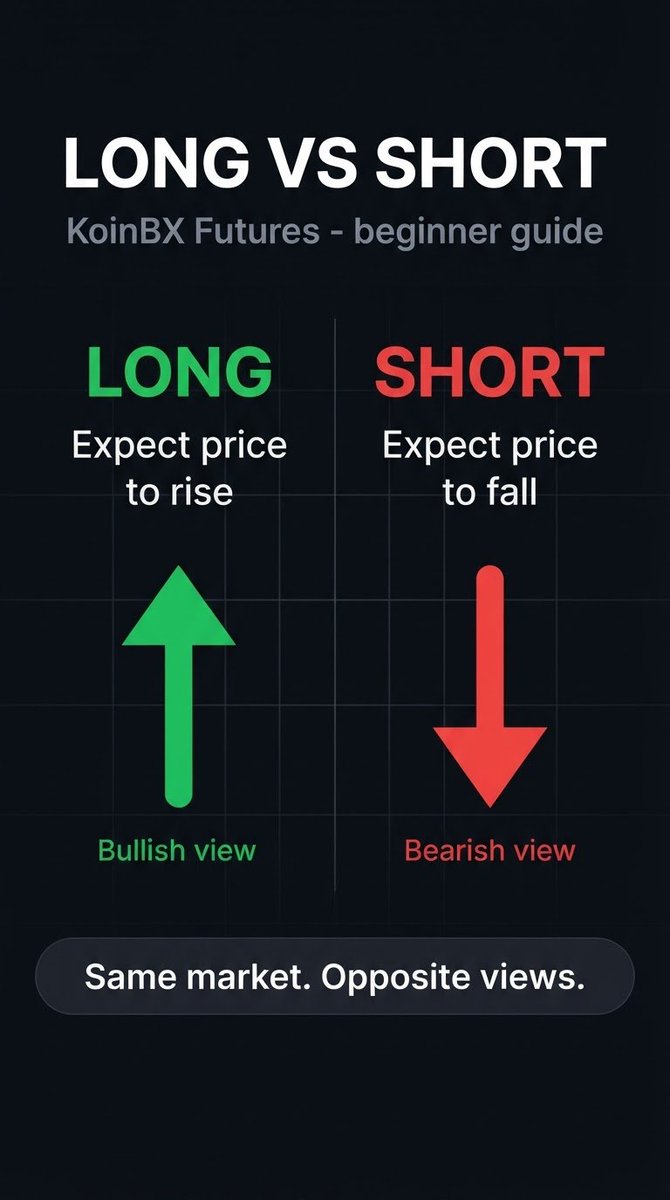
KOINBX FUTURES: LONG VS SHORT (SIMPLE)
Futures lets you take a view on price direction.
Not “I own the coin.”
More: “I think price goes up” or “I think price goes down.”
LONG
You open a long if you expect the price to rise.
If price moves up, the position can work in your favor.
If price moves down, the position works against you.
SHORT
You open a short if you expect the price to fall.
If price moves down, the position can work in your favor.
If price moves up, the position works against you.
QUICK EXAMPLE (HYPOTHETICAL)
Say BTC is at $100,000 on the chart you’re watching.
Trader A thinks it goes higher → looks at a long.
Trader B thinks it goes lower → looks at a short.
Same market. Opposite views. That’s the core idea.
WHAT BEGINNERS SHOULD LOCK IN FIRST
1️⃣ Long = bullish view
2️⃣ Short = bearish view
3️⃣ Direction matters before leverage does
4️⃣ A wrong view still loses -- especially with leverage
5️⃣ This is education, not a signal to open a trade
On KoinBX Futures, long and short are both available so you can study how directional positioning works inside the interface -- after you understand the risk.
Futures involves substantial risk. Leverage amplifies gains and losses.
@KoinBX
WHAT EXACTLY IS LEVERAGE?
Leverage is the part of futures that looks like a shortcut.
It is not.
Leverage does one job: it lets a smaller amount of capital control a larger position. That larger position is the exposure. The cash you post to open it is the margin.
Those two numbers are not the same thing. Beginners get hurt when they treat them as the same thing.
A SIMPLE WAY TO SEE IT
Imagine a trader wants $10,000 of BTC exposure.
With no leverage, they need about $10,000.
With 5x leverage, they can open that same $10,000 exposure with about $2,000 of margin.
With 10x, the margin required drops again.
The market did not get kinder. The position just got bigger relative to the money sitting behind it.
WHAT GETS AMPLIFIED
Price does not need to move far.
If the trade goes the right way, the gain is calculated on the full exposure, not just the margin. That is why leverage looks attractive.
If the trade goes the wrong way, the loss is also calculated on the full exposure. A 2% move against a 10x position is not a 2% hit on the account. It is much larger relative to the margin.
That is the whole mechanism. Gains scale. Losses scale. The account feels every tick more than a spot bag would.
MARGIN IS NOT A PROFIT CUSHION YOU CAN IGNORE
Margin is what keeps the position alive.
If losses eat too much of it, the exchange can close the trade. That is liquidation. You do not get to “wait for the bounce” the way you can on spot coins sitting in a wallet.
Higher leverage usually means the price does not have to travel as far before that happens.
WHY “HIGHER LEVERAGE” IS NOT AUTOMATICALLY BETTER
@KoinBX Futures can offer high leverage on selected pairs, including up to 100x.
Available is not the same as suitable.
100x means a very small move can wipe the margin. That is not a strategy. That is a short timer.
For someone still learning futures, the useful question is not “what is the maximum leverage?”
It is “how much of a move can my margin actually survive?”
BEGINNERS SHOULD BE CAREFUL FOR A BORING REASON
Leverage does not fix a bad idea.
It does not replace a plan.
It does not cancel fees or funding.
It does not make a Pass safer. A Futures Pass can change what trading fees cost inside an allowance. It does not change liquidation math.
If you cannot explain the position size, the margin, and where the trade becomes dangerous, the leverage is too high.
HOW TO THINK ABOUT IT ON @KoinBX
Learn the order:
Spot first --- you own the asset.
Then Long vs Short --- you are trading the move.
Then leverage --- you are choosing how large that move feels against your margin.
@KoinBX has spot, futures, and a monthly Futures Pass for people who already understand volume and risk. None of those products are a reason to size a position you cannot afford to lose.
This is education, not a signal.
Futures can liquidate the margin.
Only use money that can go to zero.
#KoinBX #CryptoFutures #Leverage #CryptoEducation
1/5 🧵
ON-CHAIN DATA IS PUBLIC. YOUR FINANCES ARE STILL OPAQUE.
A wallet explorer shows hashes, method IDs, and logs. That is not a financial record.
If you run more than one wallet across more than one chain, you cannot answer simple questions: what left, what arrived, what was a swap, what was an internal transfer, and how much gas you actually paid.
That gap is the problem TSERA is trying to close.
@cellframenet 6/6
That's the idea behind a VPN with no boss:
Distributed nodes. Post-quantum encryption.
Community participation.
Your connection, not theirs.
@cellframenet $KEL
HOW A VPN WITH NO BOSS WORKS
How can a VPN work without one company sitting in the middle?
The answer starts with the architecture.
KelVPN distributes traffic across a network of independent nodes.
Let's break it down.
@cellframenet $KEL
@cellframenet 5/6
The result is a VPN designed around decentralization.
No central owner controlling the whole network.
No central log repository. No single central point that everything depends on.
NOBODY CAN NAME THE WINNING POST-QUANTUM SIGNATURE YET
There is no single algorithm the field can honestly lock in and walk away from.
NIST already standardized more than one family because the families rest on different assumptions. ML-DSA, from Dilithium, is lattice-based. SLH-DSA, from SPHINCS+, is hash-based. Falcon is still moving through the FN-DSA process. Additional signature schemes are still under evaluation.
That is not a delay. Different schemes trade different costs: signature size, verification speed, key size, and how hard they are to implement correctly. A design that looks efficient in 2026 can look awkward once hardware and cryptanalysis move again.
For a blockchain, that uncertainty becomes an architecture problem. If one algorithm is wired into addresses, transaction format, and consensus, replacing it later is not a library update. It becomes a network-wide migration. Wallets, nodes, and users all have to move with the same change.
The obvious question is which algorithm looks strongest on a comparison table.
The better question is whether the protocol can add another primitive without splitting the chain.
That is where Cellframe becomes interesting. Post-quantum signatures are native rather than a later retrofit. Multiple algorithms can sit at the primitive level at the same time. The design goal is to introduce a new scheme without a hard fork.
That is not a claim that the current set is final. It is a claim about how a ledger should age while the standards are still open.
cBTC is being designed on that stack. It is in development, not a live product.
@cellframenet $CELL
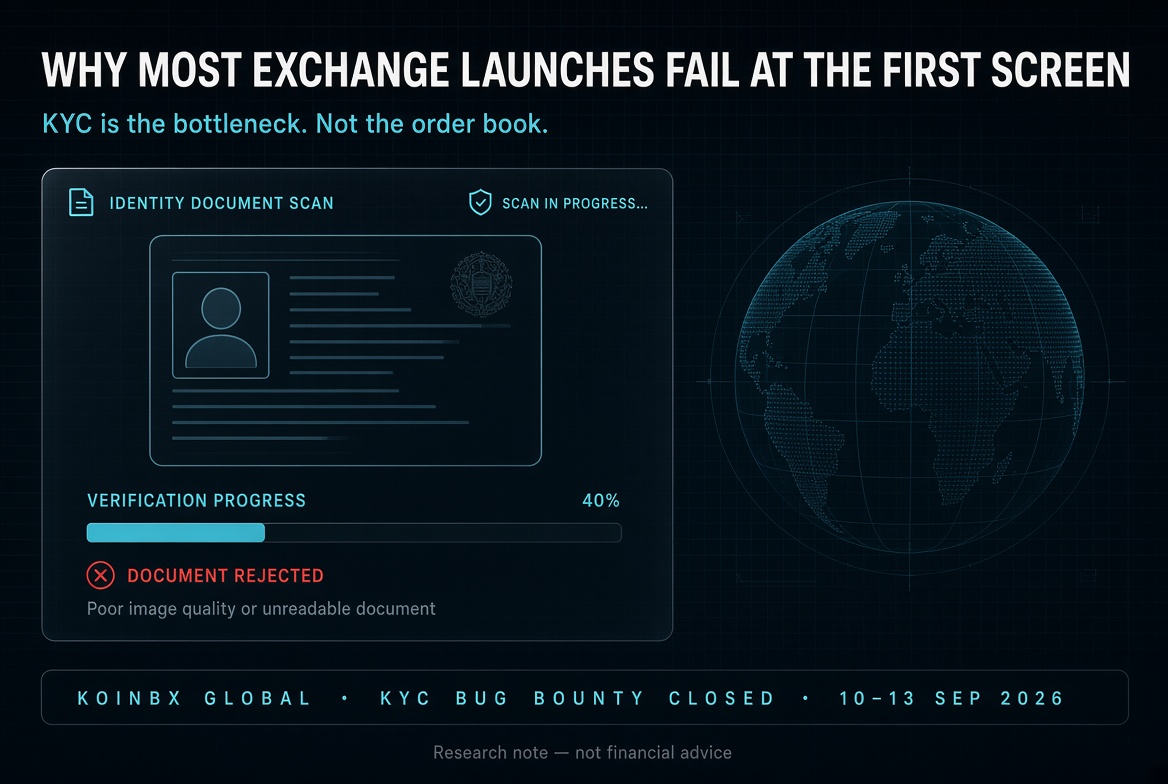
WHY MOST EXCHANGE LAUNCHES FAIL AT THE FIRST SCREEN
The hardest part of a new exchange is not the order book.
It is KYC.
Accounts stall. Documents bounce. Eligible countries are unclear. Support only shows up after traders are already gone.
@KoinBXGlobal just closed a KYC Bug Bounty that ran 10–13 September 2026. Completers who finished full verification from an eligible country and submitted the form were credited $2. That is not the point. The point is what they chose to test before calling Global live.
1️⃣ THE REAL BOTTLENECK
Onboarding is where global products die. A futures venue can have clean fees and still lose the user at identity check. Paying testers to complete KYC and report breaks is operational work, not marketing.
2️⃣ WHAT WAS LIVE VS WHAT WAS A CAMPAIGN
Live now: KoinBX Global is open.
Completed: the KYC bounty window. Rewards were stated as credited to accounts that met the rules.
Still coming: a trading contest has been teased. Prize pool and rules are not published yet. Treat that as announced, not live.
3️⃣ THE FEE MODEL THAT ACTUALLY CHANGED
KoinBX does not make futures traders climb a VIP ladder for lower fees. Global sells a Futures Pass against an eligible fee-free volume allowance:
Trader — $25 → $100,000
Pro — $125 → $500,000
Elite — $250 → $1,000,000
Add-on — $30 → +$100,000
Once the allowance is used, standard fees apply. That is prepaid cost control, not zero-fee forever.
4️⃣ WHY THE BOUNTY MATTERS MORE THAN THE $2
If KYC is messy, the Pass never gets used. Community verification before a global open is how you find country-dropdown failures and document rejects while the crowd is still small.
5️⃣ THE LIMITATION
A $2 task does not prove liquidity, engine quality, or withdrawal speed. It only proves they instrumented onboarding. Those other claims still have to be earned in live markets.
Fee-free volume is useless if you cannot get verified. Verification is useless if you size positions because fees look cheap.
That is the order most traders reverse.
#KoinBX #KoinBXGlobal
Most teams still treat email as a separate stack.
You brief a campaign, then hand it to a copywriter, a designer, and an ESP. Then you hope it actually renders in Gmail, Apple Mail, dark mode, and Outlook. That last part is why a lot of “AI email” tools still fail in production. They generate a draft. They do not own delivery.
What Migma just shipped inside Grok Bot is different. You describe the goal and the audience in chat. It designs the campaign, builds the segment, lets you test-send, then sends. The compatibility claim is the part worth paying attention to: they render through their own email language, Zinn, instead of dumping generic HTML into inboxes that still break on old clients.
That matters because the bottleneck was never “can AI write a subject line.” The bottleneck was going from idea → on-brand creative → correct list → inbox that doesn’t collapse. If that loop now lives inside Grok Bot, email stops being a department and becomes another agent workflow.
The next question is not whether AI can write campaigns. It is which tools still deserve a tab once the bot can design, segment, send, and learn from the result.
@ThejesterVerse The useful test is not “can Grok write a campaign.”
It is whether idea → segment → test send → live send now happens in one chat without opening Klaviyo, a design tool, and a copy doc.
If that loop holds, email stops being a three-person handoff and becomes another agent job.
@cellframenet 5/5
Privacy infrastructure gets more interesting when the community can help run it.
Contribute bandwidth. Help carry the network.
Get rewarded in KEL for that contribution.
That's KelVPN.
@cellframenet $KEL
NOT JUST USE IT, BE PART OF IT
Here's something interesting about KelVPN:
You don't have to stop at using the network.
You can actually help run it.
And yes, that's different.
@cellframenet $KEL
@cellframenet 4/5
The more interesting part is the relationship between user and network.
You aren't simply a customer.
You can become part of the infrastructure that helps KelVPN operate.