🦸♀️ The Girl of Steel is officially coin-ready.
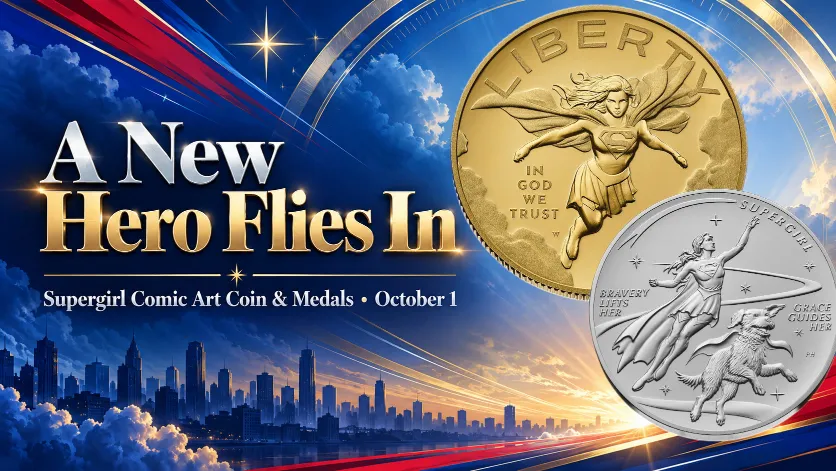
Today's the day, collectors. The U.S. Mint, working with Warner Bros. Discovery Global Consumer Products, begins taking orders for the Supergirl coin and medals, the fourth release in its Comic Art Coin and Medal Program, on Thursday, October 1 at noon ET.
💰 Today's prices:
🥇 ½ oz 24K Gold Proof $50 Coin: $3,390
🥈 2.5 oz Silver Medal: $400
🥈 1 oz Silver Medal: $200
What's dropping:
The gold coin is struck at West Point and the two .999 fine silver medals at Philadelphia. The $50 gold piece has a proof finish, while the silver medals carry a matte finish similar to an uncirculated coin.
The art:
The obverse shows Supergirl flying above the clouds with her cape trailing behind her, designed and sculpted by Mint Chief Engraver Joseph Menna. The reverse, by Mint Medallic Artist Phebe Hemphill, pairs Supergirl with Krypto inside a starburst. Yes, Krypto made the cut. 🐕✨
The silver medals carry "SUPERGIRL," "BRAVERY LIFTS HER," and "GRACE GUIDES HER," a nod to the two values the Mint built her release around.
The numbers that matter:
The gold coin is capped at 10,000 with a household limit of 1. The 2.5 oz medal is capped at 25,000, also limited to 1 per household. The 1 oz medal has no mintage limit. Household limits typically lift the business day after launch, so day one is your shot at the capped pieces.
The gold coin and 2.5 oz medal each come with a numbered Certificate of Authenticity, and every piece arrives encapsulated in a presentation case.
⚠️ Heads up: gold pricing follows the Mint's pricing grid, which can be adjusted weekly as gold moves, so $3,390 may not hold.
Why it's a big deal:
Supergirl rounds out the 2026 lineup alongside Green Lantern and Robin, with The Flash, Batgirl, and Aquaman slated for 2027. And the timing is perfect, with the Supergirl movie having opened June 26 and putting fresh eyes on Kara Zor-El.
⏰ Noon ET. https://t.co/FQrrSVX2VV. Set your alarm.
Are you going gold, silver, or the full set ($3,990 all in)? 👇
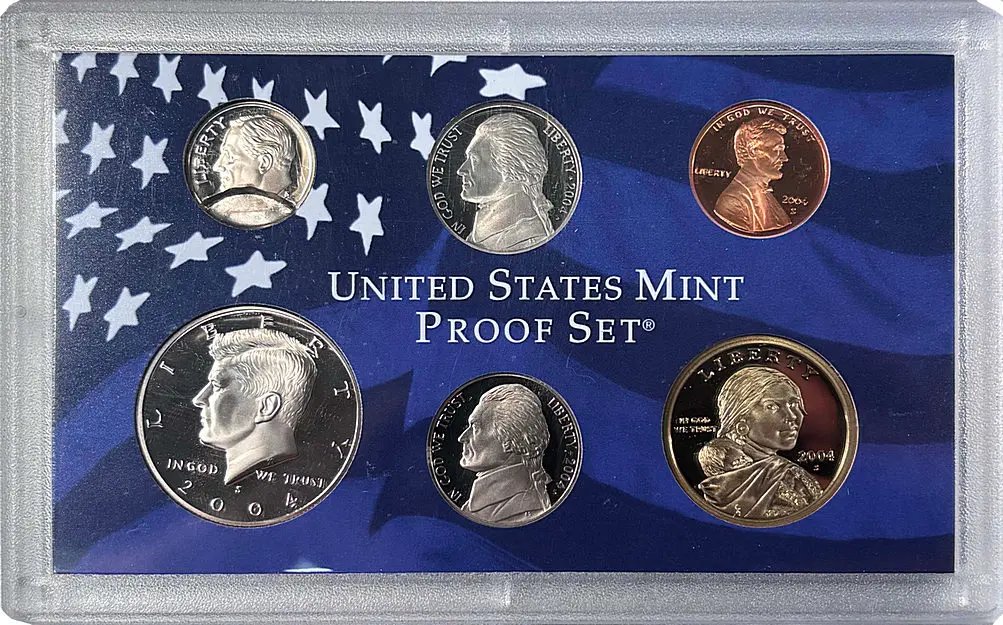
A Mint error sat sealed in a 2004 Proof Set for 22 years, and nobody noticed. 🪙
Proof coins are supposed to be the most carefully made coins the U.S. Mint produces. This one slipped through anyway.
A 2004-S Proof Roosevelt dime with a large indent covering about a quarter of the obverse has turned up, still locked in its original government-sealed Proof Set lens. It never circulated, no collector removed it, and no grading service ever slabbed it.
How it was found
An unnamed dealer spotted and bought the set at the 2026 ANA World's Fair of Money in Pittsburgh, then contacted error specialist Mike Byers, who later acquired it.
Byers says that in 50 years of dealing in major errors, this is the only major mint error he knows of inside a sealed U.S. Mint Proof Set. He also searched auction records and checked with other specialists and found no match.
What caused the indent?
An indented strike happens when two planchets land in the coining chamber together and overlap. When the press strikes, the top blank gets driven into the one underneath and leaves a rounded depression.
Why this is so unlikely
In 2004, San Francisco struck Proofs with specially polished dies, hitting each coin at least twice for frosted designs and mirror fields. NGC has pointed out that modern Proof errors are scarce because of the Mint's strict quality control, and badly flawed pieces get another chance to be caught during packaging.
So this dime had to clear several hurdles. It survived the misfeed, passed inspection, reached packaging, and got sealed and shipped. Then it sat untouched for more than two decades.
The numbers
The clad 2004-S Proof dime had a mintage of 1,789,488. The 1,175,934 figure you often see belongs to the silver version. Among nearly 1.8 million clad Proof dimes, no other example with a major indent still in its original set has been reported.
Extra context
The 2004 set was already notable. It had 11 coins, including the Peace Medal and Keelboat nickels, which were the first new Jefferson nickel reverses since 1938.
The bottom line
Any "only known" claim deserves some caution, since another one could surface someday. But for now, this is the only reported major striking error in a sealed annual U.S. Proof Set.
Most errors get separated from their context. This one still has its evidence sealed around it.
Worth checking the sealed Proof Sets in your collection. 👀
Two tiny letters. Four coins. 145 years without an answer. 🔍
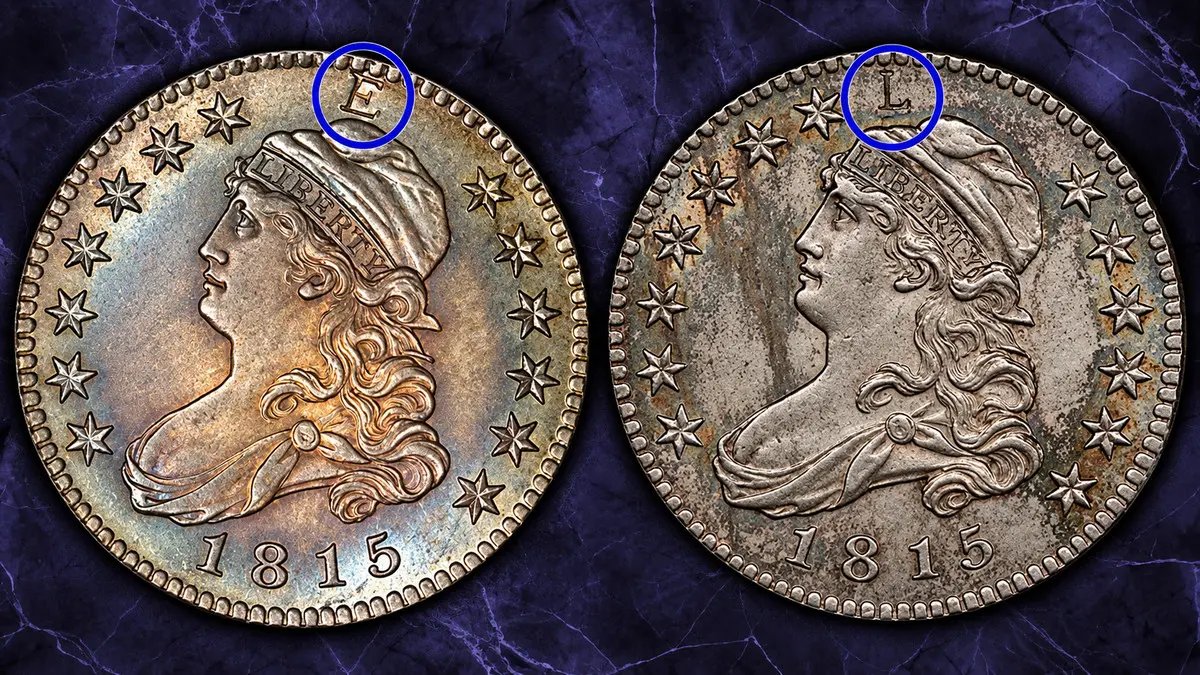
Somebody punched an "E" or an "L" above Liberty's head on a small group of Capped Bust quarters, and nobody has ever found a record saying who did it or why.
There are four known combinations: 1815 "E," 1815 "L," 1825 "E," and 1825 "L."
What makes it strange:
🪙 The picking looks deliberate. Every 1815 quarter came from a single die marriage, but for 1825, current cataloging puts the counterstamps only on the B-2 marriage, not B-1 or B-3.
🪙 The coins weren't spent. Most survivors grade XF or better, which suggests they were stamped early and then kept.
🪙 They appear suddenly. The earliest documented auction appearance is an 1815 "L" in a George Massamore sale on August 31, 1881, and more examples turned up in 1882 and 1883.
That timing is the new angle. Researcher Karl Moulton pointed out that William DuBois, a Philadelphia Mint assayer and curator of the Mint Collection, died in July 1881, just weeks before the first one surfaced. Coincidence? No document ties DuBois to the coins, so it remains speculation.
The leading theories:
⛪ Voting counters in a religious split. A 2004 John Reich Journal article by Ted McAuley proposed that the Harmony Society at Economy, Pennsylvania used them during its 1832 schism, with "E" for the Economites and "L" for Count de Leon's followers.
📚 School prizes. Walter Breen suggested in 1982 that academies awarded them, with "E" for English and "L" for Latin.
⚖️ Weight marks. A 1921 idea held that "L" meant Light, but weight comparisons haven't supported it.
Each theory explains part of the puzzle. None comes with proof.
The market no longer treats them as damage. PCGS began giving them numerical grades in August 2019. An NGC MS66 1815 "E" from the Madison Collection sold at Heritage for $35,937.50 in January 2008.
The answer might still be in an old newspaper or archive, waiting for the right search.
🐾🇺🇸 From Therapy Dogs to K-9 Heroes: The U.S. Mint Just Unveiled the 2027 Working Dogs Coins
Some of America's hardest workers never clock out, and they have four legs. The U.S. Mint is honoring them with a brand-new commemorative coin program.
On September 21, representatives from the U.S. Mint, America's VetDogs, and the Guide Dog Foundation unveiled the designs for the 2027 Working Dogs Commemorative Coin Program at a White House ceremony. The event was held in the Indian Treaty Room of the Eisenhower Executive Office Building as part of a National Service Dog Month celebration.
Three coins, three kinds of heroes 👇
🥇 $5 Gold: Therapy Dogs
The obverse shows a therapy dog gazing upward alongside the words UNCONDITIONAL SUPPORT, while the reverse captures a tender moment between a child and a therapy dog.
🥈 $1 Silver: Guide & Service Dogs
A golden retriever guide dog stops at a crosswalk to warn its visually impaired handler about a raised curb, with the motto LIVE WITHOUT BOUNDARIES. On the reverse, a Labrador retriever engages with a veteran in a wheelchair, inscribed PUPPY WITH A PURPOSE.
🪙 Clad Half Dollar: Military & Police K-9s
A German shepherd in a bulletproof vest and goggles stands on rubble and exposed rebar beneath the words DEFENDING AMERICA. The reverse shows a German shorthaired pointer on point beside a duffel bag at an airport, its handler close behind, with POLICE K-9 along the rim.
📊 Key numbers for collectors
• Maximum mintages: 50,000 gold, 500,000 silver dollars, and 750,000 half dollars, issued only in 2027 in proof and uncirculated finishes.
• A three-coin proof set with one of each denomination is also planned.
• Surcharges are $35 per gold coin, $10 per silver dollar, and $5 per half dollar.
❤️ Where the money goes
Once the Mint recovers its program costs, surcharge proceeds go to America's VetDogs for service-dog training and care, instructor development, and client support. Breeding, raising, training, and placing one assistance dog costs over $50,000, yet VetDogs provides them free to veterans, active-duty service members, and first responders with disabilities.
"Every day, working dogs protect our communities, heal souls, and transform lives," said John Miller, President and CEO of the Guide Dog Foundation & America's VetDogs.
📅 When can you buy them?
The Mint hasn't announced an on-sale date or retail prices yet; the release date will appear on its 2027 Product Schedule.
Wall Street is now openly talking about $10,000 gold and $300 silver. 🟡⚪
Not long ago, calls like that got you laughed out of the room. Today they're coming from bank research desks and billionaire investors.
Here's what changed 👇
1️⃣ The big names are on record
JPMorgan's Jamie Dimon has floated gold reaching as high as $10,000/oz. Eric Sprott keeps nearly all his personal wealth in gold and silver. And J.P. Morgan's research team expects gold to push $6,000 by year-end 2026, pointing to central bank buying and rising institutional demand.
2️⃣ Gold isn't really going up. The dollar is going down.
This is the key reframe. Years of debt and money printing outpacing real growth, rate cuts through 2024 and 2025, sticky inflation, wars, and trade uncertainty all chip away at what a dollar can buy.
Central banks see it. They've been stacking gold at a historic pace, effectively betting against the very currencies they issue.
Seen this way, $10K gold looks less like a moonshot and more like a revaluation catching up to reality.
3️⃣ Silver is the spring that's been pressed down
📊 Gold-silver ratio: historically closer to 15–17:1. Today it's about 66:1. Silver is extremely cheap relative to gold.
🏦 Bank of America's metals team sees a 2026 range from about $135 to above $300 if that gap narrows.
🏭 Industrial demand: solar, EVs, AI hardware, and electronics now use more than half of global output.
📉 Supply: the Silver Institute has tracked five straight years of deficits, with a sixth expected. The cumulative shortfall is around 820 million oz, close to a full year of global mine supply.
⛏️ And roughly 70% of silver comes as a byproduct of gold, copper, and zinc mining, so producers can't just ramp up when prices rise.
4️⃣ Why now?
Monetary stress, inflation, geopolitical risk, and industrial demand are all hitting small physical markets at once. Historically, metals don't reprice slowly. They move in sharp bursts, and the people positioned early are the ones who benefit.
This week's pullback on Fed jitters is the kind of dip long-term buyers watch for.
5️⃣ The retirement angle
A Gold IRA lets you hold physical gold and silver in a tax-advantaged retirement account instead of paper promises. Nobody can print more of either.
With gold around $4,310 and silver near $65 today, these targets imply roughly 2.3x for gold and about 4.6x for silver.
The real question isn't whether the repricing is coming. It's whether you're positioned before it speeds up.
📖 Full breakdown: https://t.co/VHkjRpAiw5
📞 Free consultation: 888-369-2950
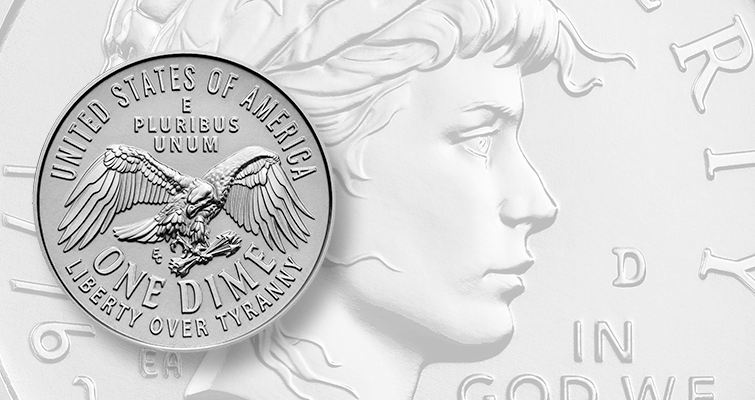
The 2026 dime has an eagle holding arrows and nothing else. Here's what's actually going on. 🦅🧵
For 244 years, the American eagle has come with a built-in message. On the Great Seal, finalized in 1782, it grips 13 arrows in one talon and an olive branch in the other, war and peace held in balance. Its head turns toward the olive branch, the side the Founders wanted the nation to lean toward.
Charles Thomson, who helped design the seal, explained that the two symbols stood for the powers of peace and war, powers the Constitution would later give to Congress, not any single leader.
Now look at the new Semiquincentennial "Emerging Liberty" dime. Lady Liberty replaces FDR on the front for the first time since 1946. On the back, an eagle in flight clutches arrows in one foot and looks back at the other foot, which is empty. Underneath: "LIBERTY OVER TYRANNY."
No olive branch. Not even the olive branch from the old Roosevelt dime, which sat beside the torch and the oak branch.
It's easy to read that as a statement about the present, and plenty of people have. But the timeline complicates that:
→ Congress authorized the 250th anniversary redesign years ago under the Circulating Collectible Coin Redesign Act.
→ The design was presented to the Citizens Coinage Advisory Committee in October 2024, before the last election. The olive branch wasn't in it then either.
→ The designer says the empty talon is deliberate. In 1776 the colonies had declared independence but had no peace yet. The eagle is still waiting for it.
Read that way, it's a pretty powerful piece of storytelling. The coin captures the Revolution at its most uncertain moment: arrows in hand, peace not yet won.
Still, symbols don't stay locked inside their designer's intent. A coin carries whatever meaning the people holding it bring to it. In a year full of conflict at home and abroad, an eagle holding only weapons is going to land differently than it would have in a calmer year. Both readings can be true at once.
The good news for olive branch fans: this is a one-year design. The Roosevelt dime, torch, oak, and olive branch included, is set to return in 2027.
So check your change. You're holding a small argument about what America was in 1776, and what it wants to be at 250. 🇺🇸
Sourcing for your own fact-check: The olive branch is traditionally held in the eagle's right talon, and the redesign is a one-year-only overhaul authorized by Congress bearing dual dates of 1776–2026. The design presented to the CCAC in October 2024 did not include the olive branch, and the designer, Eric David Custer, told Spotlight PA the omission shows the colonies had not yet reached peace, with the empty talon showing they were still waiting for it; Treasury Secretary Scott Bessent gave final approval. The fresh wave of attention came after a Fortune analysis called the omission "a cultural signal" that is "hard to read as accidental." According to the Mint, the dime will revert to its previous design in 2027.
The Rebel Gold Dollar: How the Confederacy Struck America's 1861-D $1 Coin 🪙
In May 1861, something happened that has never happened before or since: an enemy of the United States minted a U.S. coin.
Not a counterfeit. Not a fantasy piece. A genuine gold dollar, struck on U.S. Mint equipment, with U.S. Mint dies — by the Confederate States of America.
Here's the wild story. 🧵
The setup: Dahlonega, Georgia had hosted a small branch mint since 1838, coining gold pulled from the Southern Appalachians. In December 1860, Philadelphia shipped two pairs of gold dollar dies south, and they arrived on January 7, 1861 — expecting a normal production year.
Twelve days later, Georgia seceded.
The seizure: Under orders from Governor Joseph E. Brown, state officials took control of the mint's building, equipment, and materials, and Confederate troops formally occupied the facility on April 8, 1861. Superintendent George Kellogg wrote to President Lincoln that Georgia had handed all federal property over to the Confederate government.
The strike: Despite lacking real minting expertise, the Confederacy used the bullion still on hand in May 1861 to strike roughly $3,000 face value in gold dollars and half eagles.
And here's the key distinction: while some 1861-D half eagles had been made under federal authority before the takeover, every single 1861-D gold dollar was struck by the rebels — making it the only U.S. coin produced exclusively by the Confederacy. The 1861-O half dollar and 1861-C half eagle both have federal-struck counterparts. This one doesn't.
Why they look so rough: The Confederates used a leftover 1860-D obverse die, and their inexperience produced a crude strike — on every known example, the U in UNITED is faint or missing entirely, and Liberty's hair shows weakness. Irony worth savoring: on a coin struck by secessionists, "UNITED" barely appears.
The rarity: Traditional estimates put the mintage at 1,000–1,500 coins, though modern research by Carl Lester, based on assay records, suggests as few as 500. Survivors? Perhaps 50 to 60 pieces exist today, with some estimates running slightly higher.
The aftermath: The Confederate Congress converted Dahlonega into an assay office in August 1861, and the facility never struck another coin. The building later served as a Confederate hospital, then a college, before fire destroyed it in 1878.
What one costs: These trade well into six figures in top grades — one MS63 example brought $111,625 at Heritage in 2013, and prices have only climbed since. Even worn examples command serious money, and counterfeits abound, so PCGS or NGC certification is considered mandatory.
A tiny gold coin, barely half an inch across, that captures the exact moment the country split in two. That's why collectors call the 1861-D the crown jewel of Dahlonega — and one of the most historically loaded coins in all of American numismatics.
What's the most historically significant coin in your collection? Drop it below. 👇
Seven minutes. That's all it took to create a modern American rarity. 🧵👇
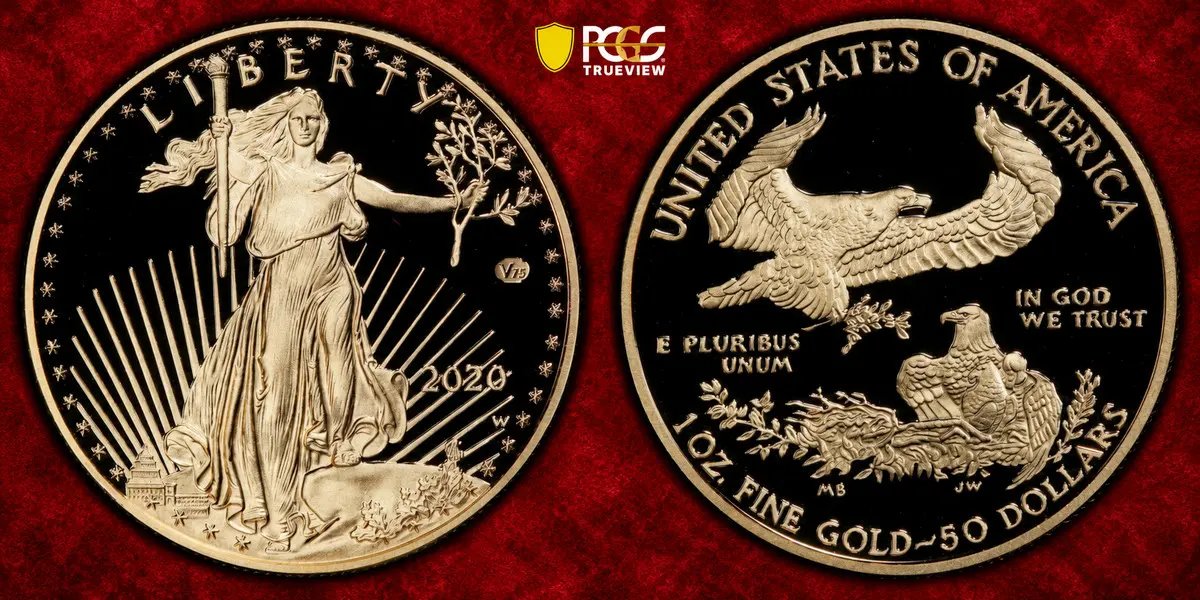
On November 5, 2020, at noon Eastern, the U.S. Mint put a coin on sale that would rewrite the modern collecting playbook: the 2020-W V75 Proof American Gold Eagle.
The mintage? Just 1,945 coins — a deliberate nod to 1945, the year World War II ended. It remains the lowest mintage ever established for a U.S. Mint numismatic release. No other American Gold Eagle comes anywhere close.
Collectors flooded the Mint's website the moment sales opened. Record traffic overwhelmed the servers, throwing error messages at thousands of would-be buyers. Seven minutes later, it was gone. A $2,600 Mint product became one of the hottest modern coins in America — instantly.
What makes it special beyond the mintage:
🪙 The V75 privy mark on the obverse isn't just a stamp — its shape is based on the Rainbow Pool, the reflecting pool at the heart of the National World War II Memorial in Washington, D.C. A privy mark on a U.S. coin is itself a rarity.
🦅 It carries Augustus Saint-Gaudens' Liberty — arguably the greatest design in American coinage — paired with the original heraldic family-of-eagles reverse in its final era. The Mint overhauled the Gold Eagle reverse in mid-2021, making this a closing chapter, not just a low mintage.
💰 Issue price: $2,600. Secondary market prices exploded almost immediately, with PF70/PR70 examples commanding multiples of issue. Perfect-grade certified coins became the modern trophy.
The lesson for collectors: Rarity + symbolism + iconic design + historical timing = a coin that becomes a key date the day it's born. Most modern issues take decades to earn "key" status. This one earned it in seven minutes.
The 1,945 people who got through that day didn't just buy a coin. They bought the modern era's answer to the classic rarities.
🪙 A $1 coin just sold for $1,181,250. Here's why.
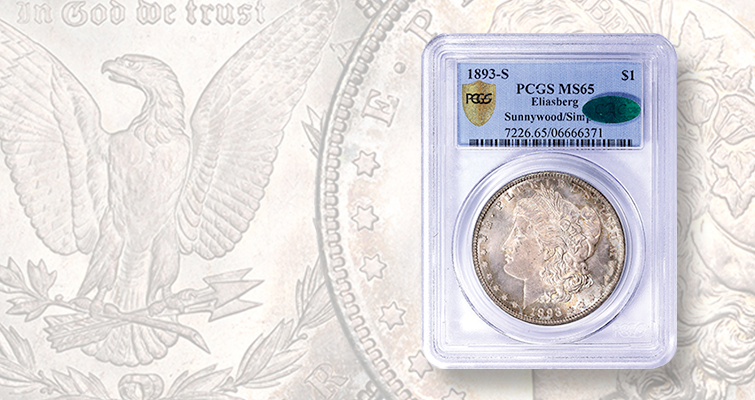
On August 9, GreatCollections hammered down one of the most famous coins in American numismatics: the Clapp–Eliasberg 1893-S Morgan Silver Dollar, graded PCGS MS65 with a CAC green sticker — $1,181,250, a new auction record for the date at that grade, and roughly 52% above the $775,000 PCGS Price Guide value.
Why the frenzy? The 1893-S is the "King of the Morgan Dollars." The San Francisco Mint struck just 100,000 for circulation — the lowest business-strike mintage of the entire 1878–1921 series. Nearly all of them went straight into commerce during the Panic of 1893, and many survivors were later melted under the 1918 Pittman Act. Fewer than 125 are believed to survive in any Mint State grade, and true Gems number only a handful.
Then there's the pedigree — arguably the best in the series. The chain of ownership has never been broken since the coin left the Mint: Philadelphia dealer J. Colvin Randall acquired it in 1893, J.M. Clapp in 1894, and the Clapp cabinet passed intact to Louis E. Eliasberg Sr. in 1942 — the only collector ever to complete a full set of U.S. coins. After the 1997 Eliasberg sale it moved through the Stellar, Sunnywood, and Bob Simpson collections, before spending a decade overseas as the centerpiece of a world-class Morgan set.
Last time it crossed the block, in October 2014, it brought $646,250 — itself a record for the date at the time. That's an 83% appreciation in a dozen years.
The listing drew over 14,000 page views and 430 bidders tracking the lot, and the winning bidder — from the Midwest — collected the coin at the ANA World's Fair of Money in Pittsburgh.
Specialists rank this coin second finest known, behind only the Vermeule PCGS MS-67 CAC, which sold for $2,086,875 in 2021.
131 years old. One dollar face value. Seven figures. Provenance is everything. 👑
🇺🇸 NEVER FORGET — The U.S. Mint Just Put 9/11 on America's Pocket Change
Twenty-five years after September 11, 2001, remembrance is being struck in metal.
The Treasury announced the special-issue 2026 Semiquincentennial Enduring Liberty Half Dollar one day before the 25th anniversary of the attacks — a coin bearing a privy mark with the date "9-11-01" encircled by the words NEVER FORGET. It honors the lives lost in both the September 11, 2001 attacks and the February 26, 1993 World Trade Center bombing.
And this isn't just any half dollar. The Enduring Liberty design is the first U.S. half dollar since 1964 without JFK's portrait — the obverse shows the Statue of Liberty gazing toward the future, while the reverse depicts Liberty passing her torch to a new generation, with the dual date 1776 ~ 2026 marking America's 250th birthday.
The story began quietly in August: the Mint presented 2,983 special West Point-struck coins — bearing an "ALWAYS REMEMBER" privy mark — to the National 9/11 Memorial & Museum. That mintage matches the 2,983 names inscribed on the Memorial itself.
One coin for every name. Let that sink in.
Now the public gets its turn. 🪙
📅 THE DETAILS:
Philadelphia-struck circulating-quality coins are offered in 20-coin rolls and 100-coin bags. Pre-orders opened September 10 and close September 25 at 3 p.m. ET, with shipping expected to begin December 3. Prices range from $40 to $100 depending on the product.
Demand is likely to be fierce — the non-privy Enduring Liberty two-roll sets sold 99.7% of their 100,000 limit, and this version carries far more emotional weight.
Treasury Secretary Scott Bessent called the coins symbols of the honor and bravery of victims, survivors, and first responders, while Mint Director Paul Hollis emphasized their role in teaching younger generations about events that happened before many of them were born.
That's the real purpose here. An entire generation of Americans has no living memory of that Tuesday morning. Soon, some of them will find this coin in their change — and ask what it means.
A half dollar that carries history forward, one hand to the next. Just like the torch on its reverse.
The Million-Dollar Eisenhower Dollar Found in a Department Store Cash Register 🧵💰
Somewhere in Washington, D.C., in early 1977, a cashier at the Woodward & Lothrop department store counted out a drawer full of change. Sitting in it was a big, heavy Eisenhower dollar — the kind of coin people spent without a second thought.
Except this one should not exist.
That coin is the unique 1976 Type 2 "No S" Silver Proof Eisenhower Dollar — and today, experts value it at $1 million or more.
Why this coin is impossible
The Bicentennial Ike dollar was one of the most mass-produced commemorative designs in American history — well over 200 million struck. Common as dirt. So how is one of them worth seven figures?
Because this single coin combines four attributes that were never supposed to appear together:
🔹 Proof surfaces — the mirror-like finish reserved for collector coins 🔹 40% silver — the special collector composition, not the everyday copper-nickel 🔹 The Type 2 reverse — the refined Bicentennial design with slimmer, serifed lettering 🔹 No "S" mintmark — every silver proof Ike was struck at San Francisco and should carry the "S"
All silver proof Bicentennial dollars were Type 1. All Type 2 proofs were clad and bore the S. This coin breaks both rules at once.
Only one example has ever surfaced. In nearly 50 years, no second specimen has appeared.
The mystery of its origin
Nobody can fully explain why the U.S. Mint made it.
The leading theories:
1️⃣ It was struck as an experimental or trial piece, perhaps under Chief Engraver Frank Gasparro. 2️⃣ It was a presentation piece for a government or White House official — who then accidentally spent it, sending a priceless rarity into a cash register in the nation's capital. 3️⃣ A Mint record explaining it exists somewhere, still undiscovered.
Worth noting: some numismatists, including researchers at the grading services, have expressed healthy skepticism about the cash-register discovery story itself — it's the account that has traveled with the coin since 1977, but it has never been independently documented. That only deepens the legend.
The paper trail
The coin passed through Devonshire Rare Coins after its 1977 discovery, was certified in the mid-1990s, and is now owned by Mitchell Spivack of Wondercoins. PCGS long ago valued it at $850,000; given what the two known 1975 "No S" proof dimes have brought at auction, specialists now call it a "strong seven-figure" coin.
Error dealer Mike Byers says he gets messages daily from people worldwide convinced they've found the second one. So far, every single one has turned out to be an ordinary Philadelphia business strike — one of the millions.
Why it matters
America's great rarities usually emerge from estates, bank vaults, or old aristocratic collections. This one came from a department store till — face value, one dollar.
The coin made for America's 200th birthday hits its own 50-year milestone as the nation celebrates its 250th. And the poetry writes itself: from one of the most common coin designs ever made came a coin that stands utterly alone.
So yes — check your change. The odds are essentially zero. But once, in 1977, they weren't.
🍁 The Royal Canadian Mint just did something it's never done before.
For 2026, the RCM is bringing a brand-new color technology to its Ultra High Relief Maple Leaf line: the "Vivid Toning Effect," a first for the mint, debuting on both a gold and a silver coin.
The idea? Capture autumn in Canada. Fall foliage isn't one flat color — a single maple leaf carries a whole spectrum of hues. The new finish translates that into intense, realistic color with a foil-like appearance that seems to glow against the coin's surface.
The lineup:
🥇 2026 Reverse Proof UHR Maple Leaf, 1 oz .9999 fine gold, $200 face value — obverse pairs Rosati's King Charles III effigy with the new background design carried over from the reverse.
🥈 2026 Reverse Proof UHR Maple Leaf, 1 oz .9999 fine silver, $20 face value — struck with a peak relief height of 1.4 mm, taller than the standard silver Maple Leaf.
And these won't be sitting around: mintages are capped at just 550 for the gold and 11,000 for the silver.
Sculpted relief + foil-bright autumn color = a Maple Leaf unlike any the RCM has struck before. If modern Canadian issues are your lane, this one's worth watching. 🇨🇦
Full story by Jake Utz at Coin World: https://t.co/7LUL7w5zBW
The Coin Roosevelt Demanded Is Back — And the U.S. Mint Saved It for Last 🦅
In 1905, Theodore Roosevelt looked at American pocket change and saw an embarrassment. He saw a national canvas — and he turned to sculptor Augustus Saint-Gaudens to fill it, wanting American coins to reflect the nation's growing stature.
What Saint-Gaudens delivered was unlike anything the Mint had ever attempted. Liberty didn't sit quietly on the obverse — she surged forward. The eagle didn't rest on a shield — it flew into a rising sun. The relief pushed the limits of early 20th-century coinage technology, and the artistic ambition pushed even further.
Too far, in fact. Early trial dies gave such high relief that regular coining presses couldn't produce a satisfactory coin — a medal press was required, needing roughly a dozen blows per piece. The Philadelphia Mint managed only a limited run of High Relief double eagles before Chief Engraver Charles Barber flattened the design for high-speed production. Saint-Gaudens never saw the circulating version — cancer took his life in August 1907.
The experiment ended. The legend didn't. Today it's widely called the most beautiful coin America ever struck, and high relief survivors trade for serious money — roughly $16,000 on the low end up to a quarter-million for a superb gem, with one MS69 example selling for a sum approaching a million dollars.
Now, 119 years later, it returns.
For America's 250th anniversary, the U.S. Mint is closing out its collector-voted Best of the Mint series with its biggest statement: a reissue of the 1907 Saint-Gaudens High Relief $20, struck in one ounce of 99.99% fine gold with the high relief detail Saint-Gaudens originally intended. It's paired with a one-ounce 99.9% fine silver companion medal reinterpreting the design — the fifth and final installment in the program, following the Mercury dime, Standing Liberty quarter, Walking Liberty half, and 1804 dollar.
📅 Mark your calendar: the set goes on sale September 24, 2026, at 12 noon ET, with a household order limit of 1.
Roosevelt demanded a coin worthy of the nation. The Mint finally has the technology to strike it the way Saint-Gaudens dreamed it. Don't sleep on this one.
America's "Euro Before the Euro" Just Sold for $2.56 Million 🪙
In 1879, decades before anyone dreamed up the euro, the U.S. Mint quietly experimented with a universal currency of its own.
The idea: a gold coin whose metal content aligned with European currencies, so American money could move seamlessly through international trade. The result was the "Stella" — named for the star on its reverse — a $4 pattern coin that never entered circulation.
But the $4 Stella has a bigger, far rarer sibling almost nobody talks about: the 1879 $20 Quintuple Stella.
Only five were ever struck.
One sits in the Smithsonian. The other four are in private hands. And this week, the finest-certified example of them all — graded PCGS PR64+ Deep Cameo — crossed the auction block at Heritage Auctions' 2026 ANA U.S. Coins Signature Auction after 18 years off the market.
Final price: $2,562,000.
The pedigree on this coin reads like a hall of fame of American numismatics: Virgil Brand → Fred Olsen → Dr. John E. Wilkison → the Southern Collection → Bob R. Simpson. Every name a titan of collecting.
Why does this coin matter beyond the price tag?
Because it's a physical artifact of a road not taken. The Quintuple Stella represents a moment when the United States seriously considered harmonizing its gold coinage with the world's — a "metric" $20 gold piece designed for a globalized economy that wouldn't fully arrive for another century.
Congress passed on the idea. The Stellas became patterns, curiosities, legends.
And now one of just five Quintuple Stellas in existence has a new home — and a new chapter in a story that started 147 years ago.
Sometimes the most valuable coins aren't the ones that made history.
They're the ones that almost did. 🇺🇸
One Day. One Die Pair. 8,000 Dimes.
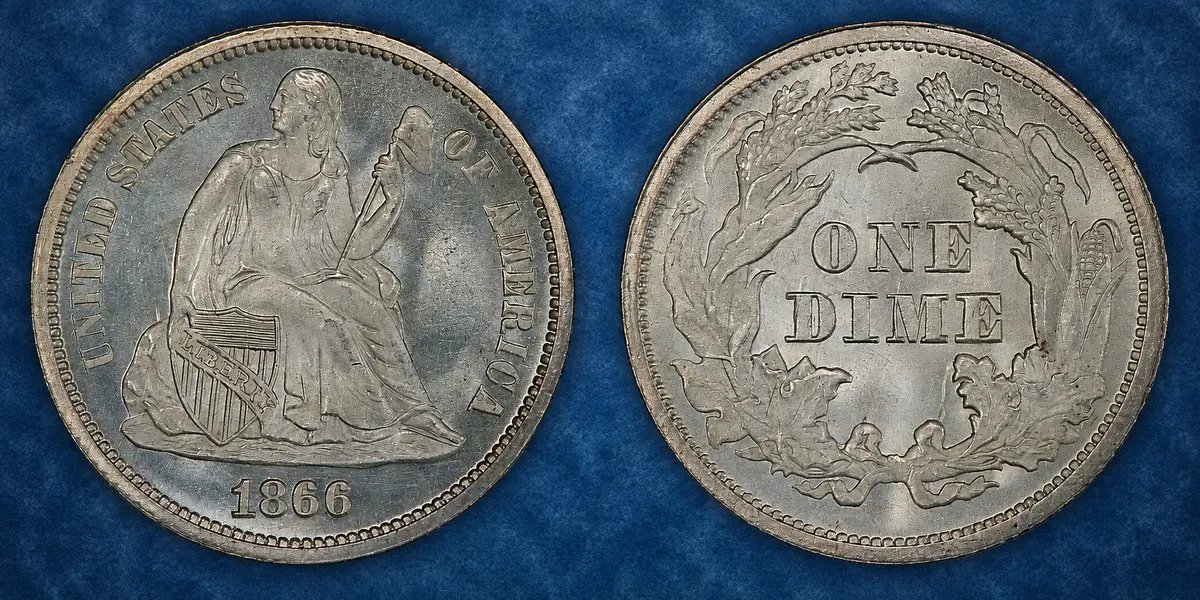
On January 31, 1866, the Philadelphia Mint did something almost unheard of: it struck an entire year's business-strike dime production in a single day. 🪙
8,000 coins. That's it. When the presses stopped that January afternoon, no more circulation dimes would bear the 1866 Philadelphia date—ever.
Why so few?
Context is everything. The Civil War had ended just months earlier. Lincoln was gone. The nation was staggering into Reconstruction, and silver coinage had largely vanished from daily commerce in the East—hoarded during the war and replaced by fractional paper currency. The Mint's real energy in 1866 went into base-metal coinage: the new nickel three-cent and five-cent pieces that everyday Americans actually used.
Silver dimes? An afterthought. The half dollar was the only Philadelphia silver denomination struck in real quantity that year (roughly 745,000). The dime got a token run—plus about 725 Proofs for the small collector community of the day.
Why collectors chase it now
That 8,000-coin mintage makes the 1866 one of the great key dates of the entire Liberty Seated dime series (1837–1891). A few things elevate it further:
🔹 It sits in the middle of a run of starvation-level mintages from 1863 to 1867—all tough, with 1867 arguably the hardest.
🔹 High-grade survivors are genuinely rare. Combined NGC/PCGS grading events number only in the dozens, clustered around MS63–64.
🔹 The condition census includes some spectacularly toned pieces, including a coin from the Millholland Collection that resurfaced in 2023 after more than a century off the market.
⚠️ Buyer beware
Here's the trap: the 1866-S dime (San Francisco) is far more common—and some examples have weak or worn-away mintmarks. Unscrupulous or simply mistaken sellers pass these off as the rare Philadelphia issue. Authentication matters. Die diagnostics matter. Buy certified.
The takeaway
Most rarities are rare because of accidents—melts, fires, hoards lost to time. The 1866 dime is rare by design: a nation too broke, too battered, and too paper-driven to need silver dimes. One day's work at the press, 160 years ago, and every survivor is a small piece of Reconstruction America you can hold in your hand.
💵 America Has Never Issued a True Commemorative Bank Note. Why?
Commemorative coins are nearly as old as coinage itself. Commemorative paper money? That took a lot longer — and the U.S. still hasn't joined the party.
A quick history lesson: 📜 China pioneered bank notes back in the Song Dynasty (10th–11th century) 🇸🇪 Europe didn't catch up until 1661, when Sweden printed the first European notes 🏴 And the first commemorative notes? Scotland, 1822 — when the privately held Leith Bank marked King George IV's royal visit to Edinburgh with special £1, guinea, and £5 notes
That's a 200+ year tradition the United States has never truly embraced.
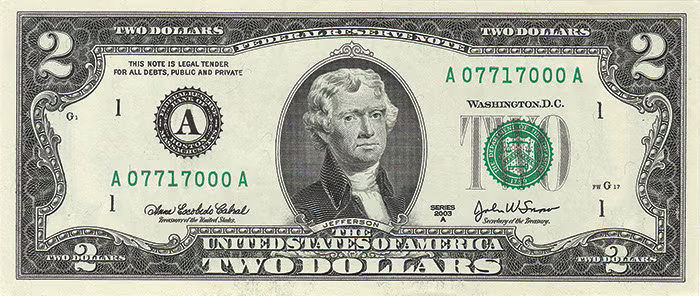
"But what about the Bicentennial $2 bill?" Fair question. The Series 1976 $2 note feels commemorative to many Americans — but it never went away. It's about as "commemorative" as the Washington quarter, which was originally planned as a one-off in 1932 and is still jingling in pockets 94 years later.
A genuine commemorative note should be issued for a limited time. Plenty of other nations have done exactly that — some even in denominations that never circulate normally.
So here's the big idea: 💡 Why can't the U.S. issue non-circulating legal tender (NCLT) bank notes?
They wouldn't need to be standard denominations. They'd almost certainly be profitable to print — likely more profitable than commemorative coins, some of which barely make money for the Treasury despite all the effort poured into them.
We put enormous energy into commemorative coinage. With America's 250th right here in 2026... why not notes? 🇺🇸
What denomination would YOU want on a U.S. commemorative note? Drop it below. 👇
🪙 Big news for coin collectors: eBay just brought its Authenticity Guarantee to collectible coins.
Starting August 18, eligible U.S. and world coins priced at $500+ are professionally authenticated by PCGS — at zero additional cost to buyers or sellers.
Here's why this matters 👇
The counterfeit problem is real. Fake coins and even counterfeit grading slabs have plagued the online numismatic market for years, especially at higher price points. Buying a rare coin sight-unseen has always required a leap of faith.
Now the process looks like this:1️⃣ You buy an eligible coin (look for the blue Authenticity Guarantee badge) 2️⃣ The seller ships it to PCGS, where experts run a multi-point physical inspection against an extensive reference database 3️⃣ The coin gets an e-tag — a tamper-proof seal with a unique QR code you can scan to view its authentication record 4️⃣ It's securely packaged and shipped to your door
Returns are verified too — the exact coin sold goes back through the authentication center before reaching the seller. No swap scams.
The timing isn't random. Coin collecting is booming: eBay says searches for collectible coins jumped 30%+ year over year, historic coin listings are up 40%+, and PCGS reports double-digit growth in collector submissions in 2026.
This also deepens eBay's partnership with Collectors (parent of PCGS and PSA) — the same playbook that transformed trading cards, sneakers, watches, and handbags on the platform.
Worth noting: eligibility covers U.S. coins (raw and graded) and graded world coins, with slabs accepted from PCGS, NGC, ANACS, CACG, and ICG. Bullion is not included.
Trust has always been the biggest friction point in online collecting. This removes a huge chunk of it.
Discovering the Smithsonian's National Numismatic Collection 🪙
Hidden within the National Museum of American History is one of the greatest treasure troves on Earth — the Smithsonian's National Numismatic Collection, home to 1.6 million artifacts spanning thousands of years of human history.
This isn't just a coin collection. It's the story of civilization told through money.
Among its holdings are some of the rarest objects in the numismatic world: the legendary 1933 Double Eagle, a $20 gold coin so rare that owning one was once illegal. The 1804 silver dollar, known as the "King of American Coins." Colonial currency signed by hand, Depression-era scrip, and gold from the California rush that transformed a nation.
But the collection reaches far beyond America's borders. Ancient Greek drachms, Roman denarii, Chinese knife money, and medieval trade coins reveal how commerce connected empires long before globalization was a word.
Every coin tells a story — of kings and revolutions, of economic collapse and recovery, of art pressed into metal small enough to fit in your palm.
What makes this collection extraordinary isn't just rarity or value. It's that money is one of the few objects nearly every human being has touched. These artifacts passed through countless hands — merchants, soldiers, farmers, immigrants — each transaction a small thread in the fabric of history.
Next time you're in Washington, D.C., look for "The Value of Money" exhibition. You'll walk out seeing the change in your pocket a little differently. 💵