go-livepeer gets its last security patches on Nov 30. after that it's archived.
Orchestrators: update to v0.10.0 now, keep your main wallet offline and call rewards from a low-privilege delegate (LIP-118). remote transcoders now need an orchestrator secret.
Builders: v0.10.0 removes BYOC, the batch pipelines and the standalone AI worker, and their routes return 410 Gone. what replaces go-livepeer is the new node stack from the Network Engineering SPE.
release notes: https://t.co/sFPwlKujAz
docker: https://t.co/meWdwjlCc1
wallet guide: https://t.co/5T6XTESfup
new node stack: https://t.co/sAizMtiqkb
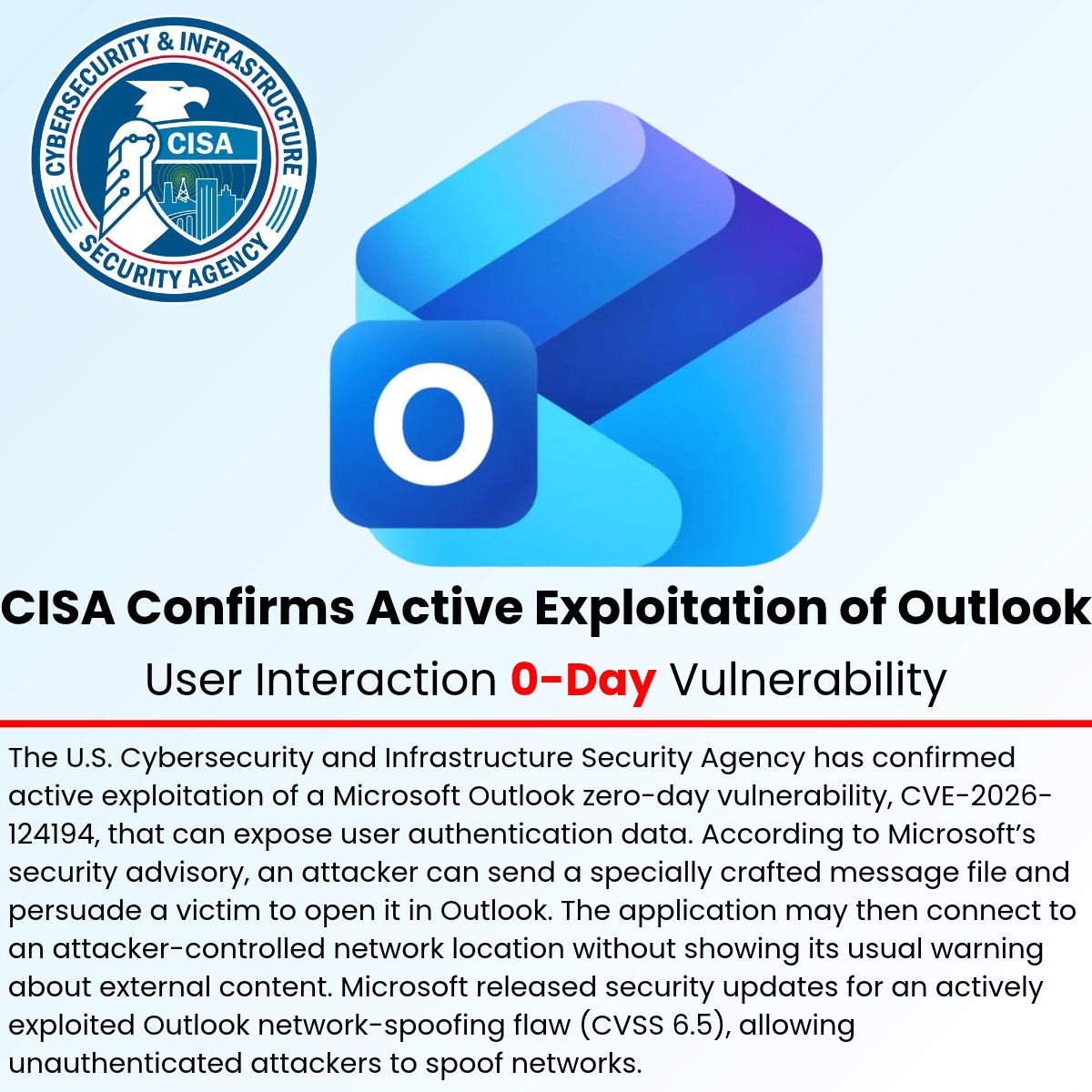
‼️ CISA Confirms Active Exploitation of Outlook User Interaction 0-Day Vulnerability
Details: https://t.co/9hqn7XHeqI
The U.S. Cybersecurity and Infrastructure Security Agency has confirmed active exploitation of a Microsoft Outlook zero-day vulnerability, CVE-2026-124194, that can expose user authentication data.
According to Microsoft’s security advisory, an attacker can send a specially crafted message file and persuade a victim to open it in Outlook.
The application may then connect to an attacker-controlled network location without showing its usual warning about external content. Microsoft released security updates for an actively exploited Outlook network-spoofing flaw (CVSS 6.5) that allows unauthenticated attackers to spoof networks.
#CybersecurityNews
Interesting.
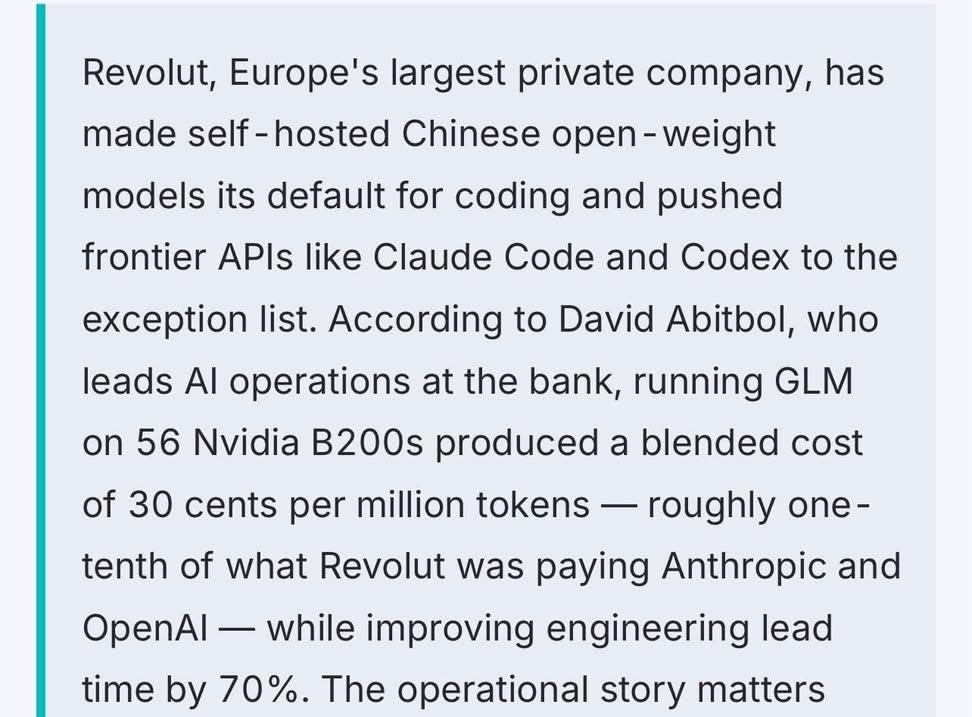
Revolut reportedly only started seeing meaningful AI productivity gains after moving away from expensive OpenAI and Anthropic models to self-hosted GLM.
Decagon reportedly runs ~90% of its workloads on open weight models.
Why? Because when you're running AI agents in production for e.g. customer service, cost and latency matter enormously. You don't need a frontier model with PhD-level reasoning or even a model that knows the capital of Finland to handle every customer interaction.
We're seeing similar dynamics across hypergrowth AI startups and increasingly the large enterprises we work with.
But most importantly, the future isn't binary.
When use cases are new, you want the smartest general-purpose model available. But once workflows mature and become predictable, smaller, faster, specialized models increasingly win.
I wouldn't be surprised if 80–90% of routine enterprise AI workflows eventually run on open-weight and smaller models.
This doesn't mean frontier labs lose.
It means the market is splitting into two massive opportunities: frontier intelligence and specialized execution at scale.
the reason no one showed up for Devconnect Argentina in 2025 and barely anyone will go to Devcon Mumbai is simple:
these places don’t have users that really matter for the bottom line
we lived in a beautifully playful era up until 2021 where travelling around the world funded by VCs was okayish ROI
2026 is entirely different. a very small number of projects succeed now, let alone alts that go up. there isnt enough ROI in gallivanting around the globe to meet users who barely make a dent in revenues
the userbase that matters is on CT, in Korea, Japan, HK, US. these places have a lot of rich people who generate fat fees for dapps
teams that roam around the world to random locations are just burning VC money and aren’t focussed enough on user acquisition
Not many want to talk about this, but once you become conscious, life stops being fun and turns into a prison
Try listening to music
The lyrics are manipulation.
Try watching a movie.
Everything is propaganda.
Your brain instantly spots the hidden agenda of whoever paid for the story.
Try going out to an event and everyone around you is laughing at things that aren’t funny.
It’s like everyone is running the same programming.
It’s a performance of insecurity held together by dopamine and ignorant confidence.
Consciousness does not set you free.
It isolates you.
It disconnects you from the clown world everyone else is still pretending is normal.
Anime to live action, made on Livepeer.
@harendrashakya_ shows how MangaFable turns a story into manga, animation and live-action shots, built with the Livepeer Agent MCP and backed by an early SPE micro-grant from @GeoDeFine.
I overheard an argument between a vibe coder and a software engineer.
The vibe coder said, “Name one software I can’t build with AI in a day.”
The engineer replied, “Instagram or TikTok.”
“Easy. Give me 6 hours.”
The engineer then asked, “If it’s that easy, why do these companies still employ thousands of engineers to build and maintain their platforms when they can afford all the AI tokens in the world?”
The guy went silent.
Then the engineer said something interesting:
“It’s not just about building it. It’s about how it’s built.”
You can vibe code something that looks and works like Instagram in a few hours, but can it handle millions of users, protect their data, scale efficiently, and keep running without falling apart?
Software engineering was never just about writing code. It’s about understanding how to design, build, scale, and maintain systems.
AI has made writing code easier, not engineering software effortless.
Funny how we’ve gone from developers struggling with impostor syndrome to people thinking they can build absolutely anything because they know how to prompt AI.
‼️ BREAKING: Go has issued an URGENT security update blocking 8 certificate authority keys over undisclosed security concerns.
It will reject certificate chains using these keys, potentially breaking connections for rebuilt applications.
The filter cannot be disabled.
Here's what we know: https://t.co/X0uIVXrlp1
‼️ Linux Kernel Flaw Lets Attackers Escape Virtual Machines and Take Control of Hosts
Details: https://t.co/znWU0Rtebz
A critical flaw in the Linux kernel may allow an attacker-controlled virtual machine (VM) to breach its isolation boundary and impact the host system. Paulos Yibelo demonstrated a technique that exposes host memory and, in their lab, progressed to host-level code execution.
The flaw is serious for cloud providers and organizations that run untrusted workloads in virtual machines. VM isolation is meant to stop code inside one guest from reaching the host and other workloads.
PwnEscape shows how a weakness in a host’s packet-processing path can threaten that boundary, even when the underlying issue is not in the hypervisor itself.
#cybersecuritynews
OpenCode Security Breach Exposes Third-Party API Keys of its Console Users
Details: https://t.co/Mqt844YOUs
OpenCode has disclosed a security breach affecting 1.4% of its Console users, warning that third-party API keys saved in affected workspaces may have been exposed.
In an October 17 statement, the company linked the incident to a large-scale distillation attack and said it was working with Anthropic, OpenAI, and Google to address it. The affected group was limited to some Console users who had linked external providers.
OpenCode said it had emailed everyone affected that morning and stated that users who did not receive an email were not impacted. The percentage refers to Console users, not the entire OpenCode user base.
#cybersecuritynews
Microsoft Says AI Agents Cannot Be Trusted and Could Become Insider Security Threats
Details: https://t.co/prF2S7mYnw
Microsoft warns organizations to treat AI agents as potential insider risks not because they are automatically malicious, but because they can access company data, apps, and tools and act on that access at high speed.
The warning, published on October 19, 2026, comes as businesses use agents to handle tasks such as writing code, reviewing documents, and processing expenses.
An agent’s actions can change as its instructions, data, or working context change. It may make a mistake, follow harmful directions hidden in a document, or be compromised.
#cybersecuritynews
If you learn Forward Deployed Engineering, you will never be unemployed again.
I’d do this.
Stage 1: Enterprise Identity & Access (The Gatekeeper)
- Learn: OAuth2, SAML, OIDC, SCIM provisioning, Row-Level Security (RLS) and multi-tenant data isolation.
- Practice: Build an auth bridge connecting your AI app to a simulated customer's Okta/Azure AD, ensuring User A can only query data their specific RBAC role permits.
- Why: No SSO and strict data isolation means no enterprise contract. Security review is the first gate.
Stage 2: Air-Gapped & VPC Deployments (The Environment)
- Learn: Kubernetes (K8s), Helm, Terraform, private container registries, air-gapped networking and egress filtering.
- Practice: Script a one-click Terraform/Helm deployment of your entire AI stack into a simulated customer VPC with zero egress to the public internet.
- Why: Banks, hospitals and governments don't let your AI talk to the public cloud. You must deploy in their basement.
Stage 3: Legacy Data Extraction & ETL (The Fuel)
- Learn: OCR, unstructured PDF parsing, mainframe DB connectors, Apache Airflow, dbt and data reconciliation.
- Practice: Build a pipeline that ingests 10 years of messy, scanned customer invoices and turns them into a clean, queryable hybrid (vector + relational) store.
- Why: Enterprise AI starves without clean data. The customer's data will always be a mess.
Stage 4: Secure RAG & Permission-Filtered Retrieval (The Brain)
- Learn: Hybrid search, document-level access control, citation grounding, metadata tagging and abstention logic.
- Practice: Build a RAG pipeline where the LLM dynamically filters out retrieved chunks that the specific user asking the question doesn't have clearance to see.
- Why: An AI that leaks HR salaries or M&A docs to a junior employee is an immediate breach of contract.
Stage 5: MCP & Legacy System Integration (The Hands)
- Learn: Model Context Protocol (MCP), SOAP/REST translation, web scraping, headless browsers and API rate-limit handling.
- Practice: Build an MCP server that lets an LLM safely query and write to the customer's 15-year-old on-prem SAP or Oracle instance without exposing raw credentials.
- Why: Agents are useless if they can't touch the customer's actual systems of record.
Stage 6: AI Guardrails & PII Redaction (The Shield)
- Learn: NER (Named Entity Recognition), deterministic regex filtering, LLM output validation, UUID masking, and audit logging.
- Practice: Build a middleware proxy that intercepts LLM inputs/outputs, masks SSNs and credit cards with UUIDs before they hit the model, and restores them post-generation.
- Why: Compliance teams will kill the deal if a single PII token hits an external frontier API.
Stage 7: Human-in-the-Loop (HITL) Workflows (The Trust)
- Learn: Temporal {dot} io, webhook routing, state machines, durable execution and UI approval gates.
- Practice: Build a workflow where the AI drafts a $50k purchase order, but physically pauses execution until a human manager clicks "Approve" in Slack or Teams.
- Why: Enterprises adopt AI only when humans remain legally accountable for the final action.
Stage 8: Edge & On-Prem Inference (The Silicon)
- Learn: vLLM, TensorRT-LLM, Ollama, GPU partitioning (MIG), and local quantized models (AWQ/GGUF).
- Practice: Deploy a quantized 8B model on a single customer-owned GPU node to handle highly sensitive triage locally without network latency.
- Why: Sometimes the data is too hot to move. You must bring the model to the data.
Stage 9: Observability & Customer Health (The Pulse)
- Learn: OpenTelemetry, Langfuse, custom Grafana dashboards, usage telemetry and cost-attribution.
- Practice: Build a "Customer Health" dashboard showing the exact cost-savings, time-saved and token-spend the AI has generated for their specific team this month.
- Why: If the customer doesn't see the ROI quantified, they will churn at renewal.
Stage 10: Evals on Customer Data (The Proof)
- Learn: Golden dataset creation, trajectory grading, shadow testing, and LLM-as-a-judge calibration.
- Practice: Take 100 real past customer support tickets, run them through your agent in shadow mode, and prove to the VP of Support that it resolved 80% accurately.
- Why: Generic benchmarks mean nothing to a buyer. You must prove the AI works on *their* messy data.
Stage 11: Technical Discovery & Scoping (The Translation)
- Learn: Stakeholder interviewing, architecture diagramming, SOW (Statement of Work) writing and expectation management.
- Practice: Translate a vague "we want AI for supply chain" executive request into a scoped, 4-week technical deployment plan with defined, measurable success metrics.
- Why: FDEs are the translators between revenue (Sales) and reality (Engineering).
Stage 12: The Handoff & Self-Serve Admin (The Scale)
- Learn: Technical writing, runbooks, admin portals, automated onboarding and chaos testing.
- Practice: Write a deployment runbook and build an admin UI so the customer's internal IT team can manage the AI stack, update prompts and view logs without calling you.
- Why: Your leverage is measured by how little the customer needs you for day-to-day operations.
AI labs build the engine. FDEs build the roads.
The modern Forward Deployed Engineer builds the secure, durable nervous system that connects frontier intelligence to legacy reality.
Bookmark and Repost!
More SF observations:
1. Seeing the word "inference" on billboards in SF still blows my mind. 99.9% of america has no idea what inference is and I wonder how many know what an agent is. Will Muse, Instinct, Dots etc will change that over the next 12 months?
2. You know who doesn't get enough credit? Manus. In March 2025 they shipped the blueprint for AI agents: every task gets its own computer in the cloud, you can watch it work, it writes a todo list and checks it off, and you walk away while it finishes. So much of what we use today runs on those ideas!
3. Your product now has to sell itself twice. First the agent has to pick it, then the human has to trust that pick enough to say yes.
4. I was talking to a guy who told me we should just destroy all the data centers. I think that sentiment is more common than people in SF realize. You can already see some of the big AI companies adjusting positioning their AI as something that helps people and gives them more time/cures for cancers etc.
5. AI is making people work 5x faster (at least), so for freelancers/agencies that charge per hour you're earning 5x less per unit of work. But your rate is the same? I think a lot of freelancers and agencies are about to have to rethink how they price.
6. Running a company now feels kinda dystopian sometimes, especially with a small team of a few humans and a lot of agents. Some days the Slack channel is mostly bots reporting to each other, and you're the only one in the room with a pulse.
7. Every product company is turning into a product studio. I see it firsthand as a co-founder of @meetLCA , which is basically a Labs as a Service company incubating new products for companies. (DM me if you want to work together in 2027).
8. Personal software is exploding. People at every company are building their own little tools for their own jobs. It's amazing for productivity and a nightmare for IT, because nobody knows what's running or who owns it.
9. Revenue per human is the new flex. Founders used to brag about headcount. Now they brag about how much they're doing with how few people.
11. More founders are using agents for customer research. Agents run the interviews, read every support ticket and summarize what people are begging for. Synthetic market research is the new thing.
12. Shipping technology that actually takes 3-6 months with unique partnerships that are hard to replicate. So, partnerships are sooo back!
13. Insane amount of young people (22 or younger) making absurds amounts of money. At least it feels that way. Never seen anything like that, even during mobile era.
14. Only 2% of the US is paying for AI products, but it feels like 110% SF is.
15. Advice for college grads used to be “follow your passion” and now it’s follow careers that are not document- driven, rules-bound and verifiable
16. Seeing the word inference on billboards in SF still blows my mind.
17. Agents paying for things feels futuristic. I think its coming, only a matter of time, but I’m wondering when it becomes mainstream. 2027?
18. Lots of talk about proactive agents being the next phase of personal agents. Right now you ask your agent to do something. In 2027, it’s all going to be about noticing things (context/memory) and acting first. "Your flight got delayed, I already rebooked you."
19. The quote "what the smartest people do on the weekend is what everyone else will do during the week in 10 years." by Chris Dixon. It feels like that length of time isnt 10 years anymore, its 12 months.
20. This is the most asymmetric window I've ever seen in business.
My DMs are open. Respond to the most interesting ones.
Loved my trip to SF. Until next time. Maybe NYC next?
Thank you for everything.
I'm rooting for you.