@housecor Exactly. And therefore we could also say that types are a positive influence in the achievement of the holly grail of software engineering: design apps capable to cope with change.
@baeldung Depends. For example, it is good to abstract away adapter logic in hexagonal architectures, specially at the beginning of new projects, when choosing the right tech (e.g., DB solution) is hard
@davefarley77 Delivery speed always over quality (literally). I even had to hear “doesn’t matter if we are releasing spaghetti code, we’re gonna have to throw it away anyways”. That piece of code caused headaches during months.
Hi @nestframework engineers! Are you in the need of a lightweight and type-safe custom #Mongodb repository without having to write all CRUD operations yourselves? The following article explains how to do it 🔥
https://t.co/8vIG26OXF9
Thanks #DEVCommunity for hosting!
Code #quality is about complying with the #solid principles and applying the right design #patterns at the right time. Ultimately, it’s about writing code that copes with change.
The North Star Metric is an extremely simple, powerful concept.
But it's largely misunderstood.
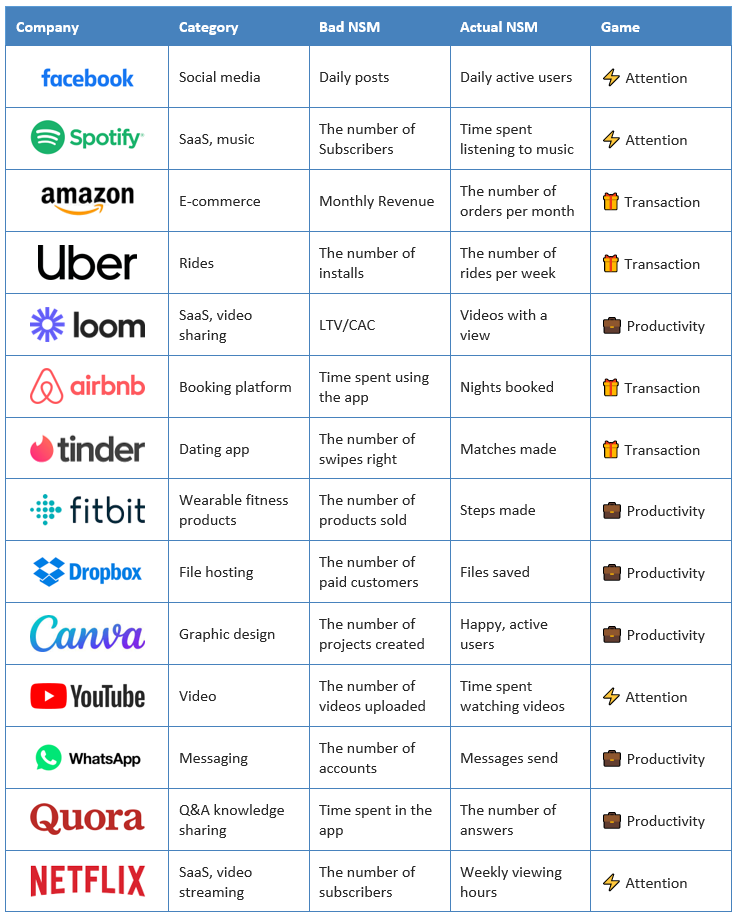
In this tweet, I explain:
1. What is a North Star Metric?
2. Common misconceptions
3. Recommended classification
Let's tackle them one by one:
1. What is a North Star Metric?
The term has been popularized by @SeanEllis, also known for coining "growth hacking" while being a growth marketer at Dropbox.
In the Growth Hacking world, North Star Metric:
- Is a single metric. The goal is to create focus.
- Is easy to understand, enabling everyone to speak the same language.
- Is customer-centric. Reflects how customers get value from the product.
- Ideally ensures the value is sustainable, typically by forming habits.
- Represents your progress toward vision/mission, fostering alignment and inspiring teams to move in the same direction.
- Is quantitative. It relies on numbers, not opinions.
- Is actionable. You will take action based on how it changes. Otherwise, what's the point of tracking it?
- Serves as a leading indicator of your long-term business success.
2. Common misconceptions
It's important to clarify what the North Star Metric is not:
- A few metrics. While a company may select a few key metrics, referring to them as "North Star Metrics" is a misunderstanding. Have you ever seen multiple North Stars in the sky?
- A metric focused on business value, like LTV/CAC. This overlooks the essential aspect of being customer-centric. Besides, can your team truly get excited about solely growing revenue?
- An Objective Key Result - OKR is a goal-setting technique. You can use OKR to express an expected mid-term change in the Nort Star Metric. But it is important not to confuse these terms.
- A strategy - A strategy is a cohesive set of choices, such as a Value Proposition, that reinforce one another and enable you to succeed in your chosen playing field. Your North Star Metric must align with your strategy.
3. Recommended classification
I've come across various attempts to classify North Star Metrics. The best one I've found is proposed by @Amplitude_HQ. Depending on the game you are playing, you might want to focus on:
⚡ Attention - How much time do your customers want to spend in your product? The time and recurrent use of a product can indicate the value people derive from it.
🎁 Transaction - How many transactions do your customers make in your product? Your goal is to assist customers in finding the right product quickly and easily.
💼 Productivity - How efficiently and effectively can someone do their work? Your goal is to help customers with specific tasks.
Identifying the game you are playing is the first step toward finding your North Star Metric.
-
Hope you find value.
More information:
My new post, The North Star Framework 101: https://t.co/SN5AipaADJ
More about Amplitude's classification: https://t.co/LYQb3Aurd9
@davefarley77 I recently had a conversation on what code quality is and I wish I had read this post earlier because it nails it. Design towards change.
Dealing with "Coupling" is one of the things that makes SW a genuinely difficult activity. But I think Coupling is at least as big a deal for SW dev teams as it is for the software itself.
Here's a #Thread
1/14
Hey! Just wrote an article on node-abstract-repository, a #nodejs library that eases the implementation of custom repositories for #mongodb. Check it out! https://t.co/ZxfRMYxJhN