Imagine governors leave their own state to go sit in another state because of elections!
This is another abhorrent culture
Ask them what are they there to do?
Are they there to support INEC!
I have followed with deep concern the developments surrounding the reported freezing of the bank accounts of the Osun State Government by the Economic and Financial Crimes Commission (EFCC), coming just days before the governorship election.
Let me reiterate that I have always supported a relentless fight against corruption. However, that fight must never become a tool for political intimidation or the suppression of democracy. No institution, however important, should be used in a manner that creates the impression of influencing the electoral process.
The timing of this action raises legitimate questions. If investigations had been ongoing for months, why take such a drastic step on the eve of an election? In a democracy, institutions must not only be impartial but must also be seen to be impartial.
What is increasingly troubling is the growing perception that state institutions are being deployed to achieve political ends and secure power at all costs. This is dangerous for our democracy. Governments come and go, but once institutions lose their independence and credibility, the nation suffers.
If there is evidence of wrongdoing, the Constitution provides a clear path: seek the appropriate orders from a competent court. Due process is the foundation of justice. No agency should exercise powers beyond those granted by law.
I call on all relevant authorities to act strictly within the Constitution and ensure that nothing undermines the credibility of the Osun Governorship Election. The people of Osun must be allowed to freely determine their future through the ballot, without intimidation or institutional interference.
Nigeria’s democracy was built on sacrifice. We must not allow it to be weakened by the misuse of institutions or the pursuit of political advantage.
A New Nigeria is POssible. -PO
When a Government Declares War on the Truth
President Donald Trump of America recently described Nigeria as “a now disgraced country.” The painful reality is that Nigeria’s challenges continue to deepen. Each passing day reveals deeper signs of decline, especially when a government becomes increasingly intolerant of truth and hostile to those who speak about the suffering of the people.
The Catholic Church has never functioned as an opposition party in Nigeria. Across military regimes and successive democratic administrations, the Catholic Bishops’ Conference of Nigeria (CBCN) has maintained a principled voice on national issues and the nation’s conscience, commending governments when they deserved commendation and speaking the truth whenever national conscience demanded it. Its interventions are driven by a moral obligation, rooted in Christian social teaching, to defend truth, justice, and the common good.
The same applies to Nigeria’s major religious organisations. Bodies such as Jama’atu Nasril Islam (JNI), the Supreme Council for Shari’ah in Nigeria (SCSN), the Christian Association of Nigeria (CAN), and the Nigerian Supreme Council for Islamic Affairs (NSCIA) have repeatedly raised concerns over economic hardship, inflation, and insecurity. Living among the people, religious leaders often encounter the suffering of citizens firsthand. They speak because they witness families struggling with rising food prices, unemployment, and the fear created by kidnappings and insecurity.
As leaders, we should be gracious enough to listen to people and organisations that speak the truth to us and genuinely criticise us when things are not going in the right direction. As Governor, I had the opportunity of working with a very strong Council of Traditional Rulers, led by the Obi of Onitsha, and religious bodies that consistently criticised me and offered suggestions. This contributed greatly to our success in Anambra State, especially in critical areas like education and health.
Against this background, the attacks on the CBCN, and especially on His Eminence, John Cardinal Onaiyekan, are deeply troubling. Even in 1998, when Pope John Paul II visited Nigeria and told General Abacha some hard truths, including about the incarceration of Chief Moshood Abiola, nobody vilified him.
During the inauguration of Pope Leo XIV in Rome, to demonstrate his purported commitment to and respect for the Catholic Church, President Bola Tinubu arrived in Rome days before the event, ahead of most other visiting dignitaries, including Catholics such as the U.S. Vice President, JD Vance. He participated in the liturgy, queued with other world leaders to greet the Holy Father, and displayed deep respect for the moral authority of the Church. Back in Nigeria, however, that posture has now changed completely.
What is playing out today also reveals how political leaders sometimes exploit religion and ethnicity to divide the people. Even when it was obvious that the CBCN was speaking on issues affecting Nigerians across religious and ethnic boundaries, aides to the President immediately reduced it to a “religious affair.” The question is: are insecurity, poverty, inflation, unemployment, and hardship problems exclusive to a particular faith? Do these challenges recognise religious or tribal boundaries?
The bishops merely expressed what millions of Nigerians experience daily: insecurity has worsened, poverty is deepening, inflation is crippling families, businesses are struggling, and hope is fading. These are realities echoed by religious leaders across the country, to whom successive governments gave thanks and promised to look into their observations.
Rather than address these concerns or explain the measures in place to ameliorate them, President Bola Ahmed Tinubu’s aides and supporters responded with vicious attacks, particularly against Cardinal John Onaiyekan, with little regard for his age, stature, and accomplishments.
Rehabilitate Existing Infrastructure Before Embarking on New Projects
I have consistently advised governments at all levels to prioritise rehabilitating existing infrastructure before embarking on new projects that may also end up abandoned or left unfinished. For expressing this position, I have often been criticised and called all sorts of names. Yet, it remains the most responsible approach to governance.
It is therefore noteworthy that President Bola Tinubu has now cautioned state governors against committing scarce public resources to constructing unnecessary flyovers in areas with little traffic while neglecting more pressing developmental needs.
The President is, in essence, saying what I have always maintained: government must prioritise projects that directly address the immediate needs of the people. I hope those ministers, officials, and supporters who have consistently attacked this position will now direct the same criticism at him.
However, this admonition must also apply to the Federal Government. There are several unrealistic and white-elephant projects being pursued by the current administration, even as much of our critical infrastructure remains in a state of disrepair. Given our present fiscal realities, priority should be given to rehabilitating and completing existing infrastructure rather than embarking on expensive new projects with limited immediate impact.
Across Nigeria, many of our major highways linking commercial centres and food-producing communities have deteriorated into death traps. Neglecting these critical roads while pursuing prestige projects is neither economically prudent nor people-centred.
This philosophy guided my administration as Governor of Anambra State. I prioritised completing viable projects initiated by my predecessors before embarking on new ones. Government is a continuum, and development should never be measured by who starts a project, but by whether it is completed and serves the people.
Leadership is about making the right choices: fixing what is broken, completing what has already been started, and investing limited public resources where they will have the greatest impact on the greatest number of people.
A New Nigeria is POssible. -PO
“I took a £75,000 loan from UK to invest in Nigeria, now everything is gone. I feel like counting my losses, tearing my Nigerian passport and going back to the UK. I have friends who have done it.” — Abuja-based Businessman laments
Hunger and the Insensitivity of Mr. President
I watched with deep concern the statement made by President Bola Tinubu to the Catholic Bishops who visited his office, that there has always been hunger in Nigeria, even before he was born.
While it is true that hunger has been a part of human life and has existed in our country for decades, such a statement appears insensitive to the plight of the millions of Nigerians who face worsening economic hardship today. More importantly, we must focus on the facts and the measurable outcomes of governance.
Before the present administration assumed office in 2023, an estimated 17 million Nigerians were facing acute food insecurity, primarily caused by insecurity, armed conflict, widespread banditry, and devastating floods. Today, less than three years later, that number has risen to about 35 million Nigerians. Instead of improving the situation, the crisis has worsened significantly under the current administration.
The same trend is evident in poverty. Before this government took office in 2023, Nigeria’s extreme poverty was estimated at 87 million people. Current projections suggest that this number is approaching 140 million people, making Nigeria home to the largest population of people living in extreme poverty anywhere in the world.
No one disputes that this administration inherited serious challenges. However, leadership is measured not by the challenges inherited but by the results achieved. The government must honestly acknowledge that its response has fallen far short of what the situation demanded, with millions more Nigerians pushed deeper into poverty and hunger.
The combination of persistent insecurity, poor economic management, fiscal indiscipline, wasteful public expenditure, and inadequate investment in productive sectors has compounded the suffering of ordinary Nigerians.
A responsible government must prioritise investment in education, healthcare, agriculture, security, and small businesses while pursuing policies that create jobs, expand production, and lift people out of poverty. That remains my commitment to the Nigerian people.
A New Nigeria is Possible. PO
Strengthening Democracy Through Inclusive Voter Registration
Yesterday, after attending the graduation ceremony of the Millennium College of Nursing Sciences in Awka, I visited an INEC Continuous Voter Registration (CVR) Centre in Enugu.
I was pleased to witness an orderly and well-organised registration process. I also met a number of people patiently queuing to register, demonstrating their commitment to participating in our democracy. I commend the INEC staff for their dedication and professionalism.
I, however, urge INEC to extend the Continuous Voter Registration exercise to at least 90 days before the General Elections to give more eligible Nigerians the opportunity to register and participate in the electoral process.
A New Nigeria is POssible. -PO
Earlier today, I met with the British High Commissioner to Nigeria, His Excellency Dr Richard Montgomery. We had a thoughtful discussion on the state of our democracy, the economy, the importance of strengthening our institutions, and the need to ensure that our elections remain free, fair, credible, and truly reflective of the will of the Nigerian people.
As Dr Montgomery prepares to conclude his diplomatic assignment in Nigeria next month, I thanked him for his service and for the role he has played in strengthening the longstanding relationship between Nigeria and the United Kingdom. His time in Nigeria has been marked by constructive engagement and support for our democratic and economic development.
I wished him well as he prepares for his next assignment and thanked him for the friendship and cooperation he has extended to Nigeria throughout his tenure. I look forward to seeing the strong relationship between our two countries continue to grow.
A New Nigeria is POssible. -PO
Strengthening Development Through Partnership
Yesterday, I met with the Swiss Ambassador to Nigeria, Mr. Patrick Egloff, and we had a productive and engaging discussion on our country’s developmental journey, with particular emphasis on the critical sectors that drive development: education, healthcare, and lifting people out of poverty.
I expressed my gratitude for the invaluable contributions of the Swiss Confederation to Nigeria’s development, especially its support for critical economic, cultural, humanitarian, and peace-building initiatives, particularly in the North-East.
Building stronger partnerships founded on shared values and a commitment to human development remains essential to creating a more prosperous and inclusive Nigeria.
A New Nigeria is POssible. -PO
FIFA World Cup: A Gallant Finish
The FIFA World Cup concluded successfully today, with the best team emerging victorious.
This is yet another fitting birthday gift, further demonstrating that the youth have not only arrived but are proving that excellence, when given the opportunity, will always prevail.
Today, competence, capacity, character, and capability were on full display. It is a powerful reminder that when young people are properly nurtured, entrusted with responsibility, and given the opportunity to lead, they deliver outstanding results.
This is the spirit we must replicate across every sector of our national life. A New Nigeria is Possible, and it must be reflected in every endeavour that brings pride, progress, and honour to our nation. -PO
Roadmap to a New Nigeria That Is Possible – Part II
Education and Healthcare: The Foundation of a Renewed Nigeria
Recall that on July 1st, in Part 1 of "My Vision for a Productive and Prosperous Nigeria," I outlined the broad framework of my proposed roadmap for national renewal. In it, I emphasised that the transformation of Nigeria must begin with rebuilding our human capital through quality education and healthcare, supported by reforms in Technical and Vocational Education and Training (TVET), character and civic education, and strategic investments that will move our nation from a consumption-driven economy to a production-driven one. I promised to follow up with other parts in the coming weeks and months.
Today, July 16th, in the middle of July, I wish to expand on these two critical pillars - education and healthcare - because they are the bedrock upon which every prosperous nation is built. They are the cornerstones of the foundation that will ensure that a son of nobody can become somebody and remove many from the ranks of the disaffected who often become tools in the insecurity challenges confronting us.
Evidence from around the world shows that quality education and accessible healthcare are among the clearest distinctions between thriving nations and lagging ones. Princeton University Nobel Prize-winning economist Angus Deaton highlights this reality in his book, “The Great Escape: Health, Wealth, and the Origins of Inequality.”
Nothing, therefore, could be further from the truth than the claim by some young people that “education is a scam.” Education, when combined with good health, provides the ladder for individual upward mobility and drives economic growth for the nation.
We must become more intentional about aligning education with our national priorities, as Singapore did, and challenge our country to value education in the same way Deng Xiaoping repeatedly urged China to do from 1978 onwards, with the remarkable transformation we see today.
We will work through commissions that strengthen collaboration among the tiers of government, ensuring that primary education is domiciled at the community and local government levels, with strong parental involvement and curricula that are sensitive to local economic factor endowments and the value chains derived from them.
State governments will be supported to expand high-quality Technical and Vocational Education and Training (TVET), as well as general secondary education, through targeted grants and incentives.
We are also developing schemes that will enable universities to focus more deliberately on specialised areas of teaching and research, making them globally competitive while producing a workforce equipped for the demands of the future.
A NEW Nigeria is POssible. -PO
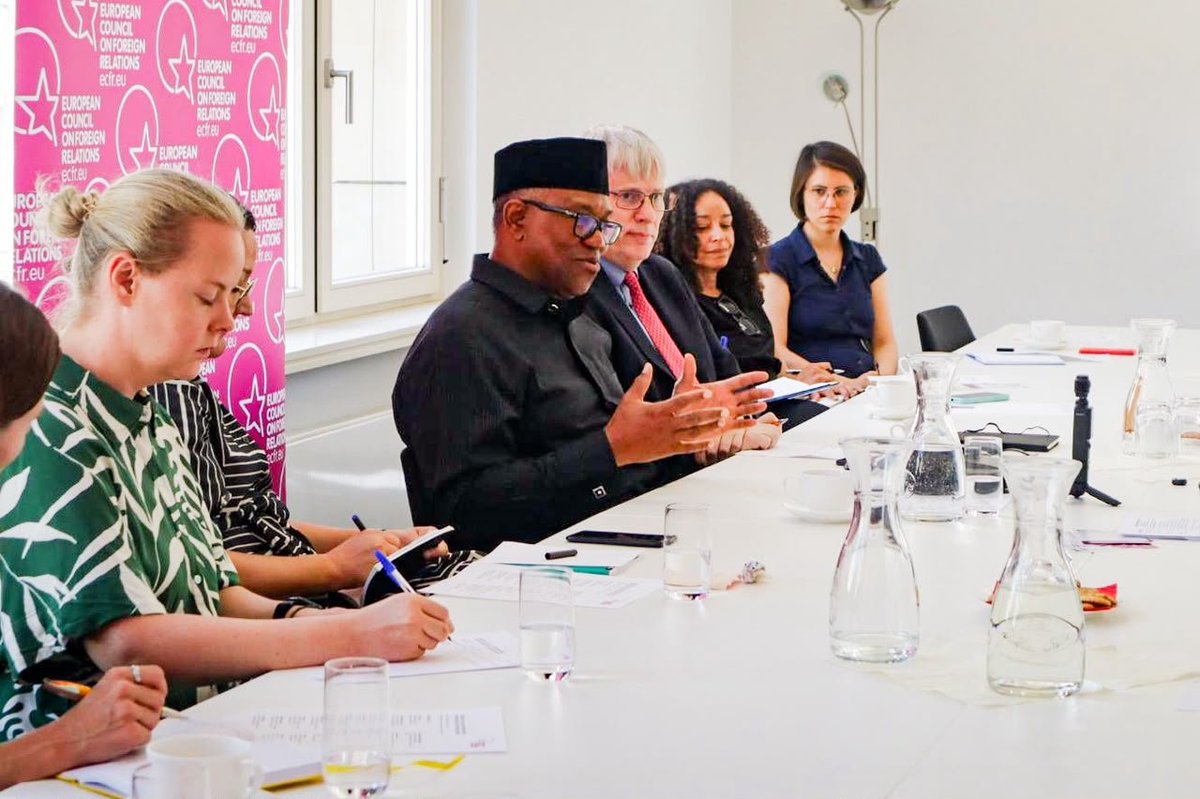
Nigeria in Focus at the ECFR Berlin Roundtable.
Yesterday, at the invitation of the European Council on Foreign Relations (ECFR), I had the honour of participating in a high-level roundtable discussion titled “Nigeria in 2027 and Beyond,” held at the ECFR office in Berlin, Germany.
The dialogue brought together policymakers, diplomats, development experts, business leaders, representatives of international organisations, and members of the international media to discuss Nigeria’s future and its role in an increasingly interconnected global landscape.
Our discussions centred on Nigeria’s democratic journey beyond 2027, international affairs, development cooperation, and the need to strengthen bilateral partnerships that can accelerate economic growth and improve the lives of our people. A key focus of the engagement was how Nigeria can deepen collaboration with international partners to support Small and Medium-sized Enterprises (SMEs), recognising that they remain the backbone of every productive economy and are indispensable to job creation, innovation, wealth creation, and sustainable national development.
We also exchanged views on strengthening democratic institutions, expanding trade and investment opportunities, promoting regional stability, improving governance, and creating an enabling environment that inspires confidence among citizens, investors, and Nigeria’s international partners.
I was encouraged by the thoughtful contributions and genuine interest demonstrated by participants in Nigeria’s future. The presence of senior representatives from the German Federal Government, development agencies, business associations, policy institutes, foundations, international organisations, and respected global media organisations underscores the strategic importance of Nigeria and the shared desire to see our nation realise its enormous potential.
During the discussions, I reiterated my unwavering belief that Nigeria possesses all the human and natural resources required to become a prosperous, secure, and globally competitive nation. What is required is competent, accountable, and compassionate leadership that prioritises investment in people, education, healthcare, productive enterprise, the rule of law, and strong institutions over politics of consumption.
Nigeria’s future is bright, but only if we make the deliberate choices that will move our country from consumption to production, from poverty to prosperity, and from division to unity. By embracing good governance, fiscal responsibility, and productive partnerships with the international community, we can build an economy that works for all Nigerians and restores our nation’s standing among the comity of nations.
I sincerely thank the European Council on Foreign Relations for the invitation and all participants for a frank, engaging, and constructive exchange of ideas. Conversations such as these remain vital in fostering mutual understanding, strengthening international cooperation, and building enduring partnerships for the benefit of Nigeria, Africa, and the global community.
A New Nigeria Is POssible. - PO
Statewide Broadcast by His Excellency Seyi Makinde, FNSE, Executive Governor of Oyo State, Following the Safe Return of the Oriire Abductees - 13 July 2026