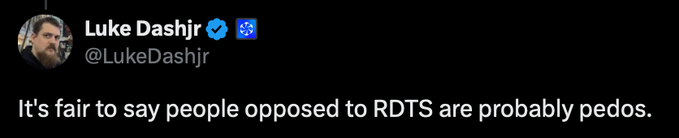
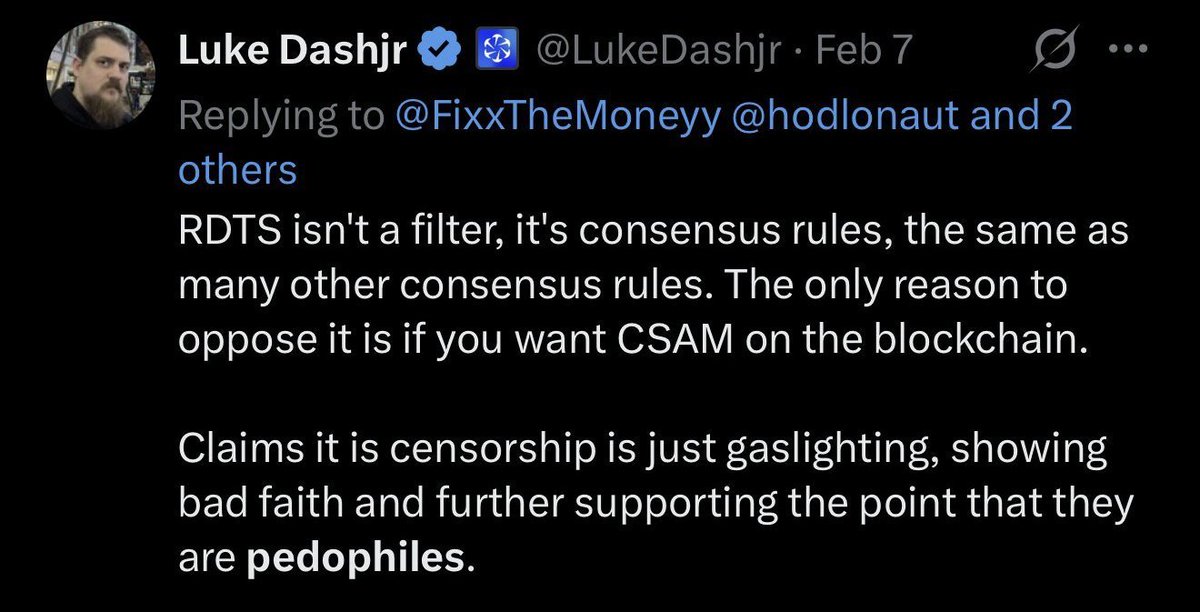
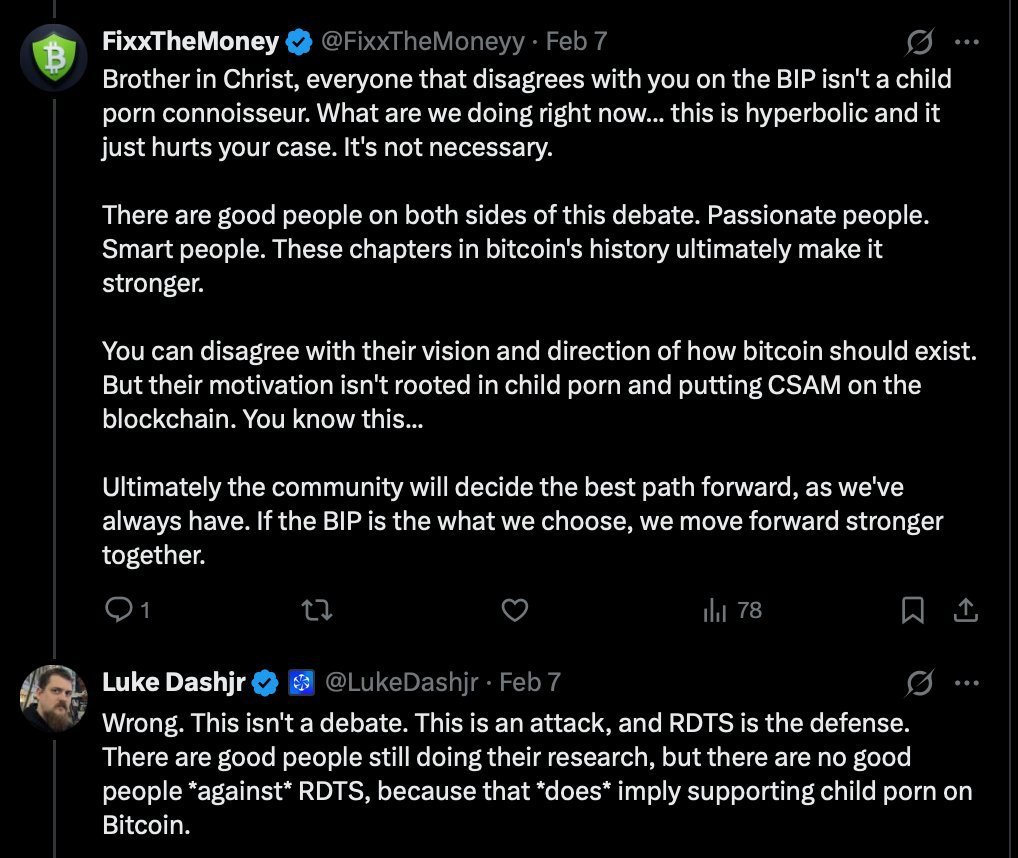
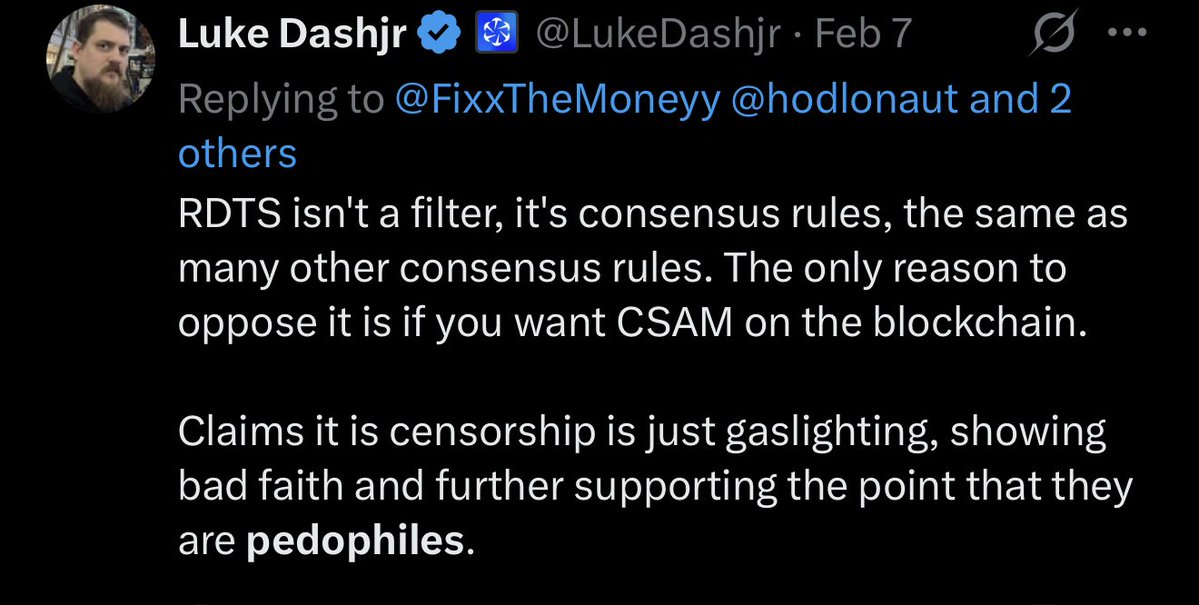
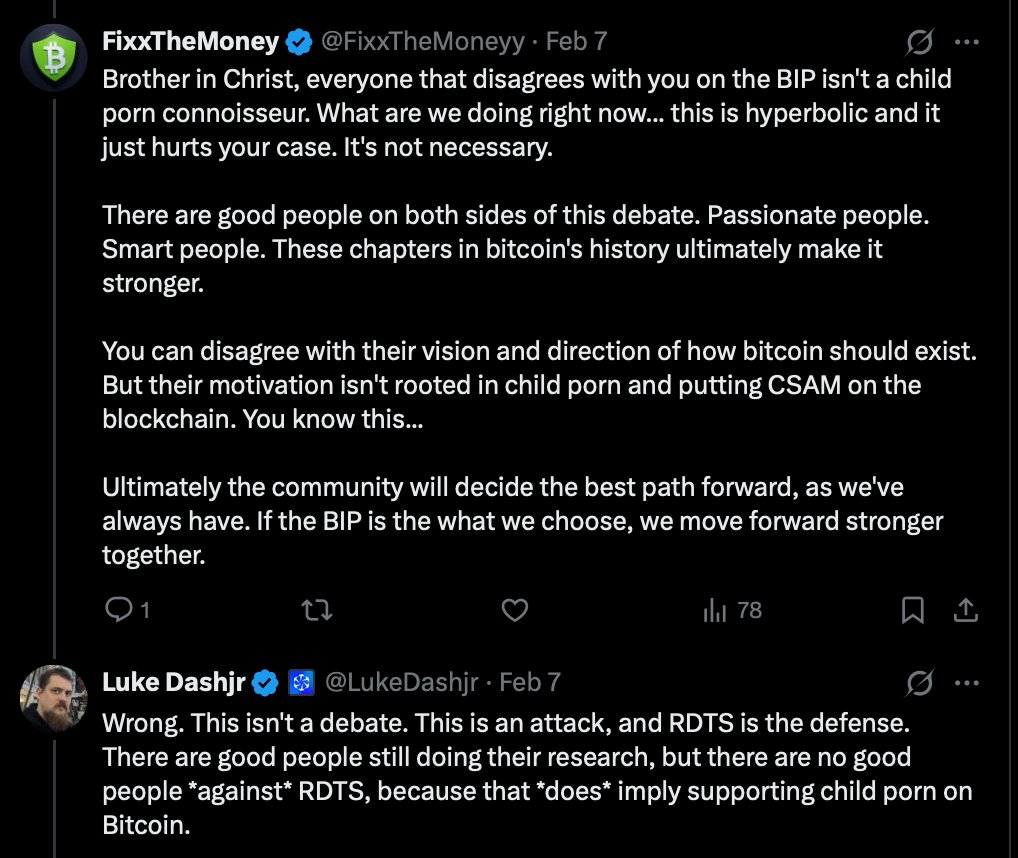
@1914ad <luke-jr> and 16 is not pedo territory
<luke-jr> 16 is not a child
<luke-jr> 14+ is young adult
<luke-jr> if the law does not forbid it, then it's fine
@cguida6@over21m@MichaelDunwort1 And BIP110 only helps if you adopt an artificially restrictive definition of arbitrary data.
In other words, it doesn't *actually* help anything.
@cryptorebel_SV@Weirdo25805401 BSV doesn't require signatures for every tx either.
The WP also doesn't dictate the order of txs within a block.
The WP doesn't say it *must* be inflation free.
The checkpoints are definitely anti-WP, though, like the coin confiscation in BSV.
@CsTominaga@gm7t2 > ones with no protocol changes.
BSV's got *tons* of protocol changes, though. OP_LSHIFT, confiscation transactions, sighash algorithm, soft forks to enforce push-only scriptSigs... I could go on.
@CsTominaga > So to claim, as you do, that "anything valid after a soft fork was already valid before it" is technically and historically false.
No, it's true. By definition! Nothing you said here shows that it's false.
@CsTominaga@gm7t2 > Bitcoin, by definition, is a system where validation rules are set in stone. If you change script semantics, you’ve changed the consensus rules.
BSV changed opcode semantics independent of Bitcoin. See, eg. OP_LSHIFT.
Sorry!
@BlockExtreme@CsTominaga@grok@Yinpengzi Nonsense. They're (with the exception of RBF) part of the protocol as optional extensions ('expansions'). Satoshi deliberately put soft-fork expansion opcodes into the protocol.
https://t.co/fVvIQMEc1D
RBF is merely policy and a more lenient version was present in the original.
@sgbett_614@CsTominaga@grok@Yinpengzi And even if someone wanted to do a P2SH-type output but not have it evaluate, they certainly can with just minor variation. Functionally, it would still be absolutely equivalent.