Ellsworth Toohey + Lysander Spooner = Ellsander
Fabian_Anarchist. Evolution not Revolution. You can't impose liberty on people & YES, that is Frederic Bastiat
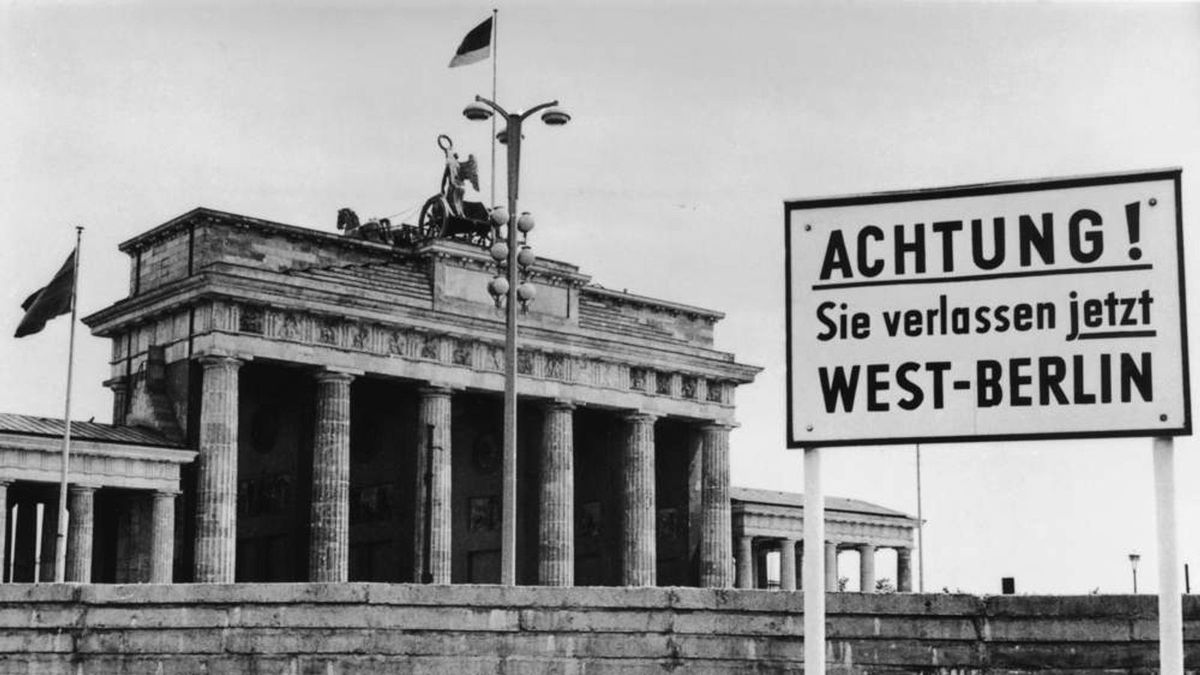
The Berlin Wall was built to trap East German citizens inside their supposed workers' paradise, not to keep enemies out. East German authorities erected it in 1961 because their system had already failed: when you need barbed wire and machine guns to prevent people from leaving, you've admitted as much.
By 1961, over 2.7 million East Germans had fled to the West through Berlin. The exodus included doctors, engineers, skilled workers, and intellectuals. Brain drain doesn't begin to capture the hemorrhaging. The East German economy was collapsing as productive people voted with their feet against socialism. Walter Ulbricht's government faced a choice: reform the system or build a prison. They chose the prison.
You can see the same pattern everywhere socialism takes hold. Cuba builds rafts. North Koreans risk execution to cross the DMZ. Venezuelans walk thousands of miles to escape Maduro's paradise. The pattern never changes because the economics never change. When the state controls production, innovation dies. When bureaucrats set prices, shortages multiply. When politicians promise equality, they deliver poverty equally.
The Wall stood for 28 years as the perfect symbol of socialism in practice. Guards shot 140 people trying to escape between 1961 and 1989. Each death proved the same point: people will risk everything to escape centralized planning. They will climb walls, dig tunnels, and hide in car trunks to reach free markets.
Ludwig von Mises warned in 1922 that socialist calculation was impossible without market prices. Every socialist experiment since has required walls, gulags, or killing fields to function. The Berlin Wall was just socialism being honest about what it really takes to make paradise work.
Communism is class fascism.
Fascism divides people by nation or race.
Communism divides people by class.
Both justify subordinating the individual to a collective and both require political control over the lives and property of others.
No, it’s not “Pride Month.” Not for me, and not for millions of others.
You’re welcome to be proud of whatever you want, in any month you like—because this is America. But what started in 1969 as a rebellion against persecution, morphed into a license for public depravity, and then morphed again into a weapon aimed at families and innocent children. Along the way it went from a day, to a week, and then a month and became official, and thereby effectively mandatory for all.
Enough!
If you’re gay and wondering why you are facing resistance now, the answer is that, with few exceptions, most of you didn’t stand up against the expansion and weaponization of “pride,” and the coercion that went with it. In that failure to resist, the gay community compromised any expectation that the rest of us should support “pride” at all, but especially the obscene display of hostility toward civilization and the families of which it is built, and for whom it exists.
If your hackles are raised by the idea that civilization is about families, realize that families are how civilizations persist through time. Not everyone needs to form one, but we all must respect and protect them—It is the foundation of what it means to be civilized.
For the small fraction of gays and lesbians who DID courageously stand up and resist expansion, coercion and the weaponization of “Pride,” I stand with you, and I have all along. But I won’t be celebrating, and I won’t be silent.
It’s not too late to join the voices of reason and to confront the insanity of what “pride” has become.
The state didn't invent money. Carl Menger destroyed that myth in 1871 with his regression theorem, and statists have been seething ever since.
Picture yourself in a primitive barter economy. You're a blacksmith who needs grain, but the farmer doesn't want your horseshoes. He wants pottery. The potter wants leather goods. The leather worker wants meat. You face what economists call the double coincidence of wants problem: finding someone who both has what you want and wants what you have. Barter works for simple trades, but complex economic coordination becomes impossible.
Smart traders notice that certain goods get accepted more readily than others. Cattle, salt, shells, precious metals. These commodities share specific properties: durability, divisibility, portability, recognizability. Over generations, market participants gravitate toward the most marketable goods as media of exchange. No central authority decrees this. No committee meets to decide monetary policy. Individual actors pursuing their own interests spontaneously converge on the same solution.
Money emerges from voluntary exchange, not government decree. Every unit of money traces its value back through an unbroken chain of exchanges to its original commodity value. Gold became money because people valued it first as jewelry, ornamentation, and industrial uses. Its monetary premium built on top of that foundation. When governments later monopolized monetary systems, they parasitically appropriated this organic market institution.
You can observe this process today in Venezuela, Zimbabwe, Lebanon. When state currencies collapse, people don't wait for permission to adopt alternatives. They trade cigarettes, rice, Bitcoin. Markets route around monetary failure because human cooperation demands a medium of exchange.
@bernsteind@tricrobotics Even better, strips of wildflowers planted throughout crop fields reduces the need for spraying pesticides by slashing "pest numbers in crops & even increase yields"
https://t.co/XqqiAiHMTi
The key to saving the environment is not looking backward, it’s moving forward.
I realized this the first time I visited Italy twenty years ago. Everything was clean and green. The rivers sparkled. The lesson for me was obvious: the answer is not underdevelopment. The answer is progress.
When China was poor, the air was so polluted that people could barely see the blue sky. Today, blue skies have returned to their cities. Development does not only create wealth, it also provides the resources needed to restore and protect the environment.
Some environmentalists want us to preserve every aspect of our biodiversity, including the mosquitoes for example, so that researchers can fly in once every ten years from their universities (which build particle accelerators and billion-dollar laboratories with their pocket money), study our ecosystems, and count how many people died from dengue outbreaks.
They want to buy our air through carbon credits. If carbon credits were such a great deal, they would be selling them to us, not the other way around.
Cleaning every river, lake, and water source in El Salvador, and ensuring they remain clean and sparkling, would cost roughly $12 billion. Where is that money supposed to come from without economic development? Carbon credits?
The path forward for our country is the path of Japan and Singapore, not the path of the Congo.
Property rights aren't some abstract legal concept. They're the operating system for human cooperation. When you can't secure the fruits of your labor, you stop producing beyond survival. Why build a better mousetrap when the village chief's nephew can just take it?
Look at North Korea versus South Korea. Same people, same culture, different property regimes. The South protects what you create and earn. The North... doesn't. Result: $31,000 per capita GDP versus $1,300. That's not a rounding error.
Every prosperous society in history built itself on this foundation. The Romans codified property law and conquered the Mediterranean (then abandoned it and collapsed). England secured property rights in 1688 and launched the Industrial Revolution. China started protecting private property in 1978 and lifted 800 million people out of poverty. The pattern never breaks because the incentives never change.
Tout le monde pense que le monde libre a gagné en 1989, à la chute du mur de Berlin.
C'est faux.
Et c'est exactement pour ça que le monde est aujourd'hui en feu.
Ce qui est tombé le 9 novembre 1989, c'est un appareil.
Une économie planifiée, un empire militaire, un mur de béton. Ce qui n'est pas tombé, c'est l'idée. L'idée que le monde se divise en oppresseurs et en opprimés. L'idée qu'il existe une égalité finale à atteindre, par tous les moyens. L'idée que tout ce qui existe (la famille, la nation, le mérite, l'héritage) est une structure de domination à abattre.
Cette idée-là n'était plus dans le bâtiment quand le bâtiment s'est effondré.
Il faut reprendre la chronologie, parce que tout est dans la chronologie :
Le communisme économique avait un défaut fatal : il était réfutable. Il promettait l'abondance, il produisait des famines. Il promettait l'émancipation, il produisait des barbelés. Budapest 1956, Prague 1968, L'Archipel du Goulag publié à Paris en 1973, les boat people de 1979 : à chaque décennie, le réel envoyait sa réfutation. Les boat people étaient une réfutation flottante, visible depuis les plages.
Alors l'idéologie a fait ce que fait tout organisme menacé : elle a muté.
La mutation a un nom, et j'en ai raconté la généalogie ici : la French Theory.
Foucault a déplacé la guerre du terrain des faits, où le communisme perdait à chaque fois, vers le terrain du savoir lui-même.
S'il n'y a pas de vérité, s'il n'y a que des rapports de pouvoir déguisés en savoir, alors plus aucune famine, plus aucun mur, plus aucun goulag ne peut réfuter quoi que ce soit.
La French Theory n'a pas enterré le marxisme.
Elle l'a rendu irréfutable.
Et la mutation a des dates. Toutes antérieures à 1989.
1934 : l'École de Francfort, chassée d'Allemagne, s'installe à Columbia. La critique de l'économie devient critique de la culture.
1964-1965 : Marcuse, exilé allemand devenu professeur américain, remplace le prolétariat défaillant par un nouveau sujet révolutionnaire (les minorités, les étudiants, les marginaux) et écrit noir sur blanc que la tolérance doit être accordée aux mouvements de gauche et refusée à ceux de droite.
Octobre 1966 : le débarquement a une date précise. Université Johns Hopkins, Baltimore. Derrida, Barthes, Lacan présentent la pensée française aux campus américains.
1967 : Rudi Dutschke lance le mot d'ordre, la longue marche à travers les institutions.
1968 : les révolutions de rue échouent partout.
Qu'importe. La révolution ne passera plus par la rue, elle passera par la salle de classe.
1975-1985 : Yale, Berkeley, Columbia absorbent la théorie, qui devient le système d'exploitation des humanités.
1987 : Allan Bloom publie The Closing of the American Mind pour donner l'alerte. Un million d'exemplaires vendus.
L'université le traite de réactionnaire et passe à autre chose.
L'Amérique avait son Aron, elle en a fait la même chose que nous du nôtre.
Puis arrive le 9 novembre 1989.
Le Mur tombe. L'Occident célèbre. Fukuyama avait déclaré la fin de l'Histoire dès l'été, avant même la chute. On démantèle les missiles, on encaisse les dividendes de la paix, on déclare le match terminé.
Nous avons célébré notre victoire sur une adresse vide. L'idéologie avait déménagé vingt ans plus tôt. Nous avons gagné contre les chars et perdu contre les chaires.
Pendant ce temps, l'autre empire communiste faisait la lecture inverse. Pékin avait écrasé Tian'anmen dans le sang cinq mois avant Berlin. Sinistre, mais lucide sur un point : la Chine savait que la guerre était idéologique.
Elle a choisi : abandonner l'économie marxiste, garder le contrôle du récit. L'Occident a fait l'exact opposé : il a gardé le marché et absorbé l'idéologie. Trente-cinq ans plus tard, regardez qui construit des centrales et qui déboulonne ses statues.
Vous voulez la preuve que c'est le même logiciel ? Faites la table de correspondance.
La lutte des classes est devenue la lutte des identités.
Les koulaks sont devenus les privilégiés.
L'autocritique maoïste est devenue le privilege checking. Les commissaires politiques sont devenus les DEI officers.
Le samizdat est devenu le compte shadowbanné.
La nomenklatura a quitté Moscou pour Davos et Bruxelles.
Et le paradis ne s'appelle plus la société sans classes : il s'appelle l'équité, l'égalité des résultats.
Exactement ce que je décrivais ici il y a quelques semaines.
On me dira : il n'y a pas de Goulag.
C'est vrai. C'est même tout le génie de la version 2.0.
Le communisme dur devait briser les corps parce qu'il ne tenait pas les esprits.
Le communisme mou tient les esprits : il lui suffit de briser les carrières.
Pas de camps, des services RH.
Pas de procès de Moscou, des excuses publiques.
Pas de Sibérie, la mort sociale.
Demandez aux émigrés du bloc de l'Est installés en Occident ce qu'ils ressentent en traversant une université américaine en 2026.
Ils reconnaissent l'odeur.
Et voilà pourquoi le monde est en feu.
Une civilisation a passé trente-cinq ans à enseigner à ses propres enfants qu'elle était le problème. Résultat : elle ne sait plus défendre ses frontières, transmettre son héritage, ni même nommer ses ennemis.
Quand la présidente de Harvard, devant le Congrès, répond que condamner un appel au génocide « dépend du contexte », vous voyez le logiciel tourner en production.
Et les prédateurs du dehors lisent cette faiblesse comme un livre ouvert : Moscou teste, Pékin patiente, l'islamisme avance dans les rues de nos capitales.
Le feu extérieur n'est que la conséquence du désarmement intérieur. On ne brûle bien que les maisons qui se sont vidées de leurs défenseurs.
Le Mur n'est pas tombé. Il s'est déplacé. Il ne sépare plus l'Est de l'Ouest : il passe désormais à l'intérieur de chaque institution occidentale, entre ceux qui construisent et ceux qui déconstruisent.
La première guerre froide s'est gagnée avec des missiles et du PIB. La seconde se gagnera avec des écoles, des médias libres et des modèles d'IA. Celui qui écrit les valeurs dans les machines écrira le prochain 1989.
Cette fois, ne nous trompons pas de victoire. Au travail.
While six million Ukrainians starved to death in 1932-33, Stalin employed a personal chef who prepared elaborate Georgian feasts in his private dining rooms. You need to understand what this tells you about the fundamental nature of state power and economic calculation.
Stalin maintained twenty dachas across the Soviet Union, each staffed with servants, stocked with rare wines, and equipped with private cinemas for his entertainment (this makes for a very interesting Google search). His security detail numbered in the thousands. His personal train car featured bulletproof glass and mahogany paneling. Meanwhile, peasants in Ukraine ate grass, bark, and leather belts before dying in the streets. Bureaucratic incompetence did not cause this. The iron logic of socialism produced it.
Central planners face no market prices to guide resource allocation. Without profit and loss signals, they cannot know what people actually need or value. So resources flow to political priorities instead of economic ones. Stalin's comfort took precedence over Ukrainian lives because political power, not consumer demand, determined production and distribution. The state controlled all grain, all transportation, all information. When you eliminate private property and market exchange, you eliminate the only mechanism that coordinates production with human needs.
Free market economists predicted this outcome decades before the Holodomor. Ludwig von Mises explained in 1920 that socialist economies cannot rationally allocate resources because they lack price signals from voluntary exchange. Without market prices, central planners operate blindly. They literally cannot know what to produce, how much to produce, or where to send it.
Every socialist experiment repeats this pattern: the political elite live in luxury while ordinary people suffer shortages, famines, and death. This outcome was inevitable the moment private property was abolished.
Ngl, life before capitalism was the elephant in the room when it came to anxiety.
Wondering if the harvest would fail and your family would starve causes anxiety.
Watching your child die from a disease that is now cured with a cheap antibiotic is stressful.
Living without reliable heat, electricity, refrigeration, sanitation, or clean water feels hopeless.
Working from sunrise to sunset just to survive is exhausting.
Having no meaningful opportunity to improve your circumstances is depressing.
Burying half your children before adulthood is traumatic.
Capitalism didn't invent struggle. It inherited a world defined by it and made survival easier, healthier, longer, and more prosperous for billions.
It's no wonder so many people take that progress for granted. They never had to live without it.
Rothbard didn't just publish another economics textbook in 1962. He torched the entire discipline and rebuilt it from first principles, using only logic and human action as his foundation.
You won't find a single graph, regression, or statistical model in Man, Economy and State's 987 pages. Rothbard rejected the mathematical positivism that had infected economics since the 1930s. Instead, he constructed economic theory the way Euclid built geometry: starting with self-evident axioms (humans act purposefully) and deriving all economic laws through pure logical deduction. No empirical testing required. When you understand that people choose between alternatives to remove uneasiness, you can deduce the entire structure of market prices, interest rates, and capital formation without collecting a single data point.
The book systematically demolishes every interventionist policy you can imagine. Rothbard proves that minimum wage laws create unemployment, rent controls cause housing shortages, and antitrust legislation protects inefficient competitors. Not through statistical studies that opponents can cherry-pick and debunk, but through ironclad logical demonstration. When government forces wages above their market level, employers hire fewer workers. This follows necessarily from the logic of human choice.
Most economists today remain trapped in the positivist methodology that treats human beings like particles in a physics experiment. They build elaborate mathematical models that predict nothing and understand less. Rothbard handed us a complete science of human action that explains every economic phenomenon from first principles.
The establishment ignored the book for good reason: you can't refute pure logic with statistics and computer models.
White people have been fighting for black people since slavery, and they gave their lives to end slavery when they didn’t even start it. The least I can do is fight for them too. We have to End Racism Against White People Too.
Love Beyond Color
In France there is a new activity that the Left is getting their knickers in a twist about.
Le Canon Français is running massive banquets. For about £70 you can have great food and drinks and spend time singing patriotic songs.
The “Far Left” is furious.
LFI says it has evidence of racist chanting, and of immigrant staff being insulted. With pork regularly on the menu, they say the feasts are purposely designed to exclude Muslims and vegetarians.
Meanwhile, everyday people who love France, love food and beer are having the time of their lives.
My daughter was just screaming in her bedroom and I thought someone died.. or at least a big spider. But no, @NASA just dropped this banger trailer.
Kids are excited about space again 🚀
Paper Pepper is a Korean papercraft artist who gave Van Gogh a makeover, fixed his ear, and proved Korean skincare is so good it can regrow body parts.
Not a filter. Not AI. Just paper, patience, and Seoul-level beauty standards.
Understand your opponents motivations. Envy, resentment, greed, retribution, are powerful motivations. They are also very dangerous when groomed into a political movement.
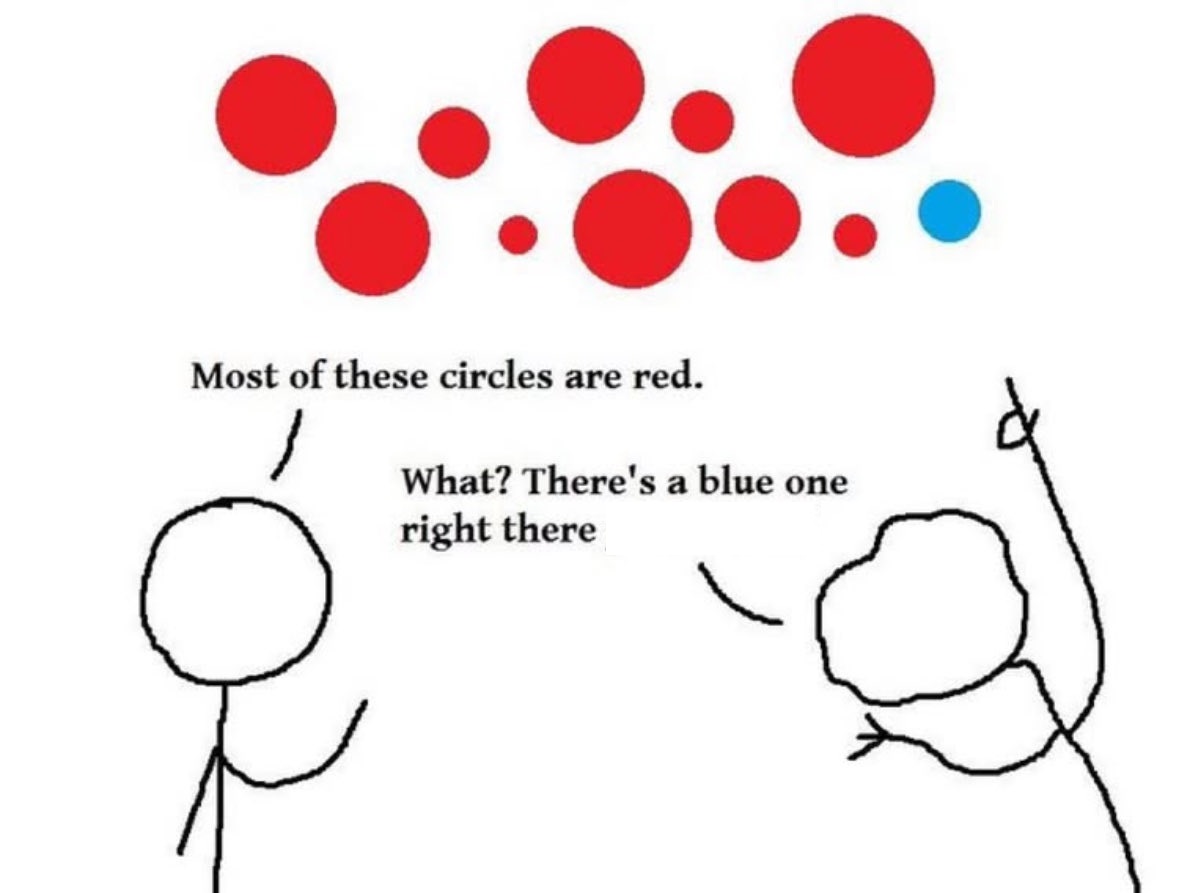
The reason this meme resonates with me is that it captures a common tactic in public democrat debate. Someone points to a broad trend and instead of discussing whether the trend is real, the conversation immediately shifts to an exception.
Mention fatherlessness and someone brings up a successful person raised without a father. Mention failing schools and someone points to a student who excelled. Mention crime and someone finds a neighborhood that remains safe. The exception is treated as though it disproves the pattern.
The problem is that exceptions do not erase trends. Nobody is claiming every circle is red.
They will call me a outlier... An exception.... an anomaly.
The point is that when most of the circles are red, focusing exclusively on the blue one prevents an honest discussion about what the overall picture actually shows. Serious analysis begins with patterns, not exceptions.
That is why so many conversations about public democrat policy go nowhere. Instead of asking why a problem exists, people spend all their energy trying to prove the problem doesn’t exist because they found a single exception.
Reality doesn’t work that way. If most of the circles are red, then the responsible thing to do is explain why.
#AStoneGroove #SilentMajoritySpeaks
To you, it's just a Cracker Barrel parking lot. To me, it's where I gave my life to Jesus Christ.
I was 21 years old. I was working at the Cracker Barrel in Tallahassee after some of the worst years of my life. I'd made mistakes. Real ones.
I grew up in Crown Heights, Brooklyn, raised by a mom who worked hard and didn't accept excuses. But I made decisions that should have ended my story before it ever really started. By the grace of God, they didn't. But every day, I was carrying them.
One afternoon, a church group came into the restaurant, just back from a revival. I served them their meals like I served any other table. But something happened while I was serving them. I can't fully explain it to you. The Lord spoke to me. He said, “Stop running from Me.”
It knocked me back.
I went to find the table, and they were all gone. I could see through their windows that they were getting on their bus, and I knew deep down that if I let them drive away, I was going to keep running. So I went outside. The last woman, just as she was stepping onto the bus, turned to me and asked, “Are you okay?”
I told her, “No ma’am, I’m not okay.” I told her the Lord was telling me to stop running.
That whole bus emptied out, stood with me in the parking lot of a Cracker Barrel in Tallahassee, Florida, and prayed over me right there.
I gave my life to Christ that day. Right there.
I still get emotional about it. Because I know what I was before that moment, and I know what He's done since. He gave me a wife who shares my faith. He gave me three sons. He gave me a career, a community, a calling I never would have dared to ask for. He took a kid from Crown Heights who’d run out of chances and gave him a life that doesn't make sense apart from grace.
People ask me sometimes why I talk about it. Why I bring up the parking lot. Why I don't just keep that part private and let folks see the polished version.
I'll tell you why.
Because there's a young man out there right now — maybe in Tallahassee, maybe in Tampa, maybe in Miami, maybe in a small town in the Panhandle — who thinks his story is already over. Who thinks the mistakes he's made disqualify him from the life he could have had. Who thinks God doesn't want anything to do with somebody like him.
I'm here to tell him: that's a lie.
In life, you're not who you are at the lowest point. You're who you choose to become after.
The Lord met me in a Cracker Barrel parking lot. He'll meet you wherever you are.
You just have to stop running.
2018 President Trump signs into Law an Act of Congress removing prohibition of growing Hemp at the Federal level. This is one of the things that just cannot please an angry Libertarian who demands that Trump has done nothing. Maybe your Trump tantrums will succeed in Socialists winning and putting Trump in prison. After you tire of cheering the Socialists for satiating your TDS, maybe they will make growing Hemp illegal again so as to protect the industries of chemical alternatives. And remember angry kids, that it was the Socialist Democrat Juggernaut of Franklin D. Roosevelt that made it illegal in the 1st place.
Marx lived his entire adult life as a dependent. The capitalist system funded his "research" through Engels, whose family wealth came from textile factories. The irony cuts deep: capitalism's profits subsidized its most famous critic.
Marx never held a real job. Never met payroll. Never risked capital or faced bankruptcy. He spent decades theorizing about labor value while avoiding actual labor. His insights into production came from library books, not factory floors.
The parasitic intellectual tradition he spawned continues today. Academic Marxists collect taxpayer-funded salaries while denouncing the market system that creates the wealth they consume.
It's time to get rid of these people.