Within the neighbourhood of Bruntsfield, Fin & Grape focuses on Scottish fish, responsibly sourced wines and plates to share.
With a cosy atmosphere, rustic and stylish décor and menu designed to share, this independent restaurant is the perfect neighbourhood spot to enjoy with loved ones - whether it's a meal in the main dining room or a delicious snack in the wine bar.
À l’heure où l’IA est utile mais encore souvent brinquebalante, autant se tourner directement vers les incroyables dessins de Stephen Biesty plut��t que d’en reproduire le style.
Ces livres, parus il y a plus de 30 ans (avec quelques détails forcément datés ou discutables aujourd’hui) ont bercé l’enfance de beaucoup d’entre nous.
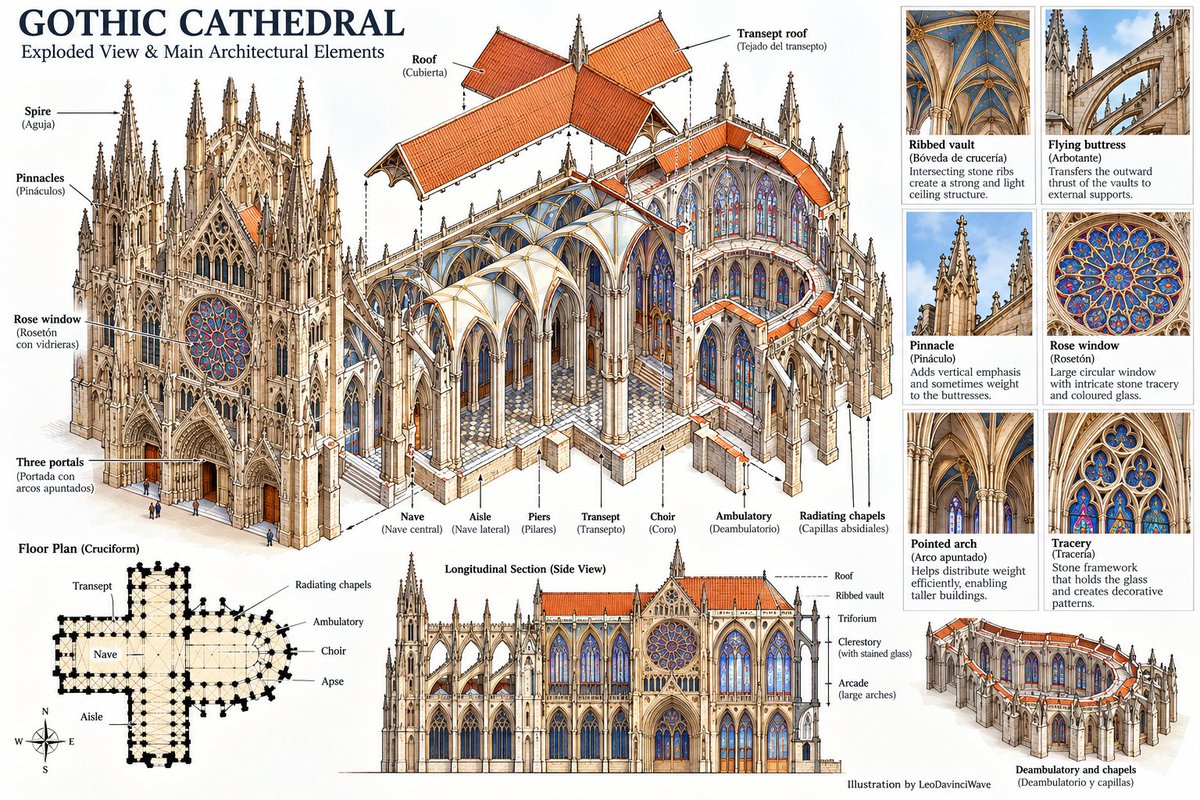
A Gothic cathedral was far more than a monumental place of worship. It was an extraordinary achievement in medieval engineering.
From around the 12th century, builders across Europe developed a distinctive architectural language using pointed arches, ribbed vaults and flying buttresses. Together, these features helped distribute the enormous forces generated by tall stone ceilings, allowing walls to accommodate larger windows.
Look closely at the structure. The ribbed vaults channel loads towards supporting piers, while flying buttresses transfer outward thrust to external masonry supports. Pinnacles crown many of these supports, adding vertical emphasis and, in some cases, useful weight.
The transept forms the crosswise arm of the church, while the ambulatory allows movement around the choir. Above the entrance, a rose window transforms stone tracery and coloured glass into intricate patterns of light.
What fascinates me most is how Gothic architecture combines structural logic with visual drama. Every arch, column and window contributes to the experience of height, light and space.
These cathedrals were built over generations, often changing as designs, resources and ambitions evolved.
Clotted cream is the richest dairy product in the British kitchen, nearly two thirds fat, and it was invented as a way of keeping milk in a county with no ice.
The method is older than anyone can trace. Fresh milk from the morning is left in a wide pan until the cream rises, then the whole pan is set over a very low fire or in a cooling bread oven for hours, never boiling, until a thick crust forms on top the colour of old gold. It cools overnight and the crust is lifted off with a skimmer. That crust is the cream, and the scalding is what kept it. Heated that way it lasted for days when fresh cream would have turned by teatime.
Devon and Cornwall argued over it for centuries and still do. The Cornish got the legal protection in 1998, on condition that the milk is Cornish and the fat is at least fifty-five per cent, though the good stuff runs higher. The argument about whether the cream or the jam goes on the scone first has split the two counties for as long as there have been scones, and it is the only question in British food that people will genuinely fight over.
If you grew up in the West Country it came in a cardboard tub with a crust you broke through with a knife, and it went on everything: the scone, the apple pie, the porridge, a spoon of it straight off the blade when nobody was looking. A pot sent by post to a relative in London was the standard Christmas present from Cornwall for a hundred years.
It is milk with the water taken out and the fat left in, and it was the ordinary household food of the two poorest counties in England.
The cream tea is now a treat you drive to and photograph. In 1930 it was what a dairy farmer's wife did with Tuesday's milk, and the fat was the whole point of doing it.
Kartoffel-Lauch-Stampf mit Frikadellen und einer leicht spicy Schnittlauchrahmsauce
Aus »Rezepte und Geschichten aus dem Kochlabor No. 2« https://t.co/UJJUxqYG4K
Buchhandel schickt bitte Mail an [email protected]#Kochbuch#vegetarisch#vegan#HerrGruenkocht