@CatfishFishy Random question. What are your thoughts on Twitter accounts that only talk shit on LINK or whatever crypto they hate? I will never understand why they waste so much time and resources instead of accepting they don’t like the token, cutting their costs and walking away?
I don’t understand accounts that hate a specific crypto and continue to waste time and energy posting about it. If you don’t like it then cut your losses and leave? I don’t get it.
Investing in LINK is def not for the faint hearted. It hurts to see some days but sometimes it’s best to just hold and forget. That being said, I hope that something happens for LINK marines soon.
LIVE: Fidelity International, a global asset manager with $1+ trillion total client assets, launches its first tokenized fund FILQ, powered by Chainlink.
Through onchain NAV, Chainlink is enabling Fidelity International to bring regulated yield-bearing liquidity into 24/7 digital market.
Sergey on what the DTCC is, the quadrillions in value they settle and how they are working with Chainlink
“The DTCC is the clearing and settlement system of the United States, which is the largest clearing and settlement system of the securities industry”
“They are kind of like the "Fed of the securities industry”
“They settle two to four quadrillion dollars a year”
> Did you say quadrillions?
“Quadrillion. That’s right”
“This is what people need to understand. I’m not talking about another trillion; I’m talking about quadrillions in transactional throughput that could touch our industry if we are able to create the security and reliability and unique properties that our industry can create”
“And that’s what this is about. It’s about getting the whole world’s value—and in order to get the whole world’s value, you have to work with the systems where the value resides”
“You have to create a path for them to integrate with this trust-minimized, blockchain-powered world”
“Our work with the DTCC… is [enabling] the ability for DTCC to interact with various chains and for them to enable the settlement that happens around those chains to be legally binding and to use the various services and additional properties of a CSD”
“Imagine if you could have tokenized equities that were considered legally accepted right fantastic yeah and then imagine the amount of stablecoin transactions that would generate”
The Depository Trust and Clearing Corporation (@The_DTCC) is the most important company in the world that you have never heard of
They settle $4.7 quadrillion in securities transactions per year, making it by far the highest financial value processor in the world
They are the world’s largest securities depository and the primary infrastructure in the United States for clearing, settlement, and asset servicing
DTCC’s infrastructure covers equities, bonds, ETFs, treasuries, mutual funds, money market instruments, mortgage backed securities, and OTC derivatives
Their scale is incomparable:
✅ $114 trillion in assets under custody
✅ Serving issuers from 150+ countries
✅ 100+ million transactions processed every day
✅ Designated a Systemically Important Financial Market Utility (SIFMU) by the U.S. government
Practically speaking, the DTCC is the plumbing that underpins the U.S. financial system (and by extension, the global financial system)
And today, the DTCC announced they are integrating @chainlink to advance 24/7 collateral mobility on the DTCC Collateral AppChain
Today we announced progress toward our goal of advancing 24/7 collateral mobility. DTCC’s Collateral AppChain, a shared infrastructure platform for collateral, will leverage the Chainlink Runtime Environment (CRE) and @chainlink data standard to enable near real-time collateral management across financial markets and blockchains.
The integration will enable the seamless pairing of asset prices, valuations, and movement, with the aim of overhauling how market risk is managed globally and unlock greater capital efficiency.
This milestone reflects our broader vision to enable 24/7, near real-time collateral management across the global financial system.
Read the full announcement: https://t.co/ELVio44scA
NEW: @The_DTCC is integrating Chainlink data and orchestration standards into the DTCC’s Collateral AppChain.
DTCC and Chainlink are advancing 24/7, near-real-time collateral workflows across global markets and blockchains.
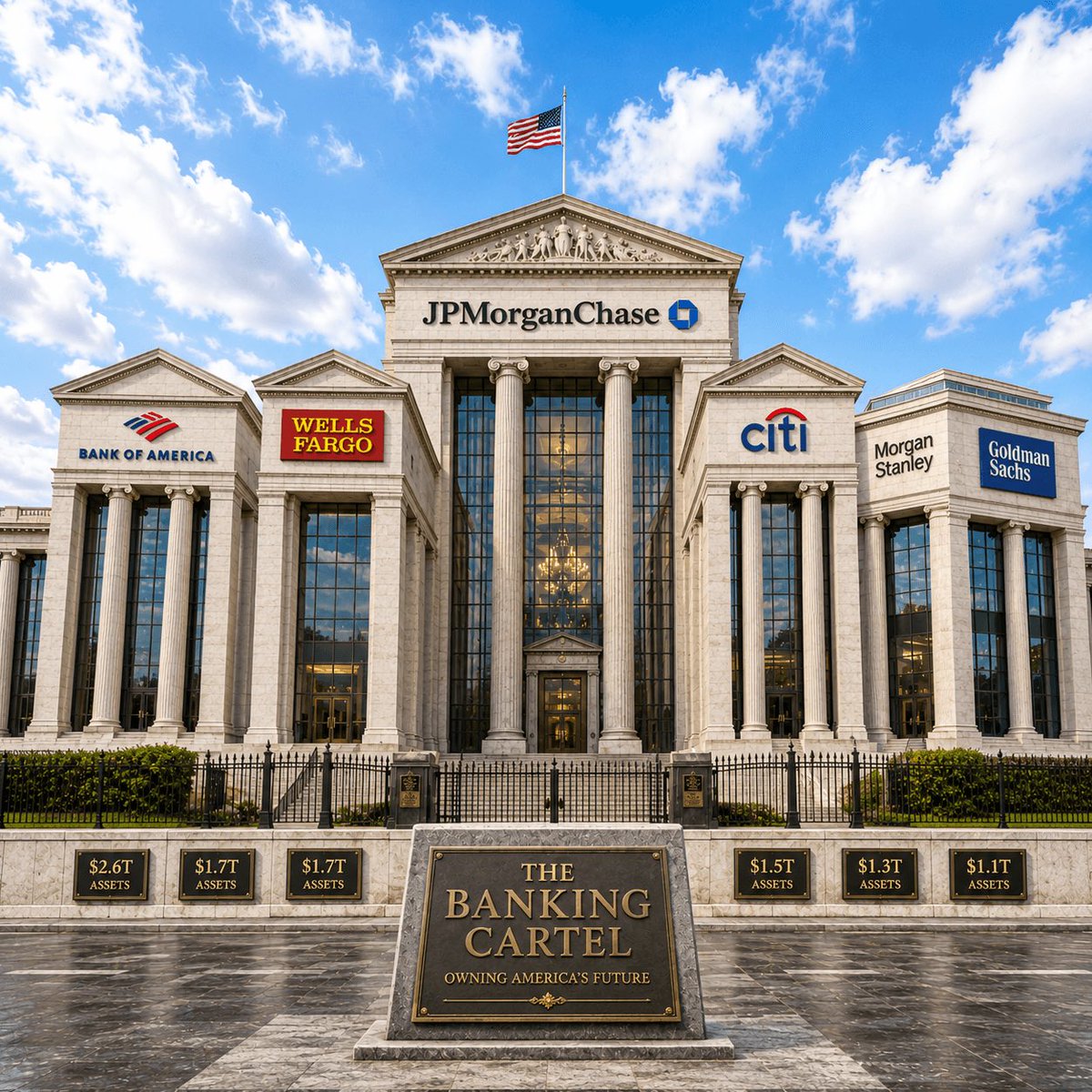
JUST IN: 🇺🇸 Senator Bernie Moreno says the "banking cartel is in full panic mode" over crypto Clarity Act.
"For decades, these banks have treated your deposits like their personal piggy bank, paying you next to nothing while lending YOUR money out for massive profits and executive bonuses."
"Now that innovative stablecoins threaten to break their monopoly and give you actual financial freedom? They're running to Congress again, screaming about threats to economic growth and financial stability."
🚨 The banking cartel is in full panic mode. 🚨
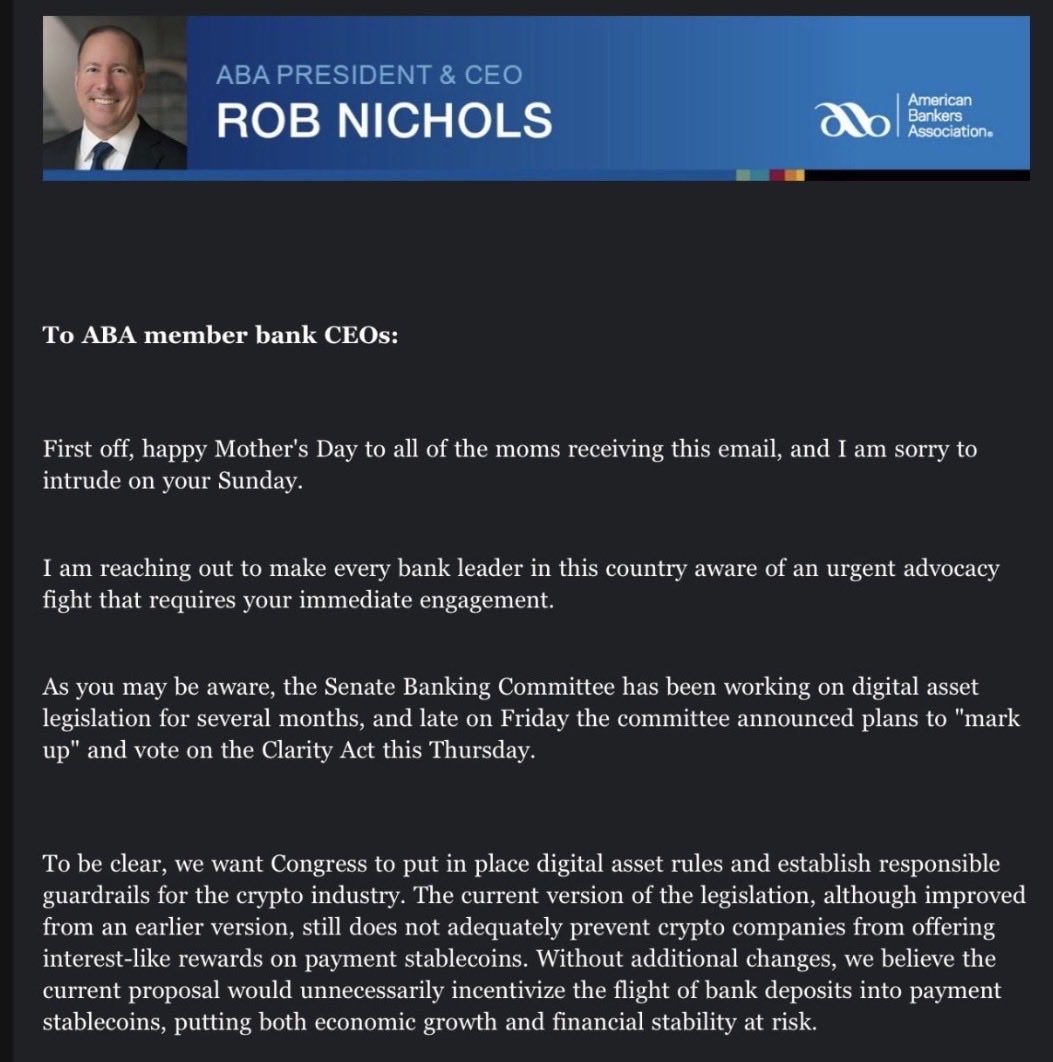
While Americans were celebrating Mother’s Day with their families, the CEO of the American Bankers Association sent a frantic alert to every bank CEO in the country, demanding “immediate engagement” to lobby Senators and kill stablecoins that would finally let everyday Americans earn real yields on their own money.
This line in the letter sticks out: “we believe committee members may not be fully aware of the risks to the economy by the stablecoin loophole.” That’s both intellectually dishonest and simultaneously demeaning. First, there is no “loophole.” This entire issue was litigated during the GENIUS Act debate. @BillHagertyTN worked tirelessly on this issue and this statement is an insult to his and others work.
For decades, these banks have treated your deposits like their personal piggy bank, paying you next to nothing while lending YOUR money out for massive profits and executive bonuses.
During the Biden era, these same banks worked hand-in-glove with @SenWarren and her allies to debank Americans, including President Trump’s own family. They shut down accounts of conservatives, patriots, and anyone who dared challenge the regime, all while regulators applied pressure under schemes like Operation Choke Point 2.0. It wasn’t about risk. It was about political control.
Now that innovative stablecoins threaten to break their monopoly and give you actual financial freedom? They’re running to Congress again, screaming about “threats to economic growth and financial stability.”
Translation: Protect the racket at all costs.
The Senate Banking Committee votes on landmark crypto legislation this Thursday.
As a member of that committee, my message is clear:
Hands off the people’s money. Let Americans choose real competition and better returns. No more shielding Wall Street from the future. The banking elite’s days of rigging the system and debanking their political enemies are over. Innovation, freedom, and the American people will win.
I’m voting to break the cartel.
Chainlink just posted this on their Linkedin.
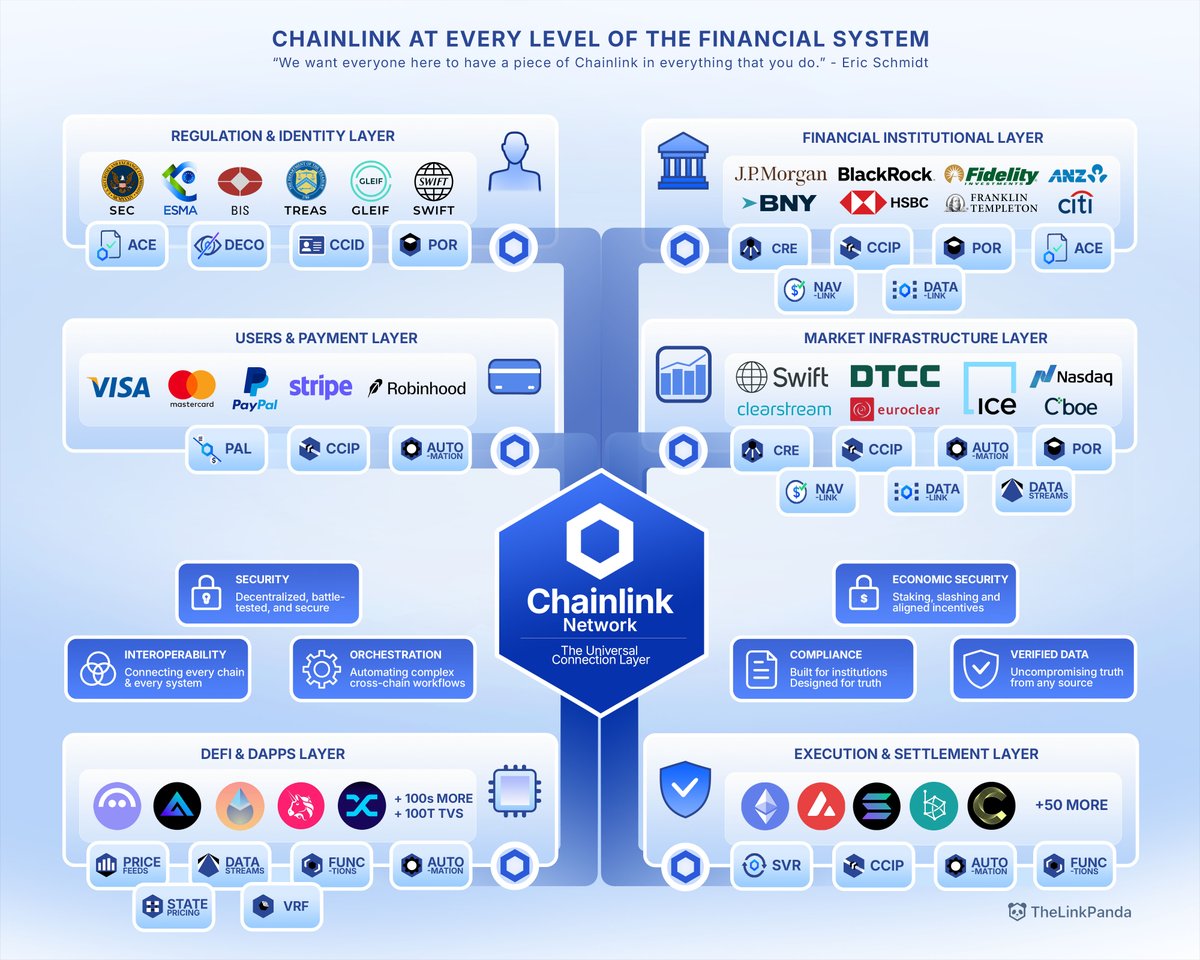
Amazon web services (AWS) just spotlighted the missing $LINK between traditional finance and blockchains: @chainlink Runtime environment (CRE)
This is the second time @chainlink mentions they are working closely with Amazon in a short period of time.
$LINK everything!
I encourage everyone who wants the Clarity Act passed to "politely" contact Sen Tom Tillis's office asking to pass the Clarity Act.
Every phone call is equal to 10k constituents to Congressional Officials. 🤳👇
THIS IS THE LAST WEEK TO SAVE THE BIGGEST CRYPTO BILL IN US HISTORY.
AND IT’S STARTING TO SLIP.
A week ago, the window was clear: April 13 and April 20 were the only two weeks the Senate Banking Committee had to move the CLARITY Act.
That was the entire window.
Now we are at the end of that window, and the bill is still not scheduled for a Banking Committee markup.
That is the key problem.
Because without a markup in April, the path breaks.
No markup → no committee approval
No committee approval → no Senate floor vote in May
And if it doesn’t reach the floor before the May 21 Memorial Day recess, the calendar becomes a bigger issue than the policy itself.
After May, the midterm cycle takes over.
By late summer, Congress is no longer focused on passing major legislation.
And as already stated by lawmakers, if this bill slips past that window, it likely gets pushed out or dies in its current form.
Now look at what changed this week.
First, the timeline slipped.
Tim Scott has publicly said there is no fixed date and listed three unresolved issues:
Stablecoin reward structure
DeFi developer protections
Internal alignment within Republicans
Each of these is estimated to take weeks, not days.
That pushes the earliest realistic markup into May.
Second, the biggest blocker flipped.
Coinbase, which previously opposed the bill and caused delays earlier this year, has now publicly supported it.
That removes one major risk.
Third, the White House stepped in.
The Council of Economic Advisers released a report showing that the banks’ main argument that stablecoins would drain deposits has minimal real impact.
That weakens the core resistance from the banking side.
So from a policy standpoint, the bill is actually in a stronger position today than it was weeks ago.
But the timeline is worse.
And timelines decide outcomes in Washington.
Markets are starting to reflect that shift.
Prediction odds for 2026 passage have dropped from the 70%–80% range earlier this year to around 50% now.
That is not about fundamentals.
That is about timing risk.
There is also a new issue that was not part of the discussion earlier.
Law enforcement is now pushing back against the DeFi safe harbor provisions.
That creates another delay point.
So the current setup is very clear:
The bill already passed the House with strong support.
It has backing from the industry and the White House.
The core policy framework is agreed.
But it still has no confirmed date to move forward in the Senate.
And every week of delay reduces the probability of it passing this cycle.
What matters now is very simple.
If the Banking Committee schedules the markup in the next few days, the bill still has a path to the Senate floor in May.
If that does not happen, the window starts closing fast.
This is no longer about whether the bill is good or bad.
It is about whether there is enough time left to pass it.