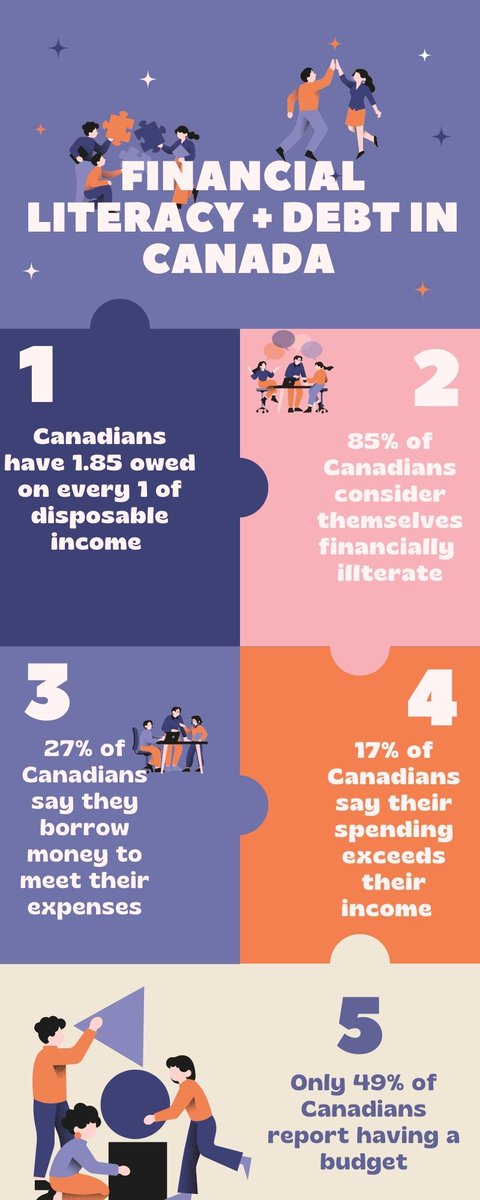
@bankofcanada@mikalskuterud@CanEconomics RT if you think Canada needs better financial literacy and debt education. See more info attached! https://t.co/PhSSWzUDRI
Here is my presentation on my #EM203problem which is low levels of financial literacy and high levels of debt in Canada. Linked here: https://t.co/PhSSWzUDRI
I only received one hour of financial literacy education in high school. In one study, only 15% felt they had strong financial literacy. There are rising debt levels and low financial literacy in Canada. #Em203robin#em203problem
In Grade 11 we had 1 hour of financial literacy education for the entire 4 years of high school. "Canadians have one of the highest debt levels in the world, owing nearly $1.74 for every dollar of income" See this report by the GoC https://t.co/5ssAFe3DWv
@EM203LRobbins a problem I identified in your map was how pharmacists can now prescribe/ treat certain ailments. This could damage the patient doctor relationship, lead to increased prescriptions when unnecessary and slow down the experience at the pharmacy. #EM203problems
As EM203 is an online course. If students were almost entirely self-guided, students could also struggle to motivate themselves.
Guided inquiry (as mentioned earlier in this presentation) is sometimes still necessary to facilitate the learning experience.
While clearly learning by doing can have its merits, it is clear some structure is necessary to help guide students along the way. I can see this in the structure of EM203 as a course. While the course itself is very open, it is not a complete “free for all”.
@EM203ntivirikin Hey! Thank you for responding! I definitely prefer learning by doing as it helps me grasp concepts way easier as well! For you, which learning concepts is it not applicable to? @EM203ntivirikin
Hi all! I am starting my "How You Learn" project & decided to get people's perspectives on "Learning by Doing".
I was wondering If you could help with my project by replying to this tweet & sharing some personal experiences/ pros/cons that you see with this method of learning.
My learning experiences through cooperative education & business school strongly impacted me. I now gravitate toward "Learning by Doing". This approach has become so ingrained in me, I believe I gravitate toward it subconsciously without active thought. It's become a default.
I can see my "Learning by Doing" approach in EM203 in how I approached Twitter. Although I have never had Twitter, I did no research. I just downloaded the app and started playing around with it, following topics I was interested in and adding a bio, banner, and profile picture.
Reflecting on my co-op terms, I see the “Learning by Doing” approach is overwhelmingly present in these experiences. Often, I would start a co-op term without training or instructions. You would jump right into your work and figure it out if you didn’t already know it.
In thinking about how I have taken a learning-by-doing approach in this course, I think it is important to acknowledge how my personal history and experiences have influenced the learning style that I gravitate toward.
@em203Yichina I agree. How education can meet the needs of the learner is interesting. I also found writing the discussion post on what education will look like in 2030 to be really interesting. I think it will change a lot and hopefully in conjunction with the needs of learners. #EM203Robin
@EM203AWeiner What task did you select for your learning by doing the assignment? I learned to knit and it was a little bit of a struggle but I got there in the end after a friend showed me. I definitely would have been worse singing in German. #em203robin