NetEase might’ve actually destroyed Marvel Rivals with this update.
This game has never been balanced but it’s a whole ass mess right now.
What the fuck were they thinking with the BP buff? Just had one on my team go 33-0 and was deleting everyone instantly. That’s not fun.
Alright, so now that we can confirm Bungie leadership was indeed involved in every step of deciding to end Destiny, I’ve got some unfiltered thoughts.
-The content vault was the sole destroyer of all positive momentum and sentiment for the game when players now had to spend money on new expansions every year or two with an inherent fear that content would be vaulted anyways. “Pay for access” is the death of player investment and the DCV highlighted itself as the most destructive decision ever made in any game to-date.
-Destiny 3 should’ve been green-lit immediately after the Witch Queen, Lightfall, and Final Shape reveals in 2020 and 2021. It would’ve been the perfect lead-in for concluding Destiny 2. They knew the saga was concluding with Final Shape and the game was becoming too bloated. Had they decided to do so, they could’ve announced Destiny 3’s release at this very moment 5-6yrs later. It also would’ve been the perfect bargaining chip to PlayStation for the acquisition by showing longevity of an established and secure IP with a clear title release forthcoming.
-I can guarantee a very large base of players will decide to avoid this “new journey” in Bungie if it isn’t Destiny 3. This demographic of players over the last 10yrs are Destiny fans who spent the last decade exclusively in Destiny - even bringing their kids to enjoy. For sure, you’ll have many who will try whatever comes next, but if it isn’t Destiny, you’re going to have a very large gap.
-Marathon’s “strong foundation” is grossly over-exaggerated. Don’t get me wrong, it’s a very good game that plays unbelievably well and perfectly emanates the identity of Bungie, but its retention concerns are so evident that to deny its existence is damaging. An extremely large portion of marathon players migrated from Destiny and are the core audience to consider here. To Shut down their original game with no plan in sight while saying “we have this instead” will not produce positive results. If marathon wants to succeed beyond its extraction mode, it needs a world built like Destiny, told like Destiny, and world-shaped from the marathon lore that’s been build since the 1990’s.
-If Destiny 3 is not in development and they have no plans to continue the franchise, sell the rights to another reputable studio who believes in the IP and will keep it alive. Destiny is arguably the best looter shooter that defined a literal genre and to abandon development of one of the biggest established IP’s in history is a terrible business decision.
-All of this stems from terrible decision making from the top-down. The game went from creating one of the greatest gaming worlds and stories ever made over the last decade to dollar signs and spreadsheets first. Game success comes from building a full experience that players cannot help but be immersed in.
Blaming “industry shifts” for a game struggling is code for “we aren’t getting it right on our end because we’re making the wrong decisions at the wrong time.”
The players haven’t changed; the reason for developing a game did.
I’m angry. I’m frustrated. I’m sad. I’m hurt. I’m lost. Destiny was home for over 10yrs.
I’ll see y’all in the tower.
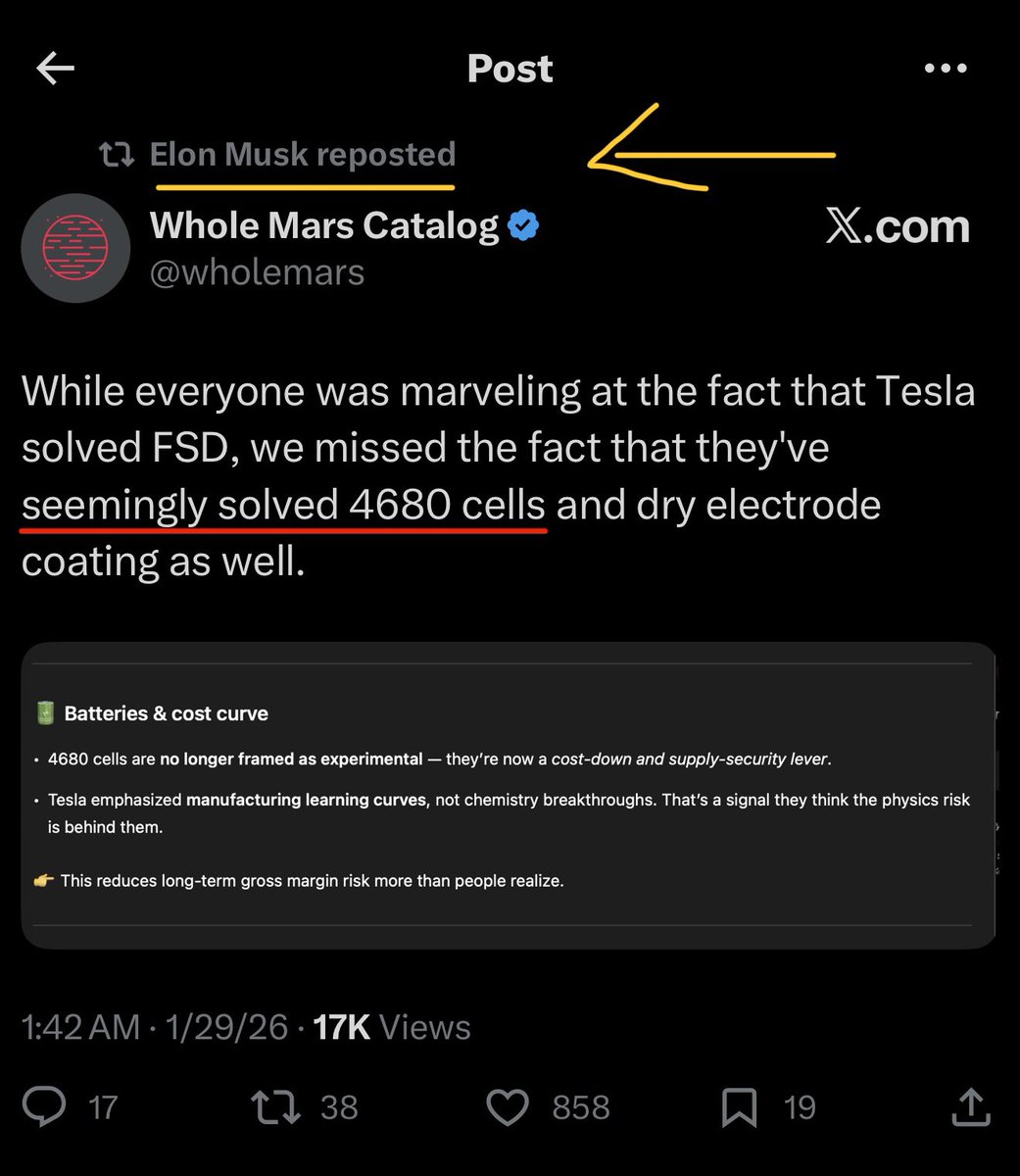
As Tesla announced yesterday…congrats to the entire 4680 Cell Manufacturing team on solving a super hard problem with dry cathode battery electrode! Huge milestone to deliver dry cathode into mass-production and have started customer deliveries last year.
2026 will be a new era for 4680 as we continue Cybertruck, restart 4680 Model Y’s, and start CyberCab + Semi production.
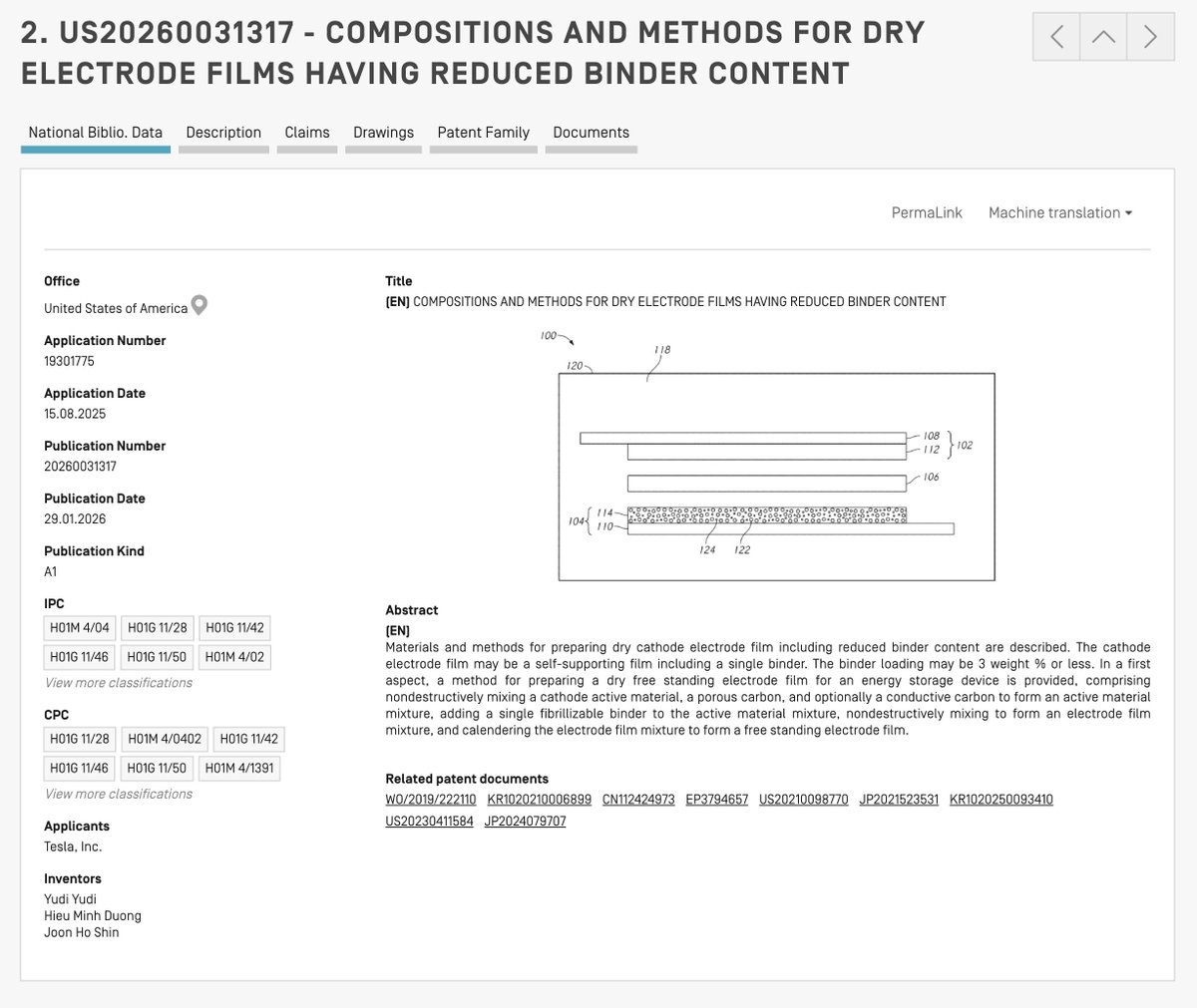
BREAKING 🚨 TESLA LOCKS DOWN THE "SECRET RECIPE" FOR ITS DRY ELECTRODE MANUFACTURING 🔒
For years, the battery industry believed that mass-producing dry electrodes was impossible, a lab trick that simply couldn't scale.
Published on January 29, 2026, patent application US20260031317A1 proves them wrong and reveals the next, ruthless phase in Tesla's intellectual property strategy.
If the previous patent was about owning the car, this one is about owning the factory. This filing serves as the definitive "cookbook" for the holy grail of battery manufacturing.
While Tesla has already secured the rights to the superior performance of the battery, this continuation protects the method. By patenting the exact order of operations and physical constraints required to ditch toxic solvents, Tesla is effectively copyrighting the "kitchen" so that no one else can bake the same cake.
This ensures that even if competitors figure out what makes the dry electrode work, they will be legally barred from using the most efficient way to make it.
To understand why this legal firewall is so necessary, we have to look at the specific engineering trap that Tesla is trying to prevent competitors from exploiting.
🧩 The problem: Copying the result, evading the method
The transition from "wet" to "dry" manufacturing is notoriously difficult because of a cruel physical trade-off: to make dry powder stick together into a solid sheet, you typically need to apply high-shear force or add large amounts of polymer "glue".
Both are bad. High shear crushes the delicate battery crystals (killing lifespan), while excess glue wastes space (killing range).
Tesla has solved this by developing a "Goldilocks" zone, a gentle mixing process that activates the binder without destroying the particles. However, this creates a legal vulnerability.
In the world of patents, securing the "end product" (a high-efficiency battery) is a massive win, but it leaves a loophole. Competitors could theoretically try to achieve similar battery performance using a slightly different, less efficient, or messier process to skirt the patent rules.
If Tesla only protects the final battery, rival manufacturers could reverse-engineer the specifications while claiming their production line is "different enough" to avoid infringement.
To truly secure its competitive advantage, Tesla needs to protect the unique, low-cost "kitchen" where the battery is made, not just the "cake" that comes out of the oven. To close this specific loophole, the new filing moves to secure the manufacturing process itself.
💡 Tesla’s solution: The "method" is the moat
Tesla’s solution, detailed in this continuation, shifts the legal focus from the device to the method of fabrication. This effectively means Tesla is moving from protecting the final battery product to patenting the specific recipe and cooking steps used to make it.
The key innovation here is not just that the electrode works well, but that it is manufactured using a specific, counter-intuitive sequence. The patent application seeks to protect a method that involves nondestructively mixing active materials with porous carbon first.
These active materials are the primary lithium compounds that actually store the energy, while the porous carbon acts as a conductive additive that functions like a microscopic electrical grid.
The process uses nondestructive mixing, which is a gentle blending technique that mixes the ingredients without crushing them, much like folding ingredients into a cake batter to keep it airy.
Only after this initial blend is complete does the method involve adding the dry binder to create the final film. This dry binder is a polymer adhesive that serves as the structural glue to hold the powder mixture together in a solid sheet.
By legally defining this specific order of operations, specifically mixing the dry energy-storing ingredients before introducing the glue, Tesla is fencing off the most logical and efficient way to produce dry electrodes. This prevents competitors from adopting Tesla’s streamlined manufacturing flow, forcing them into less efficient, more complex, or more expensive production methods.
But the "method" is only half the story; the other half relies on the specific physical characteristics of the ingredients themselves.
🔬 The innovation: Large particles and "gentle" manufacturing
This filing doubles down on a specific physical constraint regarding the size of the particles used in the battery. The patent explicitly claims protection for using active material particles that are at least 10 microns in size. For context, ten microns is roughly one-tenth the width of a human hair.
This is significant because traditional battery manufacturing often relies on pulverizing materials into fine dust to make them fit into a wet slurry, which is essentially a muddy paste created by mixing powders with liquid solvents.
Tesla has discovered that by keeping the particles larger and pristine, they can use significantly less binder. Specifically, they use less than 2% by weight of this binding glue.
The patent describes a process where these larger particles serve as the structural bricks of the electrode wall, while the PTFE binder acts as the minimal mortar. PTFE (polytetrafluoroethylene) is the same polymer found in non-stick cookware.
To achieve this structure without cracking the large particles, the method specifies using acoustic or low-speed blade mixers running at a crawl of 10 to 40 meters per minute.
Acoustic mixers use sound energy to vibrate and blend materials without direct contact, while blade mixers gently fold the powder like a slow-moving dough hook. This nondestructive approach is now a core part of the claim, ensuring that the method itself is recognized as a unique invention because it preserves the original quality of the materials.
With the physical method established, Tesla tightens the noose further by adding strict chemical rules that make the patent nearly impossible to sidestep.
📝 The fine print: Three critical constraints
To truly lock out competitors, this continuation filing adds three hyper-specific "fences" around the manufacturing process that move beyond general concepts to define the exact chemical and physical limits of Tesla's technology.
First, the patent imposes a strict "Single Binder" rule. While many battery manufacturers use a cocktail or complex mixture of glues to balance adhesion and flexibility, often mixing PTFE with other polymers like PVDF (polyvinylidene fluoride) or CMC (carboxymethyl cellulose), Tesla’s filing explicitly prohibits this.
The text specifies that the binder "consists essentially of a single dry fibrillizable binder". A fibrillizable binder is a material capable of forming a microscopic web of fibers when mechanically stressed.
This forces the recipe to rely 100% on the mechanical fibrillation of PTFE, a process that physically stretches the binder particles into thread-like networks rather than relying on chemical stickiness. It asserts that their process is so refined they don't need the chemical crutch of secondary glues.
Second, Tesla places a hard legal ceiling on conductive carbon. This carbon serves as an electrical pathway but acts as a "dead weight" filler because it does not store any power itself.
The patent caps this material at "at most 8 wt%", meaning it can comprise no more than eight percent of the total weight of the electrode. While carbon is essential for electricity to flow, it stores no energy.
Competitors might try to make a dry electrode work by dumping in 15-20% carbon to compensate for poor connectivity, but that results in a mediocre battery with less room for active ingredients. By setting this limit, Tesla protects the high-performance version where filler is kept to a bare minimum to maximize energy density, which is the amount of energy stored relative to the battery's size.
Finally, the filing reveals a "Hero" configuration that proves this process isn't just for lower-end standard batteries. It details a specific formula using 98% NMC 811.
NMC 811 refers to a lithium nickel manganese cobalt oxide chemistry rich in nickel, which is difficult to handle but offers superior range. This formula combines that high-performance material with just 1.25% PTFE binder and 0.75% total carbon.
Achieving a stable film with such a high load of active material proves this dry process is ready for Tesla's most demanding vehicles, effectively turning the electrode into a nearly solid block of energy.
Once this highly specific mixture is prepared, the final step of the process seals the advantage by defining the speed of production.
⚡ The "3-pass" efficiency
A critical detail in this continuation is the speed of formation. The filing highlights that this specific recipe allows the dry powder to be turned into a self-supporting sheet, meaning the film is structurally sound enough to be handled like a roll of fabric without crumbling or needing a supporting metal foil.
This result is achieved after passing through a process called calendering, which involves feeding the material through a series of heavy steel rollers that press it flat, much like a pasta machine flattening dough. The patent specifies this happens at most three times.
In manufacturing, fewer passes equals higher speed. By claiming a process that creates a sturdy film in just three steps, Tesla is effectively patenting the velocity of its production line. This velocity determines the overall factory throughput, or the volume of finished product made per hour.
A competitor trying to replicate this might need 10 or 20 passes to get a stable film. This requirement would force them to run the material back and forth repeatedly, making their factories slower and more expensive to run than Tesla's.
This combination of legal, chemical, and manufacturing speed constraints lays the foundation for Tesla’s dominance in the next decade.
🚀 How this continuation contributes to Tesla’s now and future
First, it blocks competitors from "fast-following" the 4680 production method. While other automakers can buy good batteries, this patent prevents them from building factories that operate like Tesla’s. By protecting the specific "mix-then-bind" sequence and the "low-binder" recipe, Tesla ensures that its Gigafactories remain unique. Competitors cannot simply buy the same mixing equipment and run the same recipe without risking patent infringement.
Second, it secures the economics of "cheap" raw materials. By specifically patenting the use of larger (greater than 10 microns) particles, Tesla is validating a cheaper supply chain. Smaller, highly processed particles cost more. This patent confirms that Tesla’s process is optimized for standard, "bulk" grade materials. Protecting this capability ensures Tesla retains a cost margin advantage, as they can turn cheaper, commoditized inputs into premium performance outputs.
Third, it creates a legal "thicket" around dry electrode tech. This filing is a classic "picket fence" strategy. The parent patent protects the battery efficiency (90-94%). This child patent protects the binder loading (less than 2%) and the particle size. Future filings will likely protect the machinery. This layering makes it nearly impossible for a competitor to design a dry electrode without tripping over at least one of Tesla’s patents.
Finally, it validates the "micro-factory" concept. The emphasis on creating a "free-standing" film without a metal foil backing is crucial. It means the electrode film can be made in one machine and rolled up, then applied to foil later. This decouples the manufacturing steps, allowing Tesla to fit production lines into smaller, non-linear spaces, which is essential for the tight footprints of future factory expansions or retrofitting existing lines.
The math on this image is insane.
New Horizons transmitted at 2,000 bits per second from 3 billion miles away. Slower than a 1990s dial-up modem. It took 16 months to download all the flyby data.
The spacecraft had to hit a target box 100km wide, arriving within 150 seconds of schedule, after 9 years of flight. Miss it and the preloaded observation commands point at empty space.
Ten days before arrival, the spacecraft crashed and went into safe mode. Engineers had 72 hours to restore everything.
The probe is now 5 billion miles out, still whispering data back to Earth. We got 50 gigabits of Pluto photos using technology slower than your phone’s bluetooth.
【Main Trailer】
JUJUTSU KAISEN Season 3
"The Culling Game Arc Part 1"
Scheduled for January 8 on Crunchyroll!
#ジャンプフェスタ#JumpFesta2026
OP: "AIZO" by King Gnu
✨More: https://t.co/a8ZtgF9ore
Suddenly, you're 27.
You make your coffee, rush to work, come home around 7, and you're too tired to do anything except eat, scroll on your phone, and pass out.
Then you wake up, and do it all again.
And when Friday comes, maybe you go out, or maybe you're just too tired. Then, out of nowhere, it hits you.
How did everything pass by so quickly?
You don't even feel 27.
You still feel like that 17 year old kid who thought they had all the time in the world.
But somehow, 10 years just disappeared. And you start missing the past. The feeling of being young, excited, and clueless.
But then you realize, one day, you'll miss this, too.
Being 25, being confused, being tired, but still trying.
So maybe the trick is to slow down a bit and actually live this chapter before it also becomes just another memory.
The point is no matter what age you are, you’ll miss these days. Life gets busy sometimes and it’s always a good time to stop and smell the roses.
Ahoy, islanders! #AnimalCrossingNewHorizons – #NintendoSwitch2 Edition and a free content update for all players both sail ashore Jan. 15, 2026.
Watch the trailer for all the details: https://t.co/FD3aV005ZO
WE FINALLY GOT CREATIVE MODE IN ACNH AND YOU CAN HAVE UP TO THREE MORE DECORATIVE ISLANDS AND YOUR FRIENDS CAN COME OVER AND HELP YOU CREATE THE ISLAND 😭😭😭😭
🌸GIVEAWAY TIME🌸
1 winner will receive 1 Nintendo Switch 2 + Pokemon Legends ZA bundle!
How to enter:
✅ Follow @SakurasCardShop
✅RT this post
✅Comment your favorite Pokemon game!👀
Tag some friends!
Winner will be drawn 11/15
Open to US residents only.
Based on how all of the tribals have been this season, i feel like this is gunna be an uneventful one even though theyre trying to cook something #Survivor I hope I'm wrong 🤞
take a drink every time you hear “it’s finally time to make a move” “no one knows kamilla and i are working together” “we can’t let joe and eva control this game” #Survivor48#Survivor