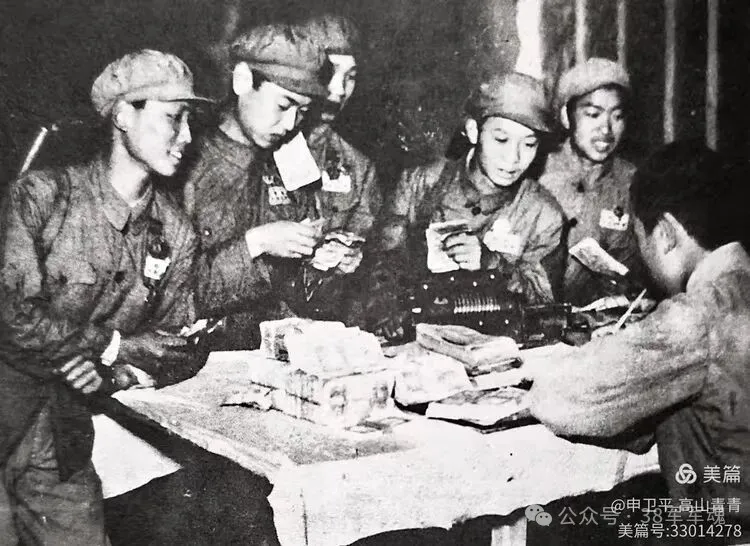
"በቀረው ዓለም ከእዝያ በፊት በታሪክ ማን ከማን ጋር ለምን ያክል ግዜ ረጅም የሆነ ውግያ እንደ ተዋጋ በውል የማውቀው ነገር የለም። በእኛ ዘመንና በአዲስቱ ኢትዮጵያ ከተካሄዱት ጦርነቶች ግን:ከኤርትራ አማጽያን እንዳደረግነው ውግያ ግዙፍና ብዙ ዋጋ ያስከፈለ አለ ለማለት እቸገራለው።
ካማንም ባዕድ ጦር ጋር ብንዋጋ ከዚህ ጦርነት የበለጠ ዋጋ አንከፍልም። ለምን? መካድ አንችልም! ሰዎቹ ተዋጊዎች ናቸው ይዋጋሉ።
ለዚያ (ለኤርትራ ጦርነት) የተከፈለው መስዋዕትነት ቀላል አልነበረም: የወጣው ገንዘብና ሎጂስቲክስ ቀላል አልነበረም : በአንድ ታዳጊ ሀገር ረዥም: ብዙ የጠየቀ : ብዙ መሳርያ የተሰለፈበት ምናልባት ከኮርያ ጦርነት በመለስ የእኛ ጦርነት ነበር።ይኼንን ሁሉም ይቀበለዋል"
Mengistu Hailemariam, 2024
“I don’t know for sure, in history, what war was fought the longest. However, from the wars that have taken place in our time and in modern Ethiopia, I hesitate to say that there was a war as massive and costly as the one we fought against the Eritrean rebels…Even if we fought against any foreign army, it would not be more costly than we did in that war. Why? We cannot deny it! The people (Eritreans) are warriors; they fight.
The sacrifice paid for that (the Eritrean war) was not small: the money spent and the logistics were not small either. For a young nation, it was long, it demanded a lot, and involved a massive deployment of weapons—perhaps, after the Korean War, it was this war. Everyone acknowledges this fact." Former President of Ethiopia Mengistu Hailemariam 2024
FACTS
-The #Eritrean armed struggle was the longest armed national liberation struggle in Africa & highly developed & effective armed struggle in the world. Many of the largest battles and military operations after WWII; the Red Star 1982 Operations, Nadew 1988, Fenkil 1990 & others, were fought in Eritrea.
-Between 1974 & 1991, #Ethiopia lost about 479,589 troops (1% of Ethiopia's then population of 46 million) fighting in Eritrea. Eritrea lost more than 65,000 her finest freedom fighters in the liberation war. 30% of Eritrean freedom fighters were women.
-From 1985-1991, #EPLF released 136,000 Ethiopian POWs. In 1985, 8000, in Dec. 1989, 10,000, in early 1991, 30,000, in Jan. 1990, about 2500, and after Independence in 1991, about 86,000 POWs including 900 officers & 3 #Soviet Officers were released.
-Mr. Fasika Sidelil, Derg's Economic Policy Chief, recently revealed that from 1974-1991, Ethiopia spent 50% of its GDP to fight against the Eritrean Armed Struggle for self-determination. From 1961 to 1974, Emperor Hailesilassie spent about 500 million U.S dollar, close to 5 billion U.S dollar worth today, for defense budget. This was mainly to fight the war in Eritrea.
-In 1991, 200 tanks, 50, 130 mm & 171, 122 mm artillery, 44 BM-21 & 18 BM-24 rockets, 127-ZU-23 anti-aircraft, 1038 mortars and a very large number of ammunitions were also taken from the defeated Ethiopian Army in Eritrea.
-In 1991, #EPLF destroyed Ethiopian Navy once and for all.
-In 1984, EPLF commandos destroyed 33 Ethiopian military aircraft including 16 MIG fighters.
-On 17 July 2001, the government of Ethiopia announced that Ethiopia spent $3 billion in the war with Eritrea, from 1998-2000.
-In 1999, Ethiopia spent 700 million U.S dollar, 9.5% of its GDP, to launch one of the biggest Offensive in history to invade #Badme, and in 2000 Ethiopia's defense budget was 620 million U.S dollar to unleash the 3rd Offensive against Eritrea.
The government also admitted that the conflict caused massive devastation with staggering human costs, demolished the country’s social and physical infrastructure, and diverted a great portion of the economically active population.
@AbiyAhmedAli
All 832 poverty-stricken counties and 98.99 million rural poor people have been lifted out of poverty since 2020. China further consolidates poverty alleviation gains in 2021-2025, with average subsistence allowance for urban, rural residents up 19.6% and 21.3% respectively. #CPC105
https://t.co/qs3HC55ZVB
“We want to break with our economic dependency. That means political independence.” — Salvador Allende
We revisit how Chile’s battle for its own copper inspired the Global South—and why empire crushed it.
In his honour, read :
https://t.co/P8lWLwzPki
"A 2009 cable records Meles telling US Ambassador Susan Rice that Ethiopia's military mobilization along the Eritrean border cost less than 1% of GDP, and that he could maintain such forces indefinitely — while Eritrea was spending a much larger proportion of its GDP on its military posture, making economic attrition an effective pressure tool". Wikileaks
Over 20 year period, (1998 and 2020, the start of the border dispute and the successful recapture of Eritrean territories by Eritrean Defense Forces) an annual average of roughly 8 to 14 million Ethiopians required food assistance. Ethiopia also received an estimated 50 billion in total foreign economic assistance.
It was despite these facts that Ethiopia decided to spend 1% of its GDP to violate international law and disregard its treaty obligations.
Had Ethiopia used the 1% GDP on...
You will only read it here!
President Trump has quitely and without any news reporting renewed Executive Order 13303, which puts all Iraqi oil revenues under his control. There has not been a single news item or White House press release since Trump signed the renewal in early May, 2026.
When Iraq sells oil to foreign companies, including the largest buyers, the Chinese, they deposit the money in a bank account in the New York Federal Reserve branch, not in an Iraqi bank. That account is controlled by the U.S. President and U.S. Treasury. EO 13303 was first signed by President George W. Bush in May 2003 after the illegal invasion of Iraq. All American presidents have since then ritually renewed it in May of every year under the guise of "national security emergency". The details of how this was done and why it is not legal have been explained by myself in different media. The Iraqi government has not dared to challenge this political and economic crime to the extent that Trump in March this year said that he did not want Nouri Al-Maliki (winner of elections last October) to become the new prime minister of Iraq. And the Iraqis obeyed. I explain some of the details in this previous interview: https://t.co/GvqjXmVS7n
Here is the document on the signing of the renewal on May 4, 2026: https://t.co/7HGdZkPFpu
The Potemkin Party is apparently seething under extreme desperation. It must indeed be at its lowest point; at the end of its tether so to speak!
How else can one explain the monotonous, 35-minute long diatribe of lies and hollow allegations against Eritrea peddled by mercurial Getachew Reda (nominally, Adivsor to the Prime Minister) that was broadcast yesterday by the Ethiopian Broadcast Corporation (EBC) and other domestic media outlets.
If the unhinged Getachew Reda is taken as a credible political analyst and a reference point, then the numerous insolent and outrageous remarks that he had made on various Tigrayan TV outlets, as well as his X Account, about the Ethiopian Prime Minister Abiy Ahmed during the war in the Tigray Region must be accorded due credibility too.
Indeed, some of his grotesquely disparaging statements on Abiy Ahmed and the Ethiopian army include:
- "Abiy Ahmed is a political pigmy. Had Ethiopia been a normal country, he would have long been confined to a mental institution or spiritual cites of healing for the deranged";
- "Abiy Ahmed is delusional enough to believe and openly brag that his mother had told him, when he was seven years old, that she saw him, in her dream, being crowned as a King";
-" Abiy Ahmed is the epitome and example of little men who come to power by some accident of history and who subsequently create huge catastrophes";
-"Abiy Ahmed cannot lead a nation without reverting to endless deceptions";
- "He (Abiy Ahmed) has literally no education...but you cannot ask him how he claims that he has a PhD as he does not give you time for reasonable discourse";
- "Abiy Ahmed is the textbook example of national treason. As such, he has no moral high ground to speak about sovereignty";
- "Abiy Ahmed is a toxic weed that has grown in this nation";
- " (General) Birhanu Jula and others are not leading a capable army. They have lost the little military knowledge they had and are sheepishly taking orders from this mad leader. This anti-people army, which is blindly implementing Abiy Ahmed's war agenda, is entailing massive deaths among the civilian population and the youth"...etc...
The rudderless Getachew Reda is indeed prone to making whimsical and contradictory statements on almost any issue depending on his unstable moods and ever-shifting political affiliations. Recently, as he struck an opportunistic alliance with the Federal Government and its PM on whom he was heaping endless insults, he has began to shamelessly disavow the political beliefs he had held for decades.
In a recent interview, he quipped (referring to his old comrades): "There are many people who maintain that Tigray should be an independent nation. I also mull about that concept whenever I am tipsy!"
His close associates confide that Getachew is tipsy or drunk from the late afternoon to the wee morning hours almost on a daily basis... This has in fact earned him the moniker :"Vodakchew".
On a more sober note, how can one give serious weight to the excesses and irresponsible utterances of this political vagabond.
In the event, there is no point in responding to all the vitriol that he has floated against Eritrea in his interview yesterday.
We will thus focus on one fallacy: his preposterous assertion that "Eritrea was created, by conspiratorial forces, as an independent State in order to weaken and destroy Ethiopia".
This spurious and revisionist claim is, of course, utterly false and deliberately peddled to rationalize and advance the Potemkin Party's wicked domestic agenda of agitation and mobilization for war.
History otherwise attests to these indelible facts:
1. Eritrea was denied its inalienable right of decolonization in the late 1940s and "federated" with Ethiopia only because the US and other powers gave precedence to their perceived geopolitical interests.
2. The international community kept mum, again for similar political calculus, when the Ethiopian government unilaterally abrogated the "Federal Act" and annexed Eritrea in November 1962.
3. The Eritrean people and nation had to shoulder the heavy burden of national liberation for thirty long years and pay huge and unparalleled sacrifices. Throughout this period, virtually the whole world showed unconscionable apathy by failing to recognize and extend moral and material support to Eritrea's legitimate war of national liberation. In the meantime, Ethiopia which was ruled by the Emperor and the military junta that toppled him continued to receive massive military, economic and political support from diverse countries - the US, USSR, European Countries, Israel, several Arab and Asian countries, Cuba etc..
4. The same pattern continued at various critical junctures in Eritrea's post independence period. The failure to take meaningful action against the Ethiopian regime when it reneged on its treaty obligations - essentially worked out under the facilitation of the the US, the EU, the UN and the OAU - and rejected the EEBC Arbitral Award to occupy sovereign Eritrean territories for almost two decades is a glaring illustration of the tendency of major powers, and the international community at large, to sacrifice legality and justice on the altar of narrow interests.
5. In all these decades, including in these critical times when the current regime is stoking the flames of war through its reckless agenda of "sovereign access to the sea", the "intensive care" accorded to Ethiopia has not diminished in any way. The IMF's 3 billion financial bailout that is underway; the EU's massive assistance, including recent budgetary assistance; individual bilateral support to Ethiopia from European, Asian, Middle Eastern countries...etc. corroborate this fact.
6. Indeed, by some accounts, Ethiopia has been the beneficiary of an aggregate 114 billion US dollars in the past three decades from multilateral and bilateral assistance. This pattern of huge and burgeoning assistance does not reek of, and cannot be misconstrued, by any stretch of imagination, as "some entrenched conspiracy to weaken and destroy Ethiopia".
In brief, and as noted earlier, Getachew Reda's "analysis" can hardly be taken seriously on any subject. For the Potemkin Party to stoop too low to use his deranged analysis for "popular mobilization" only accentuates its utter desperation.
What Caused Europe’s Industrial Collapse? Not China!
Warwick Powell writes for Guancha:
The The West’s sudden moral outrage over Chinese state subsidies conveniently obscures the real culprit behind Europe’s industrial decline:
The financialisation of European industrial capital. While Chinese firms were relentlessly reinvesting every cent of cash flow — bolstered by state-directed bank credit — into vertical integration, lithium mines, and automated manufacturing lines, European industrial giants were being hollowed out by financial rentiers demanding short-term yield.
#EU #China #Derisking #RebuildEurope @EUCouncil@ChinaEUMission
Read more on our Substack channel:
https://t.co/86VLSOZrQm
The simple, and thus tragic truth is that Europe has been hollowed out by US through death by a thousand cuts.
Nothing that produces high enough rents remains in European ownership.
German and UK patent catalogues were seized by US at the end of WW2.
Since then a secretive unit in the State Department watches for profitable innovations and facilitates US ownership.
Do you think Microsoft executives woke up and thought to buy Nokia and Skype? No, they were given orders.
Did GE plan to blackmail and intimidate Alsthom? No, they just went along with the plan.
And now as El Niño threatens US plains grain production European summer crops are burning in the fields.
It’s just good business.
Amílcar Cabral was a master of the "Weapon of Theory". He rejected rigid dogma, proving that transforming an "impossible" colonial reality into an independent future requires a rigorous, concrete analysis of our own material conditions.
https://t.co/RBiEQpc2Ir
Warwick Powell wrote for Guancha:
Last week, the US ordered Anthropic to block its top models (Fable 5 & Mythos 5) for all foreigners — even inside America. Anthropic ended up shutting them down for everyone.
At the same time, China’s Zhipu AI (https://t.co/SLimt3XHQh) released GLM-5.2 — 1M token context, strong coding & agentic capabilities — fully open-source under MIT License.
Two completely different paths:
America: control, restrictions, chokepoints
China: openness, speed, sovereignty & real resilience
This is the birth of Digital Westphalia.
Full article:
https://t.co/cuVAzyLaH9
#AIcompetition
#USChinacompetition
#ChinaUS
The system isn’t gravitating to equilibrium. It’s constantly struggling against entropy.
ThermoEconomics in a Time of Monsters is available on Amazon.
Link next post.
When symbolic claims & data flows multiply faster than the real capacity of an economic system to sustain them, we teeter on the edge of crisis.
My book Thermoeconomics in a Time of Monsters explores these interwoven dynamics.
Amazon link next post 👇🏽
On June 24, General Secretary Xi Jinping made an inspection trip to Dezhou City, east China's Shandong Province.
He said agricultural and rural modernization has a major bearing on Chinese modernization as a whole and the outcomes it delivers.
Efforts must be made to enhance the overall production capacity, quality, and performance of agriculture, ensure the stable supply of important agricultural products such as grains, build a beautiful and harmonious countryside for people to live and work in according to local conditions, and guide farmers to create a better life through hard work and wisdom. https://t.co/dU9VaITOYK
AlJazeera - Ethiopia is not being ‘dragged into war';
by Mr. Ali Ibrahim Ahmed, #Eritrea's Ambassador to Qatar
*"... The recent opinion article by senior Ethiopian officials Redwan Hussein and Getachew Reda, published on Al Jazeera English’s website, attempts to portray Ethiopia as an innocent victim being reluctantly 'dragged' into conflict by external actors. In doing so, the piece seeks to absolve the ruling Prosperity Party of responsibility for Ethiopia’s mounting domestic crises".
*"...More dangerously, this narrative serves as a diplomatic smoke screen designed to normalize the unprovoked hostility, state-sponsored inflammatory rhetoric and aggressive military mobilizations that the Ethiopian government has directed towards Eritrea since late 2023".
*"...This coordinated campaign seeks to normalize the idea that colonial boundaries in the Horn of Africa are negotiable in order to attempt to challenge inviolable principles of sovereignty and territorial integrity that have long underpinned regional stability".
*"...The broader pattern extends beyond Eritrea. Ethiopia’s recent foreign policy conduct has increasingly generated tensions with several neighboring states. The Memorandum of Understanding signed with Somaliland, which sought access to coastal territory without the consent of Somalia’s central government, triggered a major diplomatic crisis and raised serious questions regarding respect for established principles of sovereignty and territorial integrity".
*"...Similarly, Ethiopia has repeatedly pursued interventionist policies in neighboring conflicts in the quest for short-term geopolitical objectives. Whether in Somalia, Sudan or elsewhere, Addis Ababa’s reckless regional agenda of expansionism has contributed significantly to regional mistrust and destabilization".
https://t.co/MwqtJQeYx2 via @AJEnglish
Eritrea's National Service seems to be on the spotlight again by certain quarters.
The "new interest" does not stem from some "benevolent concern" for Eritrea. On the contrary, it is floated, purely and simply, in order to weaponize it as a "convenient" whiplash or cudgel for their unwarranted and malicious policies of perennial witch-hunting and harassment.
Indeed, the logic is simple and straight forward.
Countries and international institutions that were complicit in, or that kept mum, at critical junctures of Eritrea's modern history; when its decolonization rights were compromised to mollify the overriding geopolitical interests of major powers; when they left it to its own devices during the three decades of its long and arduous liberation struggle; who relapsed to their traditional position of hostility or apathy even after independence when successive Ethiopian regimes waged illicit wars, and are still contemplating reckless agendas, of territorial irredentism.. etc. have no legal or moral authority to comment on Eritrea's defense architecture.
Truth is international partnership is, and must be, a two-way street. Those who have traditionally abandoned Eritrea during its cyclical ordeals cannot pose as "good-faith" partners to offer unsolicited "advice" on its defense architecture.
The facts are otherwise unambivalent and crystal clear:
1. First off, demobilization is not a new or novel concept to Eritrea. The GOE embarked, on its own volition, on a demobilization programme in 1992, immediately after independence, to reduce the size of the 100,000-strong army of freedom fighters by 65%. The military doctrine at the time was to maintain a small professional army of 35,000 that would be supplemented by a reserve army (National Service) for reasons of contingency in the event of some grave external threat to the nation.
2. In this perspective, National Service was introduced in the context of this military doctrine. It was and remains limited to 18 months by law. And this was the operational modality until the war of aggression that was unleashed by Ethiopia in 1998 under the false pretext of a border dispute.
3. The GOE again embarked on a much more expansive Demobilization Programme in 2001 pursuant to the signing of the Algiers Agreement. The second Demobilization Programme had various training and reinsertion components as it was also funded by Eritrea's international partners including the World Bank, the European Union and bilateral funds. More than 105,000 National Service members were demobilized in this programme that continued until 2007. But it was ultimately shelved as the Ethiopian regime continued to renege on its treaty obligations; occupy, with impunity, sovereign Eritrean territories including Badme; and further pursued a hostile policy of perpetual confrontation.
4. The mindset of the current Ethiopian regime remains, in many respects, a continuation and aggravation of the misguided and deplorable policies of aggression of its predecessors.
4. But even during these trying and difficult times, the GOE has, and continues to take, various measures to mitigate the shared burden of the National Service. The measures adopted range from introduction of new and much higher Civil Service Salary Scale to deployment of the overwhelming majority of NS members to the public sector.
5. In the event, the new smear campaign on the National Service peddled by certain quarters, and its timing, only amplify a malicious ulterior agenda that has nothing to do with the welfare of the Eritrean people and/or the pursuit of regional peace and security.
I often like Ray Dalio's takes on China but he gets quite a lot demonstrably wrong in this FT article on the "tribute system."
China's ancient tribute system - called 朝贡 (cháogòng) in Chinese - is typically very misunderstood in the West: we typically think it involved tributary states paying some form of "tribute" to China in exchange for protection - the way medieval vassals would pay fealty to a lord in Europe.
In reality, it had little to do with that. In fact, it was almost the opposite: in the Chaogong system, it was actually China paying the "tributary states."
The system was basically a quid-pro-quo where China would get "得名" (dé míng, literally "getting name/prestige") while tributary states would get "得实" (dé shí, literally "getting substance/material benefit") in exchange. It was about China paying huge amounts of money and other material benefits for the recognition of its centrality.
That's what makes it so alien to the Western framework, where tributary states are paying UP to the center, and security is enforced through military presence. The Chaogong system was almost exactly the inverse on both counts: China was paying DOWN and regional order was maintained not through the military but through generosity.
The core guiding principle of the system was established by the Hongwu emperor, the founding emperor of the Ming dynasty (incidentally one of the most interesting emperors in Chinese history since he is the only founder of a major dynasty who started off in life as a wandering beggar).
The principle he set in place was 厚往薄来 (hòu wǎng bó lái) - literally "generous outflow, modest inflow": giving out much more than you take in. This wasn't a byproduct of the system - it WAS the system. The entire architecture of Chaogong was built on this principle of asymmetric generosity.
Very concretely the way it worked is that tributary states would pay largely symbolic tribute to China (like local specialties and curiosities, the system codified that tribute should be "easy to obtain and not costly", 必易得而不贵) and they would in exchange receive 3 layers of economic benefits:
1) Immediate payback in the form of money and expensive goods (silk, brocade, porcelain, tea, silver, etc.), which value was typically dozens of times the value of the tribute received by the emperor
2) The right to trade during their tribute visit: the envoys' entourage could trade with specially licensed Chinese merchants at the Huitongguan (the official guesthouse in the capital)
3) Most importantly, and that's where the real money was, they would be granted the right to trade at Chinese ports. Under the Ming maritime prohibition, tributary status was the only legal entry point into the Chinese economy
China being China, this gave rise to some pretty funny hustles. The deal was so good that people started inventing entirely fictitious countries just to get in on it. There are several documented cases of people fabricating countries and showing up as "envoys" at the imperial court just to claim the privileges (https://t.co/nlJB8yWblv).
Another funny one is that there are several cases of Fujian merchants who would sail to Southeast Asia, get themselves appointed as minor officials by local rulers, then sail right back to China as "foreign envoys" - carrying huge commercial cargoes. In 1438, three members of Java's tribute delegation turned out to be guys from Fujian (https://t.co/QBES0IVprC).
The scam got so widespread that the Ming had to invent a credential system (勘合, kānhé) specifically to verify that tribute envoys were who they claimed to be and that the countries they came from were real.
More seriously though, the Chaogong system also led to big domestic tensions in some of China's neighboring countries, notably Japan which was permitted only one tribute mission per decade. The stakes were so high that the 2 most powerful feudal clans at the time (the Ōuchi and the Hosokawa) fought a shadow war over who controlled the trade license.
This culminated in the Ningbo Incident of 1523 (https://t.co/TgKtlc7zlO): two Japanese delegations from both rival clans arrived at the port of Ningbo and got into a dispute over whose credentials were legitimate, which ended up in a pitched battle on Chinese soil. They ended up rampaging through the city, killing Ming military officers, and altogether terrorizing the local population - all over who got to trade with China.
The aftermath of the Ningbo Incident led to the total breakdown of Japan-China trade. If that sounds familiar, it should...
Which brings back to today and Ray Dalio's description of China's tribute system, as well as his claim that we're facing some sort of modern revival of it in Asia.
First of all, some parts of his article are correct: there is indeed a significant power shift happening in Asia, with countries hedging by building closer ties with Beijing, and the US progressively withdrawing and altogether losing ground.
He is also completely right that Chinese strategic culture genuinely differs from Western strategic culture: as he writes they indeed play Go (WeiQi) and not chess.
He is however wrong to describe the tribute system as one based on pressure and intimidation. As we've just seen, it was pretty much the opposite: the basic idea was to be so generous that everyone wants in (to the extent that countries would literally fight to be tributaries), not so threatening that nobody dares leave.
He also - weirdly - seems to conflate the tribute system with the Art of War, treating them as two faces of the same Chinese playbook, when they've got strictly nothing to do with each others. They're not even from the same school of thought: the Chaogong system is fundamentally Confucian (以德服人, "winning people through virtue") whereas Sun Tzu is from an entirely different Chinese intellectual tradition - the Strategist school (兵家) - which is about as far removed from Confucian thinking as Machiavelli is from the Bible.
Mashing them together reads like someone who has picked up a handful of Chinese cliché references and treats them as interchangeable ingredients in a single "Chinese strategic culture" soup.
All in all, he makes the error WAY too many Western commentators do with Chinese concepts: he uses them as exotic wrapping paper for a fundamentally Western analysis. Strip away the Chinese terminology and his argument is actually pure Western thinking: what he is claiming is that China, as a rising power, is using its growing economic and military weight to reshape the regional order, weaker states are bandwagoning, and the declining hegemon can't stop it.
He is essentially taking Graham Allison's "Thucydides Trap," awkwardly draping it in misunderstood Chinese concepts, and presenting it as if it were Chinese thinking.
That being said, he is ironically correct - I think - that there is some form of revival of a tribute-like system but not in the way he understands it: China will (and does) use trade - its "generosity" - as a gravitational force to pull countries into its orbit. Not by threatening to cut them off, but by making the relationship too valuable to walk away from. THAT is much closer to how the actual Chaogong system worked.
It doesn't mean that the system is purely benevolent. The flipside of generosity is the absence of it: in the original tribute system, you could be cut off the way Japan was after the Ningbo Incident in the 16th century. And it's also what's happening - to some extent - to Japan today: after PM Takaichi declared that Japan would go to war with China over Taiwan, China has systematically restricted trade with Japan. Same story with what happened, for instance, to Australia in 2020 over PM Morrison's declarations on Covid.
The pattern is the same: the reward for participation is trade, and the punishment for hostility is its withdrawal. Essentially in the tribute system there is no stick, just a carrot: the stick is taking the carrot away.
Which, incidentally, is why you can be extremely confident that China will go to enormous lengths to develop its internal market, and why the current situation where China runs huge trade surpluses is facing mounting pressure to change from within China itself. If countries don't feel they're benefiting enough from trade with China, the entire logic collapses. That's why developing domestic demand isn't some target China sets itself to assuage Western demands, as some claim: it's genuinely a strategic imperative.
It's also why it's ironic that the West is so keen on pushing China to boost domestic consumption: in effect, it means we're already in a de-facto Chaogong-like system and they're asking that the carrot be bigger.
-----
I also wrote a Substack version of this post, which you can find here: https://t.co/jBUIVbDT9C
#Eritrea's Agricultural Development over the Past 35 Years
MoA Newsletter June 2026
Concise and Insightful Summary of Progress Achieved under the Mantra: "Safe and Nutritious Food for Everyone; Everywhere!"
Broad themes include progress, and achievements, in:
- Nation-wide Water Reservoir Construction;
- Livestock Development and Animal Health;
- Scientific Research and Laboratory Excellence for National Food and Nutrition Security;
- National Animal and Plant Health Laboratory;
- Regulation of Agricultural Products; and,
- Desert Locust Control Strategy;
https://t.co/Vy3QtwHyPC
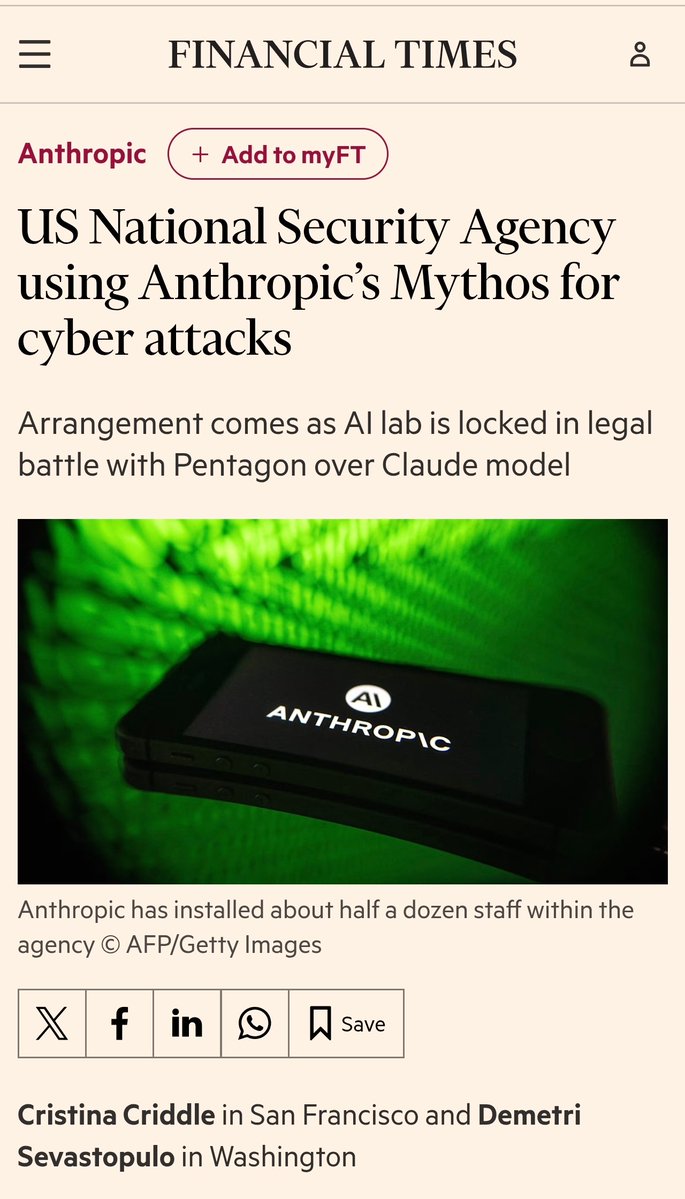
There you go: the FT confirms that not only is the NSA using Anthropic's AI "for offensive cyber operations" against "nations such as China or Iran" but Anthropic is actively helping them in that effort.
As per the article, Anthropic "installed about half a dozen staff within the NSA as so-called forward-deployed engineers to guide the use of the technology and customise models for specific applications."
It confirms two things. First: the United States is the most aggressive state actor in cyberspace, by far. It offensively infiltrates other nations' networks, and is now supercharging that capability with AI. Heck that is literally one of the core mission statements of the NSA, one of the largest security agencies of the US government.
Second, that Anthropic's carefully cultivated image as the ethical, safety-first AI company that "partners with the church" is a fiction. In reality, it is the most deeply embedded AI company in the US security state. Instead of building guardrails, they're literally weaponizing their own AI inside the NSA.
Src: https://t.co/sWmXvPSUy4