Colombia frontloaded more policy tightening – the board surprised with a 25bps hike this afternoon. Governor Villar keeps his eyes on fiscal, El Nino, quake’s impact on inflation. Finance Minister Gomez supported the hike.
A long and quiet fishing trip may be the best solution for some traders right now. Wall Street has loud doubters, but what is the remedy?
#Nasdaq100#SP500#Risks#AMTinsights
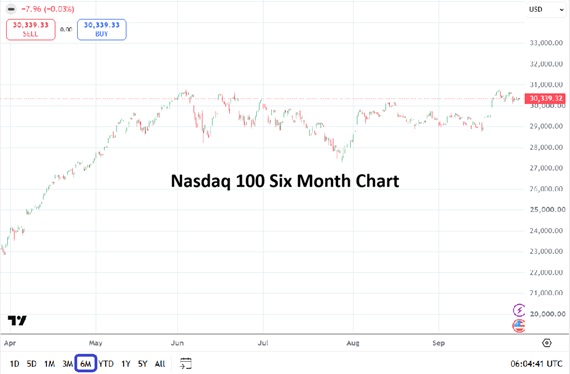
Nasdaq 100 is near resistance levels as many outwardly say they are cautious. Are there higher values to be found in the coming months or will sideways action with periodic selling occur? #WallStreet#SP500#Dow30#AMTinsights
This is what happen when Goverments and Policy makers think about solving immediate crisis , putting infrastructure and development path into distance.
When economic output is not matched by subsequent upgradation of facilities including revitalization of public spaces including roads, sewage system and cleanliness, then there is the taxpayers can't be blamed. It's the responsibility of Policy makers to focus on long term development paths and when they evade it, it ripples with climatic and environmental crisis, that will chnage into unfavourable conditions of doing business
This is not a tier 2 or 3 town, this is not even some distant far flung suburb.
This is Ambattur industrial estate, it generates employment for 200,000 people. Has an annual turn over of ₹ 15,000 crore of which ₹ 3,500 cr is exports.
It generates income taxes, CGST, SGST, excise and duties. It's support ecosystem (truckers, cleaners, security staff etc) must run into the 10's of thousands.
It's also an emerging residential real estate hub. The avg per sq in a newer condo is ₹7,500 / 8,000.
Yet it looks like a war torn dystopia. Has ZERO pavements though 10's of thousands of workers walk from railway stations / bus stops to their factori s and back.
Large parts of it lack functioning street lights.
Filthy open sewers, even spotted a few fat pigs in them, cattle, stray dogs, dust everywhere, garbage garbage garbage as far as the eye can see.
https://t.co/VQK82PTJ9V
Mexico’s peso has weakened about 5% against the dollar in the past month, the biggest decline among emerging market currencies. The exchange rate has swung on volatility in global financial markets and energy-price disruptions.
On this, Rodríguez said Mexico’s flexible currency regime helps absorb external shocks, allowing part of their impact to be reflected in the exchange rate rather in than the broader economy.
Banxico sees limited risk that those peso fluctuations will become a major new source of price pressure, Rodríguez said, pointing to the relatively low pass-through from the currency to consumer prices, particularly while the economy has spare capacity. Inflation expectations also remain anchored by confidence in the central bank’s commitment to price stability, she said.
In Indian towns, I have seen, when development paths are evaded without responsibility, people stuck between Low subsistence farming or emigrating to cities or foreign countries for employment.
India’s power plants are rapidly exhausting coal inventories as generators ramp up production to offset weak hydro and the evening drop-off in solar output, prompting the government to invoke an emergency rule to boost electricity supplies.
Read
https://t.co/0MMkqQpxdt
Rice prices, particularly those of fine varieties widely consumed in Tamil Nadu, have risen by up to 20 per cent in the past month amid poor paddy production and a decline in arrivals from neighbouring states. Traders fear prices could increase further in the coming days.
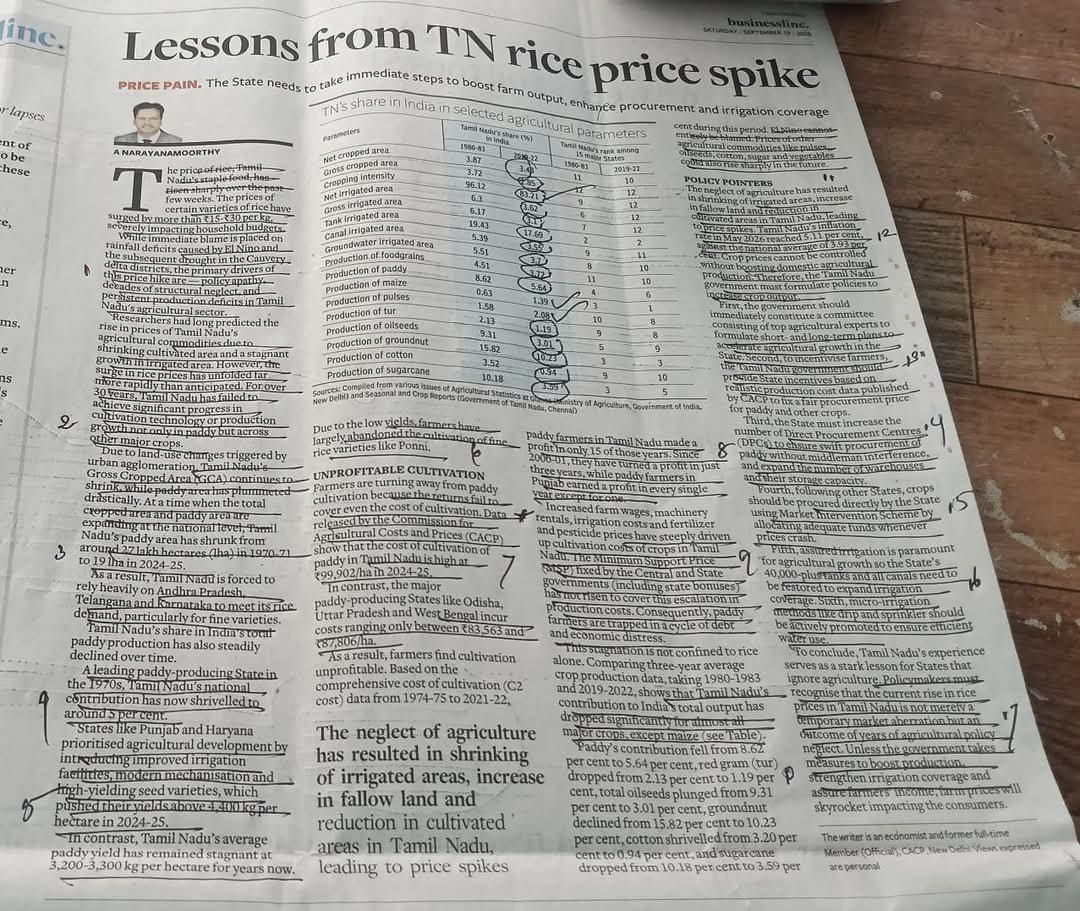
Excellent Piece by Professor Narayanamoorthy Sir on Tamil Nadu's falling agriculture output.
1) The prices of certain varieties of rice have surged by more than 15-30 per kg, severely impacting household budgets
2) The primary drivers of this price hike are - policy apathy, decades of structural neglect, and persistent production Deficits in Tamil Nadu Agricultural sector
3) Researchers had long predicted the rise in prices of Tamil Nadu's agricultural commodities due to shrinking cultivated areas and stagnant growth in the irrigated area. However, the surge in rice prices has unfolded far more rapidly than anticipated. For over 30 years, Tamil Nadu has failed to achieve significant progress in cultivation technology or Production corps not only in paddy but across other major corps
4) Due to land use changes triggered by urban agglomeration, Tamil Nadu's Gross cropped Area( GCA) continues to shrink, while the paddy area has plummeted dramatically.
5) At the time when the total cropped area and paddy area are expanding at the national level, Tamil Nadu's paddy area has shrunk from around 27 lakh hectares ( lha) in 1970-71 to 19 lha in 2024-25
6) Due to this fact , Tamil Nadu is forced to rely heavily on Andhra Pradesh, Telangana and Karnataka to meet its rice demand, particularly for fine varieties.
7) As a result , paddy-producing state in the 1970s, Tamil Nadu's national contribution has now shrivelled to around 5%
8) States like Punjab and Haryana prioritised agricultural development by introducing improved irrigation facilities, modern mechanisation and high yielding seed varieties, which pushed their yields above 4400 kg per hectare in 2024-25
9) In contrast, Tamil Nadu's average paddy yield has remained stagnant at 3200-3300 kg per hectare for years now.
Due to the low yields, farmers have largely abandoned the cultivation of fine rice varieties like Ponni
10) Farmers are turning away from paddy cultivation because the returns fail to cover even the cost of cultivation . Data released by the commission for agricultural costs and prices ( CACP) show that the cost of cultivation of paddy in Tamil Nadu is high at 99,902/ha in 2025
11) in contrast, the major paddy producing states like Odisha, Uttar Pradesh and West Bengal incur costs ranging only between 83,563 and 87,806/ ha
12) Increased farm wages, machinery rentals, irrigation costs, fertilizer and pesticide prices have steeply driven up cultivation costs of crops in Tamil Nadu.
Minimum support prices ( MSP) fixed by the central and the state governments(
including state bonuses) has not risen to cover this escalation in production costs.
Consequently, paddy farmers are trapped in a cycle of debt and economic distress.
13) Comparing three year average crop production data, taking 1980-1983 and 2019-2022, shows that Tamil Nadu's contribution to India's total output has dropped Significantly for almost all major crops, except maize.
14) Paddy production fell from 8.62 % to 5.64 % , red gram ( tur) dropped from 2.13 % to 1.19% , total Oil seeds plunged from 9.31 % to 3.01 %, groundnut declined from 15.82% to 10.23% , cotton shrivelled from 3.20% to 0.94% , and sugarcane dropped from 10.18% to 3.59% during this period.
El Nino cannot entirely be blamed. Prices of other agricultural commodities like pulses, oil seeds , cotton, sugar and vegetables could also rise sharply in the future
15) The Neglect of agriculture has resulted in shrinking of irrigated areas, increase in fallow land and reduction in cultivated areas in Tamil Nadu, leading to price hikes.
Tamil Nadu's inflation rate in May 2026 reached 5.11% against the national average of 3.93% .
Crop prices cannot be controlled without boosting Domestic agricultural production.
Is Wall Street about to suffer selling sludge? Bond yields remain stubbornly elevated. Middle East concerns remain. Oil is expensive. AI over-priced?
#Nasdaq100#SaudiaArabia#InterestRates#USD
2/2
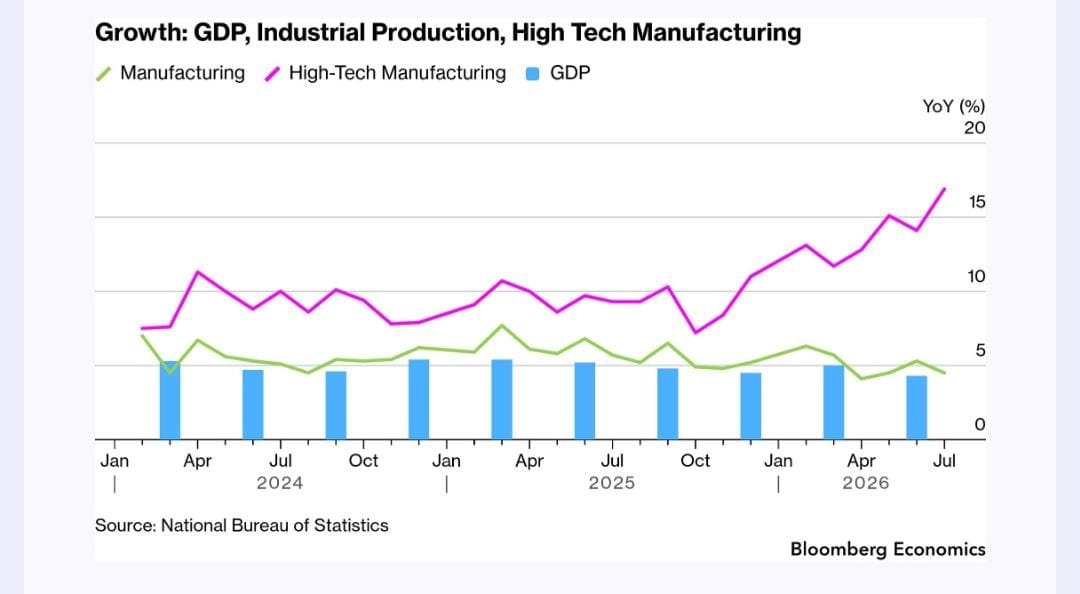
Labor weakness makes China’s new “two-speed regime” self-reinforcing, they concluded. Suppressed wage growth only enhances export competitiveness.
The situation is already so imbalanced that HSBC’s Neumann calculates China’s trade surplus in manufactured goods, as a share of world GDP (taking out China), now exceeds 2%. That’s double Japan’s mid-1990s peak, he says.
1/2
A Bloomberg Economics analysis last month showed that while China high-tech has created “spectacular growth pockets,” its impact is limited. “ Only a fraction of the population is enjoying the economic dividends of the tech transition, leaving the vast majority to absorb the pain of stagnation in legacy sectors,” economist Chang Shu wrote.
@macastel3 The quality of the cars are good , compared to other Nations, and as others pointed out, it shows their superior manufacturing and impressive sleek design that is well appealing for consumers
Neutral? Market sideways action is a warning. Is this a mere accumulation period, or a sign that bearishness will grow? USD strong, WTI high, bond yields and Wall Street nervous.
#Nasdaq100#SP500#Forex#Iran
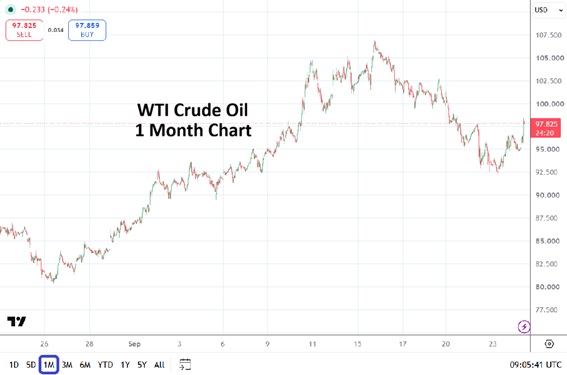
WTI Crude Oil has increased in value early today. Pressure on Iran remains. Large players appear to have turned more cautious in the past 12 hours.
#OilPrice#IranWar#SaudiArabia#Houthis#AMTinsights
Major yield spikes can structurally lock in higher borrowing costs for years - this is a lesson both from EM and the U.S. own history. Net interest outlays in the U.S. can surpass the 1980/90s peak (as % GDP) - even with much lower yields - because the debt/GDP ratio skyrocketed
Now Africa focused economists get wrong-footed, with Nigeria cutting rates 350bp to 23%, biggest headline cut since 2007
Most expected no change
Effectively a 200bp cut due to a tightening of the interest rate corridor
Lower rate at 20% in line with OMOs (so not moving mkts much)
Coffee Arabica has resumed its bearish trend. You may be able to order a 2nd cup of coffee for a cheaper price soon. However, shipping costs and container availability concerns loom, along with El Nino worries in the coming months.
#Cafe#Cocoa#Commodities#AMTinsights#Trading
https://t.co/6qP3suCAyn
While broad subsidies have helped cushion the blow for consumers this year, persistently high energy prices have started working their way through economies. That pass-through is likely to be strongest in countries where food weighs heavily in the consumption basket, such as in South Asia, the ADB said.
Several economies have scope for further monetary tightening this year if inflation persists, including Bangladesh, India, Indonesia, Pakistan, the Philippines, and Vietnam, the bank said. Once inflation recedes, policymakers may start weighing rate cuts in 2027, it said.