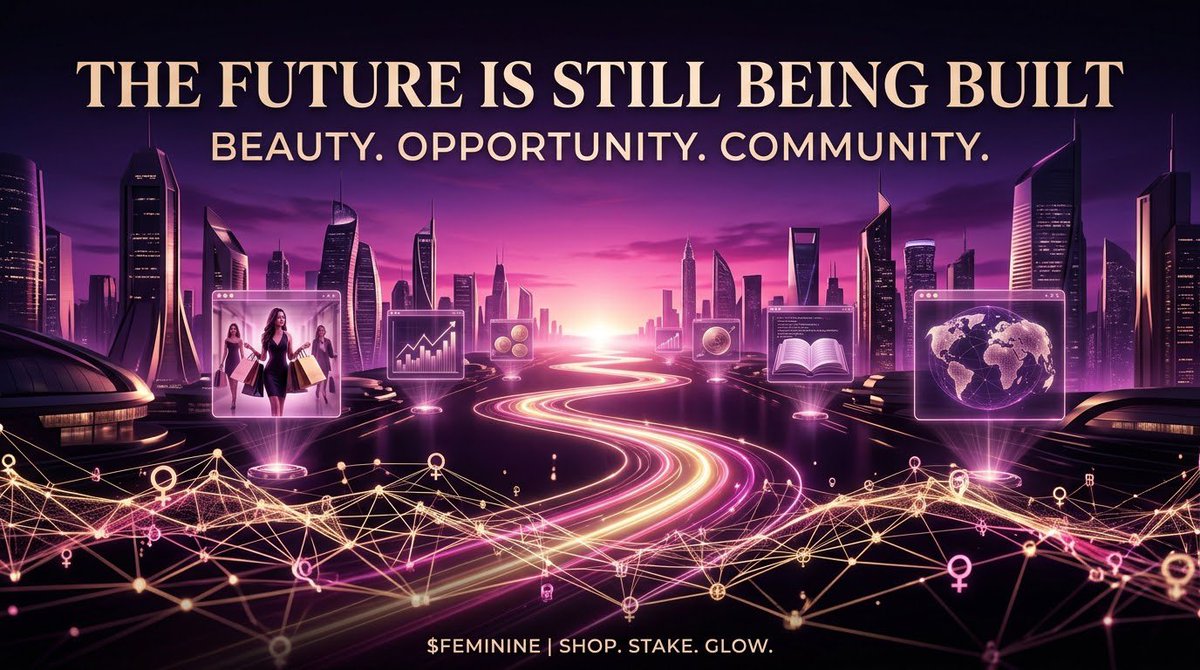
🌸 𝐖𝐇𝐀𝐓 𝐈𝐅 𝐓𝐇𝐄 𝐍𝐄𝐗𝐓 𝐁𝐈𝐆 𝐖𝐀𝐕𝐄 𝐎𝐅 𝐂𝐑𝐘𝐏𝐓𝐎 𝐀𝐃𝐎𝐏𝐓𝐈𝐎𝐍 𝐒𝐓𝐀𝐑𝐓𝐒 𝐖𝐈𝐓𝐇 𝐁𝐄𝐀𝐔𝐓𝐘?
Imagine a woman who understands skincare, perfumes, wigs, cosmetics, and wellness.
She knows how to choose products, compare brands, and spend on things that matter to her.
But when someone introduces her to Web3, everything suddenly feels different.
Wallets, gas fees, exchanges, tokens, and complicated blockchain terminology.
What if entering crypto didn't have to feel like learning an entirely new world?
What if an industry she already understands could become her gateway?
That's the idea behind $FEMININE.
A project connecting beauty, wellness, and blockchain through one ecosystem.
Let's explore the vision. 🧵
GOOD MORNING, CT! ☀️ THE FUTURE OF ON-CHAIN TRADING ISN’T JUST ABOUT BUYING AND SELLING. IT’S ABOUT WHAT HAPPENS AROUND EVERY TRANSACTION.
That’s what makes @RebateLaunch and @Hypesium interesting projects to follow.
Both are approaching different challenges, but their ideas connect to a bigger goal: creating a better trading experience.
@RebateLaunch: REWARDING PARTICIPATION
What catches my attention about RebateLaunch is how it connects trading activity with additional incentives.
Through Rebate Pad, eligible buyers can receive bonus tokens, while holders can earn rewards based on their eligible holdings and holding duration.
No staking or manual claiming is required for eligible payouts.
It’s an interesting approach to encouraging participation beyond the initial purchase.
@Hypesium: PREPARING FOR EXECUTION
Hypesium takes a more technical direction.
Built for Elysium, its Telegram trading bot focuses on transaction preparation, gas management, nonce reservation and multiple broadcast lanes.
I particularly like the idea of preparing important transaction details before a liquidity opportunity appears.
Because sometimes, the difference isn’t simply how fast you react, but how much preparation happens before you need to act.
TWO PROJECTS, TWO DIFFERENT FOCUSES.
RebateLaunch is exploring incentives that make participation more rewarding.
Hypesium is developing infrastructure designed to make trading execution more efficient.
Both remind me that strong Web3 products are built by solving real problems, not just adding more features.
New day, new opportunities to learn, explore and build.
Let’s keep growing, CT! 🚀
GOOD NIGHT, CT! 🌙 WHAT IF HOLDING A TOKEN COULD BE JUST AS INTERESTING AS BUYING IT?
That’s one of the ideas that makes @RebateLaunch worth exploring, especially when compared with the execution-focused approach of @Hypesium.
@RebateLaunch: MAKING TIME PART OF THE REWARD
One interesting feature of Rebate Pad is its holder reward structure.
According to its reward model, the longer eligible tokens remain in a wallet, the higher the holding multiplier:
0–3 days: 1x
3–7 days: 1.5x
7+ days: 2x
The idea is to reward both the amount held and the time spent holding.
Another detail worth noting is that buying additional tokens doesn’t reset the holding clock for existing tokens, while selling only affects the portion sold.
Eligible payouts are distributed in the relevant pair asset, depending on the chain, without staking or manual claims.
I find this approach interesting because it gives holders another reason to think beyond short-term trading.
@Hypesium: PREPARATION IS PART OF SPEED
While RebateLaunch focuses on holder incentives, Hypesium is approaching a different challenge.
Its Telegram trading infrastructure is built around preparing transactions before new liquidity opportunities appear.
Gas estimation, nonce reservation, transaction preparation and multiple broadcast lanes are designed to reduce unnecessary delays when execution matters.
The interesting lesson here is that speed isn’t always about reacting faster. Sometimes it’s about preparing better before the opportunity arrives.
TWO DIFFERENT STRATEGIES, ONE BIGGER PICTURE.
RebateLaunch is exploring how holding time can influence rewards, while Hypesium is working on improving how traders prepare and execute transactions.
One encourages longer participation. The other focuses on execution efficiency.
Of course, rewards depend on eligibility and actual activity, while faster execution never guarantees profitable trades.
Both projects highlight different areas that deserve attention as on-chain trading continues to evolve.
Good night, builders. Keep learning, keep researching and keep building. 🌙
Watching @RebateLaunch and @Hypesium.
GOOD NIGHT, CT! 🌙 ONE QUESTION WORTH ASKING BEFORE BUYING INTO ANY TOKEN LAUNCH: WHERE DO THE BONUS TOKENS ACTUALLY COME FROM?
That’s something I find interesting about the reward design behind @RebateLaunch.
The idea isn’t to create additional tokens whenever buyers need bonuses. According to the project’s model, every launch starts with a fixed supply of 1 billion tokens, with no further minting.
Here’s how the system is designed to work:
→ Fixed supply: Each token launches with 1 billion tokens, keeping the supply from increasing through later minting.
→ Locked treasury: At least 7% of the supply is allocated to the token’s treasury from day one.
→ Sell-fee funding: Sell fees replenish the treasury in tokens, helping fund buyer bonuses.
→ Buyer rewards: Tokens leave the treasury through bonus distributions to eligible buyers.
→ Controlled rewards: Bonus allocations and holder payouts are subject to a combined 9% cap.
What makes this model interesting is the closed-loop approach.
Instead of relying on continuous minting or an unlimited marketing budget, the reward mechanism is designed around existing token supply and trading activity.
But there’s an important distinction: a fixed supply and locked treasury don’t automatically guarantee sustainable rewards or token value. Actual trading activity, liquidity and the contract’s enforcement of these rules still matter.
That’s why I believe checking the mechanics behind a launchpad is just as important as looking at its advertised benefits.
@RebateLaunch is bringing an interesting question into the launchpad conversation: can trading activity fund buyer incentives without expanding token supply?
That’s a model worth examining beyond the headlines.
Good night, creators. Keep learning before you ape. 🌙 robinhood:0xb7ff57631b97000d950236ef63bd463da5beba7e
GOOD NIGHT, CT! 🌙 TRANSPARENCY MATTERS JUST AS MUCH AS THE FEATURES A TRADING PLATFORM OFFERS.
A bonus can make a token purchase look attractive, and low fees can make a trading bot appealing. But what really matters is understanding the full transaction before committing.
That’s one thing I find interesting about @RebateLaunch and @Hypesium.
@RebateLaunch: KNOW YOUR BONUS BEFORE YOU BUY
With Rebate Pad, eligible buyers can see their purchase bonus in the transaction quote before confirming a swap.
This gives users a clearer picture of the additional tokens they’re expected to receive, rather than leaving them guessing about the reward after the purchase.
@Hypesium: KNOW WHAT YOU PAY
Hypesium approaches transparency from the fee side.
Its trading fee is 1%, recorded as a separate on-chain transfer that users can independently inspect through a block explorer.
I like the idea of making costs visible and verifiable instead of leaving users uncertain about where their fees go.
TWO DIFFERENT APPROACHES, ONE IMPORTANT PRINCIPLE.
RebateLaunch focuses on showing buyers the additional value they may receive, while Hypesium makes its trading fee easier to verify.
But smart trading requires looking beyond those two numbers.
Slippage, gas costs, actual token allocation, liquidity and market conditions can all affect the final outcome.
A bonus doesn’t guarantee profit, and transparent fees don’t eliminate trading risks.
For me, the real advantage comes from knowing both the benefits and the costs before clicking confirm.
That’s the kind of transparency worth encouraging across Web3.
Powered by @StarListing.
Good night, everyone. Keep learning and building. 🌙
GOOD NIGHT, CT! 🌙 WHAT IF A LAUNCHPAD DIDN’T JUST TAKE FROM BUYERS, BUT GAVE THEM MORE TOKENS AT ENTRY?
That’s the idea behind @RebateLaunch, and I think it’s an interesting shift in how token launches can work.
Look at the difference in the buyer’s starting position:
Tax launch: -5%
V4 reflections: -2%
V2: 0%
Rebate Pad: +5%
The numbers highlight a different approach to launch incentives.
With Rebate Pad, qualifying purchases come with additional bonus tokens on top of the swap. Depending on the launch configuration, bonuses can range from 2% to 9%, with a minimum 1% head start built into the model.
Another detail I find important is transparency.
The bonus is displayed in the quote before the buyer confirms the transaction, and it is designed to be delivered within the same transaction.
That means buyers can understand the additional allocation before committing, rather than relying on a separate points system or waiting for a manual claim.
But there’s something worth remembering: receiving more tokens doesn’t guarantee profit. A bonus improves the number of tokens received at entry, not the market price or the quality of the project.
For me, the interesting part is how @RebateLaunch is shifting the conversation around launchpads.
Instead of competing only on fees, it’s exploring how to make the buyer’s entry more rewarding.
The next evolution of launchpads might not be about charging less. It might be about giving buyers more value when they enter.
That’s a model worth watching.
Sleep well, creators. Tomorrow brings another opportunity to learn, build and grow. 🌙
Good night, CT! robinhood:0xb7ff57631b97000d950236ef63bd463da5beba7e
Two weeks of Rebate Pad, given back:
🟣$254,000 in bonus tokens to buyers, valued at each token's high, across 26,012 buys
🟣$28,500 paid to holders, in 120,403 payouts
🟣35.3M $REBATE burned, 3.53% of supply
https://t.co/88S9mutLn4
GOOD NIGHT, CT. 🌙
There is a difference between seeing activity on a blockchain and understanding what that activity could mean.
A wallet makes a transaction. Another wallet follows. Several addresses begin interacting with the same token. On the surface, these may look like ordinary market movements, but looking deeper can reveal patterns worth investigating.
That’s the kind of perspective I appreciate about Stonk Watcher.
Its wallet-clustering and flagged-wallet features bring more context to on-chain activity, helping users investigate connections instead of judging everything by price movement or social media excitement.
And I like that the bigger mission is about making on-chain intelligence accessible, not keeping useful research tools behind a paywall.
Of course, information is not a guarantee, and every finding deserves further verification.
As the ecosystem grows, I want to see more people develop the habit of researching before reacting.
Another day of learning, another step forward.
Keep watching the chain. Keep questioning the noise.
Good night, everyone. 💤
@StonkwatcherSF $STWC
Good night X fams
A trading product needs more than a successful launch. It needs infrastructure that traders can actually use.
@Hypesium has now made its move to Elysium mainnet, bringing its Telegram trading experience into the live ecosystem.
What caught my attention is how much of the trading process it brings together.
Users can bridge assets from other EVM networks, simulate transactions before buying, execute buys and sells, snipe when liquidity opens, and monitor positions with sell limits and P/L tracking.
Another interesting detail is that Hypesium operates directly through Telegram rather than requiring traders to navigate several different interfaces.
Its latest X updates also show support for 19 Elysium launchpads and reported 24-hour trading volume of $59,420 across 14 tokens.
The public Telegram channel is still relatively small, with around 304 subscribers, so there is room for the community to grow.
For me, the interesting question now is how well Hypesium can turn its available tools into consistent trading activity.
Mainnet is live. Now comes the real test: execution, reliability and adoption.
Explore: https://t.co/eAcGGe19Qq
GOOD NIGHT, CREATORS! 🌙 THE FIRST FEW SECONDS OF A TOKEN LAUNCH CAN CHANGE EVERYTHING.
Before most traders even notice a new liquidity pool, some participants are already competing for the earliest entry.
That’s what makes @RebateLaunch and @Hypesium interesting to me.
They approach early token launches from two different angles, but both focus on one important challenge: getting access to new opportunities as quickly as possible.
@RebateLaunch: MAKING EARLY PARTICIPATION MORE REWARDING
RebateLaunch takes a different approach to the usual launch competition.
Through Rebate Pad, buyers can receive bonus tokens on qualifying purchases, while its launch mechanics are designed to reduce the advantage of early snipers.
One detail that stands out is the declining snipe tax, which starts at 99% and falls to zero within three seconds.
According to the project’s model, the collected tax goes into a locked treasury that supports buyer bonuses rather than simply becoming team revenue.
The idea is interesting: make early launch participation more beneficial to eligible buyers.
@Hypesium: COMPETING THROUGH EXECUTION SPEED
Hypesium focuses on the technical side.
Its Telegram trading bot is built for Elysium, where 100ms block times and the absence of a public mempool make execution infrastructure particularly important.
Features such as pool creation monitoring and pre-prepared transactions are designed to help traders react quickly, with sub-5ms execution as a target.
For traders looking to act early, preparation, routing and execution speed all matter.
TWO APPROACHES. ONE IMPORTANT MOMENT.
RebateLaunch is exploring how launch incentives can benefit buyers, while Hypesium is building tools for traders competing for early execution.
One focuses on changing the reward structure. The other focuses on improving the tools used to enter.
Personally, I find this contrast worth watching.
The future of token launches may depend not only on who gets in first, but also on how fairly and efficiently everyone gets to participate.
Good night, CT. Keep learning and keep building. 🌙
5/ THE VISION IS BIG, BUT EXECUTION WILL MATTER.
FEMININE outlines a roadmap that starts with foundation and token deployment, followed by marketplace development, staking infrastructure, community governance, and international expansion.
But there is an important detail worth highlighting:
The website currently states that smart contract deployment is pending. The marketplace, staking, and DAO utilities are planned developments, not services we should assume are already operational.
That makes execution the next thing to watch.
Can FEMININE turn its beauty and wellness vision into useful products, transparent blockchain infrastructure, and genuine community participation?
That's the real opportunity to follow.
🌐 Website: https://t.co/iznZc7eqes
Follow: @feminineofficia
$FEMININE: BEAUTY TURNED INTO WEALTH.
SHOP. STAKE. GLOW. 🌸
Do you think connecting beauty and blockchain could bring a new audience into Web3?
🌸 𝐖𝐇𝐀𝐓 𝐈𝐅 𝐓𝐇𝐄 𝐍𝐄𝐗𝐓 𝐁𝐈𝐆 𝐖𝐀𝐕𝐄 𝐎𝐅 𝐂𝐑𝐘𝐏𝐓𝐎 𝐀𝐃𝐎𝐏𝐓𝐈𝐎𝐍 𝐒𝐓𝐀𝐑𝐓𝐒 𝐖𝐈𝐓𝐇 𝐁𝐄𝐀𝐔𝐓𝐘?
Imagine a woman who understands skincare, perfumes, wigs, cosmetics, and wellness.
She knows how to choose products, compare brands, and spend on things that matter to her.
But when someone introduces her to Web3, everything suddenly feels different.
Wallets, gas fees, exchanges, tokens, and complicated blockchain terminology.
What if entering crypto didn't have to feel like learning an entirely new world?
What if an industry she already understands could become her gateway?
That's the idea behind $FEMININE.
A project connecting beauty, wellness, and blockchain through one ecosystem.
Let's explore the vision. 🧵
4/ THE SISTERS FUND: MORE THAN A TOKEN COMMUNITY
One part of FEMININE that deserves attention is the Sisters Fund DAO.
The whitepaper allocates 500 million FEMININE tokens, representing 5% of the total supply, to this proposed community treasury.
Its intended focus includes:
🌸 Female Web3 founder grants.
🌸 Community selected initiatives.
🌸 Education and participation.
🌸 Token weighted community voting.
Think about the bigger picture.
A woman entering Web3 could eventually move beyond being a consumer. She could become a participant, a builder, a founder, or someone helping decide which initiatives receive community support.
That is an interesting direction for a project built around inclusion.