Good night creators.
I'm new to launchpads like this, so before I looked at anything else, I checked the basics a beginner worries about.
Here's what I found on the Rebate Pad homepage.
★ You don't start at a loss.
Bonus tokens are added on top of your swap in the same transaction. Buy $100 of a token with a 5% bonus and you receive $105 worth. Your quote shows the base, the bonus and the total before you confirm, so you see it before you commit.
★ The rules can't change after you buy.
The creator sets the bonus rate (2% to 9%) and the payout rate once, when the token is created. After that, nobody can change them, and they're the same for every wallet. I like this because I only have to read the terms one time.
★ You don't have to do anything to get paid.
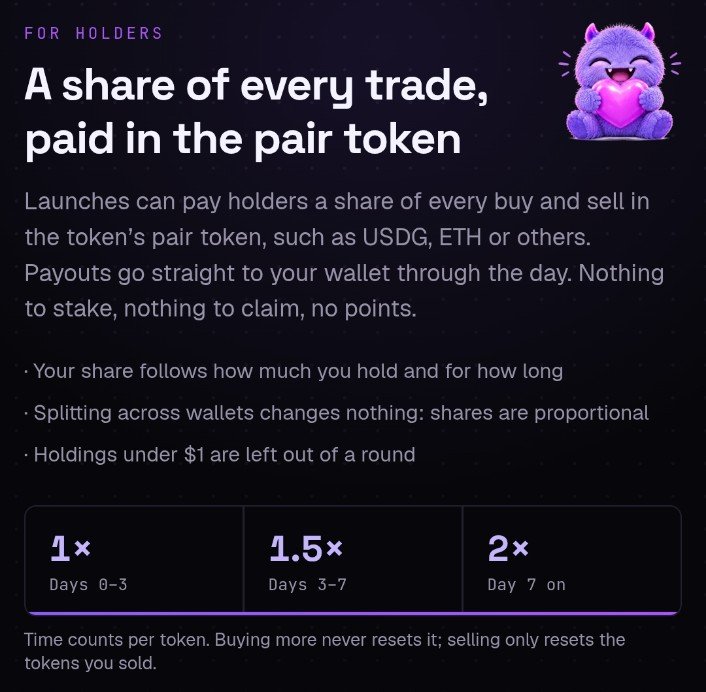
You hold the token in your wallet. Payouts go straight to your address through the day, with no staking, no claiming and no points.
★ Holding longer increases your share.
➠ Days 0 to 3: 1x
➠ Days 3 to 7: 1.5x
➠ Day 7 onward: 2x
Time counts per token. Buying more never resets it, and selling only resets the tokens you sold. Holdings under $1 are left out of a payout round.
★ The money comes from trading.
This is the part I'd tell every beginner to focus on. Holder payouts come from trading in the token's pair token, like USDG or ETH. A busy token has a bigger pot and a quiet one has a smaller pot. The bonus and payouts also share a 9% cap, so a creator can't max out both.
★ What I'd do as a first-timer:
Compare a few launches before choosing one. A high bonus with a low payout rewards the entry. A low bonus with a high payout rewards people who stay. Neither is automatically better, but know which one you're joining.
I haven't used the app yet because it's still marked "soon," so right now I'm learning the rules before it opens. That feels like the safest way to start.
$REBATE @RebateLaunch@starlisting
Everyone looks at the launches on @RebateLaunch I wanted to look at the pad's own token, Rebate.
Rebate is paired with USDG, with a 3% bonus on every buy and holder payouts in USDG.
So it works like every other token on the pad.
What makes it different is the fee loop. Platform fees from every token launched on the pad buy Rebate and burn it. Supply is fixed and nothing is minted, so burning only takes supply down.
The way I read it, Rebate isn't tied to one launch. It's tied to how much the whole pad gets used. More launches and more trading means more fees going into buying and burning Rebate.
The catch is the same one as everywhere else on the pad: it depends on activity. A quiet pad means less fee flow. I'd rather know that before I buy than find out after.
What I'm watching now: how many launches the pad gets, and whether that shows up in Rebate.
Posting through the @starlisting x @RebateLaunch partnership. You post, you earn.
Good night creators.
Good question in this quote. Every launchpad pays someone, and I want to know who before I buy.
If the fee is around 1% and the buy bonus is 3%, the bonus can't be a simple slice of that fee. Something else has to cover it. That's not a flaw, just the line I'd want in writing.
What I know so far: the bonus is added on top of your swap, the quote shows it before you confirm, and rates are fixed at launch. What I haven't confirmed is where the bonus is sourced, so I'm not claiming anything.
My advice: don't judge a bonus by its percentage. Find out who pays for it.
$REBATE | @RebateLaunch | @starlisting
Every launchpad pays someone. The question is who.
Pons: 1% on every trade. On current launches 70% goes to the creator and 30% to the protocol, and 80% of the protocol’s share buys back and burns $PONS.
https://t.co/pTHFktw87D: no launchpad fee.
@RebateLaunch : a 3% buy bonus, USDG payouts to holders several times a day, and platform fees that buy and burn $REBATE.
Rebate says it’s funded by activity with nothing minted. That’s a clear claim, and the one detail I’d want in writing is where the 3% sits: a reserve, the fees, or something else. A bonus bigger than a typical 1% fee has to come from somewhere.
The best launchpad model is the one that tells you who pays. I’m reading the docs for that line.
Good night, night owls of CT :)
Two people hold 1,000 tokens each.
Same balance. Different reward weight.
That's the part of @RebateLaunch holder system I spent some time thinking about tonight.
According to the website, holding duration changes your payout weighting:
Days 0–3: 1x
Days 3–7: 1.5x
Day 7 onward: 2x
But here's the clever detail.
Time is tracked per token not just per wallet.
Suppose you've held 1,000 tokens for eight days, then purchase another 500.
Your original 1,000 keep their 2x weighting.
The newly purchased 500 begin at 1x.
And selling doesn't automatically erase the age of everything you still hold.
That creates a different experience from systems where one transaction resets your entire holding period.
Of course, 2x weighting doesn't mean twice the guaranteed income. Actual payouts still depend on trading activity and your relative share.
I'm following these details through @starlisting while the app approaches launch.
Sleep well, everyone. Tomorrow brings another page to explore.
The best event coverage invites people who couldn't attend into the discussion.
Sharing @Utsav_DAR recap of the @DigiMaaya TechEZ KOL event at TOKEN2049 Singapore. Which community moments deserve more coverage?
@cryptojourneyrs interested in your perspective if relevant.
Angle: Educational explainer
I'm gonna make the $REBATE buy bonus easier to understand.
Imagine a purchase where the quoted swap amount is 1,000 tokens.
With a 3% bonus, the buyer would receive an additional 30 tokens, assuming the quoted amount is the eligible base and the bonus applies as described.
That's the basic idea behind the Rebate Pad mechanism.
But there's an important distinction:
Receiving more tokens doesn't automatically mean receiving more value.
The token price can change. Liquidity matters. Slippage and transaction costs matter. And a bonus is only as useful as the tokens you receive.
What makes @RebateLaunch worth examining is the combination of the purchase bonus and its separate holder payout mechanism.
Rebate holders receive USDG payouts directly to their wallets several times a day, without staking or manually claiming them.
The important questions are how these incentives are funded, how they behave as activity changes, and whether users understand the risks before buying.
Good tokenomics should be understandable before a transaction, not after it.
$REBATE | @RebateLaunch | @starlisting
Good night creators.
This breakdown from @RebateLaunch is worth a quote because it makes the buy bonus simple. Here's how I work through it myself when I look at a bonus.
I start with the quote. On Rebate Pad, the bonus is added on top of the base swap output in the same transaction, and the quote shows the base, the bonus and the total before you confirm. So I don't have to guess. If the base is 1,000 tokens and the bonus is 3%, I see 30 extra tokens and a total of 1,030 before I click anything.
Then I remind myself of the part people skip: more tokens is not the same as more value.
➠ Price moves. 30 extra tokens are worth whatever the token trades at later, not what the quote showed.
➠ Liquidity matters. A bonus on a thin market can be harder to turn into value than it looks.
➠ Slippage and costs still apply. The bonus doesn't cancel them out.
So I treat the bonus as a head start, not a profit. It's a real edge at entry, and what happens after depends on the token.
The second piece is the holder side. Holders get USDG payouts straight to their wallets several times a day, with no staking and no claiming. That's separate from the bonus, and it works differently. The bonus rewards the entry. The payouts reward the hold, and they come from trading activity.
$REBATE | @RebateLaunch | @starlisting
Angle: Educational explainer
I'm gonna make the $REBATE buy bonus easier to understand.
Imagine a purchase where the quoted swap amount is 1,000 tokens.
With a 3% bonus, the buyer would receive an additional 30 tokens, assuming the quoted amount is the eligible base and the bonus applies as described.
That's the basic idea behind the Rebate Pad mechanism.
But there's an important distinction:
Receiving more tokens doesn't automatically mean receiving more value.
The token price can change. Liquidity matters. Slippage and transaction costs matter. And a bonus is only as useful as the tokens you receive.
What makes @RebateLaunch worth examining is the combination of the purchase bonus and its separate holder payout mechanism.
Rebate holders receive USDG payouts directly to their wallets several times a day, without staking or manually claiming them.
The important questions are how these incentives are funded, how they behave as activity changes, and whether users understand the risks before buying.
Good tokenomics should be understandable before a transaction, not after it.
$REBATE | @RebateLaunch | @starlisting
The interesting part of @RebateLaunch isn't just the buy bonuses. It's how the model connects buying, holding, and platform fees.
The real test comes when the app goes live: actual trading volume, verifiable payouts, and on-chain buybacks and burns will matter more than the design on paper.
Worth watching, but execution will tell the bigger story. DYOR.
Discord access is a small update, but the bigger idea behind it matters.
For @0xhazels, ownership becomes more interesting when it connects people to actual opportunities within the ecosystem.
Access to allocations through Hazels Studio, grants, utilities, and holder only opportunities could give members reasons to stay involved beyond simply holding an NFT.
The important distinction is between having access and receiving real value. A community can open its doors, but long term engagement depends on the quality of opportunities, how transparently they are shared, and whether holders can benefit from participating.
That is what I will be watching as Hazels develops this next phase.
An NFT creates ownership. A strong ecosystem gives that ownership somewhere to lead.
Join the community: https://t.co/MhKvURupSi
gHazels.