i've been looking at what changed around @axisrobotics lately, and the interesting part isn't simply more tasks.
it's how the network is getting better at deciding which data deserves attention.
Axis has been pushing the Challenger Program while continuing to tighten the quality layer around community-contributed robot data. The recent research showed why that matters: from 660 correction attempts, only 161 short snippets survived the full verification pipeline and entered training.
but there's a deeper shift here.
data isn't valuable just because it exists.
a trajectory can be successful and still teach the wrong thing. a correction can look useful while adding redundancy, hesitation, or actions the policy never needed.
that's why the next stage of @axisrobotics feels less like “collect more robot data” and more like continuously discovering which data actually moves the model forward.
more contributors create more attempts.
better filtering determines what survives.
better tasks create new failure states.
those failures create new correction data.
the compounding loop isn't raw data → better robots.
it's new failures → verified signals → better policies → harder tasks → better data.
curious how far Axis can push this loop once Challenger tasks and the data-quality system start feeding each other at larger scale.
Sleep was never the whole story for @Sleepagotchi. It was the proof. 🦖
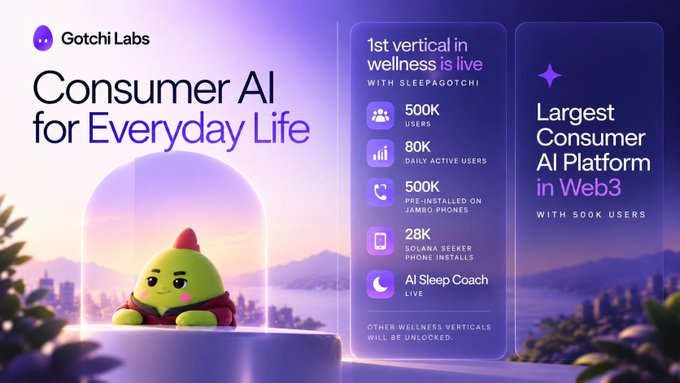
Sleepagotchi is now the first live vertical of Gotchi Labs, a broader Consumer AI platform built around specialized agents for everyday life.
The interesting part is the model:
Context → personalization → action.
With 500K+ registered users, ~80K daily active users and a live AI Sleep Coach, Sleepagotchi already has real users and real-world health context to test this thesis.
Now the vision expands beyond Health & Wellness into:
Shopping & Commerce
Fitness & Exercise
Productivity & Daily Life
Personal AI
Instead of one AI assistant trying to do everything, Gotchi Labs is building specialized agents that understand specific contexts and become more useful over time.
And this isn't starting from a whitepaper. There’s already a consumer product, distribution, historical revenue and an AI experience in users’ hands.
Sleepagotchi is the first vertical.
Gotchi Labs is the bigger bet.
Which everyday problem should AI understand deeply enough to actually change your behavior?
The next Consumer AI battle may be about context, not intelligence.
A general model can know almost anything.
But knowing your specific context is different.
Sleepagotchi uses sleep-related signals to create personalized AI interactions.
Gotchi Labs now wants to apply the same principle across multiple verticals.
That means specialized agents designed around specific behaviors rather than generic conversations.
If every vertical has its own context, should every vertical have its own AI agent?
Sleep was never the whole story for @Sleepagotchi. It was the proof. 🦖
Sleepagotchi is now the first live vertical of Gotchi Labs, a broader Consumer AI platform built around specialized agents for everyday life.
The interesting part is the model:
Context → personalization → action.
With 500K+ registered users, ~80K daily active users and a live AI Sleep Coach, Sleepagotchi already has real users and real-world health context to test this thesis.
Now the vision expands beyond Health & Wellness into:
Shopping & Commerce
Fitness & Exercise
Productivity & Daily Life
Personal AI
Instead of one AI assistant trying to do everything, Gotchi Labs is building specialized agents that understand specific contexts and become more useful over time.
And this isn't starting from a whitepaper. There’s already a consumer product, distribution, historical revenue and an AI experience in users’ hands.
Sleepagotchi is the first vertical.
Gotchi Labs is the bigger bet.
Which everyday problem should AI understand deeply enough to actually change your behavior?
A contributor's position can mean more when the community is known.
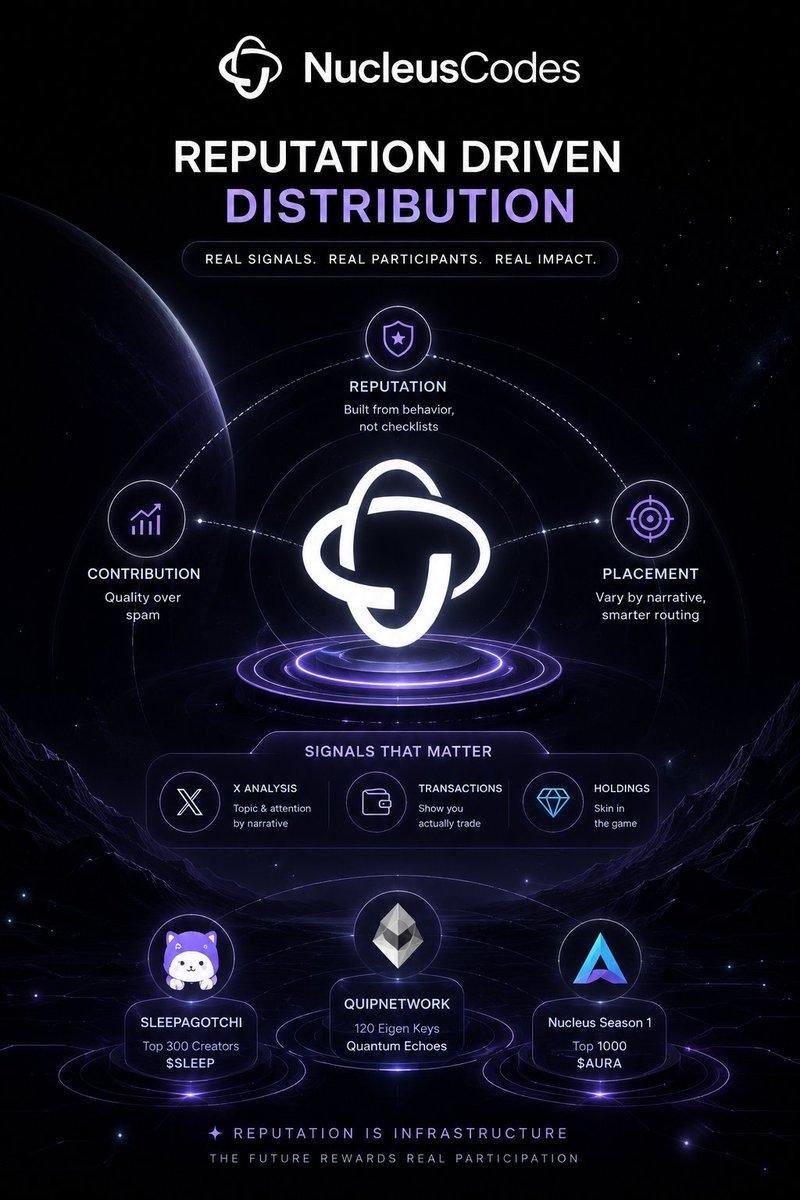
Community Rankings add context to individual performance on @NucleusCodes. A contribution isn't just an isolated action; it can be understood within a particular ecosystem. Could community-specific reputation become a new distribution primitive?
the interesting thing about @NucleusCodes right now isn't another leaderboard.
it's how they're starting to make community, contribution, and reputation separate signals.
the recent rollout of Community Rankings lets users choose one community, while the new vangrid Contribution Campaign puts $100K worth of rewards across the Top 300 contributors.
but the part i keep coming back to is how Nucleus describes contribution.
not simply posting more.
their HoodMiners campaign explicitly says rankings look at content quality, relevance and impact — and that one strong post can be worth more than several weak ones.
that creates a different incentive structure.
old model:
more posts → more visibility
Nucleus model:
better signal → stronger contribution → better position
and Community Rankings add another layer: your activity isn't only individual anymore. The community you associate with can also become part of the ecosystem's reward structure.
that's a much more interesting direction than simply adding another points leaderboard.
the question now is whether Nucleus can keep distinguishing genuine contribution from optimized farming as these campaigns get larger.
if quality becomes the scarce resource, how should a contribution platform measure it at scale?
@Girlgym67@NucleusCodes The strongest signal may come from consistency across different dimensions. One viral post can create attention, but sustained contribution creates evidence.