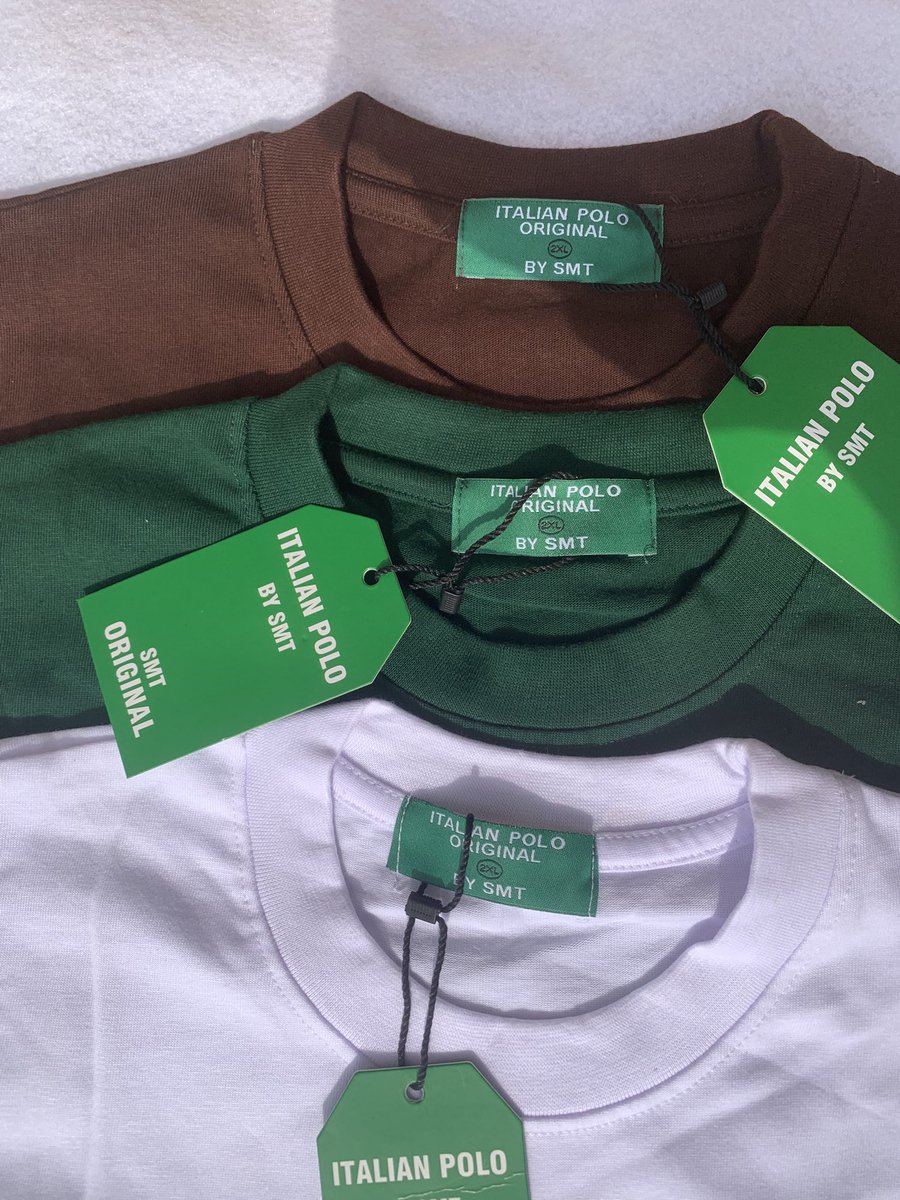
“Tell me your favorite plain T-shirt color and I’ll tell you your personality.”
•Black = Confident
•White = Minimalist
•Navy = Mature
•Grey = Easy-going
@Olami_deeEbony I moved all my properties in 2 nights with the help of my brother who was around then.
If you take out some of the properties a little bit away from the lodge then we flagged down a shuttle
Dear men,
Here are 12 foundational advice every man must have and imbibe in him.
1. Keep your word. Your reputation is built on what you do, not what you promise.
2. Master your emotions. Feel deeply, but don't let emotions control your decisions.
3. Choose character over image. Looking good is easy; being good is harder.
4. Protect your health. Strength, energy, and longevity are assets.
5. Learn to handle money. Earn, save, invest, and avoid unnecessary debt.
6. Take responsibility. Excuses solve nothing; accountability changes everything.
7. Respect women and people in general. Respect costs nothing and reveals everything.
8. Keep learning. A man who stops growing starts declining.
9. Choose your circle wisely. Your company influences your future.
10. Be dependable. Let people know they can count on you when it matters.
11. Stand for something. Principles are more valuable than popularity.
12. Live with purpose. Don't just exist—build, contribute, and leave a positive impact.
Shalom.
@streetcated There can never be success without checks and balances. Success can never can without a challenge.
Comparison is one of the driving forces to a big breakthrough but you have to keep yourself in check. Comparison is not bad
@Olami_deeEbony@BlaqShild50@DoraAd10 Heart to heart isn’t kiss. The important part is that you didn’t report any case of physical abuse or emotional abuse.
They have been living fine and having heart to heart talk.
Could normalize not talking down on peoples priorities.
Could we normalize not transferring or projecting our pain on other people.
Could we normalize opening up to people who look up to you that you don’t know anything about this skill set instead of calming to know and misleading them.
Could we cherish peace, lives and properties of others as much as we do to ours.
We transfer all our predicament on the government meanwhile the little we can do as individuals to make life meaningful to people around us is being overlooked.
There’s a cultural collapse in our society which started years ago, the elders are blaming the younger ones for it while the younger ones blame the older generation for it, who is to blame.
It’s high time we woke up from our slumber and salvage our society.
It’s a new day.
A day filled with opportunities.
A day that will find its place in memory.
A day some people will never forget.
A day that will make some and break others.
A day when some dreams will come alive, while others may fade away.
A day when some will be born and some will take their final breath.
A day when some will gain freedom and others will find themselves bound by new challenges.
Whatever comes your way today, give thanks.
Give thanks in victory and in struggle.
Give thanks in abundance and in scarcity.
Give thanks when the road is clear and when it is uncertain.
For every day is a gift, and every moment carries a lesson, a purpose, and an opportunity to grow.
Have a blessed and productive day. 🙏🏽✨
The Beauty of Plain T-Shirts
In a world filled with loud designs, flashy logos, and ever-changing fashion trends, the plain T-shirt remains timeless.
Its beauty lies in its simplicity.
A plain T-shirt doesn’t try too hard to get attention, yet it always looks good. Whether paired with jeans, joggers, shorts, or layered under a jacket, it effortlessly fits almost any style and occasion.
A plain T-shirt gives you freedom. Instead of the clothes speaking for you, your personality does. It allows confidence, character, and presence to stand out without distractions.
Comfort is another reason people love plain T-shirts. They are easy to wear, easy to match, and suitable for work, casual outings, travel, gym sessions, and everyday activities.
Unlike trendy designs that may go out of fashion, a quality plain T-shirt remains relevant year after year. It is one of the few pieces of clothing that never loses its value in a wardrobe.
The beauty of a plain T-shirt is not in what it adds, but in what it removes—unnecessary distractions. It proves that style doesn’t always need complexity.
Sometimes, the simplest outfit makes the strongest statement.
Simple. Clean. Timeless.
Upgrade your wardrobe with quality plain T-shirts that combine comfort, versatility, and effortless style. Send a message today to place your order and find your perfect fit. 👕✨
A culture does not collapse in a single day. It happens slowly—when values are abandoned, traditions are mocked, and principles are exchanged for convenience. At first, the changes seem small, but over time the consequences become impossible to ignore.
When a culture collapses, respect is often the first casualty. Children no longer honor their parents, students lose respect for teachers, and leaders stop serving the people they were chosen to lead. The bonds that once held communities together begin to weaken.
Trust soon follows. People become suspicious of one another because honesty is no longer rewarded. Promises lose their meaning. Friendships become transactional, and loyalty becomes rare. A society without trust spends more time protecting itself from betrayal than building a better future.
The family, the foundation of every society, begins to suffer. Parents become less involved in raising their children, and communities stop correcting wrongdoing. Young people grow up without guidance, learning values from social media, peers, and trends rather than from elders and role models.
Crime and corruption often increase. When shame disappears and wrongdoing carries few consequences, people become more willing to cheat, steal, exploit, and deceive. What was once considered unacceptable gradually becomes normal.
The boy child, in particular, can become a silent victim of cultural collapse. He is expected to be strong but is rarely taught character. He is told to succeed but is not always shown responsibility. As positive male role models disappear, many young men grow up confused about purpose, leadership, and identity.
Eventually, a society may gain wealth, technology, and influence while losing its moral compass. Roads may improve, buildings may rise, and businesses may grow, yet people may feel more disconnected, lonely, and uncertain than ever before.
The greatest danger of cultural collapse is that people stop recognizing it. When wrong becomes normal, and normal becomes celebrated, a society can lose the very values that once made it strong.
History shows that nations are not destroyed only by external enemies. Many are weakened from within when they abandon the principles, discipline, and shared values that held them together.
Culture is the invisible foundation of a people. When the foundation cracks, the consequences eventually reach every home, every family, and every generation that follows.
The Struggles of a Young Boy Living in Africa
The rooster had not yet crowed when twelve-year-old Chinedu opened his eyes. The room was still dark. He could hear the rain tapping softly on the rusted zinc roof above his head. Beside him, his younger siblings slept peacefully on a thin mattress spread across the floor.
His mother was already awake.
“Chinedu, wake up. We need water before the neighbors get to the borehole,” she whispered.
Without complaint, he stood up. Childhood had taught him many things, but sleeping late was not one of them.
Balancing two empty containers, he walked through muddy roads before sunrise. Other children his age were doing the same. Some carried water. Some hawked bread. Some helped their parents prepare for another day of survival.
By 7 a.m., Chinedu had fetched water, swept the compound, washed the plates, and was rushing to school.
His uniform was fading. His sandals had a torn strap tied together with a piece of wire. Yet he walked proudly because education was the one thing he believed could change his future.
In class, he listened carefully. His teachers often praised him for being intelligent. But intelligence could not pay school fees.
Whenever the principal announced that students who owed fees should go home, Chinedu’s heart raced. Sometimes he escaped embarrassment. Sometimes he didn’t.
On those days, he would walk home slowly, wondering why poverty seemed to punish those who were trying hardest to escape it.
After school, while some children played football, Chinedu headed to the market.
He helped his mother sell vegetables.
He smiled at customers even when he was tired. He carried heavy baskets even when his shoulders ached. He counted small profits and prayed they would be enough for food, rent, and school expenses.
At night, he studied under a rechargeable lamp because electricity rarely stayed long enough for him to finish his homework.
There were moments when he wanted to give up.
Moments when hunger made concentration impossible.
Moments when he watched wealthy children arrive at school in comfortable cars while he walked several kilometers every day.
Moments when he asked himself, “Why is life so hard?”
But every time discouragement came, he remembered his mother’s words:
“A difficult beginning does not mean a difficult ending.”
Years passed.
The struggles did not disappear overnight. There were setbacks, disappointments, and tears that nobody saw.
Yet those difficult mornings taught him discipline.
The long walks taught him endurance.
The empty pockets taught him responsibility.
The hardships taught him gratitude.
One day, the boy who fetched water before sunrise became a man who no longer worried about where the next meal would come from.
Standing before a group of young students, he shared his story.
He told them that poverty is heavy, but hopelessness is heavier.
He told them that circumstances may delay a dream, but they do not have the power to destroy it.
And as he looked into the eyes of the children sitting before him, he saw himself—the young African boy carrying burdens bigger than his age, fighting battles nobody talks about, and dreaming dreams bigger than his environment.
Because across Africa, there are millions of boys like Chinedu.
Boys who wake before dawn.
Boys who carry responsibilities before they understand childhood.
Boys who are told to be strong even when they are hurting.
Boys whose struggles are often invisible.
Yet many of them keep moving forward.
And that quiet determination may be one of the greatest stories ever told.
The Upbringing of the Average Nigerian Boy Child
The day Chinedu was born, the room was filled with joy.
“It’s a boy!” the nurse announced.
His father smiled proudly. His mother held him close. Relatives celebrated because, in many homes, the birth of a boy came with expectations. To them, he was not just a child; he was a future leader, a future provider, a future man.
But Chinedu knew none of this.
He was just a boy.
As a child, he ran barefoot through the compound, played football with makeshift balls, and chased dreams that were bigger than the streets he grew up on. Life was simple then. His biggest worries were whether his team would win a football match or whether his mother would allow him to stay outside a little longer.
Then he started growing up.
One day, while carrying water from a nearby borehole, he complained about the weight of the bucket.
His father looked at him and said, “You are a man. Men don’t complain.”
The words seemed harmless at the time, but they became a lesson repeated throughout his life.
When he cried after being beaten in school, he was told, “Boys don’t cry.”
When he was scared, he was told, “Be strong.”
When life hurt, he learned to hide it.
Slowly, Chinedu discovered that people expected strength from him long before they allowed him to understand himself.
As the years passed, responsibilities arrived early.
His sisters helped at home, but Chinedu was constantly reminded that one day he would carry the family name. One day he would become responsible for a wife, children, and perhaps even his parents.
He was barely a teenager, yet adulthood was already waiting for him.
Secondary school brought another reality.
Every lesson felt connected to survival.
“Read your books,” his teachers said. “Education is the key.”
He watched his parents struggle to pay fees. He saw his mother stretch a small amount of money to feed the family. He saw his father leave home before sunrise and return exhausted.
Without anyone saying it directly, he understood the message:
Failure was expensive.
By the time he reached university—or, for many boys, the point where university was no longer possible—life became a race.
A race to find work.
A race to make money.
A race to become “successful.”
Some of his friends travelled abroad. Some learned trades. Some started businesses. Some lost their way.
Yet every morning, they woke up carrying the same invisible burden:
The burden of becoming somebody.
Years later, Chinedu finally understood something.
The average Nigerian boy is raised with enormous expectations.
He is taught responsibility before comfort.
Strength before vulnerability.
Provision before self-discovery.
The world often sees his confidence but not his fears.
It sees his ambition but not the pressure behind it.
It sees his achievements but not the sacrifices that built them.
And yet, despite everything, he keeps moving.
He dreams.
He hustles.
He falls and rises again.
Because deep inside the average Nigerian boy is a quiet determination—a belief that somehow, someday, all the sacrifices will be worth it.
And perhaps that is the true story of the Nigerian boy child:
Not that life was easy.
But that despite the odds, he never stopped trying to build a better future than the one he inherited.