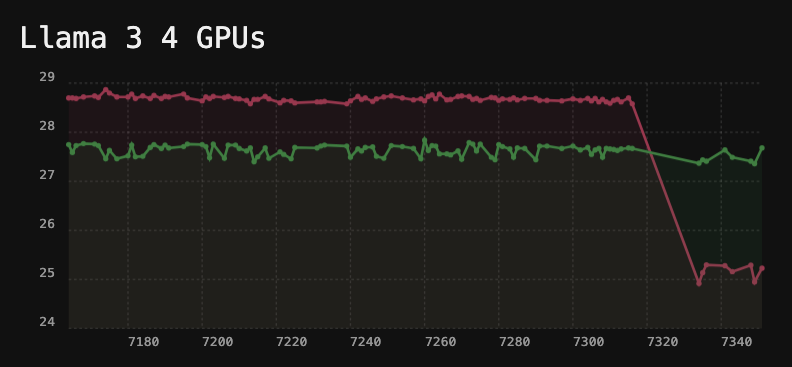
I've had access to Fable for a bit. A genuine jump in capability, I could feed it a 15 page design document for a project and it would work for 9+ hours and deliver terrific results.
But working with it is weird & weirder is coming
Lots of examples: https://t.co/HptkYunBzr
@Daniel__78@BrianDoher37387@skdh A good test for the ice lofting hypothesis is to compare transit freq. in the nuclear event -day to the +day. Cross references with major volcanic eruptions could also help test the high altitude ice crystals explanation.
Space jellyfish alert!
Starlink 17-14 from SLC-4E in California on April 22, 2026 at 7:56:39 PM PDT could produce a space jellyfish. This occurs when a rocket and its expanding exhaust plumes are illuminated by the sun and observers are in local darkness.
The rocket will enter sunlight 01m25s after launch.
See a detailed prediction for your location: https://t.co/KIadNi37so
Information as of 2026-04-23 01:08 UTC
2.6 million flood events were hiding in plain sight inside the news. Google just turned them into a training set.
Satellites and traditional databases are too slow to catch urban flash floods. The United Nations disaster database holds about 10,000 high-impact events. You can't train a global AI model on 10,000 data points. Accurately modelling climate resilience requires massive historical baselines that simply didn't exist.
Google researchers built a pipeline called Groundsource to fix this data desert. They pointed Gemini at decades of unstructured global news reports across 80 languages. The LLM translated the text and ran a strict verification process. It separated actual past floods from future warnings. It anchored relative dates to publication timestamps. Then it extracted granular street-level locations and mapped them to standardised spatial polygons.
They essentially turned unstructured text into a structured geospatial dataset. Groundsource generated 2.6 million verified flood events spanning 150 countries. Manual reviews showed 82% of these extracted events were accurate enough for real-world spatial analysis.
This historical baseline immediately upgrades urban flood forecasting. Google is now rolling out near-global urban flash flood forecasts up to 24 hours in advance.
Physical sensor networks take decades to build and deploy. Advanced data engineering provides a massive shortcut.
The world's local news is a perfectly valid historical sensor network...
The full depth of liberal Australian insanity on display here. Giving one of the most important archaic human fossils ever discovered to a group of aborigines so they can bury it somewhere it will never be found again. The people responsible should be put in trial.
In a large representative sample of humans compared to GPT-4: "the creative ideas produced by AI chatbots are rated more creative [by humans ]than those created by humans... Augmenting humans with AI improves human creativity, albeit not as much as ideas created by ChatGPT alone”
Your brain's next 5 seconds, predicted by AI
Transformer predicts brain activity patterns 5 seconds into future using just 21 seconds of fMRI data
Achieves 0.997 correlation using modified time-series Transformer architecture
-----
🧠 Original Problem:
Predicting future brain states from fMRI data remains challenging, especially for patients who can't undergo long scanning sessions. Current methods require extensive scan times and lack accuracy in short-term predictions.
-----
🔬 Solution in this Paper:
→ The paper introduces a modified time series Transformer with 4 encoder and 4 decoder layers, each containing 8 attention heads
→ The model takes a 30-timepoint window covering 379 brain regions as input and predicts the next brain state
→ Training uses Human Connectome Project data from 1003 healthy adults, with preprocessing including spatial smoothing and bandpass filtering
→ Unlike traditional approaches, this model omits look-ahead masking, simplifying prediction for single future timepoints
-----
🎯 Key Insights:
→ Temporal dependencies in brain states can be effectively captured using self-attention mechanisms
→ Short input sequences (21.6s) suffice for accurate predictions
→ Error accumulation follows a Markov chain pattern in longer predictions
→ The model preserves functional connectivity patterns matching known brain organization
-----
📊 Results:
→ Single timepoint prediction achieves MSE of 0.0013
→ Accurate predictions up to 5.04 seconds with correlation >0.85
→ First 7 predicted timepoints maintain high accuracy
→ Outperforms BrainLM with 20-timepoint MSE of 0.26 vs 0.568
Reminder for the new semester
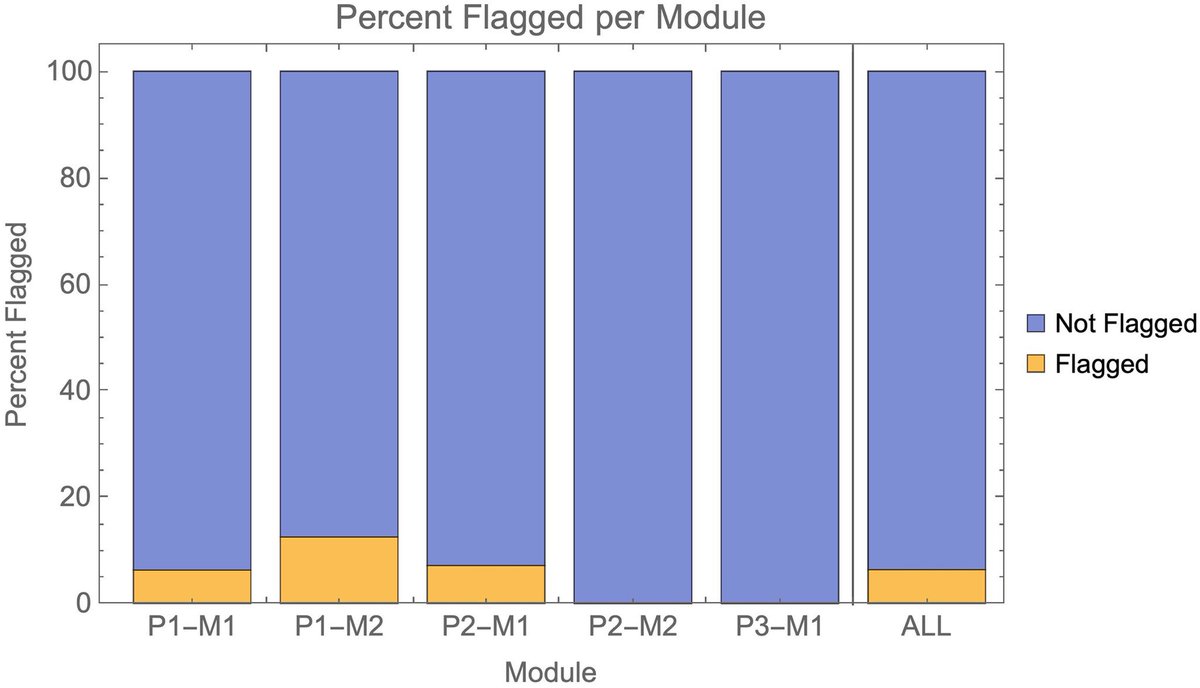
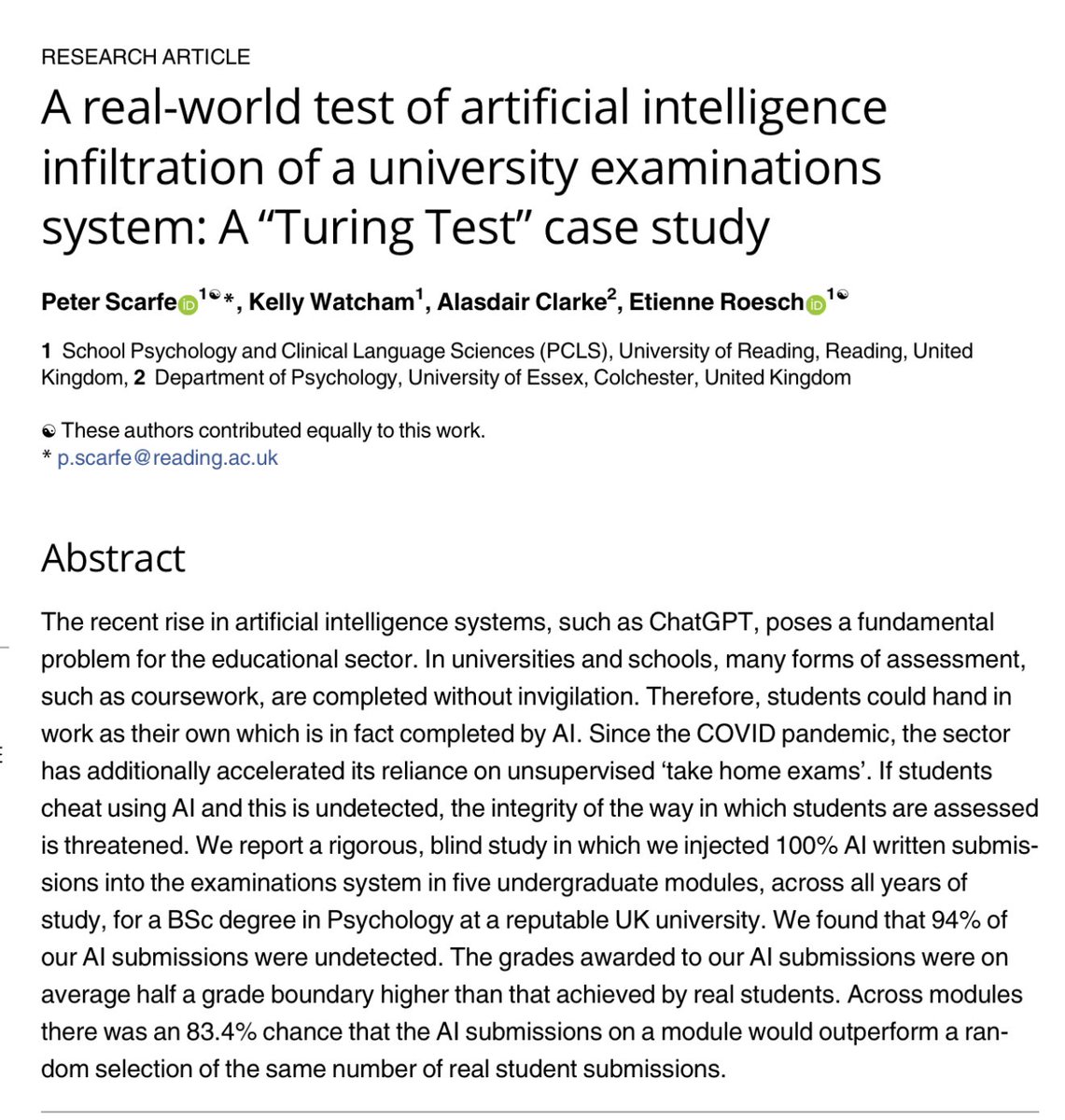
When researchers secretly added AI-created papers to the exam pool: “We found that 94% of our AI submissions were undetected. The grades awarded to our AI submissions were on average half a grade boundary higher than that achieved by real students.”
For a couple years, I have been using "otter using wifi on an airplane" as my test for the improving ability of AI image and video systems.
But this is now too easy a challenge for current AI, so what if we kicked it up a notch (these are all veo 2 clips).
The Superhuman AI for Poker is a timeless research paper.
Poker, unlike Go/Chess, is an imperfect info game. Pluribus, made by now OpenAI engineer, beat 5 pros decisively in 10,000 poker hands, winning 48 milli big blinds/game.
Made a mini demo on rock-paper-scissors too:
1/5
The tradition of folks that do not have the expertise to use notebooks effectively then going on to blame the tool continues for another year.
Bring on 2025!
the first three chapters of our book, https://t.co/KWTfVdQtvD (free online) cover the conceptual basics of web development 1.0
the perfect gift for the zoomer in your life who doesn't know what a form tag can do
zoomers & embittered, washed up gen x devs, stronger together!
I'll get straight to the point.
We trained 2 new models. Like BERT, but modern. ModernBERT.
Not some hypey GenAI thing, but a proper workhorse model, for retrieval, classification, etc. Real practical stuff.
It's much faster, more accurate, longer context, and more useful. 🧵


![emollick's tweet photo. In a large representative sample of humans compared to GPT-4: "the creative ideas produced by AI chatbots are rated more creative [by humans ]than those created by humans... Augmenting humans with AI improves human creativity, albeit not as much as ideas created by ChatGPT alone” https://t.co/rJDUZxJ4iL](https://pbs.twimg.com/media/Giv5JjrWEAAZuFf.jpg)









![emollick's tweet photo. In a large representative sample of humans compared to GPT-4: "the creative ideas produced by AI chatbots are rated more creative [by humans ]than those created by humans... Augmenting humans with AI improves human creativity, albeit not as much as ideas created by ChatGPT alone” https://t.co/rJDUZxJ4iL](https://pbs.twimg.com/media/Giv5JjtWoAA4pXH.jpg)