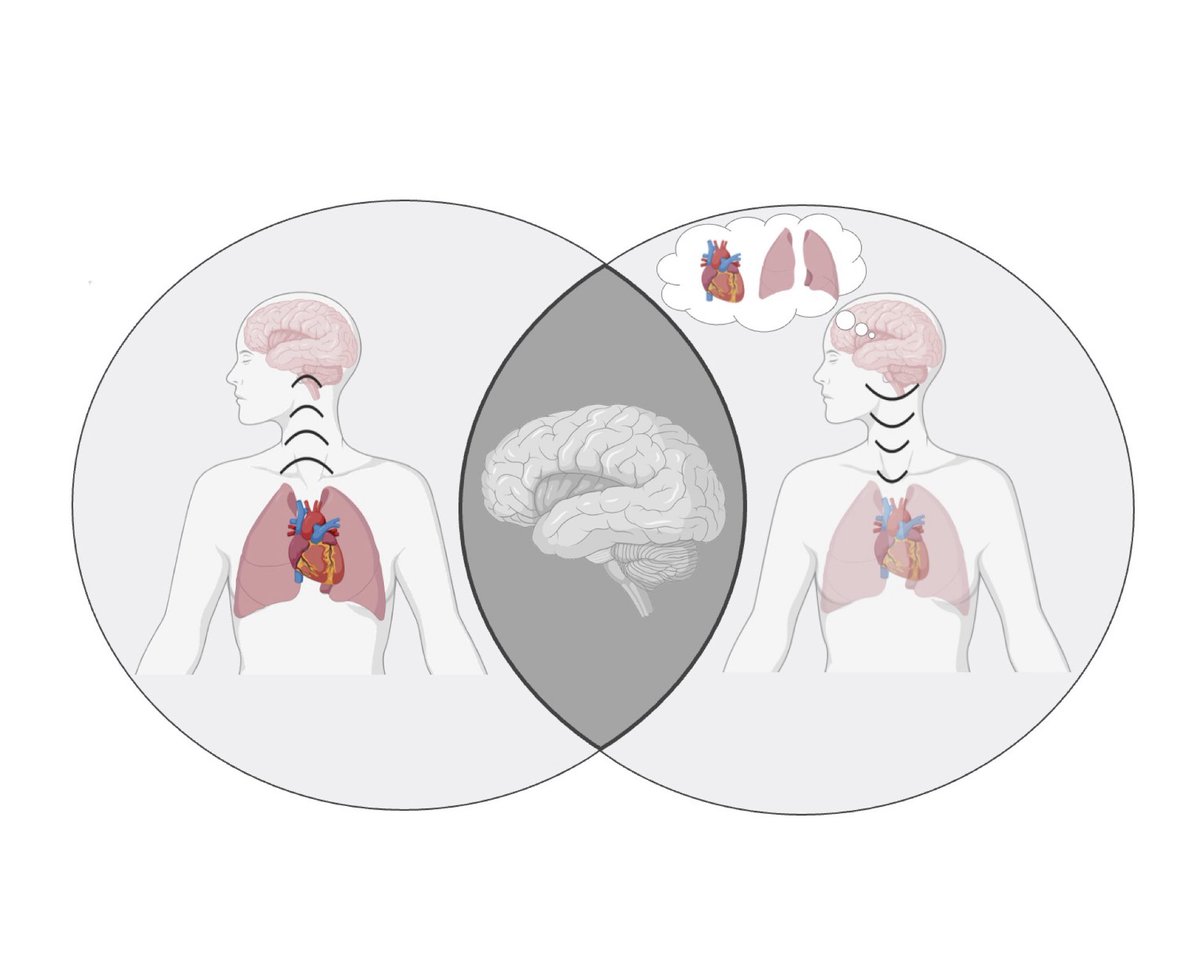
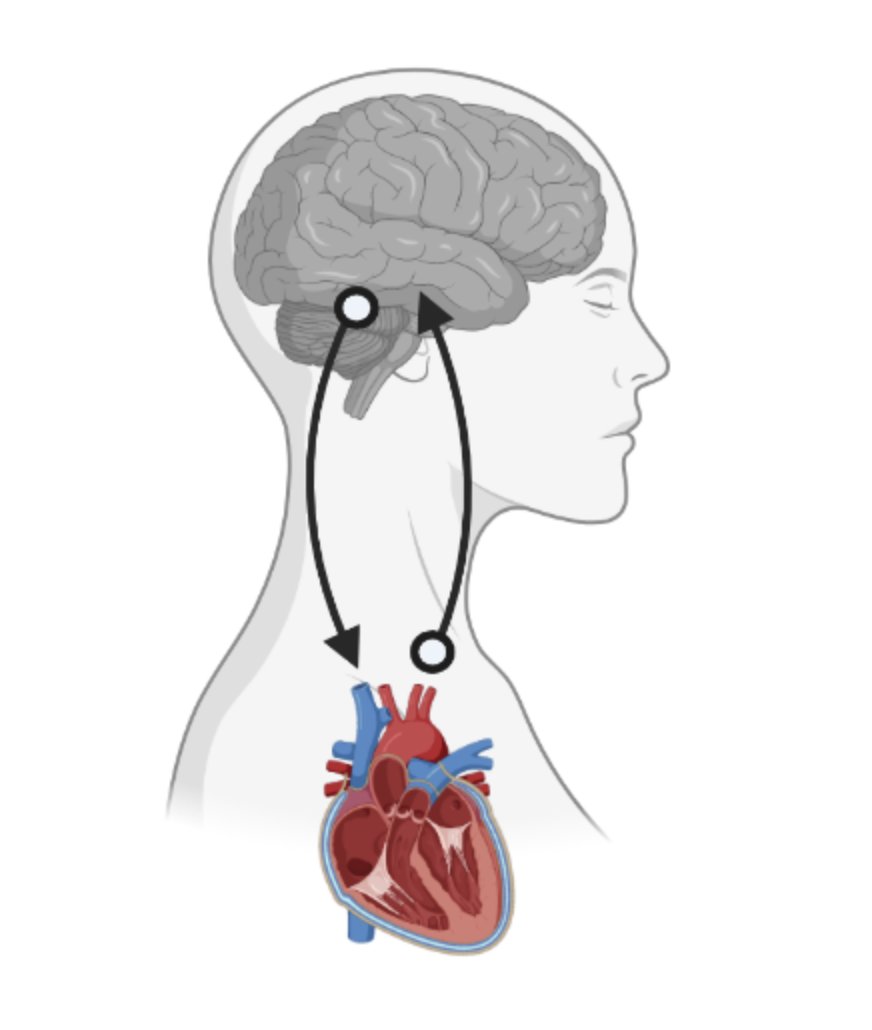
Interoception relies upon the bidirectional trafficking of brain-body signals. But where in the brain do these two information streams meet? Our latest study localized this interaction for cardiorespiratory sensation and examined how it might differ across psychiatric disorders
Take-home message #1: In GAD the brain appears to be more sensitive to signals from the heart, particularly when the heart races. There are both bottom-up and top-down explanations for this neural sensitivity. Here’s an AI-generated interpretation 🤩 6/9
A huge thank you to @NIH_NCCIH for giving me the opportunity to share my work with high-powered scientific community at today’s #interoception meeting. I feel very grateful for the constructive feedback I got, and also for the great talks delivered throughout the day!😊 (1/2)
Exciting new work from our lab showing the short-term anxiolytic effects of float therapy! An intriguing non-pharmacologic approach in an anxious and depressed sample.
What if less could be more when it comes to sensory input and anxiety? Our latest study of Reduced Environmental Stimulation Therapy (REST) explores the short-term effects of float therapy on #anxiety and #depression (1/9)
https://t.co/k0qjsHRR0U
#ChatGPT reminds me of a phrase that has stuck with me since my first day of respiratory physiology at @iu_kinesiology, a separating feature of humans from other species: "Man The Tool-Maker".
However, tools of lore may be more obvious (if more narrow) in their usage.
⏩PERFECTIONISM⏪
"Perfectionism is an insecure, and fear-driven way to live. It is exhausting and stressful – as you are continually comparing your current reality with a made-up perfect version of yourself..."
🤩I look forward to attending the #ACNP2022 annual meeting and show our last findings about altered heartbeat-evoked neural responses during peripheral adrenergic stimulation in generalized anxiety disorder
Excited to present my findings for ⬇️top-down and ⬆️bottom-up streams of 🫀 🫁 interoception, Monday and Tuesday at #OHBM2022 in the beautiful Glasgow!
And to discuss, learn, and be curious about the fascinating ways we are mapping the brain, and the brain in the body.
Excited to present my research, showing how attention towards the inner body may 🧠➡️ converge ⬅️ 🫀 🫁 with bottom-up sensory input at tomorrow's @affectScience preconference on #Interoception.
Looking forward to attending the #Interoception Preconference tomorrow. New findings from the lab will be presented via flash talks by Charles Verdonk (@Ch_Verdonk), Adam Teed (https://t.co/5WXMCAAYJL), and a poster by Emily Adamic (@EmilyAdamic), all three are scientists to 👀
@JMcoyg Manipulating the ball... something I learned post-college, playing in Hispanic leagues + coed leagues. And manipulating your body around the ball - fakes, looks, little things to unbalance defenders and buy you those precious extra bits of space and time.
Ever wonder how physical sensations such as a racing heart give rise to fear? Using an adrenaline-like challenge during brain imaging we found that abnormal heart-brain communication contributes to increased fear in women with generalized anxiety disorder…https://t.co/wZXfRE66yp