𝐖𝐈𝐍𝐤𝐋𝐢𝐧𝐤 𝐈𝐬 𝐁𝐮𝐢𝐥𝐝𝐢𝐧𝐠 𝐓𝐡𝐞 𝐃𝐚𝐭𝐚 𝐋𝐚𝐲𝐞𝐫 𝐁𝐞𝐡𝐢𝐧𝐝 𝐈𝐧𝐭𝐞𝐥𝐥𝐢𝐠𝐞𝐧𝐭 𝐖𝐞𝐛𝟑
AI can process information, automate tasks, and make increasingly sophisticated decisions.
But intelligence is only as reliable as the information behind it.
The same principle applies to blockchain.
Smart contracts can execute predefined logic automatically, but they don't naturally have access to information outside the blockchain.
They need a reliable bridge between on-chain logic and external data.
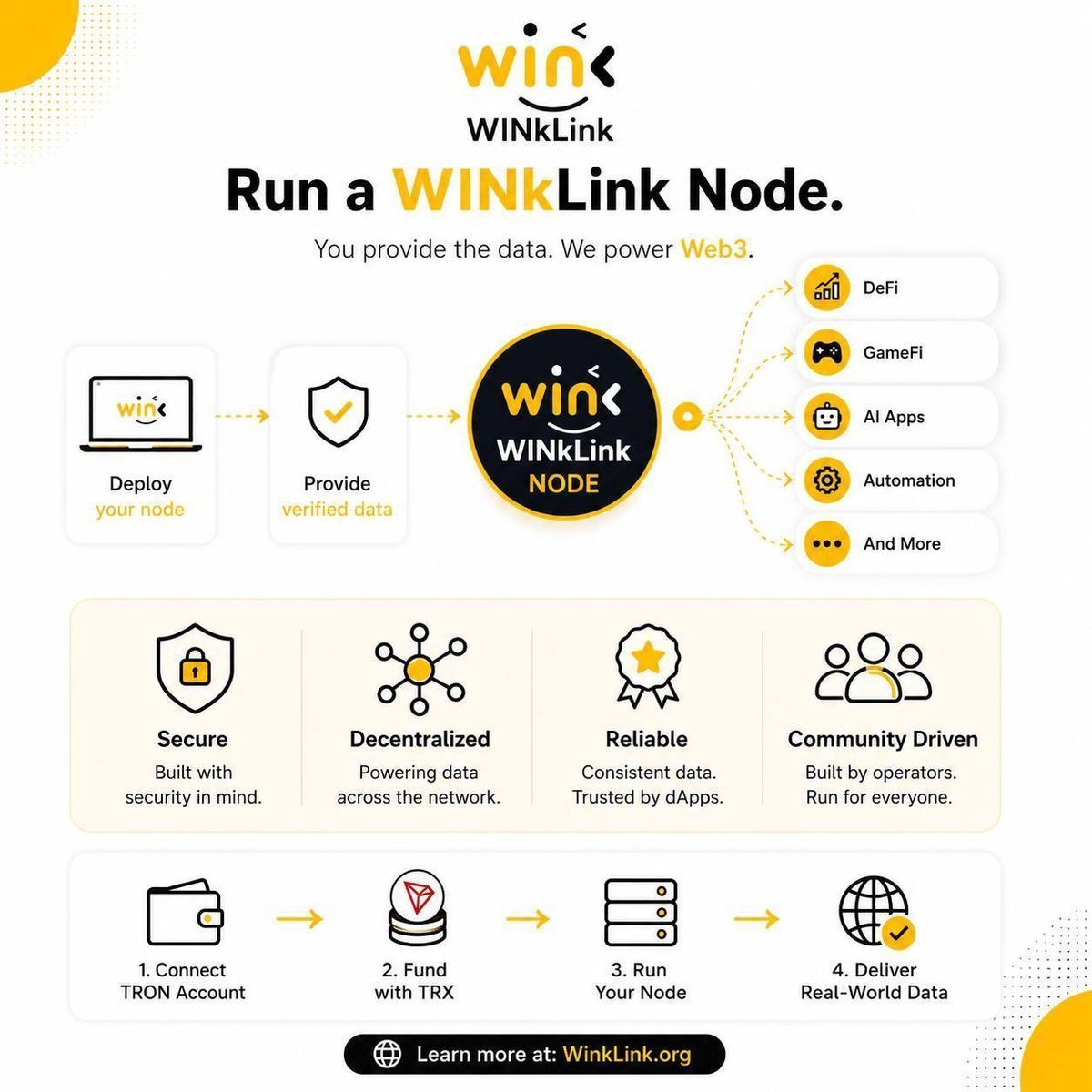
That's where @WinkLink_Oracle becomes important.
WINkLink provides oracle infrastructure that can connect blockchain applications with external information, supporting use cases across DeFi, gaming, smart contracts, and emerging AI-powered applications.
Here's how the process can work.
➞ 𝐀𝐧 𝐀𝐩𝐩𝐥𝐢𝐜𝐚𝐭𝐢𝐨𝐧 𝐍𝐞𝐞𝐝𝐬 𝐄𝐱𝐭𝐞𝐫𝐧𝐚𝐥 𝐃𝐚𝐭𝐚
A smart contract, DeFi protocol, or AI-powered application may need information that doesn't exist natively on-chain.
This could include:
➞ Asset prices
➞ Market information
➞ External events
➞ Sports data
➞ Other real-world information
The application needs a trusted mechanism to access that information.
➞ 𝐖𝐈𝐍𝐤𝐋𝐢𝐧𝐤 𝐂𝐨𝐥𝐥𝐞𝐜𝐭𝐬 𝐓𝐡𝐞 𝐃𝐚𝐭𝐚
Oracle infrastructure can retrieve information from external sources and make it available to blockchain applications.
Using multiple sources can help provide a broader view of the underlying information rather than depending entirely on one source.
➞ 𝐃����𝐭𝐚 𝐈𝐬 𝐏𝐫𝐨𝐜𝐞𝐬𝐬𝐞𝐝 𝐁𝐞𝐟𝐨𝐫𝐞 𝐄𝐱𝐞𝐜𝐮𝐭𝐢𝐨𝐧
This is one of the most important parts of an oracle system.
Raw external information needs to be handled carefully before it becomes an input for automated blockchain logic.
Reliable aggregation and validation mechanisms help reduce the impact of inaccurate or abnormal data.
➞ 𝐕𝐞𝐫𝐢𝐟𝐢𝐞𝐝 𝐃𝐚𝐭𝐚 𝐌𝐨𝐯𝐞𝐬 𝐎𝐧-𝐂𝐡𝐚𝐢𝐧
Once the relevant information is prepared, the oracle network delivers it to the blockchain application.
The smart contract can then use that information according to its predefined rules.
This is what allows blockchain applications to respond to conditions outside the blockchain itself.
➞ 𝐀𝐈 𝐂𝐚𝐧 𝐓𝐮𝐫𝐧 𝐃𝐚𝐭𝐚 𝐈𝐧𝐭𝐨 𝐈𝐧𝐬𝐢𝐠𝐡𝐭
AI adds another layer.
An AI system can analyze available information, identify patterns, detect unusual behavior, or support automated decision-making.
But the quality of those decisions still depends heavily on the quality of the underlying inputs.
Better intelligence cannot compensate for consistently unreliable data.
➞ 𝐒𝐦𝐚𝐫𝐭 𝐂𝐨𝐧𝐭𝐫���𝐜𝐭𝐬 𝐂𝐚𝐧 𝐄𝐱𝐞𝐜𝐮𝐭𝐞
Once the required conditions are satisfied, smart contracts can execute predefined actions automatically.
That could support activities such as:
➞ DeFi settlements
➞ Automated trading logic
➞ Lending and liquidation mechanisms
➞ Market-based applications
➞ Data-driven decentralized applications
The important connection is:
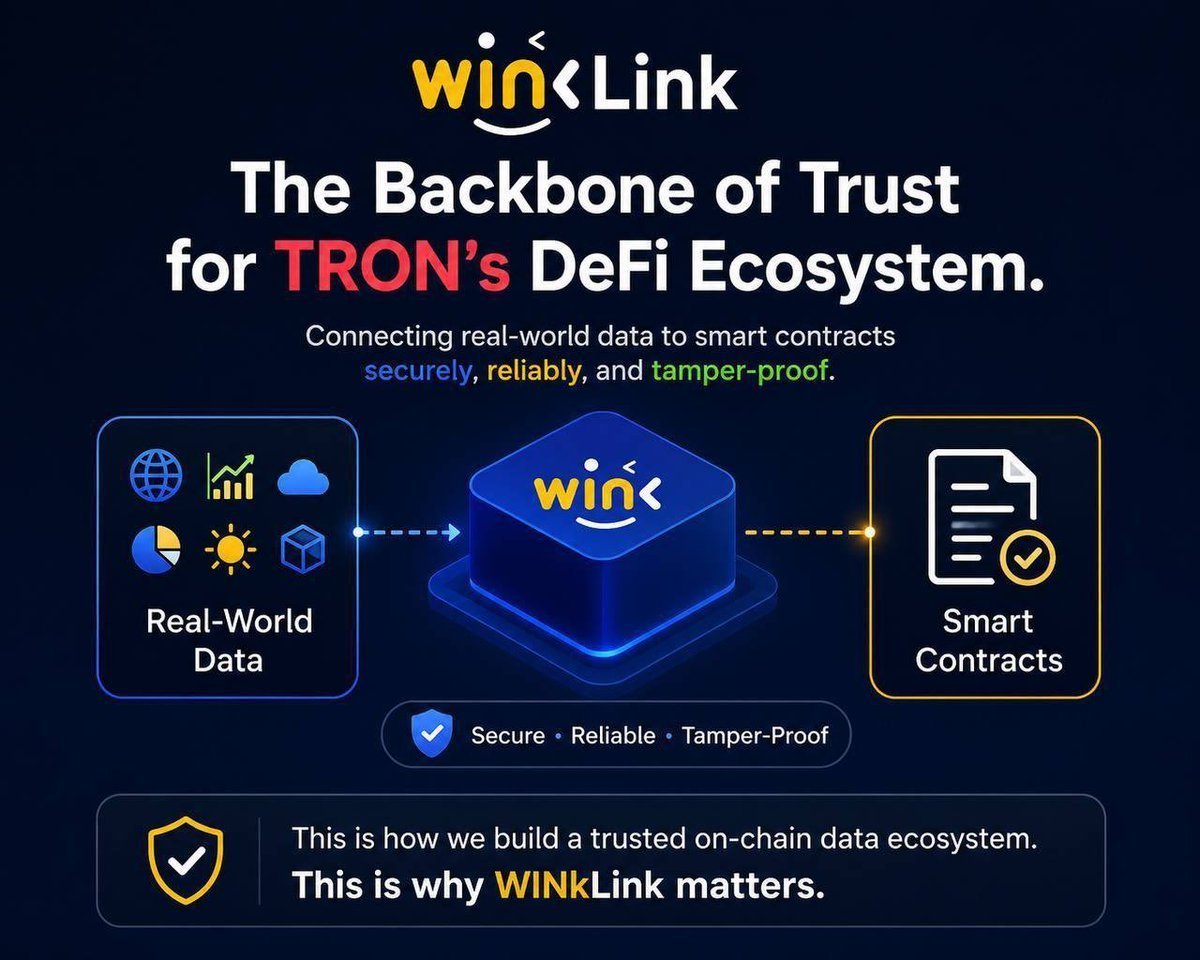
External data → Oracle infrastructure → Blockchain logic → Automated execution
And AI can increasingly operate alongside that stack.
As blockchain applications become more sophisticated, the demand for dependable external information will continue growing.
DeFi needs accurate market data.
AI agents need reliable inputs.
Automated applications need trustworthy signals.
Smart contracts need information they can act on.
This makes oracle infrastructure much more than a simple data-delivery service.
It becomes part of the foundation connecting decentralized systems with the world outside the blockchain.
AI brings intelligence.
Smart contracts bring execution.
Blockchain provides the decentralized environment.
WINkLink helps connect these systems to external data.
And as Web3 moves toward increasingly automated applications, trusted data may become one of the most important pieces of infrastructure supporting that transition.
@WinkLink_Oracle @justinsuntron
#TRONEcoStar
𝐀𝐈𝐍𝐅𝐓 𝐌𝐚𝐤𝐞𝐬 𝐄𝐱𝐩𝐥𝐨𝐫𝐢𝐧𝐠 𝐌𝐮𝐥𝐭𝐢𝐩𝐥𝐞 𝐀𝐈 𝐌𝐨𝐝𝐞𝐥𝐬 𝐒𝐢𝐦𝐩𝐥𝐞𝐫
The AI ecosystem is expanding quickly.
New models, new capabilities, and new platforms appear constantly.
But having more options can create another problem:
Finding the right AI tool can become almost as difficult as using one.
AINFT is taking a different approach by bringing multiple AI capabilities into a unified platform, giving users a simpler way to discover and experiment with different models while connecting the experience with Web3.
Getting started is straightforward.
➞ 𝐒𝐭𝐚𝐫𝐭 𝐖𝐢𝐭𝐡 𝐓𝐡𝐞 𝐏𝐥𝐚𝐭𝐟𝐨𝐫𝐦
Visit:
https://t.co/YSvpYG4hEY
This takes you directly into the AINFT AI Service Platform.
➞ 𝐒𝐢𝐠𝐧 𝐈𝐧 𝐀𝐧���� 𝐆𝐞𝐭 𝐀𝐜𝐜𝐞𝐬𝐬
Use an available authentication option, such as Google login or a supported Web3 wallet.
Once authenticated, you can access the platform's available AI services.
➞ 𝐂𝐥𝐚𝐢𝐦 𝐘𝐨𝐮𝐫 𝐂𝐫𝐞𝐝𝐢𝐭𝐬
Eligible new users can receive 100K credits upon login, subject to the platform's applicable requirements.
That gives new users an opportunity to explore the available AI capabilities before deciding how they want to use the platform further.
➞ 𝐄𝐱𝐩𝐥𝐨𝐫𝐞 𝐓𝐡𝐞 𝐀𝐈 𝐌𝐨𝐝𝐞𝐥𝐬
Instead of opening multiple platforms individually, users can explore the AI models available through AINFT.
Different models can be useful for different tasks:
➞ Writing
➞ Coding
➞ Research
➞ Content creation
➞ Analysis
➞ Problem-solving
The advantage isn't simply having more models.
It's having more choices in one environment.
➞ 𝐏𝐮𝐭 𝐓𝐡𝐞 𝐌𝐨𝐝𝐞𝐥𝐬 𝐓𝐨 𝐖𝐨𝐫𝐤
Choose the model that fits your task, enter your prompt, and start experimenting.
You can compare how different models handle similar requests and determine which one works best for your particular workflow.
That turns AI model selection from a complicated search into a much simpler process.
➞ 𝐊𝐞𝐞𝐩 𝐄𝐱𝐩𝐥𝐨𝐫𝐢𝐧𝐠
AI isn't standing still.
New models and capabilities continue emerging, so a unified platform can make it easier to discover additional tools without constantly rebuilding your workflow around a new service.
𝐖𝐡𝐲 𝐀𝐈𝐍𝐅𝐓'𝐬 𝐀𝐩𝐩𝐫𝐨𝐚𝐜𝐡 𝐌𝐚𝐭𝐭𝐞𝐫𝐬
The biggest advantage may be simplicity.
Instead of:
Find a model → Create another account → Learn another interface → Switch platforms
The experience moves closer to:
Open one platform → Choose a model → Start working
That reduction in friction can make AI more accessible to everyday users.
And the Web3 connection adds another dimension for users interested in decentralized technology and blockchain-based experiences.
The AI landscape will likely continue becoming more fragmented as the number of models grows.
Platforms that make that complexity easier to navigate could become increasingly valuable.
AINFT is positioning itself around that idea:
More AI capabilities.
One unified experience.
Less unnecessary friction.
And more ways for users to put AI to work.
👉 https://t.co/YSvpYG4hEY
@AINFTcom @justinsuntron
#TRONEcoStar
𝐇𝐨𝐰 𝐖𝐈𝐍𝐤𝐋𝐢𝐧𝐤 𝐍𝐨𝐝𝐞 𝐎𝐩𝐞𝐫𝐚𝐭𝐨𝐫𝐬 𝐇𝐞𝐥𝐩 𝐊𝐞𝐞𝐩 𝐓𝐑𝐎𝐍 𝐃𝐚𝐭𝐚 𝐑𝐞𝐥𝐢𝐚𝐛𝐥𝐞
Smart contracts can automate transactions and financial logic, but they cannot independently reach outside the blockchain to retrieve information.
They need an oracle layer.
That’s where WINkLink node operators become important.
By operating infrastructure that participates in the oracle network, node operators can help provide external information to blockchain applications across the TRON ecosystem.
Here’s a simplified look at what running a WINkLink node involves.
1. Prepare the Infrastructure
➞ Set up a suitable server or cloud environment
➞ Ensure stable internet connectivity
➞ Allocate sufficient computing and storage resources
➞ Configure appropriate security controls
Reliable infrastructure matters because oracle services depend heavily on consistent availability.
2. Install the Node Software
➞ Obtain the WINkLink node software and dependencies
➞ Follow the current official documentation for configuration
➞ Set the required environment variables and network parameters
➞ Test the installation before production use
The exact requirements can change, so operators should always follow the latest WINkLink documentation rather than relying on outdated guides.
3. Configure the TRON Account
A node needs an associated TRON account for relevant on-chain operations.
➞ Create or use a dedicated TRON account
➞ Secure the associated credentials
➞ Never expose private keys or sensitive configuration information
Operational security is just as important as uptime.
4. Maintain TRX for Network Operations
Depending on the node's responsibilities, on-chain transactions may require TRX or appropriate TRON network resources.
Operators should therefore:
➞ Monitor the account balance
➞ Plan for transaction costs
➞ Maintain sufficient resources for uninterrupted operation
A node that repeatedly runs out of resources cannot reliably contribute to oracle operations.
5. Participate in Data Delivery
Once properly configured and operating, the node can participate in the oracle infrastructure responsible for supplying external information to supported blockchain applications.
That information can be relevant to:
➞ DeFi protocols
➞ Market data applications
➞ Stablecoin infrastructure
➞ GameFi
➞ AI-powered applications
➞ Other smart-contract use cases
The goal is to help blockchain applications access dependable information without relying entirely on a single centralized source.
6. Keep the Node Healthy
Running a node isn't a one-time setup.
Operators need to continuously:
➞ Monitor uptime
➞ Apply software updates
➞ Protect credentials
➞ Watch system performance
➞ Investigate failures quickly
➞ Maintain reliable connectivity
Good node operations contribute to a stronger oracle network.
Why independent node operators matter
A decentralized oracle network becomes more resilient when responsibility isn't concentrated in one location or controlled by one data source.
More independent infrastructure can contribute to:
➞ Greater decentralization
➞ Improved availability
➞ More robust data delivery
➞ Reduced dependence on individual providers
➞ Stronger infrastructure for Web3 applications
And this becomes increasingly important as smart contracts become more connected to real-world information.
The bigger picture is simple.
Blockchains provide decentralized execution.
Smart contracts provide programmable logic.
But reliable external data allows those systems to respond to events beyond the blockchain itself.
WINkLink sits within that critical connection.
And node operators help provide the infrastructure that makes the oracle layer possible.
👉 Learn more: https://t.co/YUJUAWdSkv
@WinkLink_Oracle@justinsuntron
#TRONEcoStar
𝐓𝐑𝐎𝐍’𝐬 𝐃𝐮𝐚𝐥 𝐑𝐞𝐬𝐨𝐮𝐫𝐜𝐞 𝐒𝐲𝐬𝐭𝐞𝐦 𝐌𝐚𝐤𝐞𝐬 𝐎𝐧-𝐂𝐡𝐚𝐢𝐧 𝐂𝐨𝐬𝐭𝐬 𝐌𝐨𝐫𝐞 𝐌𝐚𝐧𝐚𝐠𝐞𝐚𝐛𝐥𝐞
One thing that makes TRON’s transaction model different is that network resources aren’t treated as one simple gas meter.
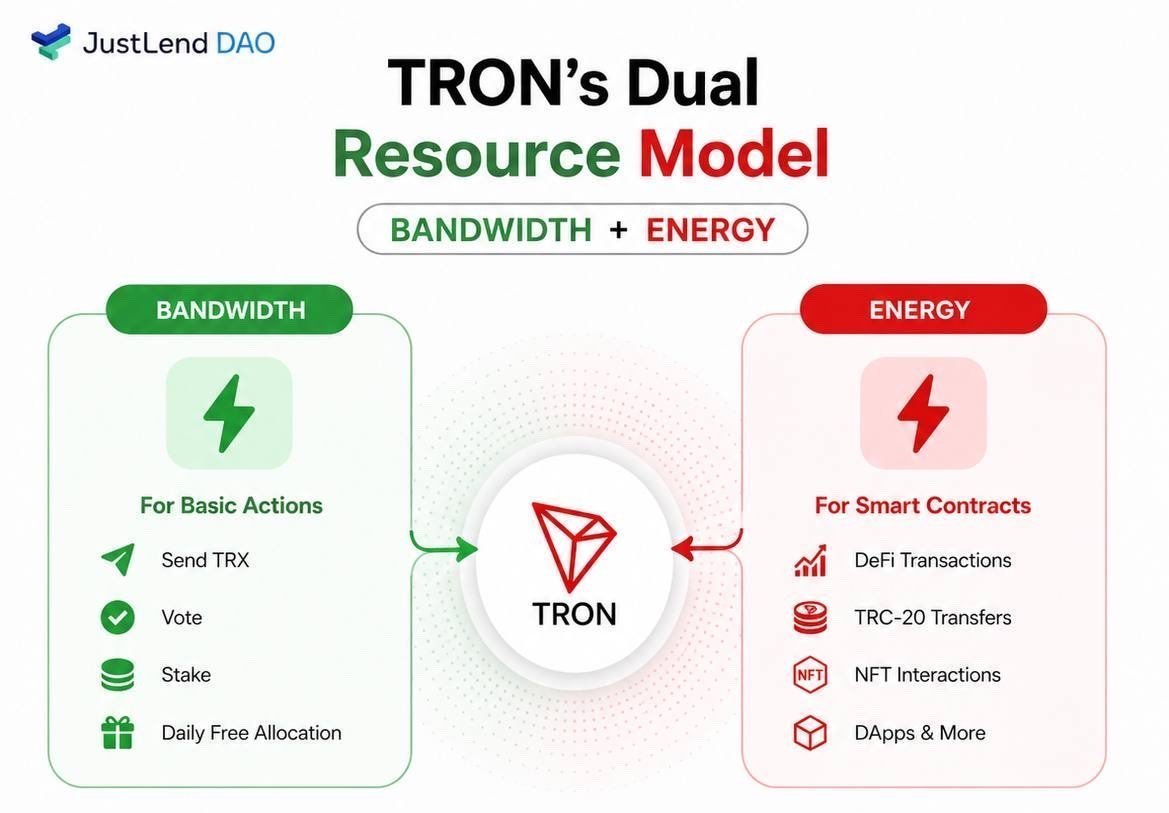
Instead, TRON separates resource consumption into Bandwidth and Energy.
Understanding the difference can help users reduce unnecessary TRX spending and interact with the network more efficiently.
1. Bandwidth Handles Basic Transactions
Bandwidth is primarily used for transactions that don't require smart contract execution.
Examples include:
➞ Sending TRX
➞ Voting
➞ Staking-related transactions
➞ Other basic on-chain operations
TRON also provides users with free Bandwidth, giving everyday users some capacity for basic network activity without immediately needing to spend TRX.
2. Energy Powers Smart Contracts
Energy is used when transactions require smart contract execution.
This includes activities such as:
➞ TRC-20 transfers
➞ DeFi interactions
➞ NFT operations
➞ Smart contract calls
➞ dApp interactions
The more computational work a smart contract requires, the more Energy the operation can consume.
3. How Users Get Energy
Users have several ways to obtain the resources they need.
➞ Stake TRX to receive network resources
➞ Use available Energy from staking
➞ Rent Energy when additional capacity is needed
Energy rental can be particularly useful for active users who frequently interact with smart contracts but don't want to lock a large amount of TRX simply to obtain resources.
4. What Happens When Resources Run Out?
This is where understanding the system becomes important.
When a transaction has insufficient resources, TRON can compensate through TRX consumption according to the network's rules.
So instead of thinking only about transaction fees, users should also think about resource availability.
Enough resources:
➞ Lower direct TRX consumption
➞ More efficient transactions
➞ Better cost management
Insufficient resources:
➞ Additional TRX may be consumed
➞ Frequent activity can become more expensive over time
5. Monitor Before You Transact
Resource management becomes especially important for active TRON users.
Before carrying out frequent transactions, check:
➞ Available Bandwidth
➞ Available Energy
➞ Expected transaction requirements
➞ Current resource costs
This simple habit can help prevent unnecessary TRX consumption.
6. Choose a Strategy That Fits Your Activity
For occasional users, free Bandwidth may be enough for many basic transactions.
For frequent DeFi users, staking TRX or accessing Energy through rental services can provide a more efficient way to manage smart contract activity.
The important point is that there isn't one strategy for everyone.
Your transaction frequency and the type of applications you use should determine how you manage resources.
Why TRON’s Resource Model Matters
The dual-resource structure creates a more flexible way to allocate network capacity.
➞ Bandwidth supports basic transactions
➞ Energy supports computational smart contract activity
➞ Staking provides access to resources
➞ Energy rental adds another layer of flexibility
And once users understand this model, transaction costs stop feeling completely unpredictable.
You can plan around the resources your activity actually requires.
That’s the bigger lesson with TRON.
Using the network efficiently isn't only about finding the cheapest transaction.
It’s about understanding the infrastructure underneath each transaction and managing your resources accordingly.
When you understand Bandwidth and Energy, you don't just use TRON.
You use it more intelligently.
@DeFi_JUST@justinsuntron
#TRONEcoStar
𝐇𝐨𝐰 𝐁𝐢𝐭𝐓𝐨𝐫𝐫𝐞𝐧𝐭 𝐁𝐫𝐢𝐝𝐠𝐞 𝐒𝐢𝐦𝐩𝐥𝐢𝐟𝐢𝐞𝐬 𝐌𝐨𝐯𝐢𝐧𝐠 𝐀𝐬𝐬𝐞𝐭𝐬 𝐀𝐜𝐫𝐨𝐬𝐬 𝐁𝐥𝐨𝐜𝐤𝐜𝐡𝐚𝐢𝐧𝐬
As Web3 becomes more interconnected, users increasingly need to move assets between different networks.
Liquidity may exist on one chain.
A useful dApp may be available on another.
And the asset you need might already be sitting somewhere else.
This is where cross-chain infrastructure becomes important.
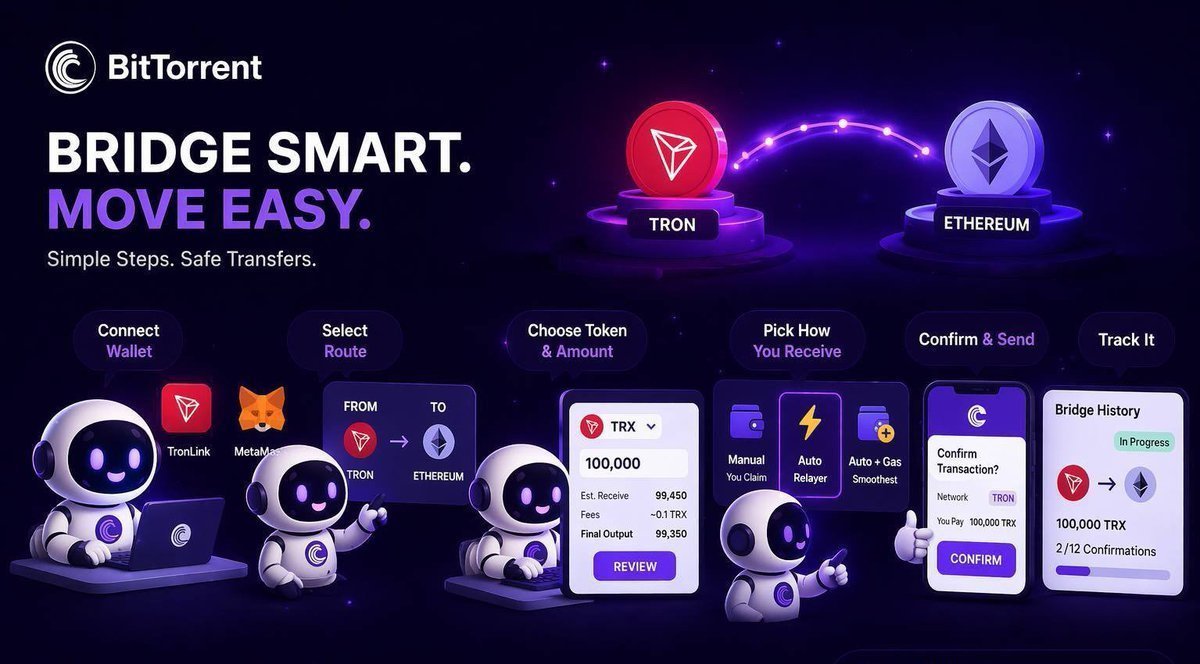
BitTorrent Bridge provides a way to transfer supported assets across supported blockchain networks while giving users visibility into the progress of their transactions.
Here’s how the process works.
1. Connect Your Wallet
➞ Visit the official BitTorrent Bridge
➞ Connect a supported wallet
➞ Make sure the wallet contains the asset you want to transfer
Only connect your wallet to the official bridge interface and verify the URL before signing transactions.
2. Select the Source and Destination
Choose:
➞ The network where your asset currently exists
➞ The destination network where you want to receive it
Always check that the selected networks are correct before proceeding.
3. Select Your Asset
Choose the supported token you want to bridge.
Then:
➞ Enter the amount
➞ Review the estimated fees
➞ Check the expected destination asset
➞ Confirm the receiving address
Cross-chain transactions can involve different network conditions, so reviewing the details before signing is important.
4. Select Your Receiving Preference
Depending on the available options, BitTorrent Bridge can provide different receiving methods, including:
➞ Manual Receive
➞ Auto Receive
➞ Auto Receive with Gas Top-Up
These options can help determine what happens after the bridged asset reaches the destination network.
5. Approve and Confirm
Once everything looks correct:
➞ Approve the token if required
➞ Confirm the bridge transaction in your wallet
➞ Wait for the required network confirmations
The bridge then processes the transfer between the supported networks.
6. Track the Transfer
You don't have to simply wait without information.
Use the bridge's transaction tracking functionality to follow the status of your transfer and confirm when the assets arrive on the destination network.
Why cross-chain infrastructure matters
Web3 is no longer a collection of completely isolated blockchain environments.
Users increasingly move between:
➞ TRON
➞ Ethereum
➞ BNB Chain
➞ BTTC
➞ Other supported ecosystems
Bridges help connect these environments by making asset movement more practical.
For users, that can mean easier access to:
➞ Different dApps
➞ DeFi markets
➞ Liquidity
➞ Blockchain-specific opportunities
The important part is that convenience should never replace verification.
Before bridging, always:
➞ Confirm the destination network
➞ Verify the receiving address
➞ Check supported assets
➞ Review fees and transaction details
➞ Consider a small test transfer when appropriate
Blockchain transactions are generally irreversible, so accuracy matters.
The bigger picture is connectivity.
As more applications and liquidity become distributed across multiple chains, the ability to move assets between those environments becomes a fundamental part of the Web3 experience.
BitTorrent Bridge helps make that cross-chain movement more accessible while giving users a clearer way to manage and track their transfers.
@BitTorrent@justinsuntron
#TRONEcoStar
𝐇𝐨𝐰 𝐭𝐨 𝐄𝐱𝐩𝐥𝐨𝐫𝐞 𝐒𝐮𝐧𝐒𝐰𝐚𝐩 𝐕𝟒 𝐚𝐧𝐝 𝐔𝐧𝐥𝐨𝐜𝐤 𝐌𝐨𝐫𝐞 𝐄𝐟𝐟𝐢𝐜𝐢𝐞𝐧𝐭 𝐃𝐞𝐅𝐢 𝐨𝐧 𝐓𝐑𝐎𝐍
DeFi becomes more useful when improvements make the underlying infrastructure more efficient without making the user experience more complicated.
That is one of the ideas behind SunSwap V4.
The upgrade focuses on improving liquidity infrastructure, streamlining execution, supporting native TRX pairs, and giving developers more flexibility through programmable liquidity.
Here’s how users can explore it.
1. Connect Your TRON Wallet
➞ Visit https://t.co/IsvFOOQDxi
➞ Connect a compatible TRON wallet such as TronLink
➞ Make sure you understand the transaction before signing
Once connected, you can explore the available trading and liquidity features.
2. Try a Token Swap
Choose the token you want to sell and the asset you want to receive.
Then:
➞ Enter the amount
➞ Review the quoted exchange rate
➞ Check the transaction details
➞ Confirm the swap
SunSwap V4 is designed to make the underlying execution more efficient while keeping the process familiar for users.
3. Explore Liquidity Pools
Liquidity providers can explore supported pools and contribute assets to help facilitate trading activity.
Before supplying liquidity, review:
➞ Pool composition
➞ Applicable fees
➞ Expected returns
➞ Potential risks
➞ Current liquidity conditions
Providing liquidity isn't risk-free, so understanding the pool before depositing is important.
4. Use Native TRX Where Supported
One notable improvement is native TRX support.
Instead of unnecessarily converting TRX into another representation before interacting with certain pools, supported activities can use TRX more directly.
That removes additional steps from the trading experience.
5. Pay Attention to Energy Efficiency
Smart contract interactions consume TRON network resources.
SunSwap V4's architecture is designed to improve execution efficiency and reduce unnecessary Energy consumption in supported operations.
For frequent DeFi users, better resource efficiency can translate into lower operational costs over time.
6. Explore Programmable Liquidity
This is where SunSwap V4 becomes particularly interesting for developers.
Hooks allow custom logic to interact with liquidity operations.
That can open the door to:
➞ Dynamic fee mechanisms
➞ Automated liquidity strategies
➞ Custom trading logic
➞ Additional risk-management tools
➞ More specialized DeFi applications
Instead of liquidity behaving as a completely fixed system, developers gain more flexibility to build around it.
Why SunSwap V4 Matters
The important part of V4 isn't simply adding more features.
It's improving what happens underneath each interaction.
➞ More efficient liquidity infrastructure
➞ Smoother swap execution
➞ Native TRX support
➞ Better resource efficiency
➞ Programmable liquidity through Hooks
For users, that can mean a simpler DeFi experience.
For liquidity providers, it creates a more flexible environment.
And for developers, programmable infrastructure opens new possibilities for building applications on top of decentralized liquidity.
The broader lesson is that DeFi doesn't always need to become more complicated to become more powerful.
Sometimes the biggest improvements happen underneath the interface.
SunSwap V4 is pushing that direction on TRON by making liquidity more efficient, execution more streamlined, and decentralized markets more programmable.
🔗 Explore: https://t.co/IsvFOOQDxi
@OfficialSUNio@justinsuntron
#TRONEcoStar
𝐇𝐨𝐰 ��𝐑𝐎𝐍’𝐬 𝐋𝐨𝐰𝐞𝐫 𝐄𝐧𝐞𝐫𝐠𝐲 𝐂𝐨𝐬𝐭𝐬 𝐂𝐡𝐚𝐧𝐠𝐞 𝐃𝐞𝐅𝐢 𝐄𝐟𝐟𝐢𝐜𝐢𝐞𝐧𝐜𝐲
When people talk about blockchain improvements, they usually focus on speed, throughput, or scalability.
But there is another layer that can have an equally important impact:
The cost of actually using the network.
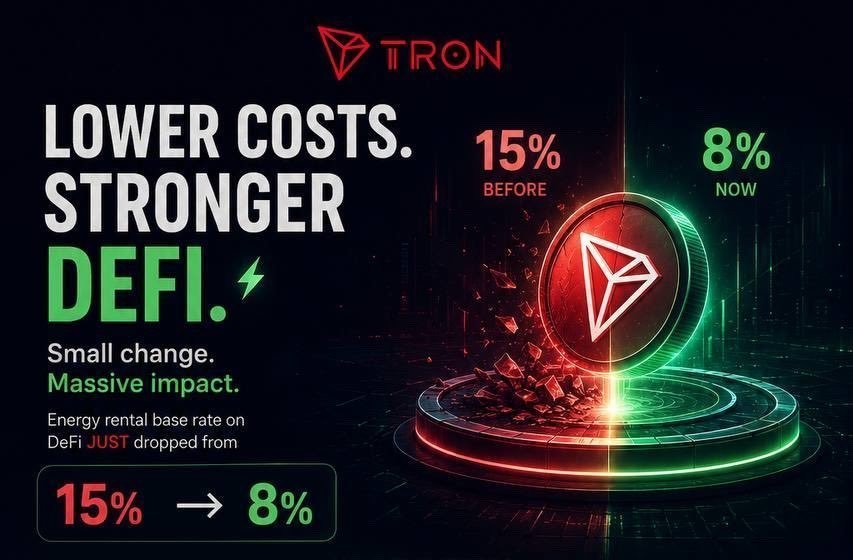
TRON’s Energy system is designed to help users manage the computational resources required by smart contracts, and the reduction in the JustLend DAO Energy rental base rate from 15% to 8% makes that resource layer more accessible.
Here’s why it matters.
1/ 𝗪𝗵𝗮𝘁 𝗘𝗻𝗲𝗿𝗴𝘆 𝗗𝗼𝗲𝘀 𝗼𝗻 𝗧𝗥𝗢𝗡
Energy represents the computational resources required for smart contract execution.
That means it can be relevant when interacting with:
→ DeFi protocols
→ TRC-20 contracts
→ Swaps
→ Lending markets
→ Staking applications
→ Other dApps
Users who don't have enough Energy may have TRX consumed to cover the required network resources.
Understanding Energy therefore becomes important for anyone interacting with TRON frequently.
2/ 𝗧𝗵𝗲 𝟭𝟱% → 𝟴% 𝗥𝗮𝘁𝗲 𝗖𝗵𝗮𝗻𝗴𝗲
The adjustment on JustLend DAO reduces the Energy rental base rate from 15% to 8%.
That doesn't change what Energy does.
It changes the economics of accessing it.
For users who regularly require Energy, lower rental costs can mean:
→ Reduced operating expenses
→ More efficient DeFi interactions
→ Less reliance on repeated TRX consumption
→ Better cost predictability
Small changes in infrastructure pricing can become meaningful when transactions are repeated thousands of times across an ecosystem.
3/ 𝗪𝗵𝘆 𝗙𝗿𝗲𝗾𝘂𝗲𝗻𝘁 𝗨𝘀𝗲𝗿𝘀 𝗖𝗮𝗿𝗲
Someone making one transaction occasionally may barely notice resource costs.
But consider an active DeFi user interacting with several smart contracts every day.
Swapping.
Supplying.
Borrowing.
Moving stablecoins.
Managing liquidity.
Those individual interactions can accumulate.
Reducing the cost of the underlying resource can therefore improve the economics of repeated on-chain activity.
4/ 𝗘𝗻𝗲𝗿𝗴𝘆 𝗜𝘀 𝗣𝗮𝗿𝘁 𝗢𝗳 𝗖𝗮𝗽𝗶𝘁𝗮𝗹 𝗘𝗳𝗳𝗶𝗰𝗶𝗲𝗻𝗰𝘆
The interesting part is that Energy isn't simply a technical concept.
For active users, it becomes a resource-management decision.
You can:
→ Stake TRX to obtain resources
→ Rent Energy when additional capacity is needed
→ Monitor consumption
→ Optimize transaction costs
This turns network-resource management into part of a broader DeFi efficiency strategy.
The objective isn't simply to transact.
It's to transact intelligently.
5/ 𝗟𝗼𝘄𝗲𝗿 𝗙𝗿𝗶𝗰𝘁𝗶𝗼𝗻 𝗖𝗮𝗻 𝗦𝘂𝗽𝗽𝗼𝗿𝘁 𝗔𝗱𝗼𝗽𝘁𝗶𝗼𝗻
Cost is one of the first things users experience when interacting with blockchain applications.
If accessing a dApp requires constantly worrying about whether you have enough resources, the experience becomes more complicated.
Lower Energy rental costs can help reduce that friction.
That matters for:
→ Existing DeFi users
→ New users entering the ecosystem
→ Developers building high-frequency applications
→ Businesses processing repeated on-chain transactions
Better infrastructure doesn't always need to be visible.
Sometimes users simply notice that everything feels easier.
6/ 𝗧𝗵𝗲 𝗥𝗲𝗮𝗹 𝗦𝗵𝗶𝗳𝘁 𝗜𝘀 𝗘𝗳𝗳𝗶𝗰𝗶𝗲𝗻𝗰𝘆
TRON's resource model gives users another way to think about transaction costs.
Instead of treating every interaction as an unavoidable expense, users can manage the resources behind those interactions.
That creates a different mindset:
→ Understand the resource
→ Estimate your usage
→ Choose the appropriate access method
→ Reduce unnecessary costs
And when those small efficiencies repeat over time, they can become significant.
🔗 Explore Energy services: https://t.co/taA2HXS8no
@DeFi_JUST @justinsuntron
#TRONEcoStar
𝗪𝗜𝗡𝗸𝗟𝗶𝗻𝗸 𝗠𝗮𝗸𝗲𝘀 𝗕𝗹𝗼𝗰𝗸𝗰𝗵𝗮𝗶𝗻 𝗗𝗮𝘁𝗮 𝗨𝘀𝗲𝗳𝘂𝗹 𝗕𝗲𝘆𝗼𝗻𝗱 𝗧𝗵𝗲 𝗖𝗵𝗮𝗶𝗻
Smart contracts are excellent at executing predefined instructions.
But they have a limitation that is easy to overlook.
They cannot naturally see what is happening outside the blockchain.
A DeFi protocol may need an asset price.
A game may need verifiable randomness.
An automated application may need information from an external API.
The smart contract itself cannot simply reach outside and retrieve that information.
That’s where @WinkLink_Oracle becomes important.
As an oracle infrastructure layer within the TRON ecosystem, WINkLink helps connect blockchain applications with external data, allowing smart contracts to respond to information beyond their native environment.
𝗪𝗵𝗲𝗿𝗲 𝗧𝗵𝗲 𝗗𝗮𝘁𝗮 𝗖𝗼𝗻𝗻𝗲𝗰𝘁𝗶𝗼𝗻 𝗕𝗲𝗴𝗶𝗻𝘀
The process can be understood through a simple flow:
➞ An application requests external information
➞ WINkLink nodes obtain data from relevant sources
➞ Data is processed and aggregated through the oracle infrastructure
➞ The resulting information is delivered on-chain
➞ Smart contracts use that information to execute their predefined logic
The important part is the connection.
Blockchain provides deterministic execution.
Oracle infrastructure provides access to information that exists outside the chain.
Together, they make decentralized applications considerably more capable.
𝗣𝗿𝗶𝗰𝗲 𝗙𝗲𝗲𝗱𝘀 𝗣𝗼𝘄𝗲𝗿 𝗗𝗲𝗙𝗶
One of the clearest examples is price data.
Lending and trading protocols need accurate market information to determine things such as:
➞ Asset valuations
➞ Collateral requirements
➞ Liquidation conditions
➞ Trading parameters
Without dependable data, even perfectly written smart contracts can produce incorrect outcomes.
WINkLink price feeds provide an important data layer for these applications across the TRON ecosystem.
𝗥𝗮𝗻𝗱𝗼𝗺𝗻𝗲𝘀𝘀 𝗡𝗲𝗲𝗱𝘀 𝗧𝗼 𝗕𝗲 𝗩𝗲𝗿𝗶𝗳𝗶𝗮𝗯𝗹𝗲
Randomness is another area where blockchains need additional infrastructure.
Gaming, NFTs, and other applications may require outcomes that users can verify rather than simply trust.
WINkLink’s VRF infrastructure is designed to provide verifiable randomness that applications can use for these types of experiences.
That creates an important distinction:
Random does not have to mean unpredictable and unverifiable.
In decentralized systems, users need to be able to establish that outcomes were generated fairly.
𝗙𝗿𝗼𝗺 𝗘𝘅𝘁𝗲𝗿𝗻𝗮𝗹 𝗔𝗣𝗜𝘀 𝗧𝗼 𝗔𝘂𝘁𝗼𝗺𝗮𝘁𝗶𝗼𝗻
WINkLink also extends beyond basic price feeds.
Its broader infrastructure can connect smart contracts with external APIs and support automated actions based on predefined conditions.
That opens the door to applications that can:
➞ Consume external information
➞ React to changing conditions
➞ Trigger predefined blockchain actions
➞ Coordinate more complex automated workflows
The result is a blockchain environment that can interact with a much wider information ecosystem.
𝗧𝗵𝗲 𝗜𝗻𝗳𝗿𝗮𝘀𝘁𝗿𝘂��𝘁𝘂𝗿𝗲 𝗨𝘀𝗲𝗿𝘀 𝗥𝗮𝗿𝗲𝗹𝘆 𝗦𝗲𝗲
Most people using DeFi never think about oracle infrastructure.
They simply open a protocol, see a token price, deposit collateral, borrow an asset, or interact with an automated application.
Behind those simple experiences can be multiple infrastructure layers working together.
WINkLink helps provide the external information that applications need to operate.
That is often the mark of good infrastructure.
Users don't need to notice it.
They simply experience applications that work as intended.
@WinkLink_Oracle @justinsuntron
#TRONEcoStar
𝗦𝘁𝗮𝗸𝗲 𝗧𝗥𝗫 𝗖𝗮𝗻 𝗧𝘂𝗿𝗻 𝗜𝗱𝗹𝗲 𝗖𝗮𝗽𝗶𝘁𝗮𝗹 𝗜𝗻𝘁𝗼 𝗣𝗿𝗼𝗱𝘂𝗰𝘁𝗶𝘃𝗲 𝗧𝗥𝗢𝗡 𝗜𝗻𝗳𝗿𝗮𝘀𝘁𝗿𝘂𝗰𝘁𝘂𝗿𝗲
Holding TRX gives you exposure to the TRON ecosystem.
But holding is only one way to use it.
Through JustLend DAO’s liquid staking infrastructure, users can stake TRX and receive sTRX while earning staking rewards and maintaining a more flexible position within the DeFi ecosystem.
The interesting part is what happens underneath.
Your staked TRX doesn’t simply sit there.
It becomes part of TRON’s broader resource economy.
𝗛𝗼𝘄 𝗧𝗥𝗫 𝗦𝘁𝗮𝗸𝗶𝗻𝗴 𝗪𝗼𝗿𝗸𝘀
The process starts with a simple conversion:
➞ Deposit TRX
➞ Receive sTRX
➞ Earn staking rewards
➞ Continue using the liquid position where supported
Instead of completely locking your capital away from the rest of DeFi, liquid staking gives your position another layer of flexibility.
That makes the capital more productive.
𝗦𝘁𝗮𝗸𝗶𝗻𝗴 𝗔𝗱𝗱𝘀 𝗔𝗻 𝗘𝗻𝗲𝗿𝗴𝘆 𝗟𝗮𝘆𝗲𝗿
TRON uses Energy to support smart contract execution.
DeFi interactions, TRC-20 transfers, staking operations, and other smart contract activities can require Energy.
Staked TRX can contribute to the network’s resource economy, helping provide Energy that supports blockchain activity.
This creates an interesting connection:
TRX staking → network resources → smart contract activity
The asset is not simply earning.
It can also contribute to the infrastructure being used by other participants.
𝗪𝗵𝘆 𝗟𝗶𝗾𝘂𝗶𝗱 𝗦𝘁𝗮𝗸𝗶𝗻𝗴 𝗠𝗮𝘁𝘁𝗲𝗿𝘀
Traditional staking can make capital less flexible.
Liquid staking approaches the problem differently.
With sTRX, users can maintain exposure to their staked position while potentially using the liquid token in supported DeFi applications.
That can create additional possibilities for capital management:
➞ Stake TRX
➞ Earn staking rewards
➞ Hold sTRX
➞ Use supported DeFi strategies
➞ Maintain a more flexible position
The important idea is capital efficiency.
𝗧𝗵𝗲 𝗘𝗻𝗲𝗿𝗴𝘆 𝗘𝗰𝗼𝗻𝗼𝗺𝘆 𝗠𝗮𝘁𝘁𝗲𝗿𝘀
Energy is more than a technical concept.
For active TRON users, it directly affects the cost and efficiency of interacting with smart contracts.
A healthy resource economy can help:
➞ Reduce unnecessary TRX consumption
➞ Make frequent transactions more manageable
➞ Support DeFi activity
➞ Improve the efficiency of network resources
This is why staking and Energy are closely connected to the broader TRON experience.
𝗙𝗿𝗼𝗺 𝗢𝘄𝗻𝗶𝗻𝗴 𝗧𝗥𝗫 𝗧𝗼 𝗣𝗮𝗿𝘁𝗶𝗰𝗶𝗽𝗮𝘁𝗶𝗻𝗴 𝗜𝗻 𝗧𝗥𝗢𝗡
The bigger picture is simple.
TRX can serve several functions across the ecosystem.
It can be:
➞ Held as an asset
➞ Staked for network participation
➞ Used to access network resources
➞ Represented through liquid staking with sTRX
➞ Integrated into supported DeFi strategies
That creates a much more productive relationship between capital and infrastructure.
Instead of simply asking, “What is my TRX worth?”
DeFi encourages another question:
“How efficiently can this capital participate?”
𝗧𝗵𝗲 𝗕𝗶𝗴𝗴𝗲𝗿 𝗣𝗶𝗰𝘁𝘂𝗿𝗲
JustLend DAO connects several important pieces of the TRON ecosystem:
TRX → staking → sTRX → rewards → Energy → DeFi activity.
Each layer contributes something different.
And when these layers work together, capital can become more productive while network resources are used more efficiently.
That is the real value of liquid staking.
It isn't simply about earning rewards.
It is about turning ownership into participation.
🔗 Explore sTRX: https://t.co/Yyu12RC3VT
@DeFi_JUST@justinsuntron
#TRONEcoStar
𝐇𝐨𝐰 𝐭𝐨 𝐆𝐞𝐭 𝐒𝐭𝐚𝐫𝐭𝐞𝐝 𝐰𝐢𝐭𝐡 𝐁𝐢𝐭𝐓𝐨𝐫𝐫𝐞𝐧𝐭 𝐍𝐞𝐨 𝐟𝐨𝐫 𝐦𝐚𝐜𝐎𝐒
A good application doesn’t just add more features it improves the overall experience.
That’s the idea behind BitTorrent Neo for macOS.
Built specifically for modern macOS, BitTorrent Neo focuses on native performance, responsive file transfers, and a streamlined interface, giving Apple users a torrent client designed for today’s operating system instead of relying on legacy software.
Here’s how to get started.
Steps to Use BitTorrent Neo on macOS
1. Download BitTorrent Neo
• Visit the official download page: https://t.co/OdZgi48so7
• Download the latest version of BitTorrent Neo for macOS.
2. Install the Application
• Open the downloaded installer.
• Follow the on-screen instructions to complete the installation.
3. Launch BitTorrent Neo
• Open the application from your Applications folder.
• Review any initial setup options or preferences.
4. Add a Torrent
• Open a torrent file or paste a magnet link into the client.
• Choose where you want your files to be saved before starting the download.
5. Monitor Your Downloads
• Track download and upload progress in real time.
• Manage active transfers directly from the application.
6. Share with the Network
• After your download is complete, continue seeding if you choose.
• Seeding helps distribute files efficiently across the BitTorrent peer-to-peer network.
Why This Matters
✅ Native macOS Performance
Built specifically for macOS, BitTorrent Neo is designed to take advantage of the platform’s capabilities for a smoother experience.
⚡ Lightweight and Responsive
A streamlined architecture focuses on efficient file transfers without unnecessary complexity.
📁 Simple File Sharing
An intuitive interface makes it easier for users to manage torrent downloads and uploads.
🌐 Part of the BitTorrent Ecosystem
BitTorrent Neo complements the broader ecosystem, which also includes BitTorrent Speed, BTFS decentralized storage, and BTTC for cross-chain connectivity.
BitTorrent has long focused on efficient peer-to-peer file sharing, and BitTorrent Neo for macOS continues that approach with a client designed for modern Apple devices. By emphasizing native optimization, performance, and simplicity, it provides Mac users with another way to access the BitTorrent ecosystem.
🔗 Download BitTorrent Neo for macOS:
https://t.co/3rinNnGJRW
@BitTorrent@justinsuntron
#TRONEcoStar
𝐇𝐨𝐰 𝐁𝐓𝐓𝐂 𝐒𝐞𝐜𝐮𝐫𝐞𝐬 𝐂𝐫𝐨𝐬𝐬-𝐂𝐡𝐚𝐢𝐧 𝐓𝐫𝐚𝐧𝐬𝐚𝐜𝐭𝐢𝐨𝐧𝐬: 𝐏𝐨𝐒 & 𝐌𝐮𝐥𝐭𝐢-𝐍𝐨𝐝𝐞 𝐕𝐚𝐥𝐢𝐝𝐚𝐭𝐢𝐨𝐧
Moving assets across multiple blockchains requires more than speed—it requires a secure way to verify every transaction.
That’s why BitTorrent Chain (BTTC) combines Proof of Stake (PoS) consensus with multi-node validation to help protect cross-chain activity. Together, these mechanisms are designed to improve network reliability and strengthen confidence in cross-chain transfers.
Here’s how the process works.
Steps to Understand BTTC’s Security Model
1. Validators Participate in Consensus
• Validators stake assets to help secure the network.
• Through the Proof of Stake (PoS) mechanism, they participate in verifying transactions and maintaining blockchain consensus.
2. Transactions Are Broadcast
• When a cross-chain transaction is initiated, it is distributed across the BTTC validator network for verification.
• No single validator has sole authority over the outcome.
3. Multiple Nodes Validate the Transaction
• Independent validator nodes review the transaction.
• This distributed validation process improves fault tolerance and helps reduce the risk of manipulation.
4. Supermajority Approval Is Required
• Before a sidechain transaction is finalized, validators submit Precommit votes.
• More than two-thirds of validators must approve the transaction before it can be executed.
5. The Transaction Is Confirmed
• Once the required consensus threshold is reached, the transaction is finalized and recorded on the network.
• This helps ensure that only verified transactions are processed.
6. Cross-Chain Transfers Are Completed
• After validation, assets can move between supported blockchain networks through BTTC’s cross-chain infrastructure.
Why This Matters
✅ Stronger Network Security
Proof of Stake encourages validators to act responsibly by aligning participation with the health of the network.
🔒 Distributed Validation
Multiple validator nodes help reduce dependence on any single participant and improve network resilience.
🛡️ Reliable Transaction Confirmation
The supermajority approval requirement adds an additional safeguard before transactions are finalized.
🌐 Secure Cross-Chain Infrastructure
Robust validation mechanisms help support safer asset movement across connected blockchain ecosystems.
As blockchain ecosystems become increasingly interconnected, security remains a critical part of cross-chain infrastructure. By combining Proof of Stake, multi-node validation, and supermajority consensus, BTTC provides a framework designed to support secure and reliable cross-chain transactions.
@BitTorrent@justinsuntron
#TRONEcoStar #TRON
𝗪𝗜𝗡𝗸𝗟𝗶𝗻𝗸 𝗚𝗶𝘃𝗲𝘀 𝗔𝗜 𝗔𝗻𝗱 𝗪𝗲𝗯𝟯 𝗔𝗰𝗰𝗲𝘀𝘀 𝗧𝗼 𝗧𝗵𝗲 𝗗𝗮𝘁𝗮 𝗧𝗵𝗲𝘆 𝗖𝗮𝗻’𝘁 𝗥𝗲𝗮𝗰𝗵 𝗔𝗹𝗼𝗻𝗲
AI can analyze information incredibly quickly.
Smart contracts can execute instructions automatically.
But neither becomes truly useful in real-world applications without reliable information.
An AI agent may need market data.
A DeFi protocol may need an asset price.
An automated smart contract may need to know when a specific external condition has changed.
The challenge is simple:
Blockchains cannot naturally access information outside their own networks.
That is where @WinkLink_Oracle provides an important connection.
WINkLink acts as an oracle layer that helps bring external data into blockchain applications on TRON, giving smart contracts and decentralized systems information they can use.
𝗙𝗿𝗼𝗺 𝗘𝘅𝘁𝗲𝗿𝗻𝗮𝗹 𝗗𝗮𝘁𝗮 𝗧𝗼 𝗢𝗻-𝗖𝗵𝗮𝗶𝗻 𝗔𝗰𝘁𝗶𝗼𝗻
The basic process can be understood as a data pipeline:
➞ An application requests information
➞ Oracle infrastructure collects the relevant data
➞ Information is processed and aggregated
➞ The resulting data is delivered on-chain
➞ Smart contracts use it according to their programmed logic
This creates a bridge between two environments.
The outside world provides information.
The blockchain provides deterministic execution.
WINkLink helps connect them.
𝗪𝗵𝘆 𝗠𝘂𝗹𝘁𝗶𝗽𝗹𝗲 𝗗𝗮𝘁𝗮 𝗦𝗼𝘂𝗿𝗰𝗲𝘀 𝗠𝗮𝘁𝘁𝗲𝗿
A decentralized application shouldn't have to depend entirely on one source of information.
WINkLink can work with data from multiple sources, allowing oracle infrastructure to process information before it reaches the requesting application.
That matters because unreliable input can create unreliable outcomes.
For example, if a lending protocol receives an incorrect asset price, its smart contract may still execute perfectly according to its code.
The problem isn't the execution.
The problem is the information.
𝗔𝗜 𝗡𝗲𝗲𝗱𝘀 𝗠𝗼𝗿𝗲 𝗧𝗵𝗮𝗻 𝗜𝗻𝘁𝗲𝗹𝗹𝗶𝗴𝗲𝗻𝗰𝗲
As AI agents become increasingly autonomous, their dependence on external information will grow.
An AI agent could analyze:
➞ Market conditions
➞ Asset prices
➞ External events
➞ Application-specific data
But intelligence is only as useful as the information being processed.
When AI interacts with blockchain infrastructure, the oracle layer becomes especially important because it helps provide the external inputs that intelligent systems can use.
𝗪𝗵𝗲𝗿𝗲 𝗧𝗵𝗶𝘀 𝗖𝗮𝗻 𝗕𝗲 𝗨𝘀𝗲𝗱
Trusted external data can support a wide range of Web3 applications:
➞ DeFi lending and borrowing
➞ Asset valuation
➞ Automated trading logic
➞ Stablecoin mechanisms
➞ Gaming applications
➞ AI agents
➞ Automated smart contracts
The use cases are different, but the underlying requirement is similar:
Applications need dependable information before they can make dependable decisions.
𝗧𝗵𝗲 𝗩𝗮𝗹𝘂𝗲 𝗜𝘀 𝗜𝗻 𝗧𝗵𝗲 𝗖𝗼𝗻𝗻𝗲𝗰𝘁𝗶𝗼𝗻
Oracle infrastructure is rarely the part of Web3 users notice.
They don't necessarily see the data request, the oracle nodes, or the aggregation process.
They simply see a DeFi position updating, a smart contract responding to a condition, or an application using current market information.
That invisible infrastructure is precisely what makes the experience possible.
𝗧𝗵𝗲 𝗡𝗲𝘅𝘁 𝗟𝗮𝘆𝗲𝗿 𝗢𝗳 𝗔𝗜 𝗔𝗻𝗱 𝗪𝗲𝗯𝟯
AI brings intelligence.
Smart contracts bring programmable execution.
Blockchains bring decentralized coordination.
But trusted external data connects these capabilities to the world beyond the chain.
That makes oracle infrastructure increasingly important as AI agents, DeFi protocols, and autonomous applications become more interconnected.
WINkLink helps provide that connection across the TRON ecosystem.
Reliable information → intelligent decisions → programmable execution.
🔗 Learn more: https://t.co/YUJUAWdSkv
@WinkLink_Oracle@justinsuntron
#TRONEcoStar
𝐇𝐨𝐰 𝐭𝐨 𝐔𝐬𝐞 𝐁𝐀𝐈𝐜𝐥𝐚𝐰 𝐭𝐨 𝐁𝐨𝐨𝐬𝐭 𝐏𝐫𝐨𝐝𝐮𝐜𝐭𝐢𝐯𝐢𝐭𝐲 𝐰𝐢𝐭𝐡 𝐀𝐈
AI is most effective when it simplifies everyday tasks instead of adding more complexity.
That’s the goal behind BAIclaw.
Designed as an all-in-one AI assistant, BAIclaw brings productivity tools, content creation, development support, and intelligent automation together in one platform, helping users manage more of their workflow from a single place.
Here’s how to get started.
Steps to Use BAIclaw
1. Access the Platform
• Visit https://t.co/ujnli0yAYW.
• Sign in or create an account to begin exploring the available AI tools.
2. Organize Your Daily Workflow
• Use features such as remote chat access, note management, file organization, and scheduled summaries to keep your work organized.
3. Create and Improve Content
• Generate content with AI assistance.
• Refine your writing, manage publishing across platforms, and organize your content calendar.
4. Enhance Development Tasks
• Connect development workflows using tools like GitHub automation, code review assistance, browser testing, and backup monitoring.
5. Automate Repetitive Work
• Set up AI-powered automation for data collection, anomaly detection, cross-platform message synchronization, and continuous background operations.
6. Manage Everything in One Place
• Combine productivity, development, content creation, and automation into a unified workflow to reduce the need for multiple disconnected tools.
Why This Matters
✅ Improved Productivity
Bring essential work tools together in a single AI-powered platform to help streamline daily tasks.
✍️ Faster Content Creation
Generate, edit, and organize content more efficiently with integrated AI assistance.
💻 Better Development Support
Automation and development tools can help reduce repetitive work and improve coding workflows.
🤖 Smarter Automation
AI-powered processes help monitor activities, synchronize information, and automate routine operations around the clock.
As AI continues to evolve, the value increasingly comes from integrating multiple capabilities into one experience. BAIclaw aims to simplify how users work by combining productivity, content creation, development, and automation within a single platform.
🔗 Explore BAIclaw: https://t.co/ujnli0yAYW
@BAI_AGI@justinsuntron
#TRONEcoStar
𝐇𝐨𝐰 𝐭𝐨 𝐔𝐬𝐞 𝐁.𝐀𝐈 𝐋𝐋𝐌 𝐒𝐞𝐫𝐯𝐢𝐜𝐞𝐬 𝐟𝐨𝐫 𝐚 𝐌𝐨𝐫𝐞 𝐏𝐞𝐫𝐬𝐨𝐧𝐚𝐥𝐢𝐳𝐞𝐝 ��𝐈 𝐄𝐱𝐩𝐞𝐫𝐢𝐞𝐧𝐜𝐞
AI is most useful when it adapts to the way you work rather than forcing you into a fixed workflow.
That’s the goal behind https://t.co/f8M3vgWSLD LLM Services.
By combining online search, customizable interaction modes, and memory options, https://t.co/f8M3vgWSLD gives users more control over how AI responds to different tasks, helping create a flexible experience for both personal and professional use.
Here’s how to get started.
Steps to Use https://t.co/f8M3vgWSLD LLM Services
1. Access https://t.co/f8M3vgWSLD
• Visit https://t.co/RrYccVjQ4p.
• Sign in or create an account to begin using the platform.
2. Start a Conversation
• Enter your question or task.
• Use the AI for research, brainstorming, writing, coding, or everyday assistance.
3. Enable Smart Online Search
• When current information is needed, allow https://t.co/f8M3vgWSLD to search for additional context.
• For general topics, rely on the model’s built-in knowledge where appropriate.
4. Customize Your Interaction
• Choose the interaction mode that best suits your workflow.
• Adjust settings such as Unbound Mode, where available, to match your preferred experience.
5. Manage Memory Preferences
• Enable memory to personalize future conversations and maintain continuity.
• Alternatively, start a fresh session when you prefer not to retain previous context.
6. Adapt AI to Your Workflow
• Combine search, customizable interactions, and memory features to support content creation, research, development, learning, and other day-to-day tasks.
Why This Matters
✅ Access to Current Information
Online search capabilities help provide additional context when up-to-date information is needed.
🧠 Personalized AI Experience
Memory options allow users to build continuity across conversations or begin fresh whenever they choose.
⚙️ Flexible Interactions
Configurable settings help users tailor AI responses to different workflows and preferences.
🚀 Built for Everyday Productivity
By bringing multiple capabilities together, https://t.co/f8M3vgWSLD supports a wide range of personal and professional tasks within a single platform.
The future of AI is not just about more capable models—it’s also about giving users greater control over how those models work for them. https://t.co/f8M3vgWSLD LLM Services combines search, personalization, and flexible interaction options to help users create an AI experience that fits their individual needs.
Start exploring: https://t.co/RrYccVjQ4p
@BAI_AGI @justinsuntron
#TRONEcoStar
𝐇𝐨𝐰 𝐭𝐨 𝐀𝐜𝐜𝐞𝐬𝐬 𝐁.𝐀𝐈 𝐋𝐋𝐌 𝐒𝐞𝐫𝐯𝐢𝐜𝐞𝐬 𝐢𝐧 𝐉𝐮𝐬𝐭 𝐚 ��𝐞𝐰 𝐒𝐭𝐞𝐩𝐬
Getting started with AI should be simple.
The less time spent on registration and setup, the more time users have to create, build, research, and solve problems.
That’s the approach behind https://t.co/f8M3vgWSLD LLM Services.
The platform supports both Web3 wallet connections and traditional Google sign-in, giving users the flexibility to choose the login method that best fits their workflow.
Here’s how to get started.
Steps to Access https://t.co/f8M3vgWSLD LLM Services
1. Visit https://t.co/f8M3vgWSLD
• Go to https://t.co/RrYccVjQ4p.
• Open the AI chat interface.
2. Choose Your Login Method
• Select the sign-in option that works best for you.
• You can connect using a supported Web3 wallet or sign in with your Google account.
3. Authenticate Your Account
• Complete the wallet connection or Google authentication process.
• Once verified, you’ll have access to the platform.
4. Start a New Conversation
• Enter a prompt, ask a question, or begin a project.
• Use https://t.co/f8M3vgWSLD for research, writing, coding, brainstorming, and more.
5. Explore AI Features
• Take advantage of available tools such as online search, customizable interaction modes, and memory settings to tailor the experience to your needs.
6. Continue Your Workflow
• Return anytime using your preferred login method and continue working without unnecessary setup steps.
Why This Matters
✅ Flexible Access
Choose between Web3 wallet authentication and a traditional Google sign-in based on your preference.
⚡ Faster Onboarding
Simple login options help reduce setup time so you can begin using AI more quickly.
🌐 Designed for Different Users
Whether you’re a developer, creator, researcher, or AI enthusiast, you can access the platform using the workflow that’s most familiar to you.
🚀 Better User Experience
Removing unnecessary onboarding steps makes advanced AI tools more accessible and easier to use.
Making AI more accessible isn’t only about improving the models—it’s also about improving how people access them. By supporting both decentralized and traditional login options, https://t.co/f8M3vgWSLD LLM Services offers a flexible experience designed to help users get started quickly and focus on what matters most.
🔗 Start here: https://t.co/RrYccVjQ4p
@BAI_AGI @justinsuntron
#TRONEcoStar #TRON
𝐇𝐨𝐰 𝐭𝐨 𝐄𝐱𝐩𝐥𝐨𝐫𝐞 𝐀𝐈 𝐓𝐨𝐨𝐥𝐬 𝐰𝐢𝐭𝐡 𝐀𝐈𝐍𝐅𝐓.𝐜𝐨𝐦
As AI continues to evolve, having powerful models is only part of the equation. Users also need an easy way to discover, access, and use those models without unnecessary complexity.
That’s the vision behind https://t.co/O9WmgKt6Cj.
Designed as a gateway to AI in the Web3 ecosystem, https://t.co/O9WmgKt6Cj focuses on making AI more accessible while supporting seamless user experiences and on-chain innovation.
Here’s how to get started.
Steps to Explore https://t.co/O9WmgKt6Cj
1. Visit https://t.co/O9WmgKt6Cj
• Open the AINFT platform.
• Browse the available AI services and tools.
2. Connect Your Account
• Sign in or connect a supported Web3 wallet where applicable.
• This enables access to platform features and supported AI services.
3. Discover AI Models
• Explore the available AI models and applications.
• Compare tools based on the task you want to accomplish, whether it’s content creation, development, research, or automation.
4. Choose the Right AI Tool
• Select the model or service that best matches your workflow.
• Review available features before starting your interaction.
5. Start Using AI
• Submit prompts, generate content, analyze information, or complete other supported tasks using the selected AI model.
6. Explore the Web3 Ecosystem
• Discover how AI services integrate with blockchain technology to support decentralized applications, digital ownership, and emerging on-chain use cases.
Why This Matters
✅ Easier Access to AI
A centralized platform for discovering AI tools helps reduce the effort required to find and use different models.
⚡ Better User Experience
A streamlined interface makes advanced AI more approachable for both new and experienced users.
🌐 Web3 Integration
Blockchain connectivity supports emerging use cases where AI and decentralized technologies work together.
🚀 Supporting AI Innovation
Making AI easier to access encourages broader participation from users, creators, developers, and businesses.
As AI and Web3 continue to evolve, platforms that simplify discovery and access become increasingly valuable. https://t.co/O9WmgKt6Cj helps bridge intelligent tools with decentralized technology, making it easier for users to explore AI while participating in the growing on-chain ecosystem.
@AINFTcom@justinsuntron
#TRONEcoStar
𝐇𝐨𝐰 𝐭𝐨 𝐀𝐜𝐜𝐞𝐬𝐬 𝐀𝐈𝐍𝐅𝐓 𝐰𝐢𝐭𝐡 𝐆𝐨𝐨𝐠𝐥𝐞 𝐨𝐫 𝐖𝐞𝐛𝟑 𝐋𝐨𝐠𝐢𝐧
Getting started with AI should be quick and straightforward.
One of the biggest barriers to adoption isn’t the technology itself it’s the time and effort required to access it.
By simplifying onboarding, more users can begin exploring AI tools without unnecessary complexity.
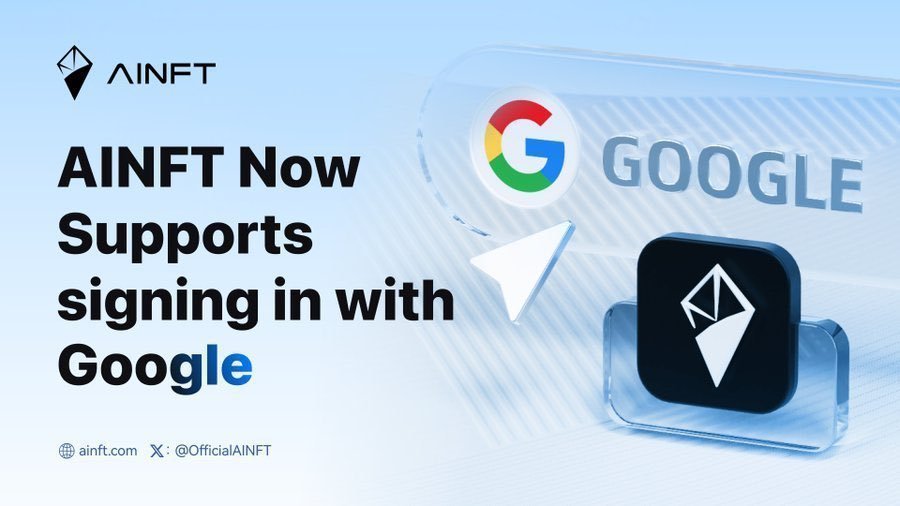
That’s why AINFT now supports Google Login alongside its existing Web3 wallet login options.
Here’s how to get started.
Steps to Access AINFT
1. Visit the Platform
• Go to https://t.co/YSvpYG4Puw.
• Open the AINFT chat interface.
2. Choose Your Login Method
• Sign in with your Google account for a familiar onboarding experience.
• Or connect a supported Web3 wallet if you prefer blockchain-native access.
3. Complete Authentication
• Follow the prompts to verify your chosen login method.
• Once completed, you’ll have access to the platform.
4. Claim Your New User Credits
• Eligible new users receive 1M credits to explore available AI models and features.
• Check the platform for any applicable terms or eligibility requirements.
5. Explore AI Models
• Browse the available AI models and choose one that fits your task, whether it’s writing, research, coding, or brainstorming.
6. Start Using AI
• Begin interacting with the platform and integrate AI into your daily workflow using the login method that best suits your preferences.
Why This Matters
✅ Faster Onboarding
Google Login makes it easier for new users to access AI services with a familiar sign-in process.
🔗 Flexible Access
Users can choose between traditional Google authentication and Web3 wallet login based on their preferred experience.
🚀 Easier AI Exploration
New user credits provide an opportunity to experience the platform and explore supported AI models.
🌐 Broader Accessibility
Offering multiple authentication options helps reduce barriers to entry and supports wider participation in AI and Web3.
As AI platforms continue to grow, simplifying access is an important step toward broader adoption. By supporting both Google Login and Web3 wallet authentication, AINFT gives users more flexibility while making it easier to begin exploring AI tools.
👉 Start here: https://t.co/YSvpYG4Puw
@AINFTcom@justinsuntron
#TRONEcoStar
𝐇𝐨𝐰 𝐖𝐈𝐍𝐤𝐋𝐢𝐧𝐤 𝐃𝐞𝐥𝐢𝐯𝐞𝐫𝐬 𝐓𝐫𝐮𝐬𝐭𝐞𝐝 𝐑𝐞𝐚𝐥-𝐖𝐨𝐫𝐥𝐝 𝐃𝐚𝐭𝐚 𝐭𝐨 𝐒𝐦𝐚𝐫𝐭 𝐂𝐨𝐧𝐭𝐫𝐚𝐜𝐭𝐬
Smart contracts are designed to execute automatically, but they can’t access information outside the blockchain on their own.
Whether it’s the price of an asset, financial market data, or another real-world event, blockchain applications need a trusted way to retrieve external information before they can act.
That’s where WINkLink comes in.
As the official oracle network of the TRON ecosystem, WINkLink connects smart contracts, DeFi protocols, and AI-powered applications to verified real-world data through a decentralized oracle infrastructure.
Here’s how it works.
Steps to Understand How WINkLink Works
1. A Smart Contract Requests External Data
• A DeFi protocol, AI agent, or decentralized application requires information that isn’t available on-chain.
• The request is sent to the WINkLink oracle network.
2. WINkLink Collects Data
• Oracle nodes retrieve information from multiple trusted sources, including APIs, exchanges, and data providers.
• Multiple sources help reduce dependence on any single provider.
3. Data Is Verified and Aggregated
• The collected data is compared, validated, and aggregated across decentralized oracle nodes.
• This process helps improve accuracy and reduce the risk of manipulated or incorrect information.
4. Verified Data Is Delivered On-Chain
• WINkLink securely sends the validated data to the requesting smart contract.
• The application now has access to trusted external information.
5. Smart Contracts and AI Take Action
• DeFi protocols can update collateral values or execute lending logic.
• AI agents can analyze verified market data and automate decisions based on predefined conditions.
6. Transactions Execute Automatically
• Once the required conditions are met, smart contracts execute transparently using trusted data supplied by WINkLink.
Why This Matters
✅ Trusted Data for Smart Contracts
Verified information helps blockchain applications execute according to accurate real-world conditions.
🤖 Better AI Decisions
AI-powered applications rely on trusted data to improve automated analysis and decision-making.
📊 Reliable DeFi Infrastructure
Accurate price feeds help support lending, borrowing, liquidations, trading, and other financial applications.
🔒 Decentralized Verification
By aggregating information from multiple independent sources, WINkLink helps strengthen transparency and resilience across the TRON ecosystem.
Smart contracts provide automated execution, and AI brings intelligent decision-making, but both depend on reliable information. WINkLink serves as the trusted data layer that connects blockchain applications to the real world, helping power DeFi, AI, gaming, and other Web3 innovations across TRON.
👉 Learn more: https://t.co/YUJUAWdSkv
@justinsuntron@WinkLink_Oracle
#TRONEcoStar
𝗪𝗜𝗡��𝗟𝗶𝗻𝗸 𝗕𝗿𝗶𝗱𝗴𝗲𝘀 𝗧𝗵𝗲 𝗚𝗮𝗽 𝗕𝗲𝘁𝘄𝗲𝗲𝗻 𝗕𝗹𝗼𝗰𝗸𝗰𝗵𝗮𝗶𝗻 𝗗𝗮𝘁𝗮 𝗔𝗻𝗱 𝗧𝗵𝗲 𝗥𝗲𝗮𝗹 𝗪𝗼𝗿𝗹𝗱
Smart contracts are powerful because they can execute predefined instructions without relying on a central authority.
But they have a fundamental limitation.
They cannot naturally look outside the blockchain and retrieve information for themselves.
A DeFi protocol may need a token price.
A gaming application may need verifiable external information.
An AI-powered system may need real-world data before making a decision.
The blockchain needs a reliable bridge between its own environment and the information outside it.
That is where @WinkLink_Oracle comes in.
𝗧𝗵𝗲 𝗗𝗮𝘁𝗮 𝗝𝗼𝘂𝗿𝗻𝗲𝘆 𝗜𝗻𝘁𝗼 𝗧𝗵𝗲 𝗕𝗹𝗼𝗰𝗸𝗰𝗵𝗮𝗶𝗻
The process can be simplified into a few important stages:
➞ A smart contract requests external information
➞ WINkLink oracle infrastructure retrieves the relevant data
➞ Information from available sources is processed and validated
➞ The resulting data is delivered on-chain
➞ The smart contract uses that information according to its programmed rules
What looks like a simple data feed to the end user is actually an important infrastructure connection happening underneath.
𝗙𝗿𝗼𝗺 𝗥𝗲𝗮𝗹-𝗪𝗼𝗿𝗹𝗱 𝗜𝗻𝗳𝗼𝗿𝗺𝗮𝘁𝗶𝗼𝗻 𝗧𝗼 𝗢𝗻-𝗖𝗵𝗮𝗶𝗻 𝗘𝘅𝗲𝗰𝘂𝘁𝗶𝗼𝗻
Consider a lending protocol.
The protocol may need to know the current value of an asset before determining collateral requirements or whether a position should be liquidated.
The smart contract can execute the rules.
But it needs the price first.
WINkLink helps provide the external information required for that decision, connecting real-world data with blockchain execution.
That same principle can apply across many other applications.
𝗪𝗵𝘆 𝗗𝗮𝘁𝗮 𝗩𝗲𝗿𝗶𝗳𝗶𝗰𝗮𝘁𝗶𝗼𝗻 𝗠𝗮𝘁𝘁𝗲𝗿𝘀
The quality of a smart contract's output depends heavily on the quality of the information it receives.
If incorrect data enters the system, the contract may still execute perfectly according to its code.
The code isn't necessarily the problem.
The input is.
That is why oracle infrastructure focuses on collecting and processing information before making it available to blockchain applications.
𝗪𝗵𝗲𝗿𝗲 𝗪𝗜𝗡𝗸𝗟𝗶𝗻𝗸 𝗕𝗲𝗰𝗼𝗺𝗲𝘀 𝗨𝘀𝗲𝗳𝘂𝗹
Reliable external data can support a wide range of applications:
➞ DeFi lending and borrowing
➞ Asset price feeds
➞ Stablecoin mechanisms
➞ Decentralized trading
➞ Blockchain gaming
➞ AI applications
➞ Automated smart contracts
➞ Other Web3 services requiring external information
The applications may be different, but they share the same basic requirement:
They need information they cannot obtain directly from the blockchain.
𝗢𝗿𝗮𝗰𝗹𝗲𝘀 𝗠𝗮𝗸𝗲 𝗦𝗺𝗮𝗿𝘁 𝗖𝗼𝗻𝘁𝗿𝗮𝗰𝘁𝘀 𝗠𝗼𝗿𝗲 𝗖𝗼𝗻𝗻𝗲𝗰𝘁𝗲𝗱
Without external data, smart contracts operate within a relatively closed environment.
With oracle infrastructure, they can respond to information originating beyond the chain.
That creates a powerful relationship:
Real-world information → WINkLink → blockchain → automated execution.
The oracle becomes the connection point between external events and on-chain logic.
@WinkLink_Oracle @justinsuntron
#TRONEcoStar
𝗖𝗵𝗼𝗼𝘀𝗶𝗻𝗴 𝗕𝗶𝘁𝗧𝗼𝗿𝗿𝗲𝗻𝘁 𝗪𝗲𝗯 𝗼𝗿 𝗖𝗹𝗮𝘀𝘀𝗶𝗰 𝗗𝗲𝗽𝗲𝗻𝗱𝘀 𝗼𝗻 𝗛𝗼𝘄 𝗬𝗼𝘂 𝗨𝘀𝗲 𝗣𝟮𝗣
Not every BitTorrent user needs the same tools.
Some want a simple way to download and stream content. Others want detailed control over transfers, bandwidth, scheduling, and other settings.
That’s why BitTorrent provides different client experiences designed around different workflows.
Here’s how to decide which one fits you.
1. 𝗦𝘁𝗮𝗿𝘁 𝗪𝗶𝘁𝗵 𝗬𝗼𝘂𝗿 𝗡𝗲𝗲𝗱𝘀
Before choosing a client, think about how you plan to use BitTorrent.
Ask yourself:
➞ Do I want simplicity or advanced controls? ➞ Do I frequently manage large downloads? ➞ Do I want streaming built into the experience? ➞ Do I need scheduling and detailed bandwidth management?
Your answers can make the choice much easier.
2. 𝗪𝗵𝗲𝗻 𝗕𝗶𝘁𝗧𝗼𝗿𝗿𝗲𝗻𝘁 𝗪𝗲𝗯 𝗠𝗮𝗸𝗲𝘀 𝗦𝗲𝗻𝘀𝗲
BitTorrent Web focuses on convenience.
It provides a browser-based experience that makes it easier to start downloading and, where supported, stream media through an integrated player.
It can be a good fit for users who prefer:
➞ A straightforward interface ➞ Quick access through a browser ➞ Simple download management ➞ Integrated media playback
The goal is less configuration and more convenience.
3. 𝗪𝗵𝗲𝗻 𝗕𝗶𝘁𝗧𝗼𝗿𝗿𝗲𝗻𝘁 𝗖𝗹𝗮𝘀𝘀𝗶𝗰 𝗠𝗮𝗸𝗲𝘀 𝗦𝗲𝗻𝘀𝗲
BitTorrent Classic is built for users who want deeper control.
It provides more advanced options for managing transfers and configuring the client around a specific workflow.
It can be useful when you need:
➞ Detailed download management ➞ Bandwidth controls ➞ Transfer scheduling ➞ Greater configuration flexibility ➞ More control over ongoing downloads
For experienced users, that additional control can make a meaningful difference.
4. 𝗧𝗵𝗲 𝗖𝗵𝗼𝗶𝗰𝗲 𝗜𝘀𝗻’𝘁 𝗔𝗯𝗼𝘂𝘁 𝗪𝗵𝗶𝗰𝗵 𝗢𝗻𝗲 𝗜𝘀 𝗕𝗲𝘀𝘁
It’s about which one matches your workflow.
→ 𝗕𝗶𝘁𝗧𝗼𝗿𝗿𝗲𝗻𝘁 𝗪𝗲𝗯
Best suited to users who prioritize simplicity, browser access, and an easier media experience.
→ 𝗕𝗶𝘁𝗧𝗼𝗿𝗿𝗲𝗻𝘁 𝗖𝗹𝗮𝘀𝘀𝗶𝗰
Better suited to users who want advanced controls and more detailed management of their transfers.
Different users have different priorities.
The right client is the one that makes those priorities easier to manage.
5. 𝗞𝗲𝗲𝗽 𝗬𝗼𝘂𝗿 𝗣𝟮𝗣 𝗛𝗮𝗯𝗶𝘁𝘀 𝗦𝗺𝗮𝗿𝘁
Whichever client you choose, use BitTorrent responsibly.
Download content you have the right to access, keep your software updated, and pay attention to your privacy and security when participating in P2P networks.
A good client should make your workflow easier without making you careless about the network you're using.
6. 𝗧𝗵𝗲 𝗕𝗶𝗴𝗴𝗲𝗿 𝗜𝗱𝗲𝗮
BitTorrent has spent more than two decades building around one fundamental concept:
Data doesn’t always need to move through a single central server.
BitTorrent Web emphasizes accessibility.
BitTorrent Classic emphasizes control.
Both support the broader peer-to-peer model that allows users to participate in distributed file sharing.
So instead of asking which client is better, ask a simpler question:
Which one fits the way I actually use BitTorrent?
@BitTorrent@justinsuntron
#TRONEcoStar