🚨 BREAKING: The United States published its FIRST AI Literacy Framework (HINT: it will likely become globally influential):
As expected, it follows the guidelines of America's AI Action Plan, and its main ideas differ from those of the EU AI Act.
Politics aside, it's a document worth reading (together with my analysis!) and considering if you are working on an AI literacy strategy.
👉I'll break it down in my newsletter tomorrow, with additional comments to help you understand and navigate it. To receive it, subscribe below.
The Code of Practice is out. I co-wrote the Safety & Security Chapter, which is an implementation tool to help frontier AI companies comply with the EU AI Act in a lean but effective way. I am proud of the result!
1/3
The European Commission has, for the first time, publicly acknowledged that no enforcement of the AI Act will start before August 2026. The AI Act's staggered timeline is more fiction than reality.
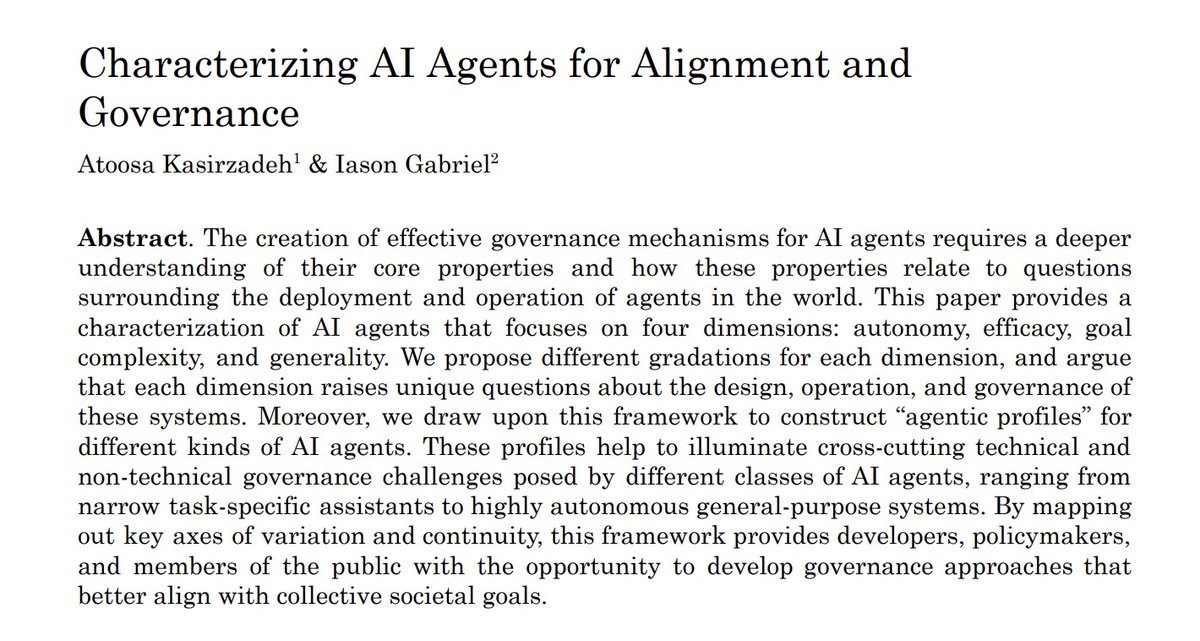
📢 New paper with @IasonGabriel is out! 2025 is being called the year of AI agents, with overwhelming headlines about them every day. But we lack a shared vocabulary to distinguish their fundamental properties. Our paper aims to bridge this gap. A 🧵
🚨NEW: The European Commission has just published the first draft of the Code of Practice for general-purpose #AI model providers.
https://t.co/ulkv5SZm64
🔥 HOT TAKE: Is the current AI wave another tech bubble? According to @Floridi, YES, and his recent paper "Why the AI Hype is Another Tech Bubble" is a MUST-READ. Below, he explains more about tech bubbles:
"A quick comparison between the Dot-Com Bubble and the Cryptocurrency Bubble shows that the former was larger in scale, longer in duration, and primarily centred in the U.S., while the latter rose and fell more rapidly and was a more global phenomenon. The Dot-Com Bubble saw significant institutional investor participation, while the Cryptocurrency Bubble was initially driven more by retail investors. Unlike purely speculative assets, many dot-coms had actual products, services, and intellectual property, even if overvalued. However, the bubbles fed each other, and shared several core characteristics, to such an extent that there are strong family resemblances, to use Wittgenstein’s famous metaphor:
1️⃣ A disruptive technology at the core. A bubble centres around a technology with the potential to revolutionise multiple industries, other technology (synergetic effect), and the tendency to cause tunnel vision.
2️⃣ Speculation outpacing reality. In a bubble, market excitement and investment outpace the actual development and implementation of the technology, its long-term usefulness, and sustainable profitability.
3️⃣ New valuation paradigms. Traditional financial metrics tend to be discarded in favour of new, unorthodox and often flawed measures of value.
4️⃣ Retail investor participation. Since the Cryptocurrency Bubble, individual investors' significant involvement, often motivated by FOMO, has become a significant feature.
5️⃣ Regulatory gap and lag. Regulatory frameworks are absent in a bubble and/or struggle to keep pace with technological and market developments."
-
"Following the previous analysis, there is a compelling argument to be made that the current AI Hype Cycle shares significant similarities with previous tech bubbles, exhibiting the typical characteristics of a tech bubble (...). The rapid advancements in AI, particularly in machine learning, deep learning, and LLMs (or, to be more precise, foundation models), have led to a surge of excitement, investment, and media attention, mutually reinforcing each other and reminiscent of previous tech bubbles, especially the Dot-Com Bubble (...). The release of ChatGPT in November 2022 accelerated this trend, creating a perfect storm (still ongoing at the time of writing, though it seems to be abating) of inflated expectations and speculative investment. This phenomenon bears striking resemblances to the tech bubbles of the past, suggesting that we may indeed be witnessing the formation of an AI bubble."
➡️ Read the full paper below.
🏛️ STAY UP TO DATE. Join 37,400+ people who subscribe to my weekly newsletter on AI policy, compliance & regulation, including outstanding research papers (link below).
🚨 [AI RESEARCH] If you want to understand some of the emerging macro-trends in AI, you CAN'T MISS the paper "The Age of AI Nationalism and Its Effects" by @AaronsonSusan. Important information:
➡️ The main topic of the paper is AI nationalism, and Susan describes some of the unintended consequences of these practices. For example, regarding competition-related implications:
"AI nationalism may further encourage monopolistic markets. According to the US Federal Trade Commission, which, along with the DoJ, regulates competition, only some 20 firms possess the cloud infrastructure, computing power, access to capital and vast troves of data to develop and deploy tools to create LLMs. These firms are also concentrated in a few advanced developed countries — in Asia, Europe and North America. As a result, a few companies with expertise in AI could hold outsized influence over a significant swath of economic activity. Perhaps most importantly, these firms hold considerable political as well as economic clout globally and they often lobby against regulation. At times, they act as de facto private regulators, particularly in technologies such as AI, whereas policy makers are just learning how to govern in these emerging fields. Prowess begets economies of scale and scope, which, in turn, begets ever more digital prowess."
-
"According to the UK Competition and Markets Authority, these monopolistic markets cause three problems:
➵ firms controlling critical inputs for developing various AI models may restrict access to these models to shield themselves from competition;
➵ powerful incumbents could exploit their positions in consumer- or business-facing
markets to distort choices and restrict competition in deployment;
➵ partnerships among key players could exacerbate existing positions of market power
through the value chain."
➡️ In the conclusion, the author states:
"Around the world, policy makers see AI as essential to economic growth and progress. AI is, at bottom, a global product — built over time on large troves of the world’s data and knowledge. Yet some officials in some countries are limiting access to the building blocks of AI — whether funds, data or high-speed computing power — to slow down or limit the AI prowess of their competitors in country Y and/or Z. Meanwhile, some officials are also shaping regulations in ways that benefit local AI competitors and, in so doing, they may also impede the competitiveness of other nations’ AI developers. These steps, over time, could reduce the potential of AI and data. Moreover, as the author has shown, sovereign AI policies could backfire, alienating potential allies and further dividing the world into AI haves and have not." (page 23)
➡️ Read the paper below.
🏛️ STAY UP TO DATE. AI governance is moving fast: to keep up with the latest developments, join 36,200+ people who subscribe to my weekly newsletter (link below).
🚨 [AI LIABILITY] AI regulation doesn't end with the AI Act, and everyone should be aware of Philipp Hacker's MUST-READ "Proposal for a directive on adapting non-contractual civil liability rules to AI." Some of its key recommendations are:
1️⃣ "Identity of concepts and definitions. The AILD includes several key concepts from the AI Act. For reasons of coherence and legal clarity, the AILD should adopt the concepts used in the AI Act (e.g. the definition of AI itself).
2️⃣ From high-risk to high-impact AI systems. The AILD should, however, add certain categories that trigger the evidence disclosure obligations and the rebuttable presumptions concerning fault and causality. This primarily concerns: general-purpose AI systems (e.g. ChatGPT); Old Legislative Framework systems (e.g. autonomous vehicles; transportation-related AI applications more generally; other AI systems falling under Annex I Section B AI Act 3 ); and insurance applications beyond health and life insurance. The study suggests an umbrella term ('high-impact AI systems') to cover high-risk AI systems and those additional systems.
3️⃣ Rebuttal of presumption. The AILD framework should allow for the causality presumption to be rebutted in cases where initial violations of the AI Act are rectified atlater stages.
4️⃣ Article 14 and 26 AI Act violations. Articles 14 and 26 AI Act require human oversight mechanisms in AI systems. The direct causation between a lack of ex-post oversight and harmful outputs is not always clear. It is suggested to establish a direct presumption of causality betweenAI outputs and damages for non-compliance with monitoring obligations.
5️⃣ Handling of prohibited AI systems. For AI systems banned under Article 5 AI Act, the recommendation is to assume strict liability for any damages they cause.
6️⃣ Impact of general-purpose AI systems. The current AILD framework does not adequately cover general-purpose AI systems, which can lead to significant harm particularly in the realms of non-discrimination (e.g. unbalanced content) and personality rights (e.g. hate speech and fake news). It is recommended that generative AI systems, such asChatGPT, be classified under the new 'high-impact' category. This would bring them under the ambit of the AILD, ensure evidence disclosure, and establish presumptions of causality for safety violations. This, in turn, aids injured parties in legal claims.
7️⃣ Extension of the AILD beyond the PLD. Given the PLD's limitations (e.g. concerning nonprofessional users and types of damage not covered by the PLD), there is a strong case for extending the AILD, to ensure a comprehensive liability framework."
and more.
➡️ Read the full proposal below.
🏛️ STAY UP TO DATE. AI governance & law are moving fast: to keep up with the latest developments, join 36,000+ people who subscribe to my weekly newsletter (link below).
The #AI Pact signatories list is out. Even with significantly diluted pledges, Apple & Meta decided not to join, continuing their collision course with the EU. Mistral & Anthropic are also out, but that makes sense since they are only in the model segment.
https://t.co/YUihJyvjEA
🚨 [AI RESEARCH] "Limitations and Loopholes in the EU AI Act and AI Liability Directives: What This Means for the EU, the U.S., and Beyond" by @SandraWachter5 is an excellent read for everyone in AI governance. Quotes:
"The AIA does not define bias or discuss how to measure it. It also does not discuss acceptable levels of bias, mitigation strategies, expected behavior if bias cannot be detected or mitigated, or how to prevent biases. It lacks examples of positive or desirable bias (e.g., positive/affirmative action), bias related to ground truth (e.g., in relation to health), or how bias differs culturally yet often has a Western-oriented view. Yet researchers in recent years have developed a wide range of technical mechanisms that can be useful for detecting and mitigating biases" (page 688)
-
"In relation to high-risk AI systems and all types of GPAI models and systems, external audits could help to detect and mitigate systemic risks. Inspiration can be drawn from the DSA, which grants access to vetted researchers and requires external audits to investigate systemic risks of very large platforms and search engines to assess the effectiveness of mitigation strategies for systemic risks. Internal checks, such as red teaming, will not be sufficient on their own." (page 714)
-
"AI’s harms are not only immaterial but also societal. A punitive system that only focuses on individual cases and monetary compensation is not good enough. The harms caused by mislabeling people as criminals, eroding scientific integrity, and misinformation campaigns are felt by society, not just individuals. To combat faulty or inaccurate AI systems, other legal tools should be employed. This could include mandatory redesign, (temporary) bans, and mandatory external audits." (page 717)
➡ Read the full paper below (*Make sure to follow @SandraWachter5's work).
🔥 To stay up to date with the latest developments in AI policy, compliance & regulation - including excellent research, join 34,700+ people who subscribe to my weekly newsletter (link below).
Rather odd commentary in the @FT today. The main case in point seems to be that the compute power threshold for designating GPAI models with systemic risk might soon be outdated. Still, it ignores that the Commission can revise it via a delegated act. 1/2
https://t.co/s4HIm3R4kU
The European Innovation Council published a checklist for integrating generative AI tools into the creative process (before the AI Office). It includes some daunting questions like: Has the software provider been involved in any known copyright lawsuit?
https://t.co/JFgC3QIIPA
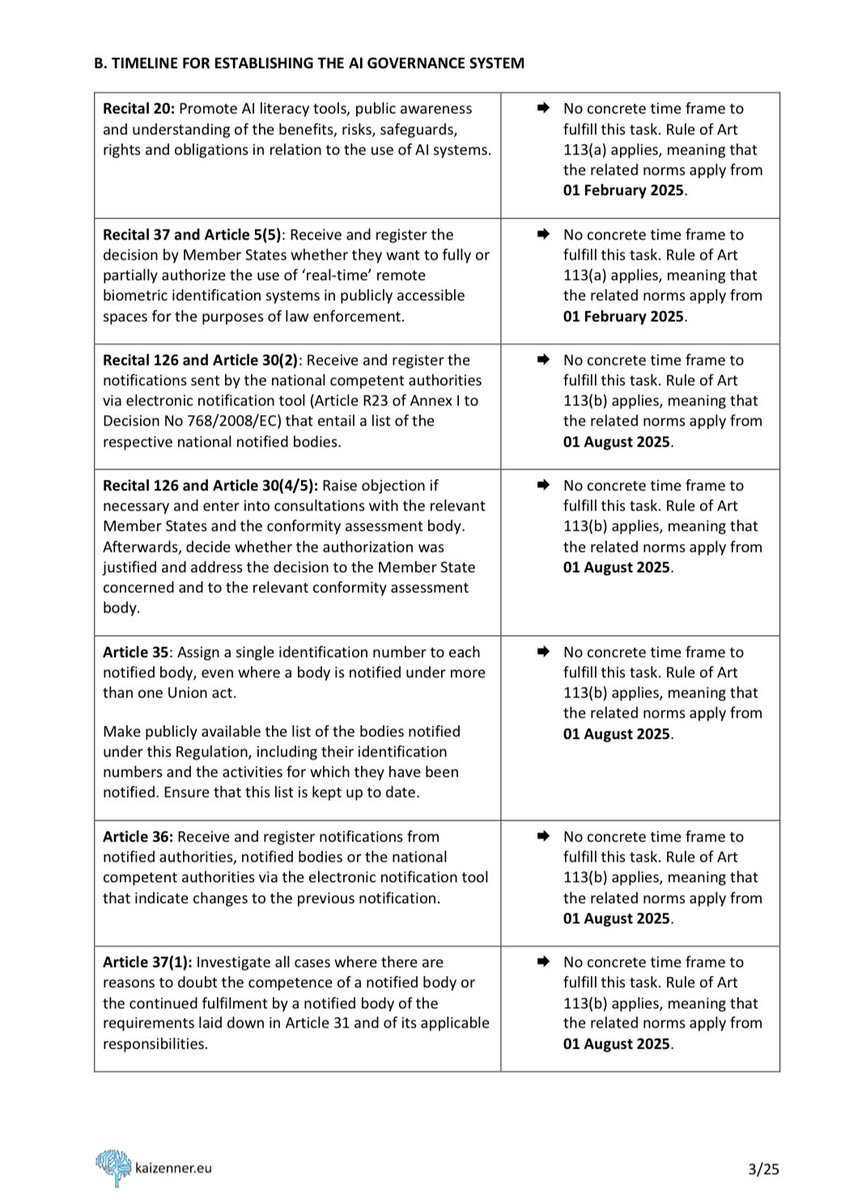
🚨 List of #AIOffice responsibilities
If you are unsure who is implementing and enforcing the #AIAct & what the specific time frames are, you might find my new document, listing on 25 pages all obligations / tasks of @EU_Commission, interesting.
👉D/L: https://t.co/2wAYcNutpZ
Who is regulating AI?
Our paper (w/@ChrisTMarsden) on AI co-regulation has just been published: https://t.co/Pb9hrIjDgK
We explore the role of standards in the AI Act, democratic legitimacy, and the need for inclusive approaches to AI regulation
While all eyes were on the #AI Act and, to a lesser extent, the AI Liability Directive, the EU quietly updated its product liability regime to cover software. That will be consequential for AI model providers & companies integrating AI into their products.
https://t.co/fDnxlEkfZX
The EU's #AI Act is set to be published in the EU Official Journal on 12 July, which means it should enter into force on 1 August, confirming @mlexclusive's previous reporting.
On 13 June 2024, the Artificial Intelligence Act (AI Act), which was formally adopted by the European Parliament and approved by the European Council, was finally signed into law. The Act needs to be published in Official Journal.
Brussels, 13 June 2024: https://t.co/PHuxnOoZ7m
The EU's signature of the world's first #AI treaty might be delayed due to an internal dispute around who should sign it. If the quarrel is not solved quickly, the delay might limit the international uptake of the treaty, starting with the United States.
https://t.co/qDLBIJ1sPW
NEW: The EU's #AI Act will be signed off on Thursday, but it will only be published in July due to a significant backlog, @mlexclusive has learned. That means the entry into force has been further delayed. Full story 👇
https://t.co/b6uLiOjee7




![LuizaJarovsky's tweet photo. 🚨 [AI RESEARCH] If you want to understand some of the emerging macro-trends in AI, you CAN'T MISS the paper "The Age of AI Nationalism and Its Effects" by @AaronsonSusan. Important information:
➡️ The main topic of the paper is AI nationalism, and Susan describes some of the unintended consequences of these practices. For example, regarding competition-related implications:
"AI nationalism may further encourage monopolistic markets. According to the US Federal Trade Commission, which, along with the DoJ, regulates competition, only some 20 firms possess the cloud infrastructure, computing power, access to capital and vast troves of data to develop and deploy tools to create LLMs. These firms are also concentrated in a few advanced developed countries — in Asia, Europe and North America. As a result, a few companies with expertise in AI could hold outsized influence over a significant swath of economic activity. Perhaps most importantly, these firms hold considerable political as well as economic clout globally and they often lobby against regulation. At times, they act as de facto private regulators, particularly in technologies such as AI, whereas policy makers are just learning how to govern in these emerging fields. Prowess begets economies of scale and scope, which, in turn, begets ever more digital prowess."
-
"According to the UK Competition and Markets Authority, these monopolistic markets cause three problems:
➵ firms controlling critical inputs for developing various AI models may restrict access to these models to shield themselves from competition;
➵ powerful incumbents could exploit their positions in consumer- or business-facing
markets to distort choices and restrict competition in deployment;
➵ partnerships among key players could exacerbate existing positions of market power
through the value chain."
➡️ In the conclusion, the author states:
"Around the world, policy makers see AI as essential to economic growth and progress. AI is, at bottom, a global product — built over time on large troves of the world’s data and knowledge. Yet some officials in some countries are limiting access to the building blocks of AI — whether funds, data or high-speed computing power — to slow down or limit the AI prowess of their competitors in country Y and/or Z. Meanwhile, some officials are also shaping regulations in ways that benefit local AI competitors and, in so doing, they may also impede the competitiveness of other nations’ AI developers. These steps, over time, could reduce the potential of AI and data. Moreover, as the author has shown, sovereign AI policies could backfire, alienating potential allies and further dividing the world into AI haves and have not." (page 23)
➡️ Read the paper below.
🏛️ STAY UP TO DATE. AI governance is moving fast: to keep up with the latest developments, join 36,200+ people who subscribe to my weekly newsletter (link below).](https://pbs.twimg.com/media/GZi7VJdXcA8u3OK.jpg)
![LuizaJarovsky's tweet photo. 🚨 [AI LIABILITY] AI regulation doesn't end with the AI Act, and everyone should be aware of Philipp Hacker's MUST-READ "Proposal for a directive on adapting non-contractual civil liability rules to AI." Some of its key recommendations are:
1️⃣ "Identity of concepts and definitions. The AILD includes several key concepts from the AI Act. For reasons of coherence and legal clarity, the AILD should adopt the concepts used in the AI Act (e.g. the definition of AI itself).
2️⃣ From high-risk to high-impact AI systems. The AILD should, however, add certain categories that trigger the evidence disclosure obligations and the rebuttable presumptions concerning fault and causality. This primarily concerns: general-purpose AI systems (e.g. ChatGPT); Old Legislative Framework systems (e.g. autonomous vehicles; transportation-related AI applications more generally; other AI systems falling under Annex I Section B AI Act 3 ); and insurance applications beyond health and life insurance. The study suggests an umbrella term ('high-impact AI systems') to cover high-risk AI systems and those additional systems.
3️⃣ Rebuttal of presumption. The AILD framework should allow for the causality presumption to be rebutted in cases where initial violations of the AI Act are rectified atlater stages.
4️⃣ Article 14 and 26 AI Act violations. Articles 14 and 26 AI Act require human oversight mechanisms in AI systems. The direct causation between a lack of ex-post oversight and harmful outputs is not always clear. It is suggested to establish a direct presumption of causality betweenAI outputs and damages for non-compliance with monitoring obligations.
5️⃣ Handling of prohibited AI systems. For AI systems banned under Article 5 AI Act, the recommendation is to assume strict liability for any damages they cause.
6️⃣ Impact of general-purpose AI systems. The current AILD framework does not adequately cover general-purpose AI systems, which can lead to significant harm particularly in the realms of non-discrimination (e.g. unbalanced content) and personality rights (e.g. hate speech and fake news). It is recommended that generative AI systems, such asChatGPT, be classified under the new 'high-impact' category. This would bring them under the ambit of the AILD, ensure evidence disclosure, and establish presumptions of causality for safety violations. This, in turn, aids injured parties in legal claims.
7️⃣ Extension of the AILD beyond the PLD. Given the PLD's limitations (e.g. concerning nonprofessional users and types of damage not covered by the PLD), there is a strong case for extending the AILD, to ensure a comprehensive liability framework."
and more.
➡️ Read the full proposal below.
🏛️ STAY UP TO DATE. AI governance & law are moving fast: to keep up with the latest developments, join 36,000+ people who subscribe to my weekly newsletter (link below).](https://pbs.twimg.com/media/GZTLBU6WAAA1rLp.jpg)
![LuizaJarovsky's tweet photo. 🚨 [AI RESEARCH] "Limitations and Loopholes in the EU AI Act and AI Liability Directives: What This Means for the EU, the U.S., and Beyond" by @SandraWachter5 is an excellent read for everyone in AI governance. Quotes:
"The AIA does not define bias or discuss how to measure it. It also does not discuss acceptable levels of bias, mitigation strategies, expected behavior if bias cannot be detected or mitigated, or how to prevent biases. It lacks examples of positive or desirable bias (e.g., positive/affirmative action), bias related to ground truth (e.g., in relation to health), or how bias differs culturally yet often has a Western-oriented view. Yet researchers in recent years have developed a wide range of technical mechanisms that can be useful for detecting and mitigating biases" (page 688)
-
"In relation to high-risk AI systems and all types of GPAI models and systems, external audits could help to detect and mitigate systemic risks. Inspiration can be drawn from the DSA, which grants access to vetted researchers and requires external audits to investigate systemic risks of very large platforms and search engines to assess the effectiveness of mitigation strategies for systemic risks. Internal checks, such as red teaming, will not be sufficient on their own." (page 714)
-
"AI’s harms are not only immaterial but also societal. A punitive system that only focuses on individual cases and monetary compensation is not good enough. The harms caused by mislabeling people as criminals, eroding scientific integrity, and misinformation campaigns are felt by society, not just individuals. To combat faulty or inaccurate AI systems, other legal tools should be employed. This could include mandatory redesign, (temporary) bans, and mandatory external audits." (page 717)
➡ Read the full paper below (*Make sure to follow @SandraWachter5's work).
🔥 To stay up to date with the latest developments in AI policy, compliance & regulation - including excellent research, join 34,700+ people who subscribe to my weekly newsletter (link below).](https://pbs.twimg.com/media/GXdI6d7WIAEtj0C.png)