It's time to pass the Clarity Act 🇺🇲
After years of bipartisan work, the U.S. is closer than ever to establishing clear rules for the digital asset industry.
Regulatory clarity fosters innovation, protects consumers, & helps establish America as the crypto capital of the world.
The Gensler-era of crypto policy feels like an absolute fever dream, like cartoon villain-level antics
Suing legitimate companies for not complying with rules they refused to explain, contradicting their own statements from case to case, making up nonsensical legal theories that courts continuously shut down, etc etc
All in an ill-advised futile attempt to kill crypto, but ultimately just slowed down the industries growth for a few years, pushed companies overseas, and established a perverse incentive structure for crypto tokens, all while failing to stop any of the actual bad actors
Let's get the Clarity Act passed and ensure this fever dream can never happen again !
🚨NEW: Senate Republicans have just released an updated version of the Clarity Act following briefing calls with stakeholders this morning.
Here are some of the key provisions in the latest text, including ethics, the BRCA and other areas we’ve been following closely.
Most people's mental model of Chainlink $LINK is completely wrong
Here's why👇
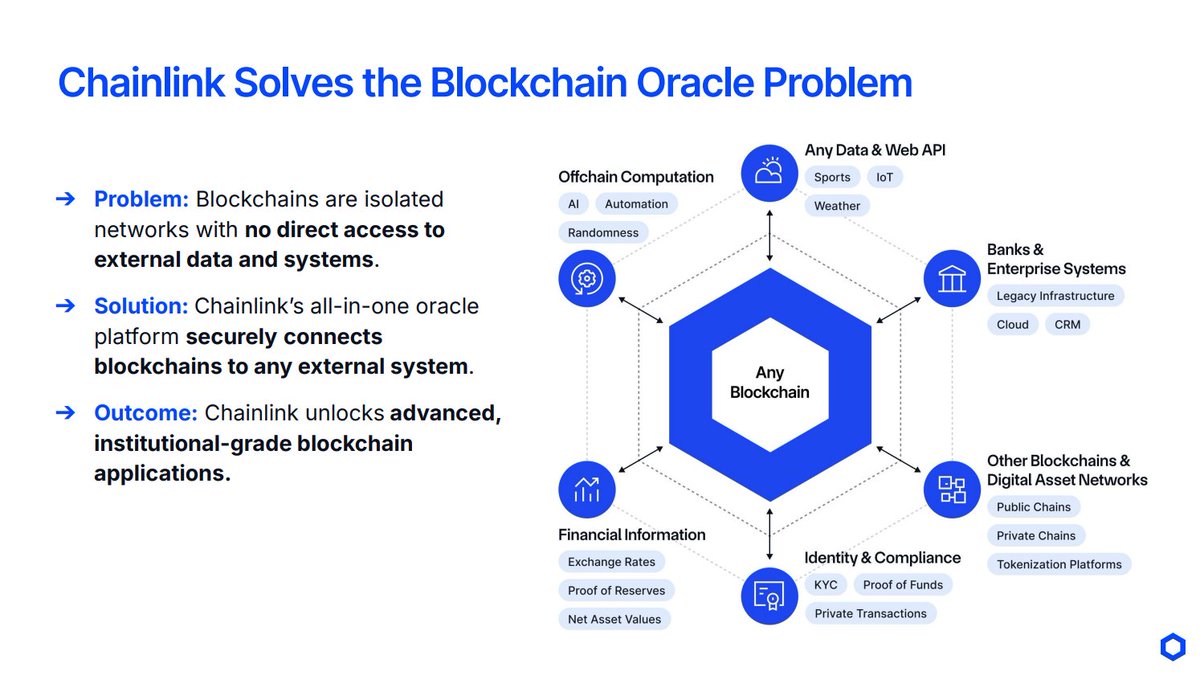
People often think of oracles as simple middleware bolted to the side of a blockchain, simply injecting price data
In their mind, Chainlink is "just an oracle" so who cares right?
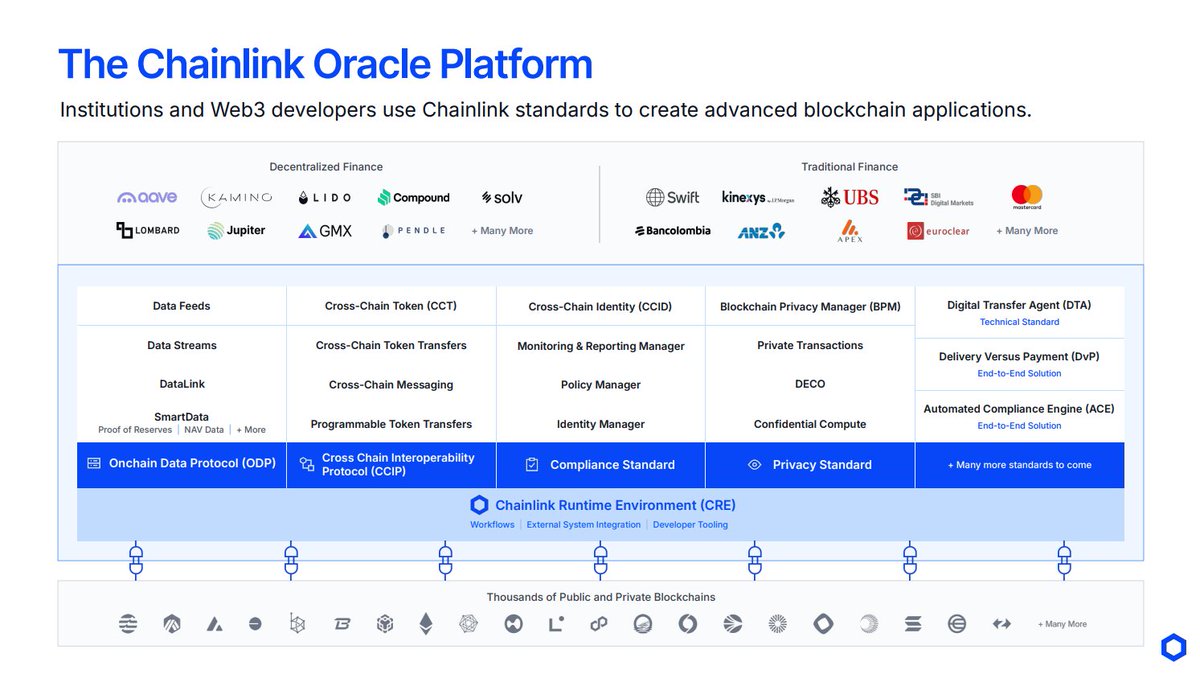
A more complete mental model is that Chainlink is the global orchestration layer that sits above and across all blockchains and external systems
A unified platform that enables organizations to create advanced business workflows spanning any number of blockchains, legacy systems, and oracle services, all powered by a decentralized runtime environment
This matters now more than ever because we are entering a Cambrian explosion of blockchains of all kinds (public & private, L1 & L2, DeFi & TradFi, EVM & non-EVM)
The cost and friction of launching a new blockchain network has never been lower
And what we have seen historically is that in order for a blockchain to be successful, it needs critical oracle services:
- Data oracles: DeFi needs market data to secure lending and derivatives, while TradFi needs NAV data for tokenized funds and corporate actions data for tokenized equities. Proof of Reserve provides public visibility into the reserves backing tokenized assets
- Cross-chain oracles: Digital assets in both DeFi and TradFi need to be securely transferable across any public or private blockchain to access a greater pool of buyers, minimizing liquidity fragmentation and enabling advanced settlement workflows
- Compliance oracles: Regulated tokenized assets need to comply with various regulations and internal business logic rules around identity verification and risk management to become adopted by institutions
- Privacy oracles: Sensitive information needs to be made accessible to blockchain apps without revealing the underlying data, while private chains need to connect to public chains while only selectively revealing what is needed to complete transactions
- Legacy-system oracles: Institutions want to access public and private blockchains using their existing infrastructure and messaging standards (Swift, FIX, DTCC) through a single integration gateway rather than manually integrating with thousands of chains individually
- Orchestration oracles: Institutions need to be able to coordinate complex business workflows that span multiple blockchains, legacy systems, and oracle services through a simple API gateway
Chainlink is the only unified platform that provides all of these solutions in a single offering, minimizing trust-assumptions and eliminating the complexity of using a patchwork of service providers
This is how institutions adopt blockchains, not by betting on specific chains, but integrating with a unified platform that provides them access to any public or private chain
While blockchains fiercely compete amongst each other to become the transactional database layer, Chainlink wins regardless of which chains are used
For Chainlink, every new blockchain introduced to market is all the more justification for why organizations need a global orchestration layer to manage the complexity
Financial market infrastructures like Swift, DTCC, and Euroclear understand this, which is why they have adopted Chainlink alongside J.P. Morgan, Mastercard, Central Bank of Brazil, UBS, SBI, Fidelity International, ANZ, and many others
In addition to powering the DeFi economy (70%+ marketshare globally, 80%+ on Ethereum, and 90%+ on L2s), Chainlink directly monetizes the integration and deployment of its services on blockchains via the Scale program and enterprise deals
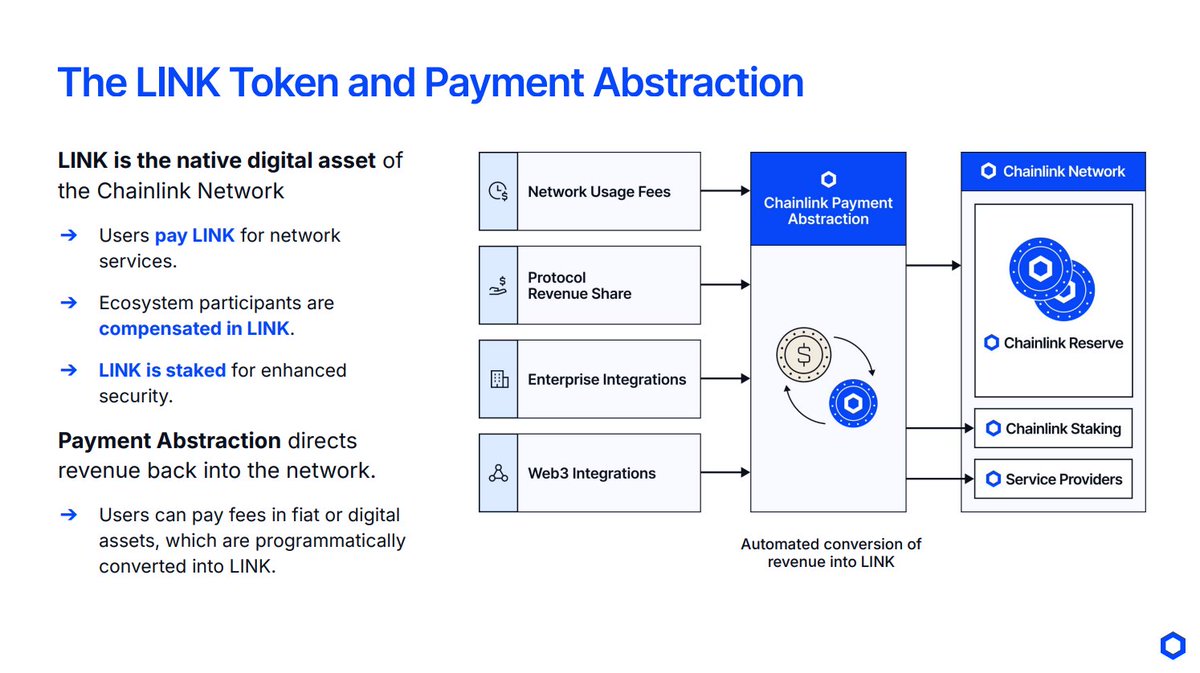
Onchain revenue from the usage of Chainlink services, as well as offchain revenue from Scale and enterprise deals, directly fuel $LINK token buybacks which grow the Chainlink Reserve
Chainlink services have already enabled $28+ trillion in transaction value across 77+ blockchain networks via 2,000+ oracle networks used by 500+ applications, with more public and private blockchains regularly integrated all the time
Today, developers build on blockchains and plug into Chainlink
In the future, developers will build on Chainlink and plug into blockchains
The result is straight forward:
More blockchains
↓
More Chainlink adoption
↓
More onchain & offchain revenue
↓
More $LINK token buybacks
↓
Chainlink's dominance compounds