Full Stack Developer skilled in building scalable web apps using Node.js, React, and modern tools. Passionate about fintech, and solving real-world problems.
The fastest way to expose a fake senior engineer:
Ask them to design a system where nothing goes according to plan.
Network fails.
Database goes down.
Kafka delivers twice.
Redis is stale.
Requests timeout.
A user clicks “Pay” twice.
One region disappears.
Junior engineers design the happy path.
Senior engineers design:
“What happens when everything breaks at the same time?”
Save this for your next system design interview.
10 DSA patterns you actually use in real production software engineering: 📌
1. Hash Tables:
Used in: Redis in-memory storage, database primary key indexes, and session caches.
2. B-Trees & B+Trees:
Used in: PostgreSQL, MySQL, and SQLite disk-based storage engines for range scans.
3. Log-Structured Merge Trees (LSM):
Used in: Cassandra, RocksDB, and Bigtable for high-throughput append-only disk writes.
4. Sliding Window:
Used in: API rate limiting (Token Bucket), network packet flow control, and rolling metric aggregations.
5. Tries (Prefix Trees):
Used in: High-speed URL router matching in web frameworks like Express, FastAPI, and Gin.
6. Priority Queues (Heaps):
Used in: Operating system process schedulers, background Celery job queues, and event timers.
7. Inverted Indexes:
Used in: Elasticsearch, Lucene, and search databases for instant full-text keyword retrieval.
8. Bloom Filters:
Used in: Caching layers to prevent cache penetration by checking if an ID exists before querying the database.
9. SkipLists:
Used in: Redis Sorted Sets (ZSET) to provide fast O(log N) search and range queries without tree rebalancing.
10. Graphs & Topological Sort:
Used in: Build systems (Make, Webpack) and CI/CD pipelines (GitHub Actions) to resolve dependency execution order.
DSA is not just an interview game.
It is the foundation of every database, web framework, and operating system you rely on.
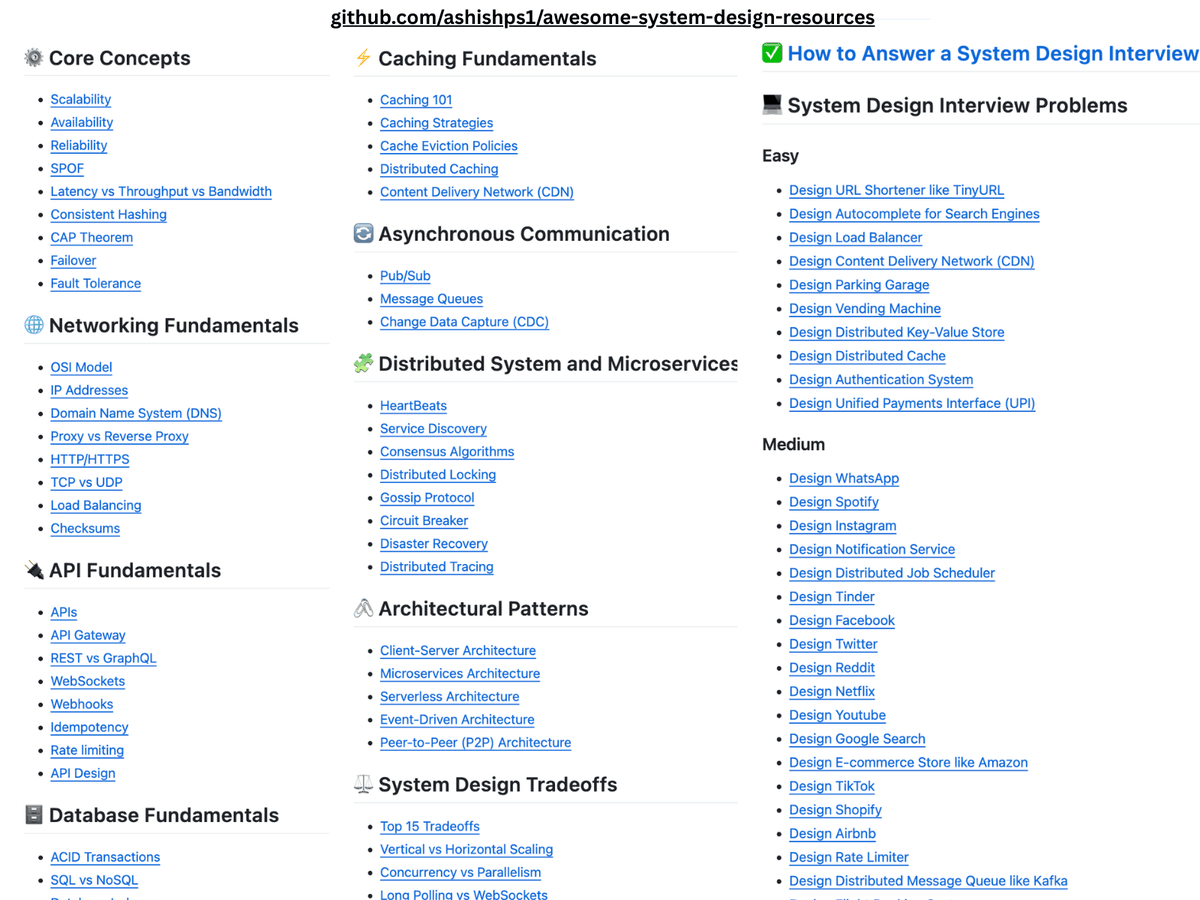
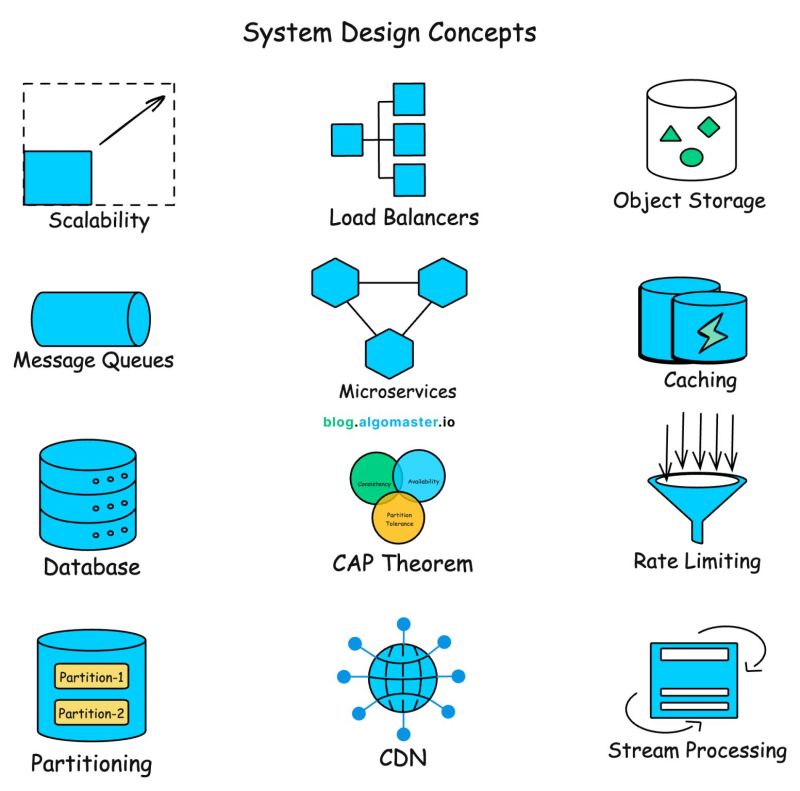
I created a Github repository to learn System Design, and I'm excited to share that it crossed 35k stars recently.
The repository contains a collection of resources to study:
- System Design Core Concepts
- Networking and API Fundamentals
- Database and Caching Fundamentals
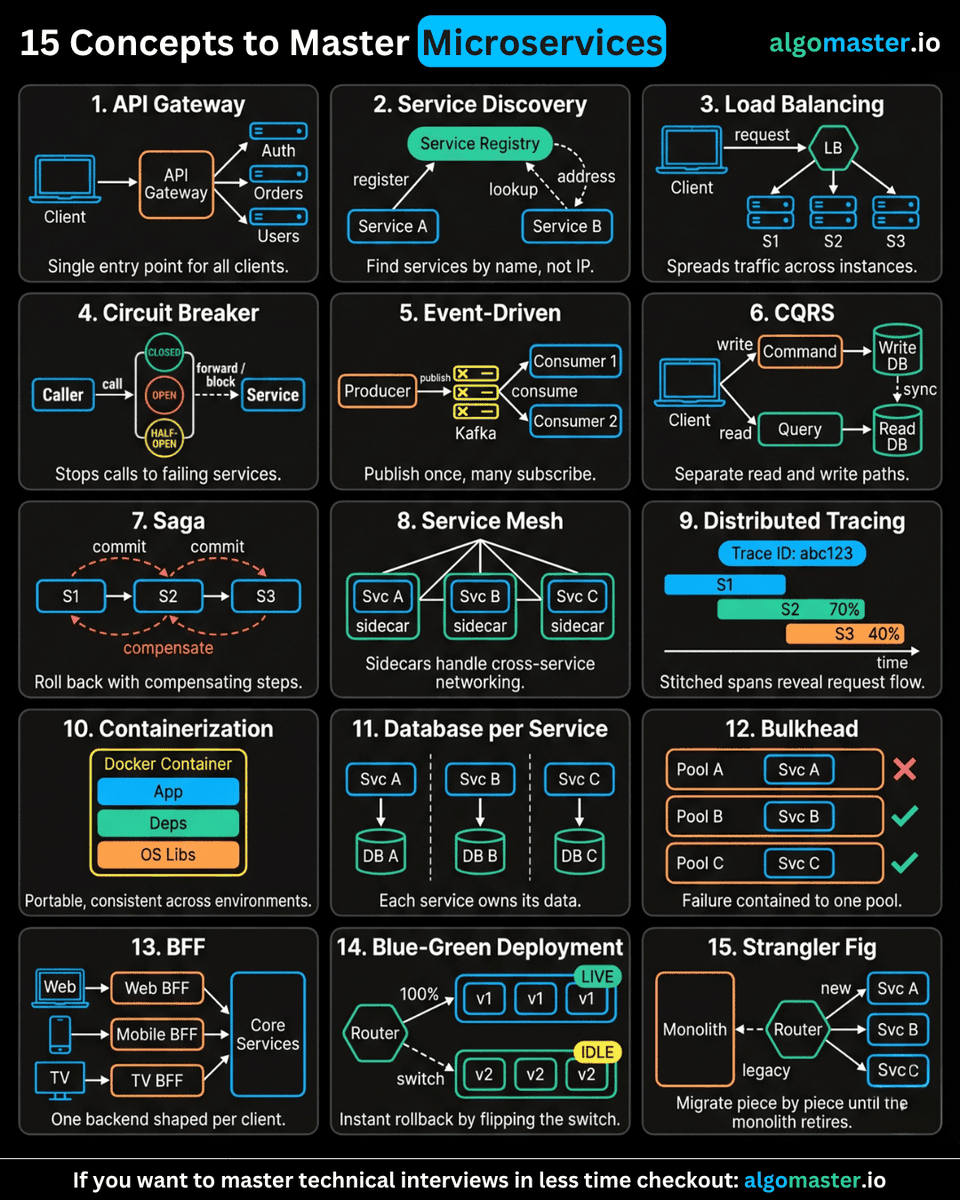
- Distributed Systems, Microservies and Architectural Patterns
- System Design Tradeoffs
- 40+ interview problems categorized by difficulty level
Check it out here: https://t.co/pkVpi6LxSV
If you find the repo valuable, consider giving it a ⭐️ and share with others.
Thanks to everyone who has starred or forked the repository!
4 GitHub Repositories to Prepare for 4 Different Types of Software Engineering Interviews:
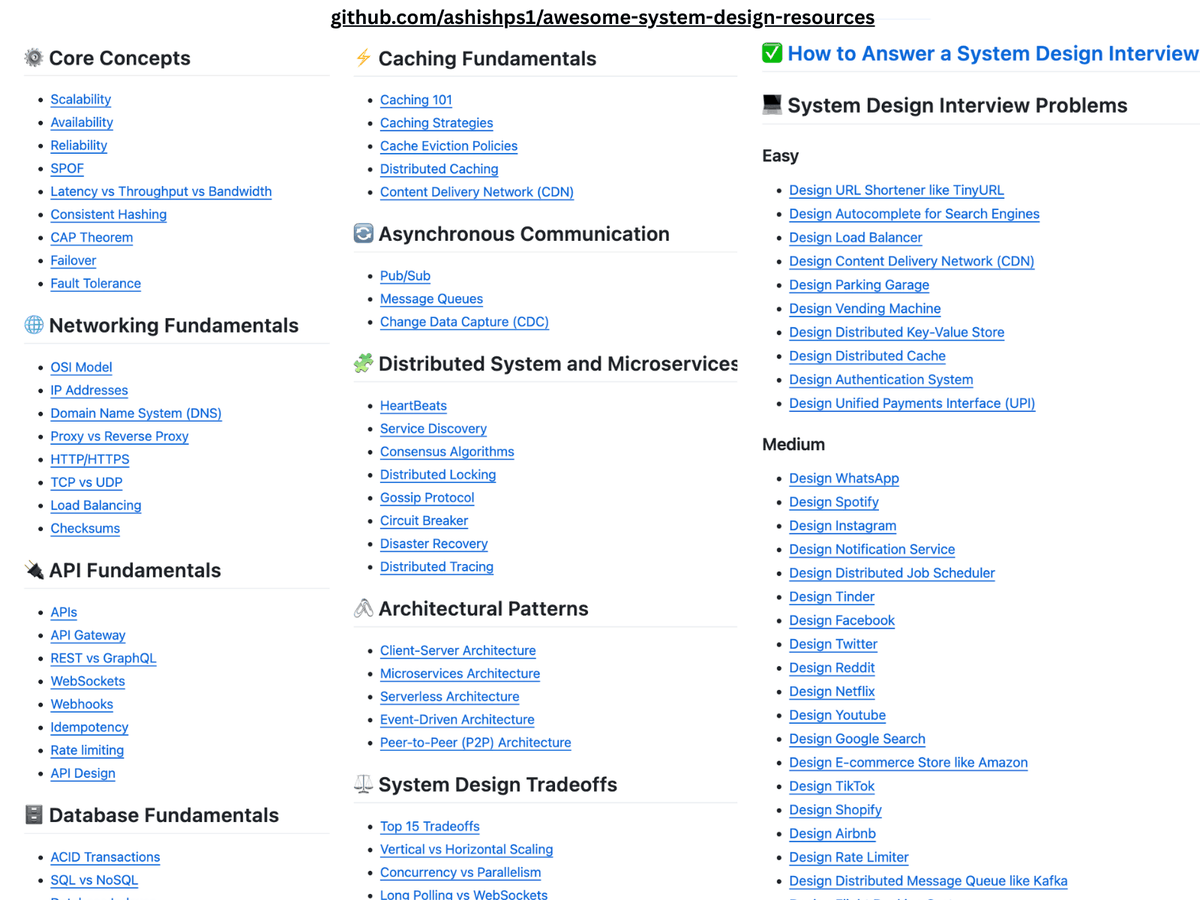
1. System Design Interviews: https://t.co/pkVpi6LxSV
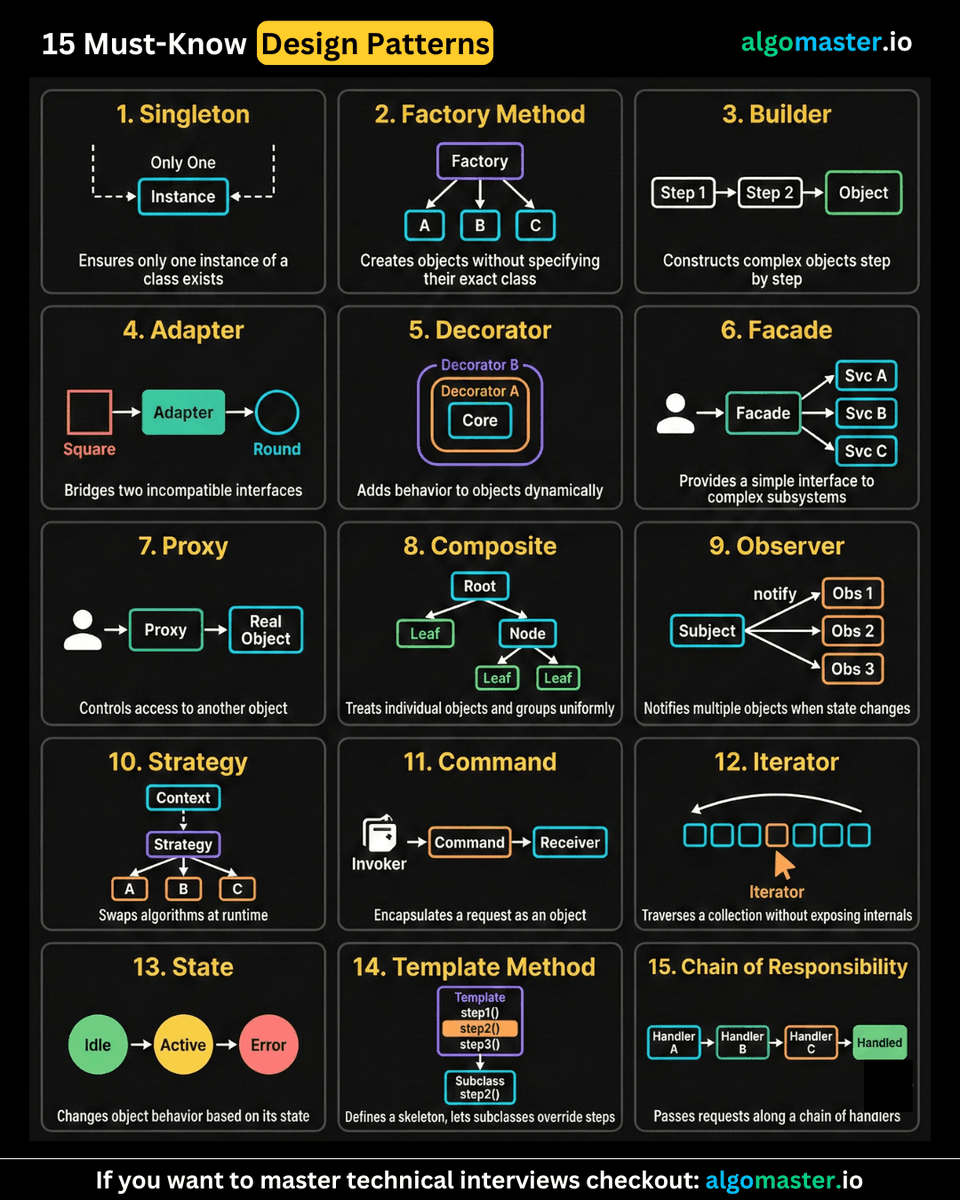
2. Low Level Design Interviews: https://t.co/ewnEgFdlfF
3. Coding Interviews: https://t.co/oTez9H4sGh
4. Behavioral Interviews: https://t.co/NsN4Ki0wlz
♻️ Repost to help others in you network
As a Senior Backend Engineer trying to move towards Staff, I can tell you one thing clearly:
At Senior level, knowing system design fundamentals is not enough anymore.
You are expected to design a good system.
At Staff level, you are expected to design the right system for the business, explain the tradeoffs, influence multiple teams, reduce long term operational pain, and make sure the system does not collapse when traffic, teams, and complexity grow.
So if you are already good at system design but still feel stuck at Senior, spend the next 3-6 months building these Staff Engineer muscles.
Architecture & Technical Strategy
↬ System boundaries
↬ Platform thinking
↬ Build vs buy decisions
↬ Monolith decomposition
↬ Multi-region architecture
↬ Migration strategies
↬ Backward compatibility
↬ API contracts
↬ Long-term maintainability
↬ Reducing operational complexity
↬ Designing for org structure
↬ Architecture decision records
↬ Technical roadmap planning
↬ Removing accidental complexity
↬ Identifying single points of failure
↬ Choosing boring technology
↬ Knowing when not to build
↬ Designing systems that teams can own
Scalability & Distributed Systems
↬ Caching strategy
↬ Queueing strategy
↬ Partitioning
↬ Sharding
↬ Replication
↬ Leader election
↬ Rate limiting
↬ Load shedding
↬ Backpressure
↬ Fan-out/Fan-in
↬ Idempotency
↬ Retry storms
↬ Consistency models
↬ Eventual consistency
↬ Distributed transactions
↬ Data locality
↬ Hot partitions
↬ Graceful degradation
↬ Capacity planning
↬ Failure mode analysis
Databases & Data Architecture
↬ Data modeling
↬ Indexing strategy
↬ Query patterns
↬ Read/write scaling
↬ OLTP vs OLAP
↬ CDC
↬ WAL
↬ Transaction isolation
↬ Schema evolution
↬ Data retention
↬ Backup and restore
↬ Archival strategy
↬ Hot/cold storage
↬ Multi-tenant data design
↬ Event sourcing
↬ CQRS
↬ Denormalization tradeoffs
↬ Data correctness
↬ Reprocessing pipelines
↬ Analytics vs product database separation
Reliability & Operations
↬ SLO/SLI/SLA
↬ Error budgets
↬ Alert quality
↬ Incident response
↬ Postmortems
↬ Runbooks
↬ On-call pain reduction
↬ Canary deployments
↬ Rollbacks
↬ Feature flags
↬ Disaster recovery
↬ Load testing
↬ Chaos testing
↬ Health checks
↬ Circuit breakers
↬ Distributed tracing
↬ Metrics design
↬ Log quality
↬ Dependency failure handling
↬ Designing for recovery, not perfection
Execution & Influence
↬ Writing design docs
↬ Getting alignment
↬ Mentoring seniors
↬ Reviewing architecture
↬ Asking better questions
↬ Challenging vague requirements
↬ Explaining tradeoffs simply
↬ Driving cross-team projects
↬ Creating technical standards
↬ Reducing duplicate systems
↬ Unblocking other teams
↬ Making hidden risks visible
↬ Communicating with product
↬ Saying no with reasoning
↬ Turning ambiguity into execution
↬ Making other engineers more effective
The Senior to Staff jump is not just about “I can build complex systems.”
It is:
“I can help the org make better technical decisions, avoid expensive mistakes, and create systems that other engineers can safely build on top of.”
That is the mindset shift imo.
January 2025. ₦0 in my account.
I sent 57 job applications in one month.
Got 2 responses. Both were rejections.
So I deleted my CV and tried something stupid.
furtunately It worked...
walk with me...
I wasted 6 months grinding just leetcode hoping to crack FAANG.
I rectified my mistake and started focusing on system design as well and cracked multiple offers.
Here's the exact 30-day plan that changed everything.
Programming Languages and Channels to Learn from🔥
Python
https://t.co/jEyfATKyfk
JavaScript
https://t.co/Ar3yEb19XQ
https://t.co/IIO84y0VAw
Java
https://t.co/MnZjLZgj6X
https://t.co/SFYfVSboKu
C#
https://t.co/zlZGP26EFM
https://t.co/e14EuD1LmU
Go (Golang)
https://t.co/h59ra2XcZv
Rust
https://t.co/UbBhit4XY3
C / C++
https://t.co/MPd4elRGsp
General
https://t.co/e14EuD1LmU
Like❤️, repost 🔁and bookmark 🔖