@Missmurima Do you watch series! There’s actually a show that depicted this, just more intense. Look up black mirror S7ep1. It’s a tough watch. It’s coming.
Along the Somalia–Kenya border, vulnerable families affected by the spillover of the Somalia conflict are rebuilding their lives through conditional cash grants. Together with @KenyaRedCross, we're helping restore livelihoods, boost incomes, and strengthen self-reliance.
As part of our cooperation with the @KenyaRedCross, our Head of Logistics met with the Kenya Red Cross senior leadership to explore partnership opportunities between the two logistics centres and visited their warehouse in Nairobi to identify mutual areas of collaboration.
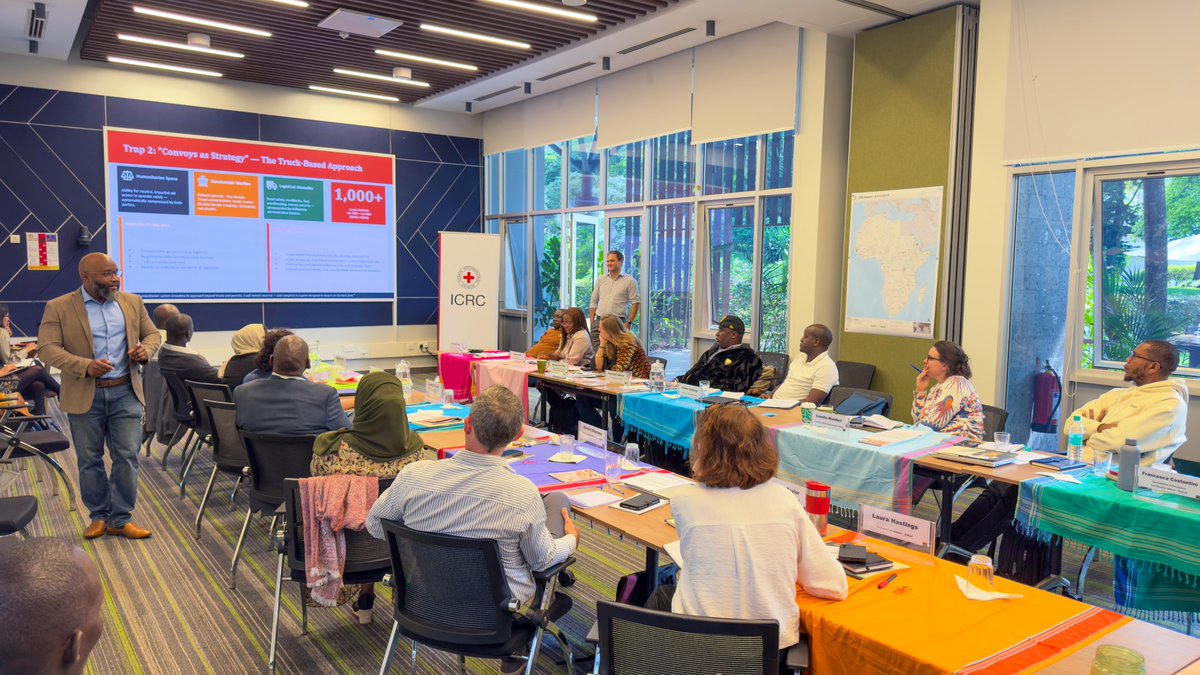
Great discussions with humanitarian professionals across Eastern Africa during the Senior Humanitarian Professionals and Policymakers Course, sharing insights on humanitarian action, protection, and advancing #IHL in armed conflict situations.
Today I made two decisions that shocked even me.
First, I cheated on my barber. Recently he’s been moving like a celebrity… doesn’t pick calls, misses appointments, acts booked and busy. Meanwhile he charges me Ksh. 3,000 per shave like he’s restoring ancient art.
Today I decided enough is enough and tried a Burundi guy charging Ksh. 500.
Let me tell you something… when that man turned the chair around, I almost stood up and hugged him. The fade was so clean.
Second… I left my car at home and took a matatu to a meeting.
At first I was tense. Then the conductor called me “boss,” the music was hitting, and somehow we reached faster than everyone stuck in traffic pretending to be important.
By the time I got to the meeting I had saved fuel, parking fees, and unnecessary suffering.
Character development is realizing Nairobi humbles everybody equally.
Understanding armed conflict goes beyond the classroom. Through immersive simulations like these with @StrathU Law School, students engage with the realities of conflict, exploring how international humanitarian law applies in situations where civilians must be protected. #IHL
Court rules that a person can’t be committed to civil jail for failing to pay a debt, in Sh788,000 dispute; Justice Nyakundi says it’s unfair to punish someone for lacking money.
We have managed to uncover Traffic (Minor Offences) Rules and the charges motorists face following the rollout of the new NTSA Instant Fines system.
Save the thread below:
There’s a quiet power in giving—the kind that brings unexpected gains.
This #IWD26, we feature colleagues who champion gender equality through everyday actions, collective effort & mentorship. Together, we continue to uplift, support & create spaces where everyone can thrive. 💜
This woman joined friends for dinner, during the dinner she had noticed they were ordering multiple appetizers, allot of drinks, high priced entrees. When it was time to pay the bill they insisted that they split the bill evenly amongst themselves. She refused to do so because she knew she barely ordered anything and she would owe way less than everyone. Of course the people who ordered allot of food started mocking her and calling her broke, she ended up only paying what she owed and she left. Did she do the right thing or did she go against the will of the group?
THE LONELY END OF A GOOD MAN.
This is the Story of My Friend, Moses Kinuthia, my campus buddy.
Since he has allowed me to share. We were in JKUAT together. Young. Loud. Brilliant.
Full of plans about the future and how we would conquer the world.
Today, Moses is an IT Director at one of the leading commercial banks in the country.
On paper, he is the definition of success.
A man who did everything right.
A man who climbed every rung through discipline and sacrifice.
But this is the part nobody sees.
His day starts before the sun.
He leaves home quietly at 5:20 AM, careful not to wake anyone.
The children are asleep.
His wife barely turns.
Moses tiptoes around the house he pays for, moving like a visitor in the place he built.
He gets to work before everyone because that is where his life makes sense.
At the office, doors open.
People greet him with respect.
Colleagues seek his advice.
Managers rely on him.
In that building, Moses still exists.
But in the house he returns to every evening, he has become a ghost.
When he gets home, the living room is always full kids watching shows, his wife on the phone, her sister in law using the TV.
There is never a seat left for him.
Never a moment that feels like his.
So Moses has learned a ritual.
He walks to his car, closes the door gently, leans the seat back and watches the 7PM news on his phone.
Sometimes he sits there long after the news ends, just staring at the roof of the car, breathing slowly, trying to feel human again.
When there is a football match, he connects his phone to the car speakers.
He used to shout at the TV with joy once, now he celebrates in silence, alone in the driveway, like a boy hiding with stolen sugarcane.
Inside the house, nobody asks where he is.
Nobody wonders why he eats dinner late.
Nobody notices that he spends more time in the car than in his own living room.
His 13–year–old son, the one he dreamt of bonding with, is always locked away in his room gaming.
The gaming console Moses bought — hoping for father–son weekends is still in its box.
His wife said the cables “make the house look untidy.”
So the box stays on the top shelf.
And the distance between father and son grows quietly, day by day.
Weekends are no different.
On Saturdays, Moses sometimes walks into a house full of chama ladies sipping tea, laughing loudly.
He greets them, forces a smile and walks back out before he blocks the doorway.
He strolls around the estate until his feet ache.
He listens to the sounds of other families in their living rooms; laughter, loud TV, playful arguments things he does not remember the last time he experienced.
When he finally returns at dusk, his younger daughter is watching cartoons on the bedroom TV.
The only other TV is in use.
So Moses sits on the edge of his bed, watching highlights on his phone, pretending he is fine.
Bills keep coming.
The mortgage letter.
The water disconnection threat.
The residents association notice.
Security warnings.
School fees.
Everyone depends on him.
Nobody checks on him.
Yet he never complains.
Because he believes a man must carry the weight silent and steady.
But silence has a cost.
Last month, he told me something that broke me.
“Bro, I feel like I’m disappearing in slow motion. I am alive, but I don’t think anyone would notice if I stopped showing up.”
This is the lonely end of a good man.
A man who gave everything.
A man who showed up every day.
A man who traded his youth, his rest, his hobbies and his peace for his family.
And somehow, without doing anything wrong, he became invisible in the story of his own life.
He is not hated.
He is not mistreated.
He is simply used and unseen which is sometimes worse.
He sits in his car after work because it is the only place he feels the world pause long enough for him to breathe.
He eats alone.
He celebrates alone.
He stresses alone.
He survives alone.
Not because he failed as a man but because good men often fade in the very homes they built
@Nyamisa_Chela@uber_kenya They did the same to me. Paid, driver claimed we didn’t, Uber was unresponsive, never bothered to investigate and added it to the next ride. Never used uber since.