Peter Tuchman says gamers became smart money and are making $20 million a year in their 20s
"I've seen a new generation of young people, 18 to 25, day trading the stock market and becoming really successful. The people day trading now are coming out of the video game generation. They know how to work a keyboard. When they were given the opportunity to make money doing something similar, the transition from video games to day trading was a very easy one."
"I've seen traders who were inspired by me, saw my first video when they were 12 or 13 years old, who are now making $20 million a year in their 20s with amazing communities around them. There's a new generation of retail that has become smart money. They've become great traders."
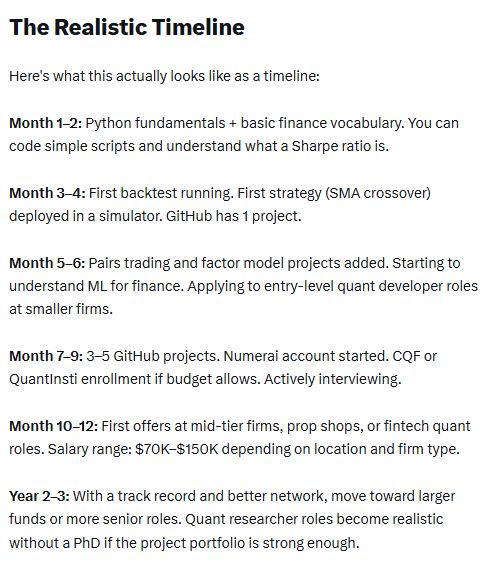
'How to become a Quant' Roadmap
Simple steps:
1. Math: Probability & Statistics, Linear Algebra, Calculus, Optimization
2. Programming: Python, NumPy, Pandas, scikit-learn
3. Finance: Market structure, Mean Reversion, Momentum, Factor Models
4. Build: Backtests, Pairs Trading, Factor Research, Volatility Models
5. ML: XGBoost, HMMs, NLP, Feature Engineering
6. Portfolio: GitHub, Research reports, Real performance metrics
Try to put your knowledge into practice asap
This is the best way to learning something
I’d like to add that without a PhD it’s highly unlikely you’ll land a high-paying job
but it’s entirely possible to apply this knowledge to your trading strategies
Nobel Prize winner Demis Hassabis just accidentally revealed who survives the next 5 years and who doesn't.
"One person who understands AI will outperform an entire startup team"
Most founders heard that and thought: "Oh no, I need to learn prompt engineering"
Wrong.
That's not what "understands AI" means anymore.
It means: building workflows. Chaining systems. Automating entire departments.
Not typing better questions into ChatGPT.
The split is brutal:
> 90% of people = still using AI like a calculator
> 10% of people = treating it like infrastructure
In 5 years, the 10% will run everything with half the headcount.
The 90%? Replaceable.
Which group are you in?
Watch the full breakdown. This is the only skill gap that actually matters right now.
Bookmark this. You'll want to reference it.
A French engineer who lives quietly in Paris has spent 30 years writing software that the entire internet now runs on without knowing his name.
He wrote the code that streams every YouTube video, every Netflix show, every TikTok clip. He wrote the code that runs the virtual servers underneath AWS, Google Cloud, and Microsoft Azure. He calculated more digits of pi than anyone in history. He has no Twitter. He has no marketing. He just keeps shipping.
His name is Fabrice Bellard.
Here is the story, because almost nobody outside the systems programming world knows what one man has built.
Fabrice was born in 1972 in Grenoble, France. He studied at École Polytechnique, the top French engineering school. He never went to Silicon Valley. He never built a startup empire. He just wrote code.
In 2000 he started a project called FFmpeg, an open-source multimedia framework for encoding, decoding, and streaming video. He was 28. The project did one thing nobody else had done well. It handled every video and audio format that existed, in one library, on every operating system. He led it himself for years.
Today FFmpeg is the invisible engine of the internet. YouTube uses it. Netflix uses it. VLC uses it. Chrome and Firefox use parts of it. Every Android phone, every iPhone, every smart TV, every video editing tool you have ever touched runs FFmpeg somewhere underneath. If you have watched a video on a screen in the last 20 years, Fabrice's code processed it.
He was not done.
In 2003 he started QEMU, a machine emulator and virtualizer. He wrote it solo until version 0.7.1 in 2005. QEMU lets you run any operating system on any other operating system. It became the foundation of modern virtualization. KVM, the Linux kernel hypervisor, runs on top of QEMU. Every major cloud provider, AWS, Google Cloud, Microsoft Azure, IBM Cloud, runs virtual machines on infrastructure built around it. The Quick Emulator is the most cited piece of cloud infrastructure code on Earth.
He kept going.
In 2001 he won the International Obfuscated C Code Contest with a small C compiler that grew into TCC, the Tiny C Compiler. TCC can compile and boot a Linux kernel from source in under 15 seconds. In 2004 he calculated the most digits of pi ever computed at the time, using a personal desktop computer and an algorithm he derived himself called Bellard's formula. In 2011 he wrote a complete PC emulator in pure JavaScript that runs Linux in your browser, a project called JSLinux that engineers still cannot believe is real.
In 2019 he released QuickJS, a small but complete JavaScript engine that fits where V8 cannot. In 2021 he released NNCP, a neural network based lossless data compressor that immediately took the lead on the Large Text Compression Benchmark.
Then he turned his attention to large language models. He built TextSynth Server, a web server with a REST API for running LLMs locally. He released ts_zip and ts_sms, compression utilities that use language models to compress text and short messages at ratios traditional algorithms cannot reach. He released TSAC, a very low bitrate audio compression system. In December 2025 he released Micro QuickJS, a new JavaScript engine for microcontrollers, separate from QuickJS, designed for environments with almost no memory.
Fabrice co-founded a telecom company called Amarisoft in 2012, where he serves as CTO. Amarisoft builds 4G and 5G base station software used by carriers and labs around the world. He has been running it for over a decade while continuing to ship personal projects from his own home page at bellard dot org
He has no Twitter. He has no Instagram. He gives almost no interviews. His personal website is a flat list of projects with no styling, no fonts, no marketing copy. Just titles and links.
A quiet French engineer who never moved to Silicon Valley wrote the code that quietly runs the internet.
He is still shipping.
MrBeast: "If you knew what I knew, you could get 10 million subscribers in six months"
"Your videos suck. You think your videos are good, but they suck. They just do. And the sooner you learn how to make good, great videos that people actually want to watch, the sooner you'll get views."
MrBeast shares his early reality:
"When I was 14, I thought my videos were the best in the world. They weren't, they were terrible. To be successful, you kind of have to have a little bit of that ego where you think your content's great.
But also, if you have sub-1,000 subscribers, there's a good probability your videos just suck. They just do."
He explains what to do about it:
"You need to make hundreds of videos. Improve something every time. And just get to the point where they don't suck. When you make good content, you'll blow up. It's not the algorithm. It's not anything.
Most people who are in my position just made terrible videos, and that's okay. Because you've got to make a bunch of videos and improve over time to be great."
MrBeast uses an analogy:
"You don't just pick up a baseball and become an MLB-level athlete within a year. It takes many, many, many years. YouTube's kind of the same way."
On analysis paralysis:
"A lot of people get analysis paralysis. They'll sit there and plan their first video for three months. If you have zero videos on your channel, your first video is not gonna get views. Period. Your first 10 are not gonna get views.
I can very confidently say that. So stop sitting there and thinking for months and months on end. Just get to work and start uploading."
He gives the formula:
"All you need to do is make 100 videos and improve something every time. Do that, and then on your 101st video, we'll start talking. Maybe you can get some views. But your first 100 are gonna suck."
How to improve something each time:
"The second video: put more effort into the script. The third one: learn a new editing trick. The fourth one: figure out a way to have better inflections in your voice. The fifth one: study a new thumbnail tip and implement it. The sixth one: figure out a new title.
There's infinite ways. The coloring, the frame rate, the editing, the filming, the production, the jokes, the pacing, every little thing can be improved. There's literally no such thing as a perfect video."
On the algorithm:
"What YouTube wants is for people to click on a video and watch it. That's what it is at its core. By studying the algorithm, you'll learn that you're more studying human psychology. What do humans want to watch?"
MrBeast shares a simple reframe:
"Anytime you say the word 'algorithm,' just replace it with 'audience' and it works perfectly. 'The algorithm didn't like that video?' No, the audience didn't like that video. Literally, that's it. If people are clicking and watching, it gets promoted more. The algorithm just reflects what the people want."
On titles:
"Short, simple, and just so freaking interesting that you have to click. If someone reads it, are they like, do they have to watch it? Is it just so intrinsically interesting that it's gonna haunt them if they don't click?"
He adds nuance:
"Keep it below 50 characters. Above 50 characters, on certain devices it goes dot, dot, dot, and that's the worst thing because then people don't even know what they're clicking on."
MrBeast shares the extremity principle:
"The more extreme the opinion, typically the higher the click-through rate. 'Fiji water sucks', that'd do fine. But 'Fiji water is the worst water I've ever drank in my life', way more extreme, would do way better. But then you have to deliver. The more extreme you are, the more extreme you have to be in the video."
On the first 5 seconds:
"Before you film a video, what is the thumbnail? What is the title? Then what's the first 5 seconds? Then what's the first 30 seconds?"
He explains why autoplay changed everything:
"On YouTube now, videos automatically play. So many people don't even see the thumbnail because it autoplays so quickly. The thumbnail is irrelevant for them. I have to visually convince you to click on the video in the first 5 seconds.
Before, the hook was important because you had to convince people to watch. Now you have to convince people to click and watch at the same time, with the first 5 seconds."
On matching expectations:
"Your title and thumbnail set expectations. At the very beginning of the video, to minimize drop-off, you want to assure them that those expectations are being met. If you click on a video called 'Tether is a scam' and at the very beginning, he starts talking about literally anything else, you're like, 'Oh, this is BS. This isn't what I clicked on.'
But if at the very start you go, 'Tether is a scam and I'm gonna teach you why,' then it's like, okay, you match the expectations. Then you want to exceed them."
He emphasizes the importance:
"The thing people undervalue the most is literally the first 10 seconds of the video. That 15% difference in viewership between losing 35% of viewers in the first 30 seconds versus losing 20%, that really does make the difference between 2 million views and 10 million views. You just had a more strategic intro that hooked them."
On removing dull moments:
"You basically want to remove every dull moment. Find the 10 most critical people you know, make them watch the video, and just roast it. If I talk to a camera for 10 seconds without a cut, a lot of people will get bored.
Having a B-cam and C-cam three seconds in, cutting to a different angle, now it's more interesting even though it's essentially the same thing."
On keeping viewers watching:
"Give them why they clicked. Tell them why they should watch. Then just stick on topic. That right there isn't even super complex, but I would already put you in the upper echelon of YouTube.
A lot of people drag it out. It's like, 'I'm going to eat $100 ice cream, but first...' and then it's them birthday shopping for their mom. That's not why I came here."
On quality over quantity:
"It's much easier to get 5 million views on one video than 50,000 views on 100 videos. A lot of small YouTubers just post videos that aren't bad but aren't great, and none of them ever pop off, so they never get an audience.
It might be better to upload half or a third or even a fifth of the videos, but make the videos you upload so freaking good that the algorithm has to promote it."
He warns against the consistency trap:
"When you set a consistent schedule and you're constantly having to upload videos that aren't as good as you'd like because you gotta hit 'Oh, this Monday I said I'd upload', that's a dangerous trap. The viewers notice the quality isn't as good and it makes them less likely to watch. I think it hurts your longevity."
On the real metric that matters:
"A big thing that everyone underestimates, what was your experience with your last video? If people loved the last video of yours that they watched, they're more likely to watch your next one. When people watch your video, you don't want them to go, 'Okay, that was good, but that's enough of you for the day.'
What you want is them to go, 'Holy crap, that was crazy! Oh my god, what's that?' and they watch 10 videos. That's how you get high view counts. People watch 10 videos, not one."
On thumbnails:
"You want it to be simple. When they're scrolling, you want them to instantly understand what you're conveying and feel some type of emotion. Make it so interesting, or spike their curiosity so much, that if they don't click it, they'll wonder before they go to bed what happened?"
He gives an example:
"If you uploaded 'I rode a skateboard with 1,000 other people on it', and people are falling off the side, it's about to go off a big ramp if you don't click that, you're gonna be so curious.
Later in the day, when you're daydreaming, you'll think, 'What happened to those 1,000 people on that skateboard?' That's the mindset you should have when making thumbnails."
On knowledge being the only barrier:
"It's all knowledge. It really is. I could start a new channel tomorrow without using my face or my voice, without ever promoting it, and in six months have 20 million subscribers. I just could. It's purely knowledge.
If you knew what I knew, you could get 10 million subscribers no matter where you are right now within six months."
He addresses the skeptics:
"90% of the people watching don't agree with that. Everyone has excuses. 'Nah, YouTube just doesn't work like that, Jimmy.' But I mentor a lot of people. I see it all the time. It is possible. It is simply knowledge.
The second you accept that it is knowledge and you start your journey of learning figuring out what makes a good video, what does my audience want, how can I elevate and then you take that knowledge and just assume 'I will never understand what the perfect video is' and every single day be devoted to learning and improving as much as possible there you go."
On money not being the barrier:
"There are tons of viral ideas that don't require money. It does not require money to go viral. One of my most-viewed videos was spending 24 hours in a desert, we just grabbed a tent and some stuff and went to the desert. It got 60-70 million views.
People say, 'I could be MrBeast if I had money.' A, I didn't start off with money; I was poor, I had no money. It took me seven years just to buy a camera saving up from YouTube. And B, some of our most-viewed videos literally anyone can do."
On why no one will outwork him:
"No one's ever gonna do what I do better than me. It's just not humanly possible. I reinvest every penny I make. I work every hour I'm awake. I devote every atom in my brain to solving this. I hire the best people on the planet.
I've been doing this for 14 years. And I think in decades, not years. I'm gonna be doing this for another 20-30 years. If I thought someone was doing better than me, I'd just start sleeping less so I could work even more."
But he doesn't recommend it:
"I don't have a life. I don't have work-life balance. My personality, my soul, my being is making the best videos possible. That is why I exist on this planet. And I don't recommend it.
You should have work-life balance. You should not devote your entire life to this one thing. I have a mental breakdown every other week because I push myself so hard. I don't recommend it."
The only question that matters:
"Subscribers don't matter. Views don't matter. I mean, they do. But everything you want as a creator comes from making the best videos possible and thumbnails. The video part's the hard part.
Ask: 'How can I make my videos better?' Do that every single day for years. And then you'll probably get views."
Indie developer:
"You're not supposed to manually grind for users. You're supposed to let your Hermes agent run your YouTube channel."
this is one of the best automated marketing workflows I've built in a long time
here is exactly how giving my Hermes agent access to the Runway API completely changed my B2C growth:
> the fully automated video generation straight to YouTube
> the self-reflecting agent that plans future uploads based on real performance
> the 24,000 views and 29 subscribers gained in just 9 days
> the passive stream of new eyes landing directly on my startup
if you've been building B2C apps for more than a month and still do marketing manually, you are leaving massive user growth on the table. probably hundreds of hours too
instead of manually editing videos tonight, try automating it
make sure to bookmark this before it gets lost in your feed
drop your best tips for automated video generation in the comments below
ÇİNLİ BİR ADAM RESMEN PARA BASMA MAKİNESİ OLUŞTURDU.
Github'da 13.000 yıldız almış bir araç var.
Adı moneyprinterturbo.
Bir çinli geliştirici yaptı.
Ücretsiz ve tamamen açık kaynak.
Tiktok, reels, youtube shorts için tam videoları otomatik üretiyor.
Nasıl çalışıyor.
Tek bir iş akışında her şeyi hallediyor.
Senaryo üretimi, seslendirme, altyazı, görsel kaynaklar, düzenleme, hepsi dakikalar içinde.
Yayına hazır video çıkıyor.
Sen hiçbir şeye dokunmuyorsun.
Şimdi neden bu kadar popüler oldu.
Çünkü normalde bu süreç şöyle işliyor.
Senaryo için ayrı araç, seslendirme için ayrı araç, altyazı için ayrı araç, görsel için ayrı araç, düzenleme için ayrı araç.
Her biri ayrı para istiyor, ayrı zaman istiyor, ayrı öğrenme istiyor.
Moneyprinterturbo hepsini tek çatıda birleştirdi.
Ücretsiz, sınırsız ve kategorisindeki en popüler açık kaynak proje haline geldi.
Tiktok shop ve youtube shorts kanalları aylık 6 ila 10 bin dolar kazanıyor.
Bunlar bu süreci kullanıyor.
Fark şu:
Onlar araçlar için para ödüyor.
Sen ödemiyorsun.
Kurulumu 5 dakika.
Github'da ara.
Kur, çalıştır, içerik üret hepsi tamamen senin elinde.
$25,000 in 4 days from tweets
& that was a slow week
Here's the full engine so you can try to copy it:
I genuinely don't care if you steal all of it because execution separates the rich from the retarded & most of you reading this won't do shit anyway…
Step 1 -> the content
Long-form content is the entire weapon
60-90 seconds of reading does something to the human brain that no ad or cold email can replicate… the reader's brain physically cannot separate "I chose to read this" from "I trust this person"
The act of reading your shit for 90 seconds manufactures trust automatically. No funnel. No webinar. No 14-email nurture sequence. Just a man reading your words on a free app & walking away thinking you understand his problems better than his own business partner does
This is the part every other platform can't touch. On X, the content IS the nurture. There is no separate step where you "warm up" the lead. He warms himself up by reading. Every tweet he consumes is a touchpoint that would've cost you $50-200 on any ad platform & here it's $0
But the content has to do a specific thing or it makes $0…
Every tweet has to make the reader feel SICK about his current situation
If he finishes reading & thinks "great tips" you made $0
If he finishes reading & immediately checks his own analytics with a pit in his stomach… you just created a buyer
"You're pulling 300k views/mo & your DMs are empty. Your content is a circus show for people who will never pay you & you can't tell the difference because the likes feel good"
Every founder who reads that opens his inbox. Sees nothing. Now he has a problem he didn't have 90 seconds ago & the only mf who described his exact symptoms is you
I've been running this play across every client for years & it works every single time because human psychology hasn't changed in 200,000 years
The brain is a machine. I just know which buttons to press & in what order
Step 2 -> the offer
Most of you are trying to sell shit that this platform will never move. So let me save you 6 months of posting into the void…
What prints on X:
- DFY agencies ($5k-$50k/mo retainers) -> absolute cheat code
- High-ticket coaching & consulting ($3k-$30k+) -> parasocial trust before the prospect ever hears your voice
- B2B SaaS -> founders selling to founders all day… buyer concentration on this app is genuinely psychotic
- Info with real teeth ($500-$5k+) -> real programs that solve real shit… not $27 PDFs
- Ecom brands with a founder who actually posts like a human -> prints harder from X than paid ads & it's not close
- Coaches & consultants where the buyer earns $75k+ -> fitness, relationships, career, biz… all of it
What dies on X:
- Commodity shit with no personality. "We do SEO" -> dead on arrival
- Low ticket garbage. $27 products attract $27 humans
- Faceless corporate pages. No face = no trust = no money
- Anything where the buyer doesn't already FEEL the pain
If your offer fits, X will print for you harder than anything you've ever tried & it won't even be close. If your offer doesn't fit, no amount of content will save you. Fix the offer first or don't waste your time
The common thread… the buyer already has money & already has the problem. You're not creating demand. You're intercepting it
Step 3 -> the sales team
This is where I genuinely want to throw my laptop across the room because this is where everyone blows it…
X inbound is the WARMEST lead source on the internet. Warmer than referrals. Warmer than anything
The prospect read your content for weeks
He diagnosed himself
He built the case for you inside his own head without you asking
The DM he sends at 1am is a man who already decided
He doesn't need a discovery call. He doesn't need a proposal. He doesn't need 40 qualification questions. He needs you to tell him the price & shut up
& then some retarded closer sends him a 14-page deck & books a "strategy session" & treats him like a stranger off a Facebook ad
Bro he already BOUGHT. In his head. 6 weeks ago
Your job is to collect the payment & get out of the way
X inbound closes in 10-15 minutes
"Here's what I'd fix. Here's what it costs. Wire or card?"
That's it. That's the whole call
This is the part that makes X different from everything else. On every other platform you need nurture sequences & retargeting & follow up funnels & 45-minute discovery calls to build trust. On X the content already did all of that. The sales team just collects
I train every sales team I work with to treat X inbound like a doctor's office. The patient walks in & tells you what's wrong. You write the prescription. You collect the copay. You don't run him through 6 more appointments to "discover" the problem he already told you about
Step 4 -> the follow up
You don't send "just checking in" messages
You don't chase
You don't follow up at all in the traditional sense
You just keep posting
The prospect sees a new tweet describing his exact situation AGAIN & the open loop eats him alive. He can't escape you because every time he opens the app there you are… describing his problem better than he could describe it to his own business partner
The content IS the follow up
The timeline does the chasing for you. You never look desperate because you never asked twice. You just kept publishing & let gravity do its thing
This is why X is the laziest sales system on earth once it's running. You're not chasing leads. You're not booking follow up calls. You're not sending "just wanted to circle back" emails. You're posting tweets & letting the prospect marinate in his own discomfort until he cracks & DMs you
The prospects who take 6 weeks to buy are the best clients btw
They show up fully bought in
Never negotiate price
Retain for 12+ months
The fast closes churn. The slow burns compound forever
Step 5 -> the psychology underneath all of it
This is my actual edge & the part nobody else on this app will ever be able to copy…
Every tweet I write hits a specific psychological sequence & I do it on purpose
First I violate a belief. Something the reader assumed was true that I flip in the first 2 sentences. His brain throws a mismatch error & he physically cannot scroll until it resolves
Then I prove it with something specific enough that his skepticism collapses. A number. A name. A result. Something he can verify in 30 seconds so his brain goes "oh shit this is real"
Then I compress the whole thing into a principle he can use tomorrow. 5-15 words. Something he screenshots & sends to his partner at 2am saying "we need to change everything"
& the whole time this is happening… the reader's brain is running a calculation he doesn't even know about
"If this mf sees THIS clearly into my situation from a free tweet… imagine what he'd see with actual access to my business"
That's the close
It happened inside his skull while he was reading. I didn't pitch. I didn't beg. I demonstrated a level of pattern recognition so specific that paying me became the only move that made sense
That's the full engine
5 steps. Content that creates patients. An offer that fits the platform. A sales team that collects instead of pitches. Follow up that runs on autopilot through the timeline. & psychology that makes the reader close himself before you ever speak to him
No funnels. No nurture sequences. No ad spend. No cold DMs. No webinars. Just tweets on a free app & a sales team that picks up the phone
This is why I charge what I charge & never negotiate
This is why every client I consult hits $100-300k/mo consistently
This is why we've done close to $200k from a single transaction that started as a tweet
$50k/mo from X is genuinely easy once you understand these 5 pieces. I've seen it happen too many times to think it's luck. It's a machine. You build it once & it prints
The system is simple
The psychology is simple
The execution is the part where 99% of you will fumble
If you have a offer , and you've never taken x seriously, this is for you.
Dm me or go to https://t.co/GYBiTzf1XT
Study this.
I would go for these books below when raising my kids, and probably arrange it according to age, and period for them to grasp the entire concept of being Onye Igbo:
1. The Igbo and Their Neighbours
Ropes of Sand
2. The Igbo Roots of Olaudah Equiano
3. Chike and the River
4. The Drum
5. The Lion and the Jewel
6. Sundiata
7. Niger Ibos
8. The Ibo & Ibibio Speaking Peoples of South-Eastern Nigeria
9. Anthropological Report
On The Ibo-Speaking Peoples Of Nigeria
10. Tribes of Niger Delta
11. An Igbo Civilization: Nri Kingdom and Hegemony
12. The Aro of South-eastern Nigeria, 1650-1980
13. In the Shadow of the Bush
14. The Peoples of Southern Nigeria
15. The Igbo and Their Neighbours
16. A Life of Azikiwe
17. After God is Dibia
18. The Concubine
19. Afa Symbolism And Phenomenology In Nri Kingdom And Hegemony
20. Akụkọ Ifo Ala Anyị (Igbo language)
21. Among Ibos of Nigeria
22. The Lower Niger and Its Tribes.
23. Douglas B. Chambers - Murder at Montpelier
24. Igbo in the Atlantic World African Origins and Diasporic Destinations
25. Igbo Metalsmiths among the Southern Edo
26. Igbo Names in the Nominal Roll of Amelié
27. Igbo De Grunne Casanovas Tefaf 2010
28. Law and Authority in a Nigerian Tribe
29. Igbo Village Affairs
30. My Odyssey: An Autobiography
31. Omalinze: A book of Igbo Folk-Tales
32. The Traditional Architecture of the Igbo of Nigeria
33. Gloria Chuku - Igbo Women and Economic Transformation in Southeastern Nigeria, 1900-1960
34. The Growth of Trade among the Igbo before 1800
35. Unearthing Igbo-Ukwu: Archaeological Discoveries in Eastern Nigeria
36. Trade and Politics in the Niger Delta 1830-1885: An Introduction to the Economics and Political History of Nigeria
37. Traditional Socio-political Organization of the Enuani Igbo of South Central Nigeria
38. Ways of the Rivers- Arts and Environment of the Niger Delta
39. Women in Igbo Life and Thought
40. Women’s Status In The Afikpo Ibo Society
Google's former CEO just said what everyone in AI already knows
Building wealth is getting easier if you actually learn the tools
Not by scrolling AI threads
By understanding agents, Claude Code, prompts, memory, skills, MCP, and routines
Save this before it disappears from your feed
Everything below is free:
Agent architecture
https://t.co/hhrSyF3y6u
Claude Code 101
https://t.co/71Zu7xQmxc
Claude Code in action
https://t.co/vg8fPChJxl
Prompt engineering
https://t.co/xEu7M3CPe1
Interactive prompt course
https://t.co/oGCxHkqFBD
Claude.md + memory
https://t.co/v6JKlS4OJl
Skills
https://t.co/AJCWlDcMU7
MCP
https://t.co/tQTUYCwN16
Routines
https://t.co/gAnEdq5SP0
Claude Code ultimate guide
https://t.co/WeDLJBVaGM
Awesome Claude Code
https://t.co/wvpwfcaf6U
Anthropic academy
https://t.co/uu3JyZyWyt
Official Claude Code docs
https://t.co/xuUWAfZGXy
All of this costs $0
Most people will keep asking AI one question at a time
Save this and start learning the stack
100 VIRAL Video Formats To Promote Your App:
1. Problem vs Solution
2. Fake FaceTime Call
3. POV Discovery
4. ASMR App Demo
5. Stop Scrolling If…
6. 3 Apps I Use Daily
7. Silent Review
8. Day in the Life
9. How It Works
10. Aesthetic Screen Recording
11. Workspace Routine
12. Relatable Skit
13. Fake Text Messages
14. Expectation vs Reality
15. TikTok Made Me Download It
16. Download This Instead
17. Loop Video
18. Green Screen Breakdown
19. Before vs After
20. Digital Unboxing
21. My Toxic Trait
22. App Glow Up
23. Micro Vlog
24. UI Tutorial
25. Transformation Timelapse
26. If You Have This Problem…
27. Street Interviews
28. Live Reaction
29. Beat Sync Montage
30. Unpopular Opinion
31. Founder Story
32. Hidden Hack
33. Direct CTA
34. GRWM + App
35. I Tried Every App
36. Silent Walkthrough
37. Comedy Skit
38. Fake News Report
39. Feature Tier List
40. Things That Make Sense
41. Lazy Person’s Guide
42. Aesthetic Feature Showcase
43. Comment Reply
44. Wrong Way vs Right Way
45. Educational Explainer
46. Review Vlog
47. Secret App Reveal
48. Underrated App
49. Clean My Phone With Me
50. Speedrun Challenge
51. Day 1 vs Day 30
52. Productivity Vlog
53. My Boss Doesn’t Know
54. Couple Skit
55. Wish I Knew Sooner
56. Night Routine
57. Budget Alternative
58. Storytime
59. Why Everyone Is Obsessed
60. This Is Your Sign
61. Pointing Text Trend
62. 3 Reasons It’s Viral
63. Dark vs Light Mode
64. Only ___ Will Understand
65. Phone-in-Hand Angle
66. Over-the-Shoulder View
67. Save 10 Hours a Week
68. Get Your Life Together
69. I Quit My Job
70. Lip-Sync Metaphor
71. Life After Downloading
72. Notification Hook
73. Things I Stopped Doing
74. Must-Have List
75. No More Frustration
76. Cheatsheet Format
77. Worth It Test
78. Cinematic UI
79. App Stack Combo
80. Link in Bio Teaser
81. Am I the Only One?
82. Stop Doing This
83. Hyper-Focus Edit
84. Before vs After Graphic
85. What’s On My iPhone
86. This App Saved Me
87. Minimalist Showcase
88. Beginner’s Guide
89. Is It Just Me?
90. Animated Testimonial
91. Ultimate Life Hack
92. Today Years Old
93. Whisper ASMR
94. Bold Statement Hook
95. Proof It Works
96. Game-Changer Feature
97. Don’t Look at My Screen
98. Apps That Feel Illegal
99. Automation Demo
100. Direct Download Pitch
Fuck selling supplements. Fuck selling kitchen tools. Fuck selling skincare.
The highest-margin product an AI character can sell is a $9 digital PDF
100% margin. Zero inventory. Zero shipping. Zero returns. Zero customer service. Zero amazon middleman taking 92% of ur commission.
A $9 PDF u make once in google docs + sell 400 times a month = $3,600/mo in PURE profit from a file that took 2 hours to create
Now stack that across 6 characters selling different PDFs to different demographics n the digital product layer alone clears $20-40k/mo before u even count affiliate revenue
Why nobody on this app talks abt this
Bc "selling a $9 PDF" sounds embarrassing compared to "clearing $50k/mo in affiliate commissions." The ego wants the bigger number. The bank account wants the margin.
Affiliate revenue on a $34 magnesium bottle at 8% commission = $2.72 per sale. U need 13,235 sales to clear $36k/mo.
Digital PDF revenue on a $9 product at 100% margin = $9.00 per sale. U need 4,000 sales to clear $36k/mo. W no middleman. No shipping delays. No inventory risk. No platform dependency.
The buyer downloads instantly. The transaction closes in her DM. The money hits ur stripe in 2 days.
What digital products actually sell to this demo
The PDFs that print are NOT ebooks. They're templates, checklists, planners, n routine guides the buyer can print at home n use immediately.
- "My 7-day sleep routine" (1 page, lists the supplements + the timing + the habit stack) = $7
- "Pantry organization checklist" (2 pages, room-by-room breakdown w product links embedded) = $9
- "30-day joint pain protocol" (3 pages, supplement schedule + exercise list + diet tips) = $12
- "Weekly meal prep planner for women over 50" (4 pages, printable weekly template) = $9
- "Dog anxiety toolkit" (2 pages, calming routine + product checklist + vet conversation script) = $11
- "Homeschool curriculum planner" (6 pages, grade-by-grade planning template) = $14
Each one takes 1-3 hours to create in google docs or canva. Each one sells for 6-18 months w zero updates required. Each one is delivered via a gumroad or payhip link dropped in the DM flow.
How it layers into the existing AI character operation
The character already has the DM funnel running. Comment trigger keyword. Meta business suite auto-DM. 4-message flow.
Add one line to the flow: "btw i made a free checklist of everything i use for sleep. Want me to send it?"
The "free checklist" is the top of the digital product funnel. She gets the free version (1 page). At the bottom of the free page: "the full 7-day protocol w timing + dosages + my personal notes is $9 here: [gumroad link]"
Free-to-paid conversion on this specific flow runs ~14-22% bc the buyer already trusts the character + the free version proved the character's expertise.
The compound across the network
6 characters x 1 signature digital product each x $9 avg price x ~400 sales/mo per character = ~$21,600/mo in pure digital product revenue
Layered on top of:
- Affiliate revenue ~ $30-50k/mo per character
- Subscribe & save book ~ $8-18k/mo per character
- Brand deals ~ $5-15k/mo per character
The digital layer adds $20-40k/mo to the network w zero marginal cost after the initial 2 hours of creating each PDF
(btw the digital products also serve as email list builders. Every buyer who purchases the $9 PDF gives u their email via gumroad/payhip. That email list becomes a second distribution channel the character owns forever, independent of any platform algorithm. If tiktok bans the page, the email list survives. If instagram changes the algorithm, the email list survives. 4,000 emails per character x 6 characters = 24,000 owned emails w a 38-44% open rate bc the audience opened the email to get the PDF they paid for.)
Sometimes the highest-margin product in the entire AI character economy is a 2-page google doc a 14yo could make in study hall + every operator on this app is too proud to sell it bc $9 doesn't look impressive on a screenshot...
The screenshot doesn't matter. The margin does.
link in bio if u want the digital product layer added to ur existing operation
or keep giving amazon 92% of ur commission while a $9 PDF pays u 100% lmfaooooo😂
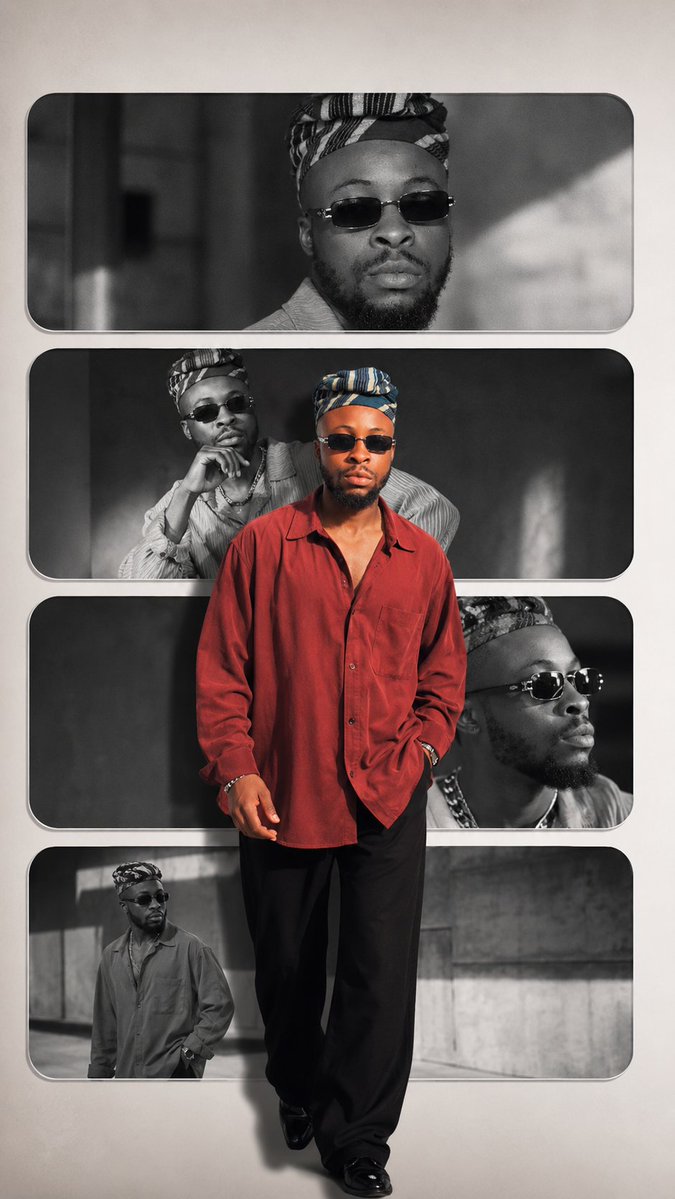
These are not done by photographer or any special edit. Ai did it and if you want something like this check comment section..
Note: use Gemini or Chatgpt