@KobeissiLetter A genuine bull market is typically driven by sustained growth in corporate earnings rather than market sentiment. Moving forward, the market will focus more on whether AI can continue to deliver tangible financial results, rather than simply relying on the narrative.
BREAKING: The S&P 500's net profit margin is on track to surge to 15.7% for Q2 2026, the highest in data going back to 2009.
If the current margin holds, it will mark the 10th consecutive quarterly increase.
This comes as 27% of S&P 500 companies have reported their results so far this earnings season.
Alphabet, $GOOGL, is the single largest margin contributor after significantly beating earnings estimates.
Meanwhile, 86% of reporting S&P 500 firms have so far beaten EPS estimates, while 80% have exceeded revenue expectations.
AI is driving historic earnings growth.
@piersmorgan The wealth tax has long been a controversial topic. Proponents argue that it can narrow the wealth gap, while opponents worry that it will stifle investment, entrepreneurship, and capital accumulation.
@BrianFeroldi What truly tests an investor is not the size of their capital, but discipline, patience, and risk management. As the account grows, these are the capabilities that ultimately determine the outcome.
If you can't invest $1,000 well, you won't be able to invest $100,000 well.
More money won't make you a better investor.
It just makes your mistakes more expensive.
🚨 ONE OF THE MOST VOLATILE WEEKS OF THE YEAR COULD BE AHEAD.
But ONE day may decide everything.
Here's everything investors need to watch.
Save this before markets open on Monday.
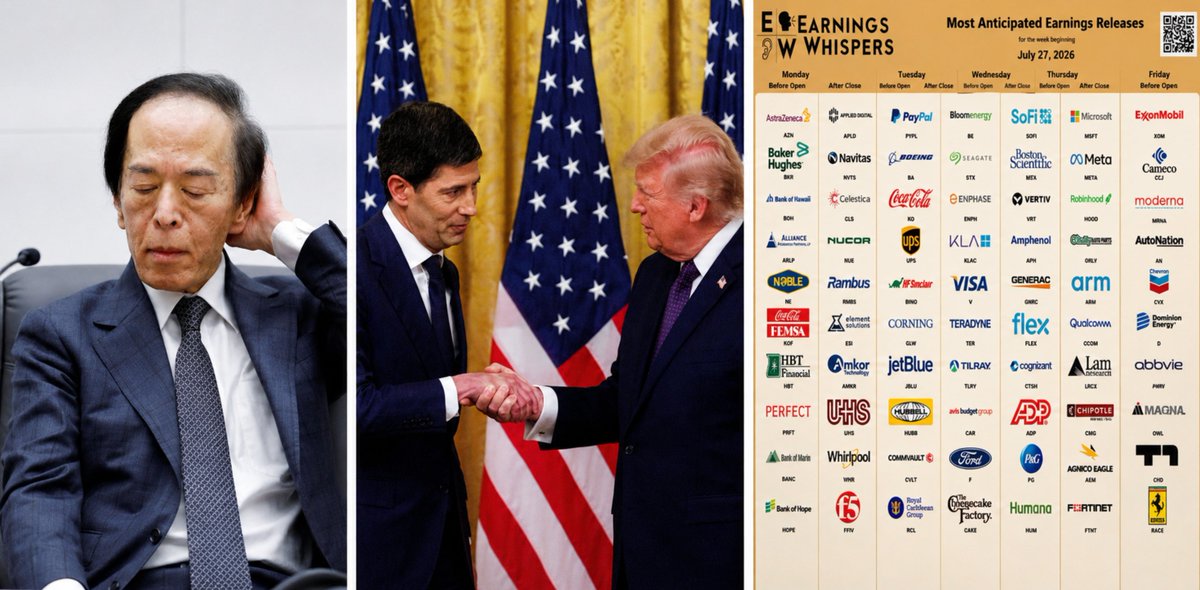
Four central bank and macro shocks are landing back-to-back in the same five trading days, with almost no room for a mistake.
MONDAY-TUESDAY: Tariff retaliation risk builds.
New Section 301 tariffs on 60 countries just took effect, hitting 99.4% of all US imports.
The EU has already doubled steel tariffs to 50% and is threatening China directly. Any retaliation this week hits stocks with almost no warning.
WEDNESDAY: The Fed decides.
New Chair Kevin Warsh runs his first high-stress meeting. Hike odds jumped from 12% to 38% in a single week, driven by oil prices climbing again.
Microsoft and Meta report earnings the same afternoon, meaning any Fed-driven volatility collides directly with megacap earnings reactions.
THURSDAY: This is the most dangerous day.
US Q2 GDP, core PCE inflation, and personal spending all drop within hours of each other.
The Bank of England and the Bank of Japan both decide policy the same day. Apple, Amazon, and MicroStrategy all report earnings too. Five major catalysts, one single day.
And the real danger is the BOJ as the yen sits at a 40-year low.
BOJ officials are privately open to hiking faster than markets expect, and swaps already price a 72% chance of another hike by October.
This is precisely the setup that caused August 2024's carry trade unwind, when a BOJ surprise crashed the Nikkei 25% and sent the VIX to its highest level since COVID.
If the Fed turns hawkish Wednesday and the BOJ surprises hawkish Thursday, both sides of the carry trade get squeezed at once.
And this is exactly when every market could tumble at once.
@BullTheoryio Gold has been a store of value for the past few decades, while Bitcoin is emerging as a store of value for the digital age. What they share is scarcity.
If you held $100 in gold since 1999, it would be worth $784 today, adjusted for inflation.
If you held $100 in cash, it would be worth just $49 in real purchasing power.
Holding gold outperformed holding the US dollar by over 1,500%.
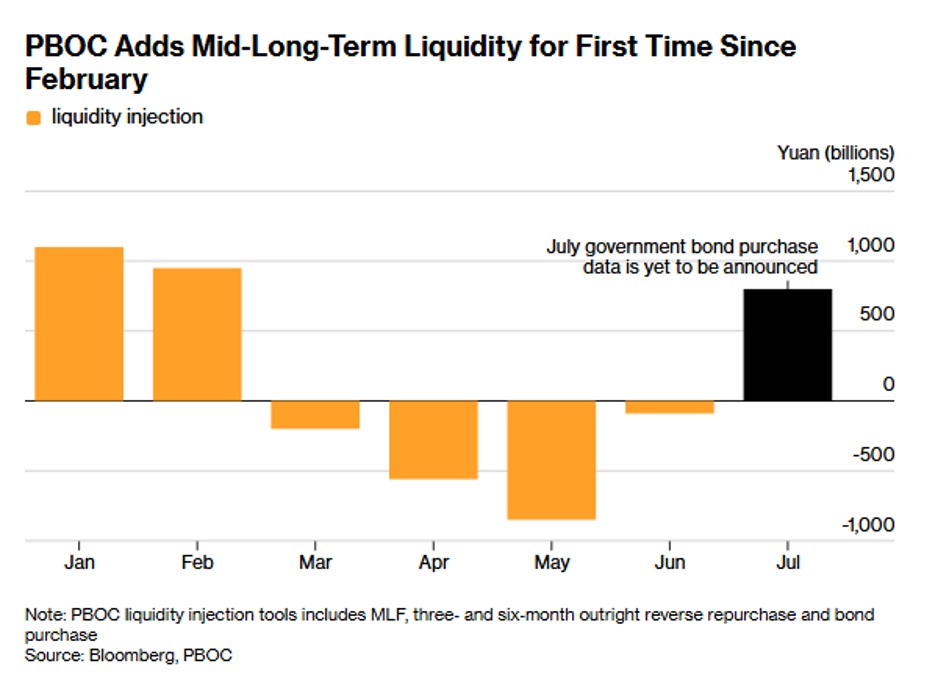
China's central bank is injecting liquidity into its financial system:
China's central bank injected +$14.8 billion into its banking system this month through its one-year Medium-Term Lending Facility (MLF) operation, the largest such liquidity injection in 5 months.
The MLF is a tool that allows the China's central bank to provide funding directly to commercial banks, helping ensure they have enough liquidity to support lending and financial stability.
Combined with +$103.3 billion added earlier this month through reverse repurchase operations, where the central bank temporarily lends money to banks in exchange for securities, total liquidity support surged to its highest level since February.
This follows 4 consecutive months of declining liquidity in the financial system.
The move comes after weaker-than-expected Q2 economic data and ahead of record government bond issuance in Q3.
China is boosting liquidity.
@KobeissiLetter Although gold and Bitcoin have different characteristics, both benefit from the demand for scarce assets. When the market turns its attention to preserving purchasing power, scarcity often comes back into focus.
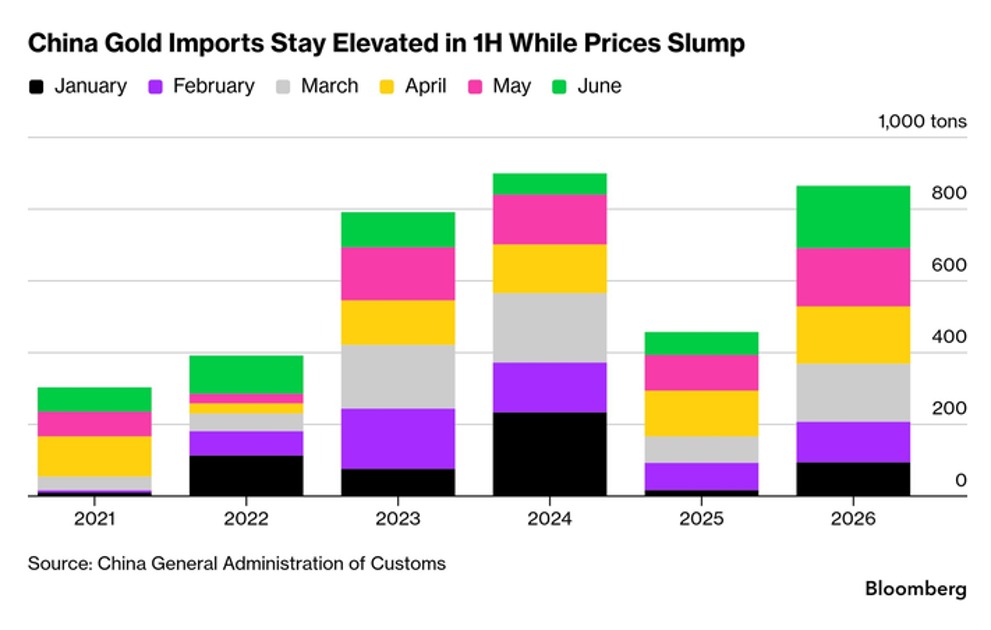
BREAKING: China imported +173 tonnes of gold in June, the largest monthly import since March 2024.
This also marks their 3rd consecutive monthly increase.
As a result, China's total gold imports in the first half of 2026 doubled, to ~820 tonnes, the 2nd-largest first-half total on record.
This is just ~10 tonnes below the first-half total record of ~830 tonnes set in 2025.
The surge was driven by investors buying the dip and banks increasing gold imports to rebuild inventories amid strong retail demand.
Meanwhile, gold-backed ETFs in China have attracted +28 tonnes of inflows year-to-date.
China's appetite for gold is incredibly strong.
@charliebilello Bitcoin and Nvidia represent the most iconic assets in their respective sectors—one benefiting from digital scarcity, the other from the AI wave. The true winners are often those who position themselves early and commit to holding for the long term.
@KobeissiLetter The data once again demonstrates the power of compounding. In the long run, the value created by investing in high-quality companies is often far more substantial than relying solely on rising property prices. Patience is the scarcest advantage in investing.
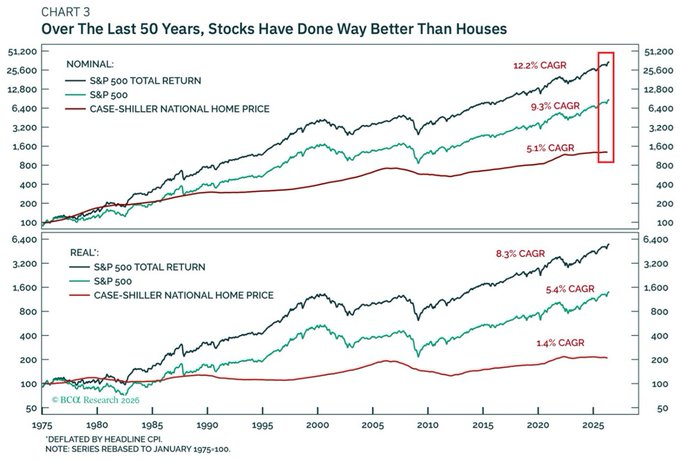
Stocks are significantly outperforming housing over the US over the long run:
Since 1975, the S&P 500 has delivered an average annual total return of +12.2%.
This is more than double the +5.1% annual gain in US home prices over the same period.
Even without reinvesting dividends, the S&P 500 has still returned an average of +9.3% per year, outperforming house price appreciation.
After adjusting for inflation, the gap is even wider, with the S&P 500's real total return at +8.3% over the last 50 years, nearly 6 times the +1.4% real annual return of US home prices.
At the same time, the S&P 500 excluding dividends and adjusted for inflation has returned +5.4% per year, on average.
Stocks have been a far more powerful driver of wealth creation than housing.
@KobeissiLetter The same applies to individuals. Consumption yields fleeting satisfaction, whereas saving and investing allow capital to generate sustained value. A long-term perspective is often more important than short-term gratification.