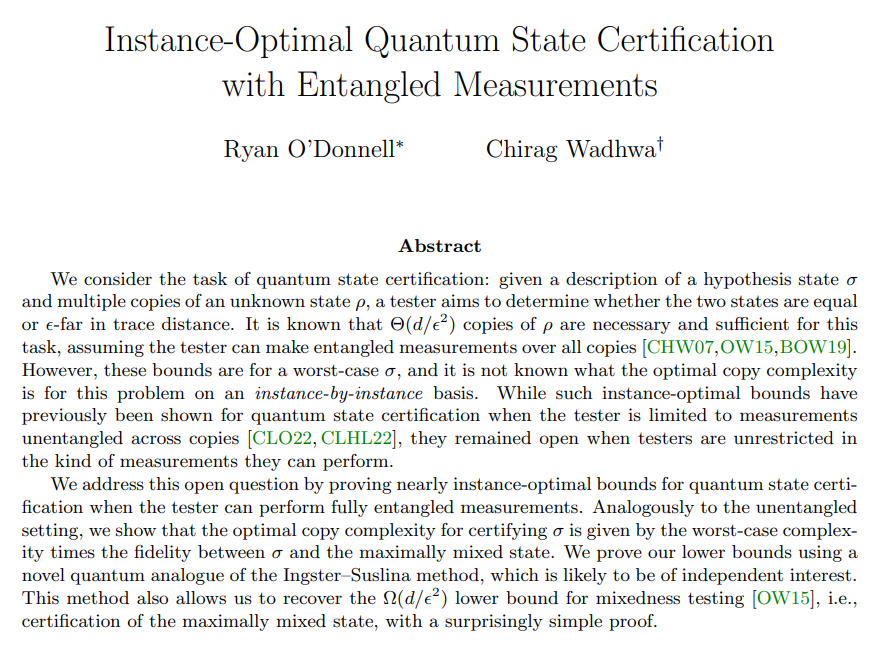
New work with @BooleanAnalysis! We prove instance-optimal bounds for quantum state certification when testers can measure all copies simultaneously, finding that the optimal complexity depends on how close to maximally mixed the hypothesis state is.
https://t.co/cDi2kUKXte
1/3
This new technique turns out to be very powerful, also allowing us to recover the optimal mixedness testing lower bound using just a few elementary calculations!
New work with @BooleanAnalysis! We prove instance-optimal bounds for quantum state certification when testers can measure all copies simultaneously, finding that the optimal complexity depends on how close to maximally mixed the hypothesis state is.
https://t.co/cDi2kUKXte
1/3
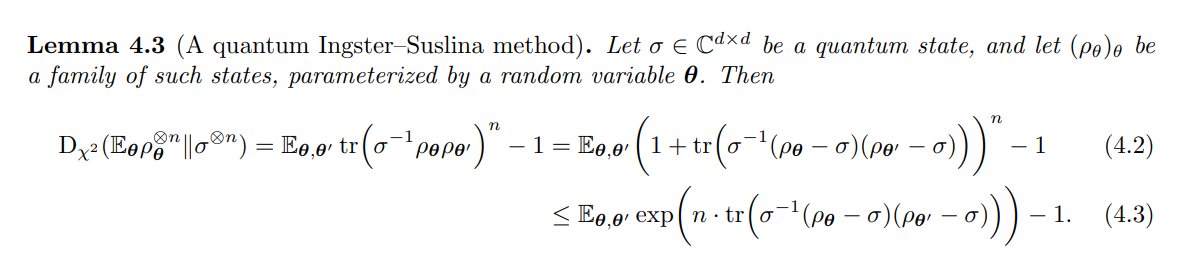
We prove our lower bounds using a new quantum analogue of the Ingster-Suslina method. Essentially, we find a convenient way to decompose the quantum χ^2 divergence between a mixture of states and a fixed reference state.
2/3
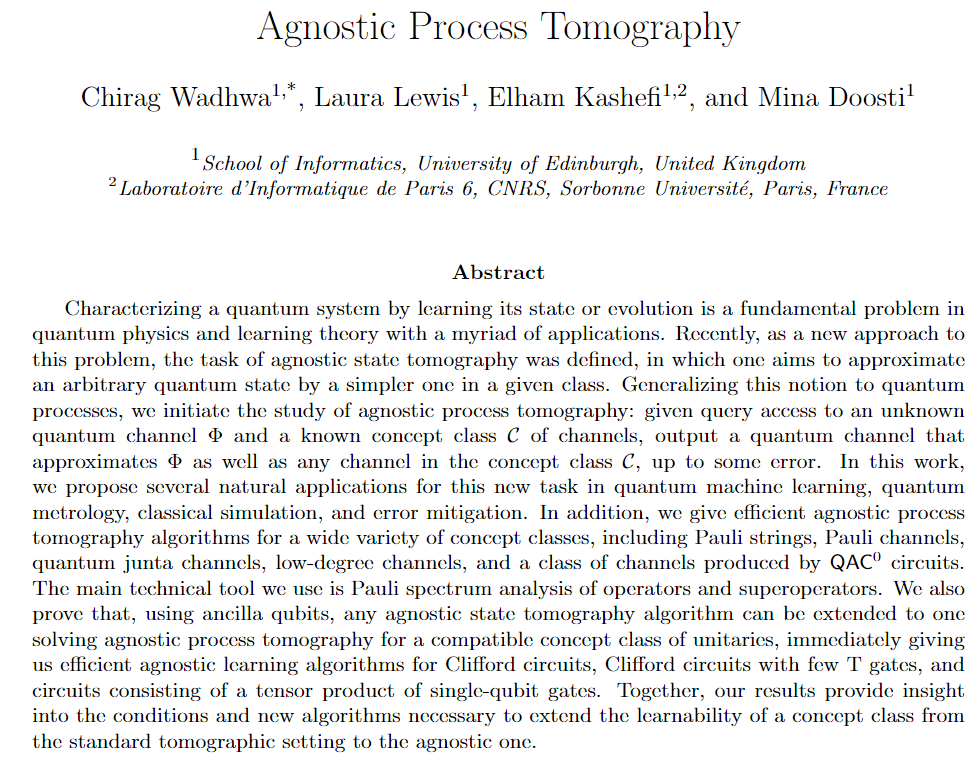
@Laura_Lewis_1 Using Pauli spectrum analysis, our main results include agnostic learning algorithms for Pauli strings, Pauli channels, quantum juntas, low-degree quantum objects and a class of channels formed by QAC0 circuits. 🥳 🫀
Implementing a complex quantum circuit ⚛️ is hard with near-term devices. Can we find its best implementation on a resource-constrained device 💻?
@laura_lewis_1, Elham, Mina and I study this problem and highlight its applications in our new work: https://t.co/qZGzVrdWO8 🔽
@Laura_Lewis_1 This immediately gives us agnostic learning algorithms for the classes of Cliffords and T-doped Cliffords, and tensor product circuits. 🔽
Next, we show that the learning algorithm of Huang et al.(2024) for constant-depth circuit can be implemented using access to our QPSQ oracle with just a linear overhead in query complexity. Together with our framework, we see that this algorithm can now be developed robustly.
Admittedly, this is not a surprising result. However, I think it’s nice to formally prove this requirement, and together with our result for Haar-random unitaries, our technique points towards a method for expanding such results to tighter requirements.
Further, we give a method for benchmarking noise with 2-copy statistical queries, as long as the noise is well-approximated by global depolarizing noise. Together, the robustness and benchmarking give us a theoretical framework for developing noise-tolerant learning algorithms.
We start by presenting two new quantum statistical query (QSQ) oracles. In our previous paper, we introduced a QSQ oracle for learning processes (QPSQ). We extend the definition of this oracle to “multi-copy” queries. We also define a new QSQ oracle for learning observables.
We show the natural noise-tolerance of QPSQ learners. This result essentially says that any QPSQ algorithm is robust to noise as long as it is within some threshold.