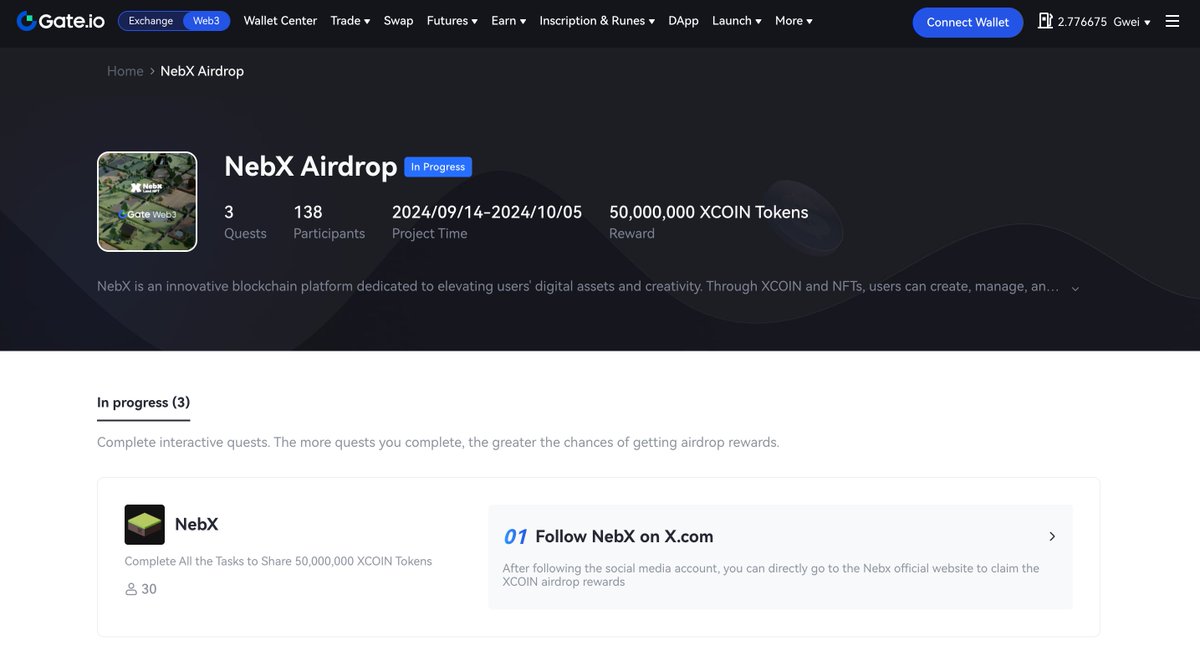
🚀 NebX Exciting Giveaway with Gate Wallet 🚀
We’re thrilled to team up with Gate Wallet @GateWeb3Wallet for a special giveaway event! 🎉
Don’t miss your chance to win incredible prizes and dive into the excitement with Gate Wallet! 🔥
🗓 Event Period: Sep 14th ~ Oct 5th
🎁 Rewards: 2000 XCOIN per person
📰 Learn more:https://t.co/fguaEQRYIR
The end of exploration is just the beginning of new discoveries—Join NebX! 🪐
#gatewallet #Giveaway #web3 #airdorp
Unlock your $XCOIN airdrop with your X account—easy and instant! 💸
We’re setting sail, and mysterious allies are joining soon. An unforgettable journey awaits—are you ready to jump in? 🔥🚀
#Airdorp#NFT#Crypto#memecoin
Rootstock Name Service (RNS) is a decentralized domain name system that allows users to register and manage domain names on the Rootstock blockchain.
RNS is based on the ENS protocol, which is a standard for decentralized domain names.
## Features
RNS offers a number of features that make it a valuable tool for managing domain names on the Rootstock blockchain.
These features include:
* **Decentralization:** RNS is a decentralized system, meaning that no single entity controls the domain name registry.
This makes it more secure and resistant to censorship than traditional domain name systems.
* **Interoperability:** RNS is compatible with the ENS protocol, which means that it can be used to register domain names that are compatible with other decentralized applications.
* **Simplicity:** RNS is easy to use, even for those who are not familiar with blockchain technology.
Rootstock Name Service (RNS) is a decentralized domain name system that allows users to register and manage domain names on the Rootstock blockchain.
RNS is based on the ENS protocol, which is a standard for decentralized domain names.
## Features
RNS offers a number of features that make it a valuable tool for managing domain names on the Rootstock blockchain.
These features include:
* **Decentralization:** RNS is a decentralized system, meaning that no single entity controls the domain name registry.
This makes it more secure and resistant to censorship than traditional domain name systems.
* **Interoperability:** RNS is compatible with the ENS protocol, which means that it can be used to register domain names that are compatible with other decentralized applications.
* **Simplicity:** RNS is easy to use, even for those who are not familiar with blockchain technology.
Rootstock Name Service (RNS) is a decentralized domain name system that allows users to register and manage domain names on the Rootstock blockchain.
RNS is based on the ENS protocol, which is a standard for decentralized domain names.
## Features
RNS offers a number of features that make it a valuable tool for managing domain names on the Rootstock blockchain.
These features include:
* **Decentralization:** RNS is a decentralized system, meaning that no single entity controls the domain name registry.
This makes it more secure and resistant to censorship than traditional domain name systems.
* **Interoperability:** RNS is compatible with the ENS protocol, which means that it can be used to register domain names that are compatible with other decentralized applications.
* **Simplicity:** RNS is easy to use, even for those who are not familiar with blockchain technology.
sactios and other data off-chain, which can reduce the load on the main chain and improve transaction throughput.
Some examples of off-chain scaling solutions include paym
## Scaling Solutions on Rootstock: Enhancing Transaction Throughput
Rootstock is a Bitcoin sidechain that is designed to support smart contracts.
As a result, Rootstock transactions are more complex and require more computation than Bitcoin transactions.
This can lead to lower transaction throughput on Rootstock than on Bitcoin.
There are a number of scaling solutions that have been proposed to address this issue.
These solutions include:
* **Off-chain scaling**.
Off-chain scaling refers