Hey Canada!
Imagine having the know-how to truly make an impact, where your voice echoes in the halls of power. That's exactly what "Reconnect to Canada" delivers. This book isn't just informative; it's your guide to getting involved. Dive into Canadian history, politics, and law, and discover practical ways to shape our future.
It’s time to take an active role in our democracy.
Grab your copy of “Reconnect to Canada” now. Empower yourself and others to build a more brighter and more united Canada. 🇨🇦📘
Now avaiable on:
@amazon: https://t.co/MKFUlUrwpd
@Shopify: https://t.co/bcrnFS89D9
@Luludotcom: https://t.co/40mQrSWceJ
Don’t wait. Get your copy today!
🇨🇦 Why does Canada have a Senate?
When Canada was founded in 1867, the Senate was designed to serve two important purposes: provide a second review of legislation and ensure regional interests were represented in Parliament.
It was intended to provide “sober second thought” and prevent more populous regions from dominating the smaller ones.
Is the Senate fulfilling the role it was created to serve?
Understanding how Canada was designed to function helps citizens assess how well it functions today.
Understanding how Canada has evolved helps citizens recognize what is possible for its future.
Discover more in Reconnect to Canada: A Guide for Empowered Canadians a book that makes Canadian civics clear, practical and accessible.
Get your copy: https://t.co/Kmzh9Fx7RJ
🇨🇦 Fun Fact!
Can you believe it was only 79 years ago, in 1947, that Canadians gained their own Canadian citizenship?
Before then, Canadians were British subjects!
Nearly 80 years after Confederation, the Canadian Citizenship Act established a distinct Canadian citizenship.
Canada’s laws, institutions and national identity have evolved considerably throughout its history.
Things change. That is how democracy works!
The Canada of tomorrow is for its citizens to shape. Canada’s evolution is far from over!
Civic education should extend beyond classrooms, courtrooms and political circles. It belongs at dinner tables, in workplaces and throughout communities.
A stronger democracy begins with knowledgeable, engaged citizens.
Get your copy today https://t.co/Kmzh9Fx7RJ
How well do you really understand Canada?
Who makes the laws? What limits government power? How are rights protected? What can citizens do when they want change?
These are questions every Canadian should feel confident discussing.
Reconnect to Canada: A Guide for Empowered Canadians by Eva Chipiuk makes Canadian civics clear, practical and accessible.
It encourages readers to ask better questions, engage in meaningful conversations and understand their role in holding governments accountable.
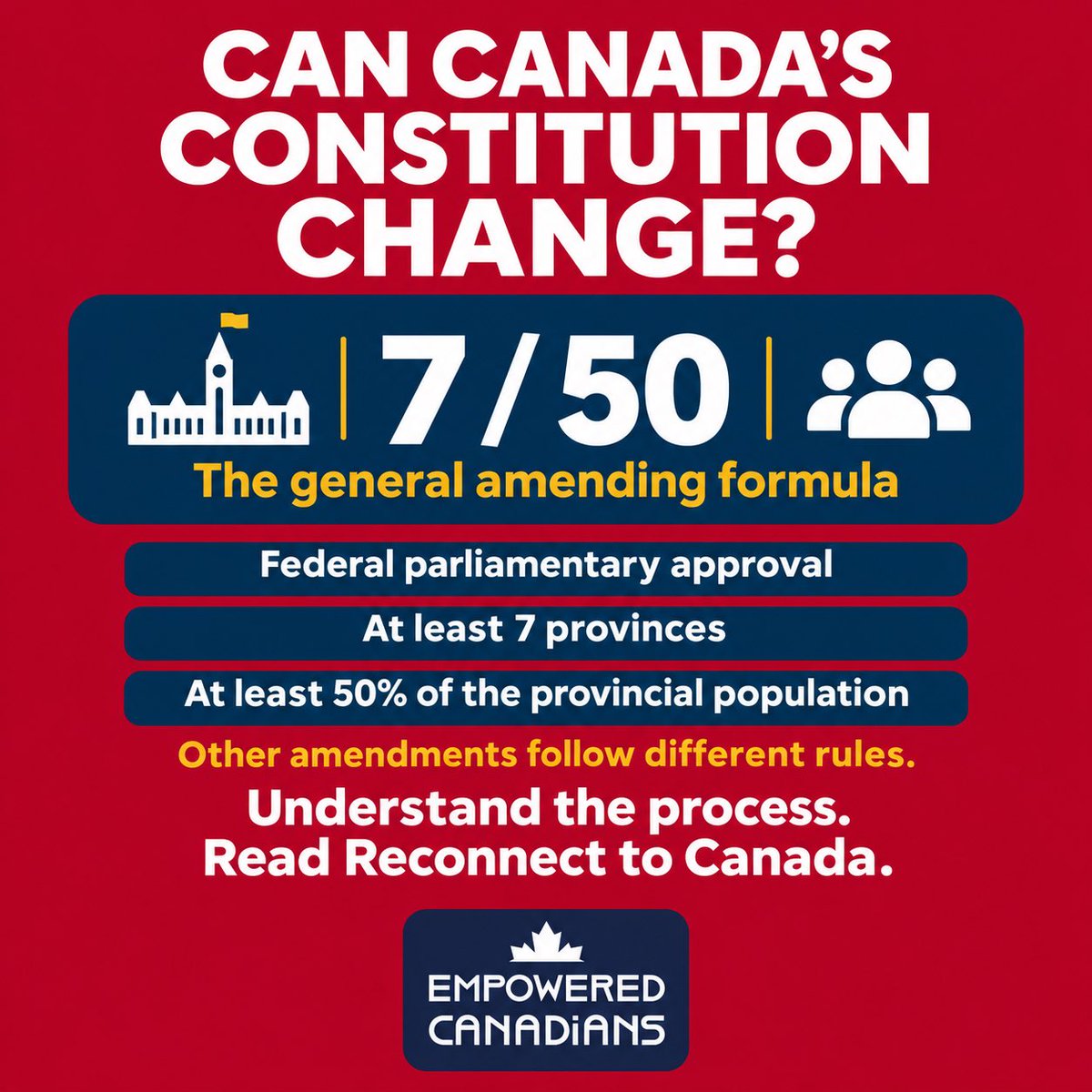
Can Canada’s Constitution be changed?
Yes, but how?
The general amending formula, known as the 7/50 rule, requires federal parliamentary approval and the agreement of at least seven provinces representing at least 50% of the combined provincial population.
@empoweredca As my Constitutional Law students @BondUniversity identified this semester, amendment formulas exist but are inherently difficult in practice. Thanks for your posts they are great subject material and refreshers for us all.
Reconnect to Canada provides a clear, practical and accessible guide to Canada’s governing institutions, Constitution and civic participation.
Get your copy: https://t.co/Kmzh9Fx7RJ
Change is possible, at least in principle.
Major constitutional reform has proven incredibly difficult in Canada. Does the amending process protect constitutional stability, or has it become an obstacle to meaningful change?
Reconnect to Canada makes Canadian civics clear, practical and accessible. Understand our country and your role in shaping its future.
Get your copy: https://t.co/Kmzh9Fx7RJ
Canada had rights and freedoms long before the Charter was adopted in 1982. So what changed?
In 1960, Parliament passed the Canadian Bill of Rights, protecting fundamental freedoms such as religion, speech and assembly. However, it applied only within federal jurisdiction.
Understanding how rights are protected helps citizens ask better questions:
Which right is affected? What protects it? How must government justify its actions?
Knowing your rights also means understanding the limits on government power and when those limits can be challenged.