Instead of “crackhead” or “schizo,” try “ἐπόπτης” and “maenad”
Instead of “psychosis” and “schizophrenia,” why not try: “lesser mysteries” and “greater mysteries”
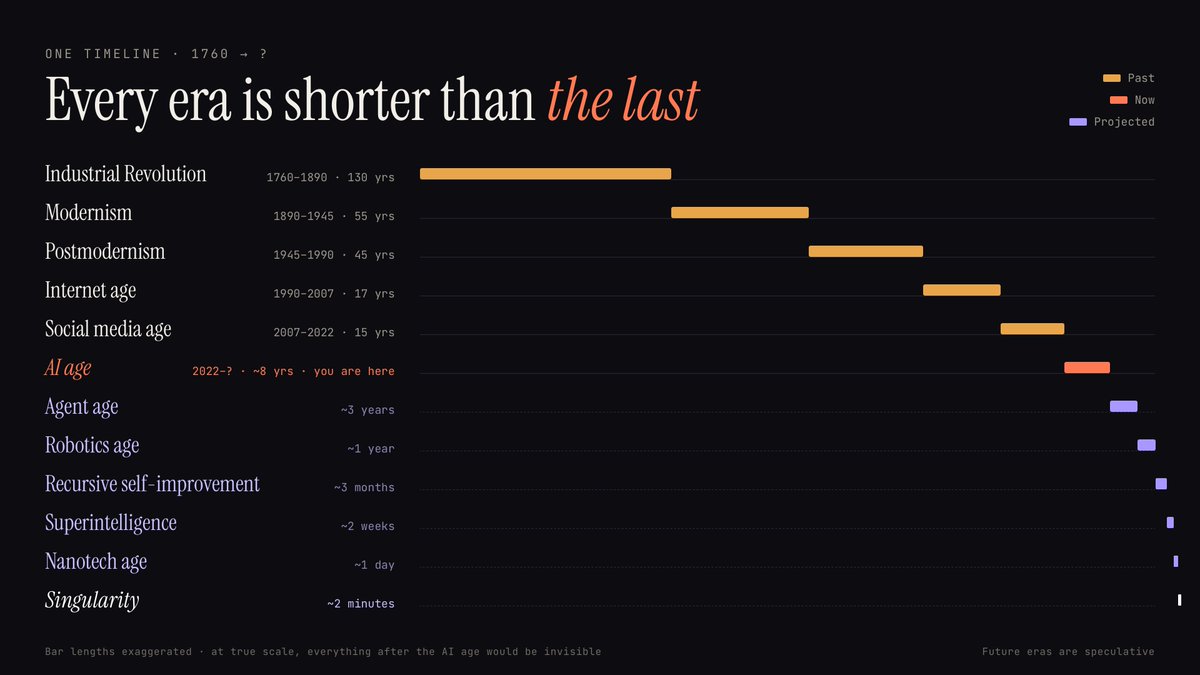
Yet I still stare at my phone saying 2026, trying to come to terms with it, wondering why it feels the present is eternal but now has ai slop and reels and only slowly decays into climatic and social collapse or techno-feudalism, looking at the lack of prospects of the youth, while my parents wonder where are the fucking flying cars, robots and spaceships and we were supposed to have by now. At least the phone has a bigger screen to show the glowing year that doesn't seem to have arrived.
It all comes down to the question about technology. because it's very rare a technology doesn't have this double aspect. You want to be a luddite or stagnate some technology development due to fear of the darkness that for certain looms in the human condition and the gates to hell the tech opens (that can't never be closed, and hell the countless dead to build the tech or due to it in history do fucking scream loud), or prefer to have hope in different social structures, rules and changes in our relationships between each other allowing another relation to technology that could expand the human condition or help us solve issues? I believe even if I lean more on the latter a bit, both have very strong arguments, and is not a settled question.
Let's change down syndrome to put some distance to the argument to a physical disability. Let's say I have a missing leg. I require a prothesis so I can function without the missing leg. I should be treated like any other person, as that it's not inherent to my value but make the necessary accommodations.
A technology is developed that may make much less people have missing legs cutting the missing leg gene. It can certainly be badly used and turned into awful eugenics for an arbitrary perfect human that doesn't exist, like all technological developments that carry this double aspect when the technology is put into contact with social structures (Haber-Bosch, nuclear energy and attention economy are some of the clearest examples); and may cause people to care less due to current social rules of treating disability opening way to that of no more missing leg persons are born. But it would make less people have the missing leg syndrome, reducing their suffering at no costs (imagine it was "perfected" not just a trial). Replace for down syndrome, the line of reasoning holds, it's not a complex picture like neurodiversity or mental health conditions, it produces shortened lifespans and suffering for the person who has it even if they report happiness.
The correct answer what's it? It's a big inferential jump to say we shouldn't develop it. It's try to change the social rules and structures so the double edge of the technology, the slippery slope towards eugenics doesn't happen. And yes, maybe we should be realistic and assume that they won't change any time soon or may worsen with these new technologies. But that's reason for brakes on commercial release (specially on countries that wouldn't cover it in public healthcare due to stratification concerns), robust testing protocols, ethical boards, limitations on pharma companies (which are needed for far more reasons than this one like the scandalous prices in some countries or the many scandals surrounding medications, trial protocols, marketing etc (prozac scandal anyone?)) and specially to push forward for a better fucking world where this double edge doesn't exist and we solved the condition for many doesn't mean we don't care about your current condition and should accommodate you!
This doesn't help people living with down syndrome. People can't understand eugenics when it's right in their face. 😐
Y'all hate disabled people. This is designer baby dystopian bs.
Ontology: magical materialism
• Epistemology: neopragmatic speculative in production realism
• Moral philosophy: metaethical amoralism-naturalism (no is not contractory), experimental revisable neo-confuncian-existentialist-benjaminian-deleuzian-nietzschean-hegelian ethics aka "Blood for all" (don't ask pls yet WIP I know it sounds even more cursed than magical materialism and I just blurted like 5 philosophers that hate each other xd)
• Theology: Social theism for all gods, uncommitted metaphysically, could admit an impersonal God with capital g
• Politics: Federative post-scarcity left libertarian willing to use the state and redirect capital for telos, but also growing parallel institutions.
gods this sounds cursed xd
DNA wasn't discovered when he wrote the will to power so idk about that one. and nietzsche kinda cba'd about raising the herd much despite flirting with eugenics due to his pathos of distance, distinguishing the aristorcrqt that rules the herd from the aristocrat of the soul. and tell me, what traits precisely count as prone to produce height? because, a priori, without becoming no one is a higher type. and, a perfect human being doesn't exist is an arbitrary measure, that would only produce a new last man, as difference is needed for agon, and fighting your own and others "decadence" using the nietzschean term even if I wouldn't frame it that way
that’s actually where I don’t think I have a clean disagreement with late Heidegger, and I probably shouldn’t pretend I do because I’ve engaged much less seriously with that part of him than with Nietzsche xd.
I think the Heideggerian point that the poet doesn’t create ex nihilo but emerges from a shared historical world is basically right. I need something like that too. My poet inherits language, myths, institutions, affects, technologies, dead traditions etc and gives form to something from inside that material. I’m not interested in the liberal fantasy of an atomized individual inventing himself from nothing.
where I become suspicious is more about what kind of shared world we are talking about, and whether the horizon itself becomes too closed. I don’t want the collective to already know what the proper historical destiny or authentic form of life is, because then we’re back to the paideia problem, you can very easily create an official image of the free or authentic individual and subsume people through it.
so maybe my disagreement is less “Heidegger is wrong about the poet” and more that I want a shared world capable of continually generating rival worlds and people capable of attacking its own horizon from inside it.
same with commitment. I’m not really anti-commitment; quite the opposite, I think you need to commit hard enough to a form for anything worth making to appear. What I distrust is eschatological closure, the claim that this form is guaranteed by History or exhausts what we can become. My commitments are wagers I can bleed for without pretending they are the final vocabulary of mankind lol.
and on which society actually breeds more poets, I don’t think I can prove mine does a priori. That’s part of the wager. A materially secure egalitarian society could absolutely produce a gigantic couch full of last men. My hope is that if you universalize some of the conditions aristocrats historically monopolized, leisure, education, access to culture, freedom from sheer necessity, while also preserving thick symbolic worlds, agon, competing traditions and avenues of recognition, you get more throws of the dice.
I don't think we can make “everyone become a poet” or “the collective manufactures higher types”, that would be submitting individuality to a eschatological telos, but more strange people from more places get the chance to encounter enough of a world to form something against it.
so perhaps the distinction is: Heidegger gives a very powerful account of how the poet can arise from a shared world. I’m more interested in with how you make a shared world that keeps producing people capable of opening another one. but idk, it's still an open question. and my realpolitik of survival (and opening way to another) in this current world may become slightly "plastic" heideggerian
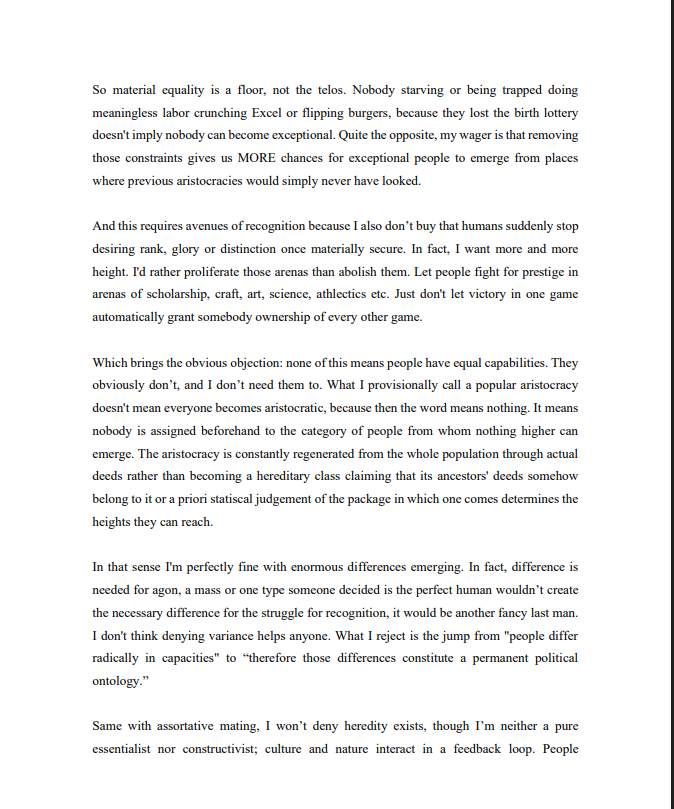
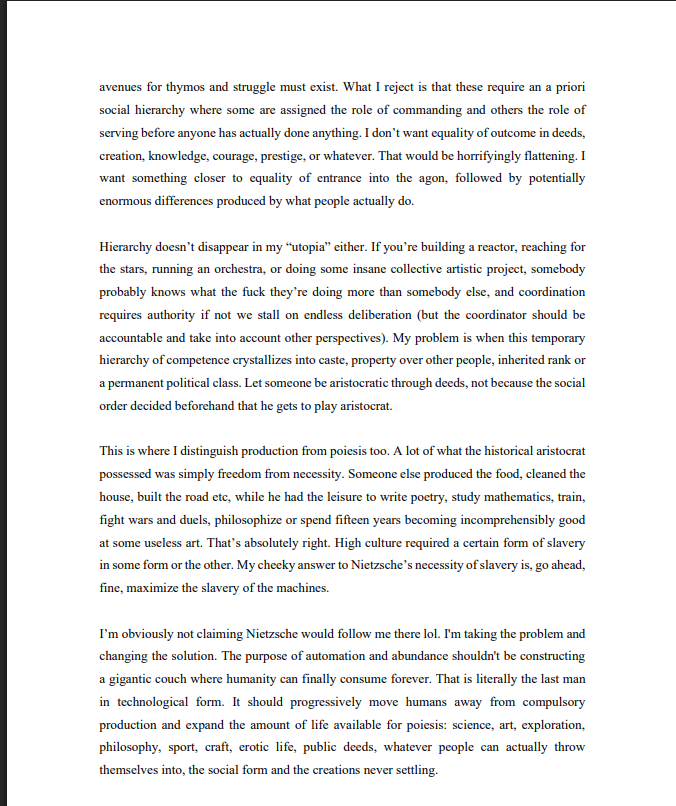
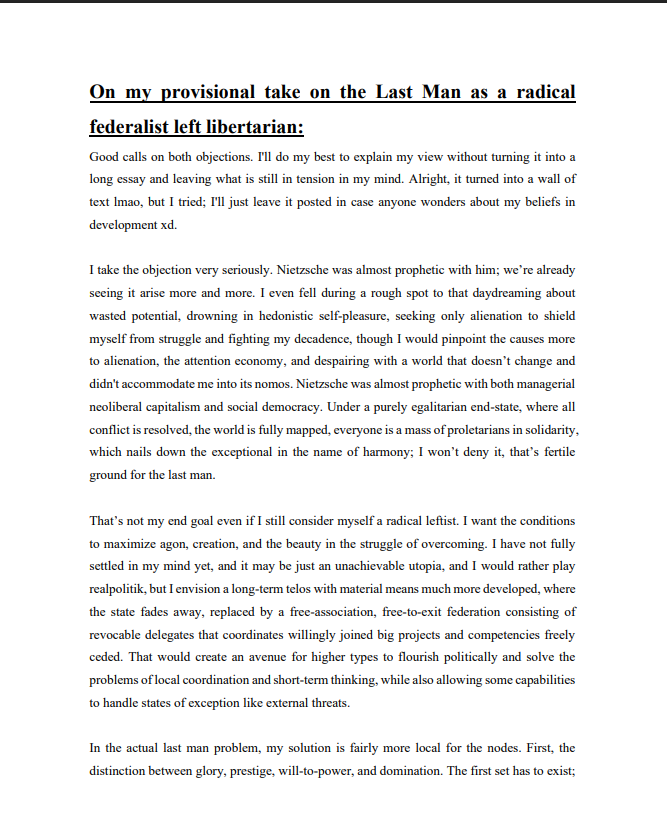
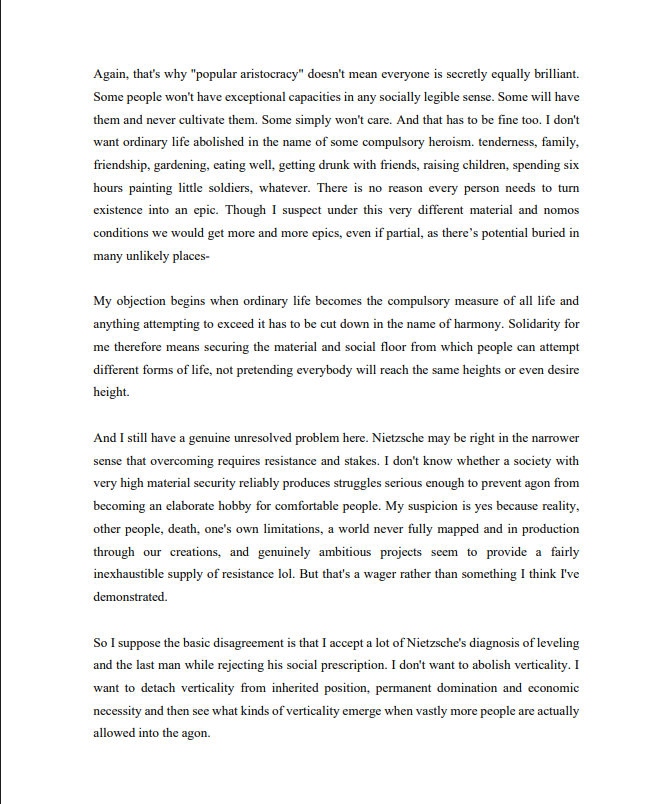
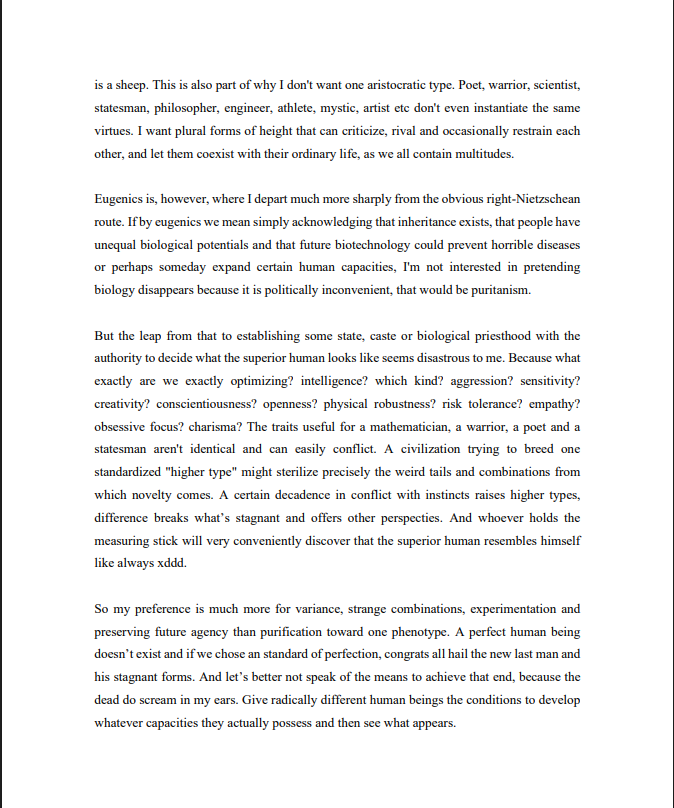
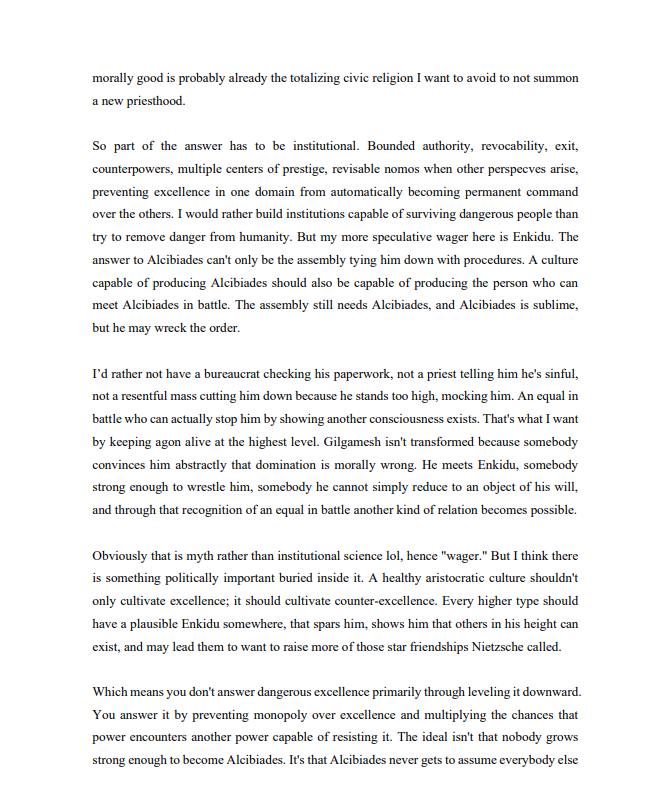
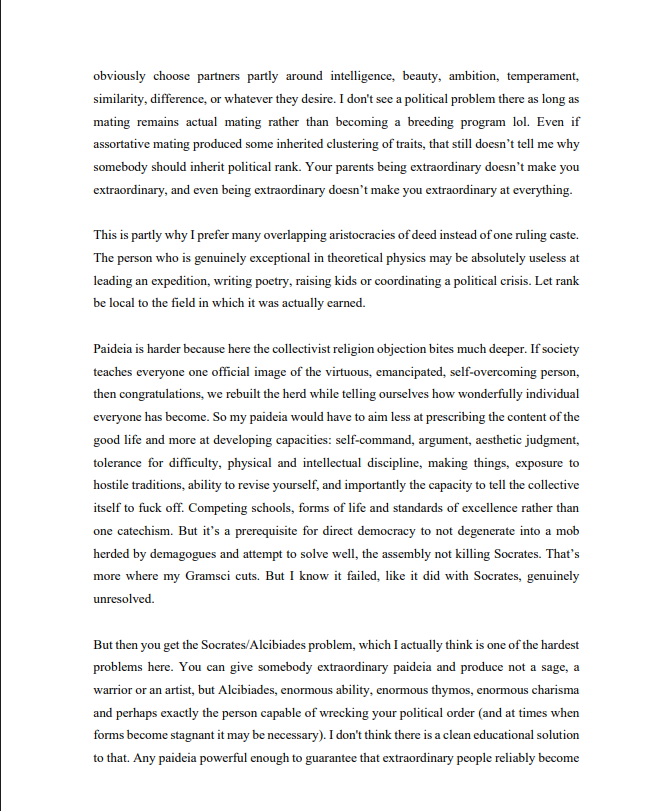
@Tomasuenim Sorry, I tried to keep it short, but given how much weight the last man has for me, it turned into a full essay I may even develop into a proper one for my Substack. My response in screenshots xd (part 1):
@Tomasuenim Sorry, I tried to keep it short, but given how much weight the last man has for me, it turned into a full essay I may even develop into a proper one for my Substack. My response in screenshots xd (part 1):
That's actually a good objection. I have a visible tension in my mind between true freedom individualism and the collectivism that may sustain the necessary base for poietic creation that can very well turn into a collectivist religion. Will explore it further. Sorry for my earlier tone, I'm confident in my ideas and open to debate, but I'm slightly insecure when I get attacked due to my weird background and got too reactive.
i didn't mean critical theory with "critical left", even if I use some of the big names in it. agree broadly with your comment here, don't know anything about you either, assumed based on your comment. i write broken prose here because I'm typing on my phone at 2 am and english ain't my first language. don't know why you called me a freshman, just for pointing out what debates could make a left nietzschean disposition falter, which btw are not settled in my mind.
@McHeartattack3@Tomasuenim Or you could go the other way and argue whether verticality collapses solidarity and tenderness, or the Straussian difference between these esoteric teachings and the noble lies the mass should believe. idk some ideas so you don't look so angry and regarded.
@McHeartattack3@Tomasuenim at least bring proper arguments to the table like if materialist immanence is enough for verticality and the difference between becoming and Being if you want a real battle.