@sedielem Made me reminisce this paper:
https://t.co/eBJb1PMknB
Fig 3 is a beautiful demonstration of this kind of analysis imo, and the multiple experts for these distinct types of tasks in different denoising intervals totally made sense
@gabriberton@iScienceLuvr DINOv2 does transfer quite well to pathology (in stark contrast to DINOv3). Current top models are almost all DINOv2 G/14.
And leveraging other sources is possible, extensively used by some groups that possess that data. Access to such data+slides is the main blocker usually.
We also released 1-bit Qwen3.8-27B quants which run on 8GB RAM.
They retain ~77% of accuracy compared to BF16.
We originally didn't want to release them but were shocked that they worked extremely well on our internal testing!
@hmyrbnl Bu konuyu sevmeyenleri ikna edecek, sevenleri mest edecek bir oyun tavsiyem var.
Elektronik devreler, kendi Assembly diliniz, ALU'larınız, CPU'nuz derken size sıfırdan komple (hardware+software) bir bilgisayarı yaptırıyor. Şiddetle tavsiye ederim.
https://t.co/tX5c8pL3Mc
@jeremyphoward We all joke but some crypto bro actually did create a Q* coin TODAY and it already has ~100k volume. I swear this timeline doesn't make any sense.
NEW PAPER 🧵: Deep neural networks are complicated, but looking inside them ought to be simple. In this paper we introduce TorchLens, a package for extracting all activations and metadata from any #PyTorch model, and visualizing its structure, in as little as one line of code. 1/
Today we're releasing the Segment Anything Model (SAM) — a step toward the first foundation model for image segmentation.
SAM is capable of one-click segmentation of any object from any photo or video + zero-shot transfer to other segmentation tasks ➡️ https://t.co/qYUoePrWVi
Our new course, "From Deep Learning Foundations to Stable Diffusion", is finally done after 8 months of work!!!
With >30 hours of video content (all free, no ads!), you'll learn how to create and train a Stable Diffusion model starting from pure Python 🧵
https://t.co/bK0PSIzFww
This might be the most eventful week AI has ever seen:
Monday:
-Stanford Alpaca 7B
Tuesday:
-GPT4
-Anthropic releases Claude
-Google's PaLM API
-AdeptAI raises $350M
-Google adds GenAI to workspaces
Wednesday:
-Pytorch 2.0
-MidjourneyV5
Thursday:
-Microsoft 365 Copilot
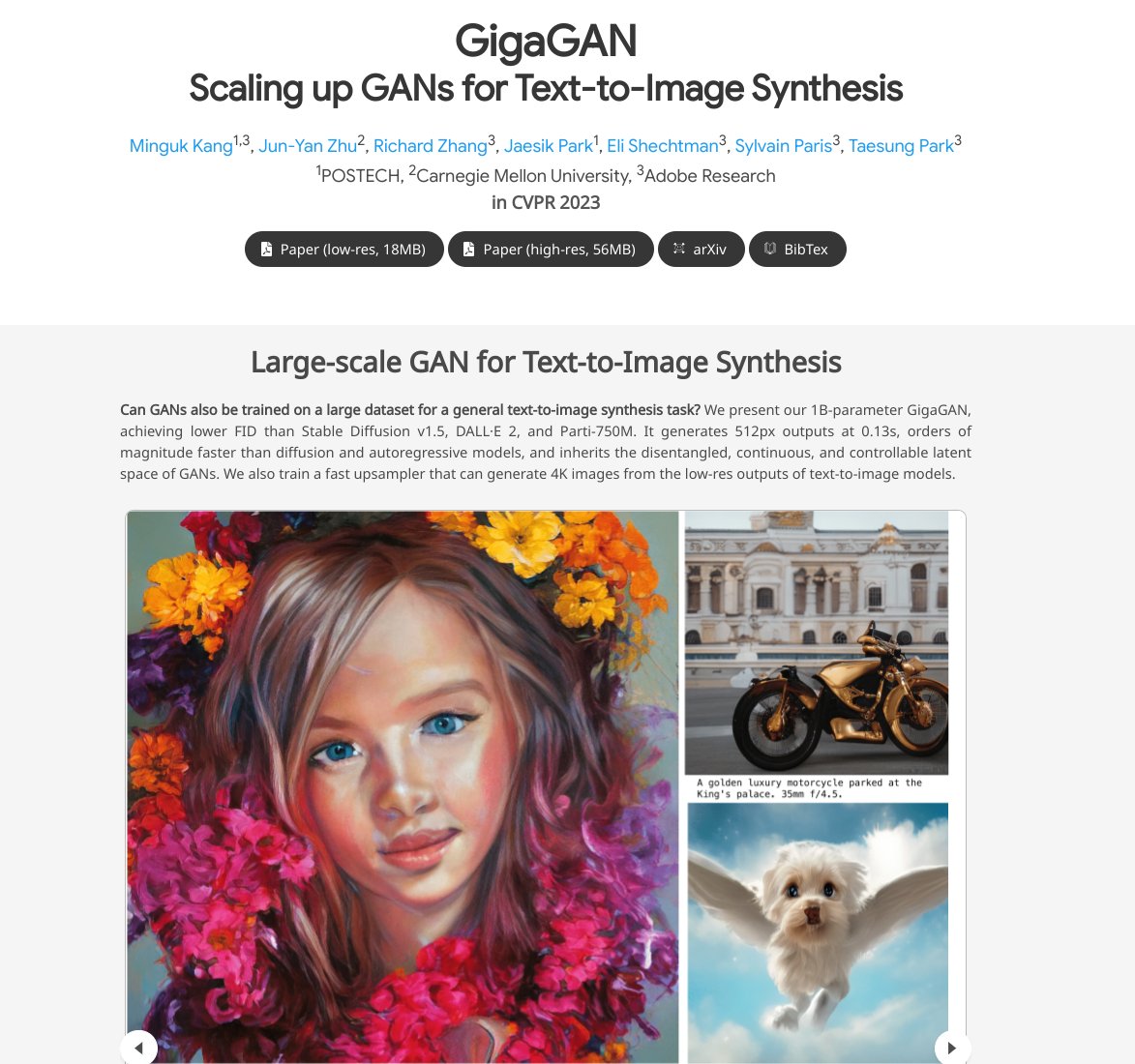
Scaling up GANs for Text-to-Image Synthesis
- Orders of magnitude faster at inference time
- Can synthesize high-resolution images, for example, 16-megapixel pixels in 3.66 seconds.
proj: https://t.co/CfsJal8NK7
abs: https://t.co/DqxNrRIqNK
Our new pre-print is out today! We demonstrate a brain-computer interface that turns speech-related neural activity into text, enabling a person with paralysis to communicate at 62 words per minute - 3.4 times faster than prior work.
https://t.co/jK1rdMT5Zl