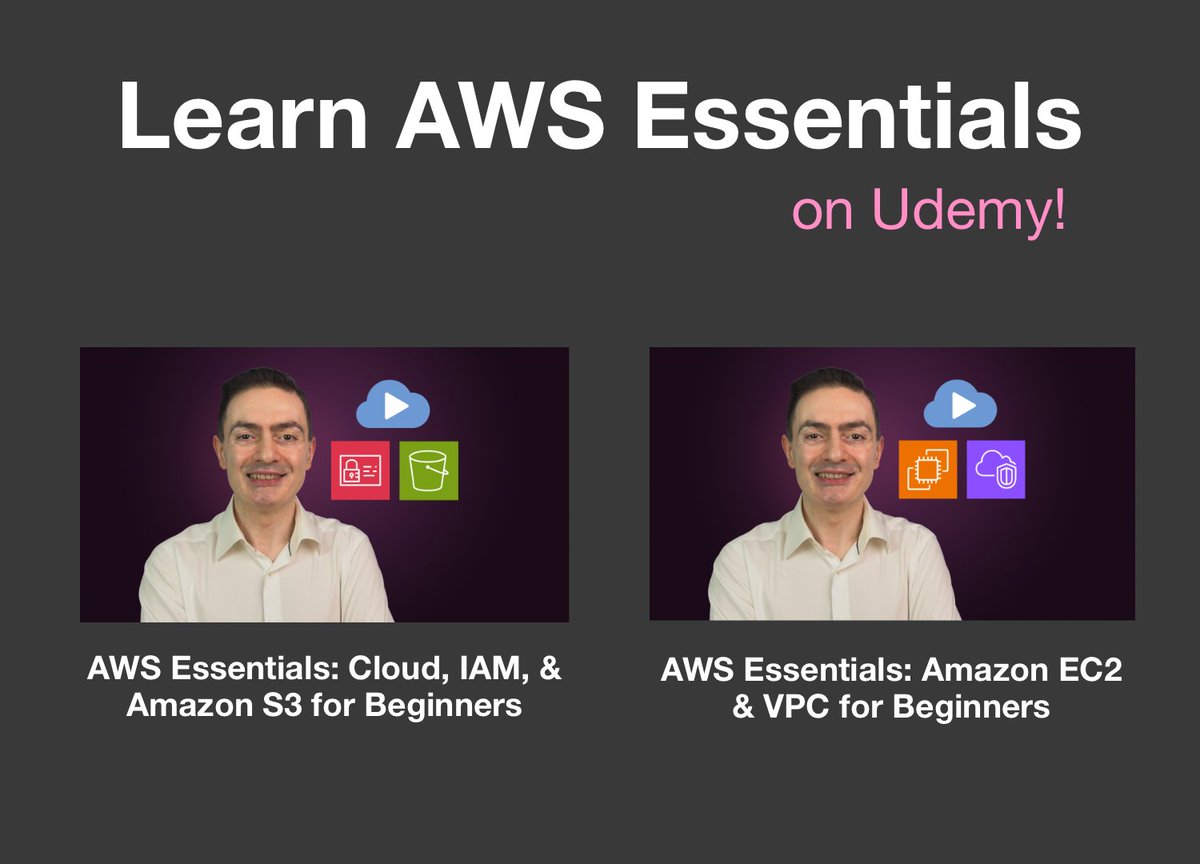
🛎️ NEW COURSE! Now live on Udemy:
AWS Essentials: Amazon EC2 & VPC Networking for Beginners
It builds on the first AWS Essentials course and continues the learning path by covering compute, networking, storage, load balancing, and auto scaling concepts essential to understanding AWS.
👨🏫 You will learn:
✓ How EC2 instances work
✓ How networking works inside a VPC
✓ How storage services like Amazon EBS and Amazon EFS work with your EC2 instances
✓ How Elastic Load Balancing and EC2 Auto Scaling help your applications become more reliable and scalable
The course is around 6 hours, which covers both theory and practice:
📖 37 colorful theory lectures
👩💻 36 hands-on demos
📝 12 short, frequent quizzes
🎭 5 AI Role Plays with enjoyable business-like scenarios
🎓 The AWS Essentials series takes the AWS Certified Cloud Practitioner exam as a basis.
🎯 But the goal is to help you understand AWS step by step through clear explanations, visual learning, and hands-on practice.
So, when you sit for the exam, you can solve the related questions more easily and comfortably.
🎬 It is now live in the Udemy marketplace.
If interested, this is your link to enroll with a discount:
👉https://t.co/xzd2xJKbda
If you haven't done so yet, this is the link for the first AWS Essentials course, to enroll in both courses as a bundle:
👉 https://t.co/bNwNbEqu1O
#Udemy #CloudComputing #AwsCertified #CloudPractitioner
You'll learn with the same step-by-step methodology as in my AWS DevOps courses, covering both theory and hands-on practice.
I'll leave links, including a discount, for those interested. 👇
AWS Essentials: Cloud, IAM, & Amazon S3 for Beginners
https://t.co/JXqnniWxt5
AWS Essentials: Amazon EC2 & VPC for Beginners
https://t.co/iaZdrecq5M
I'll be glad to see you in AWS Essentials.
Let's keep learning and producing more!
A strong AWS foundation is crucial for building scalable Gen AI apps because the cloud remains the most practical place to deploy them securely and reliably. AWS IAM, Amazon S3, EC2, and VPC are the backbone of AWS. You encounter them everywhere, often when you don't expect it.
That's why I built the AWS Essentials series on @udemy before working on new courses for AWS AI certifications and services.
#AWS #CloudComputing
I designed them around the AWS Certified Cloud Practitioner content.
After taking the exam this month (passed with 981/1000), I'm confident that they cover at least half of what the exam expects.
You'll also do more serious hands-on work than certification, such as creating a regional NAT gateway to connect your private instances to Amazon Bedrock. So we also cover some intermediate-level content.
Now, you can do 59 labs in my courses included in Udemy Business Pro subscriptions. 👩💻
So, you can practice more in Udemy's sandbox AWS environments without risking any AWS bills. 🤑
AWS CloudFormation Step by Step: Beginner to Intermediate 👉 27 labs
AWS CodePipeline Step by Step 👉 16 labs
AWS CDK with Python Step by Step 👉 11 labs
AWS CloudFormation Step by Step: Intermediate to Advanced 👉 5 labs
I hope these labs will provide a better learning experience if you can access Udemy Business Pro. I will continue to add more.
@awscloud The first alert we saw was for an amount of $3780, which belonged to an unusued AWS account. We initially worried about being hacked until we saw other accounts for billions of dollars. But the stress was too much until then. This is not funny.
You no longer have to find a globally unique name for your bucket. AWS automatically makes it unique for you. 👏 But how?
AWS introduced namespaces to bucket names:
🌍 The Global namespace is the old S3 bucket naming without suffixes.
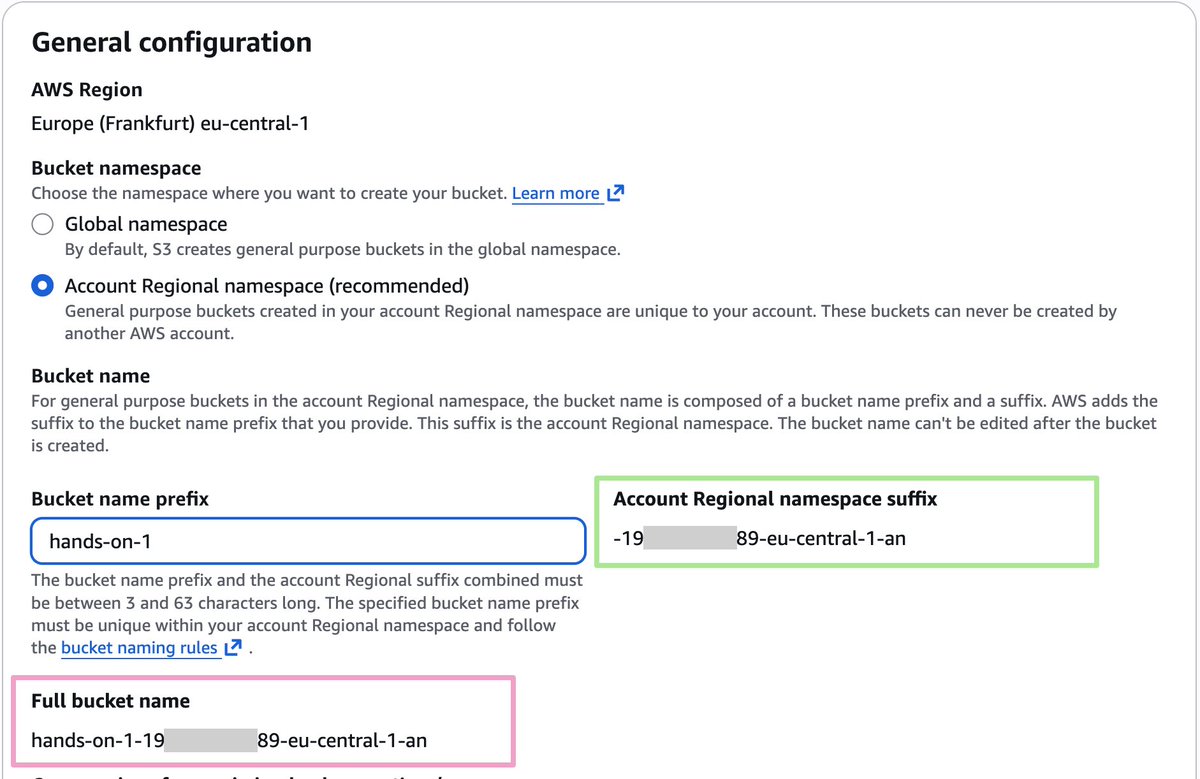
However, if you choose the Account Regional namespace, AWS automatically appends your AWS account ID and region code to your bucket name.
Suppose you create a bucket named 'hands-on-1' in your AWS account in the Europe-Frankfurt region (eu-central-1).
If you choose the Account Regional namespace, your bucket name becomes:
hands-on-1-<YOUR_AWS_ACCOUNT_ID>-eu-central-1-an
(Replace the <YOUR_AWS_ACCOUNT_ID> placeholder with your account ID.)
👉 The first screenshot below
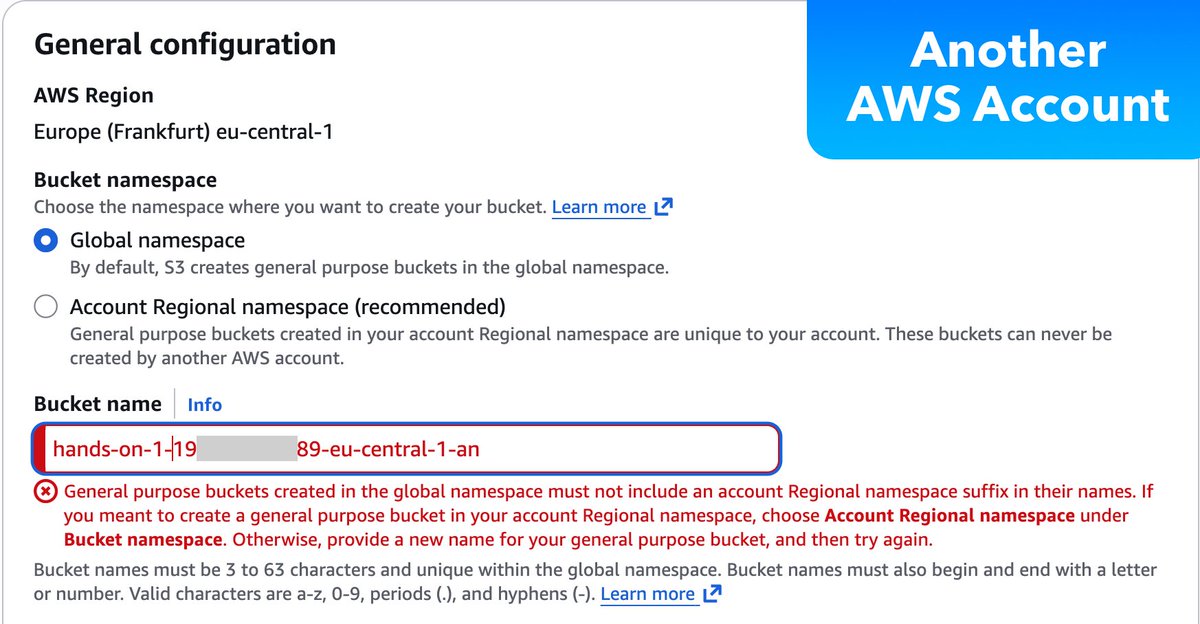
🤔 But what if another AWS account tries to create the same bucket in the Global namespace before you do?
No, they can't. All bucket names that end with your Account Regional namespace are reserved for your AWS account.
⛔ They receive an error as soon as they try to create the bucket.
👉 The second screenshot below
So, your S3 bucket names are still globally unique. However, AWS made it easier by introducing namespaces.
#AWS #AmazonS3 #CloudComputing
How do your private servers access Amazon Bedrock or other AWS services?
When your AI app accesses Bedrock via AWS CLI or AWS SDKs, it utilizes Bedrock's public endpoints.
So, this is done through the Internet. 🌐
What do you do if it is in a private subnet, then?
🔧 You create a NAT gateway in your VPC to give access to the Internet. I talked about the evolution of NAT on AWS before.
😒 But does it make sense?
Your server and Bedrock are both on AWS, maybe even in the same AWS region.
Why traverse the Internet to return to the same place?
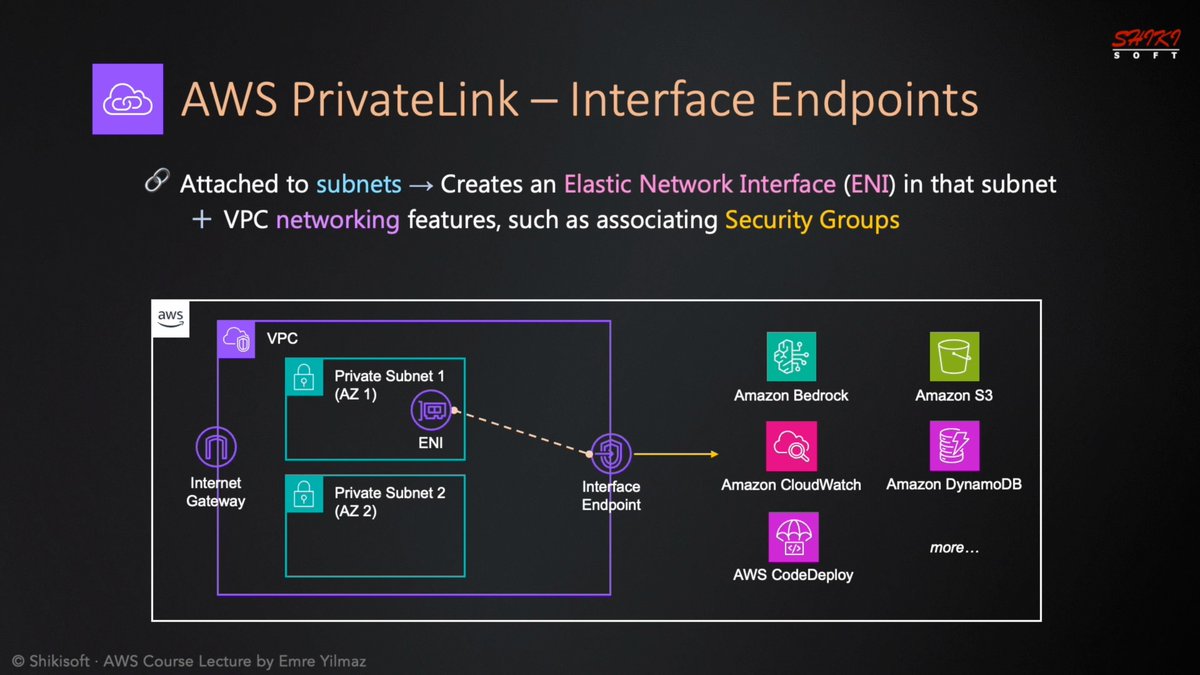
💡 Interface VPC endpoints are your answer.
You add a Bedrock endpoint to your VPC, powered by AWS PrivateLink, and, magically, all Bedrock requests are routed through the internal AWS network. No Internet! 😌
❗ But you need to create an interface endpoint for each AWS service accessed, which has a separate cost.
🩷 S3 and DynamoDB are special. They offer free gateway endpoint options.
🤯 Do these sound complex?
No worries! My upcoming AWS Essentials: Amazon EC2 & VPC Networking course will give you the foundations with an awesome hands-on lab on accessing Amazon Bedrock from a private subnet.
Subscribe to the Shikisoft Newsletter to join the waitlist. The link is in my profile.👆
PS You will also receive AWS, AI, and certification tips along the way. 😉 You can unsubscribe at any time.
#AWS #CloudSecurity #DevOps #GenerativeAI
@PiyushaaAI I agree. A hybrid cloud solution would be optimal, but of course, it will be very costly, and not everyone has sufficient capital for it. Some UAE & Bahrain companies may even be unable to consider it due to legal data-residency limitations.
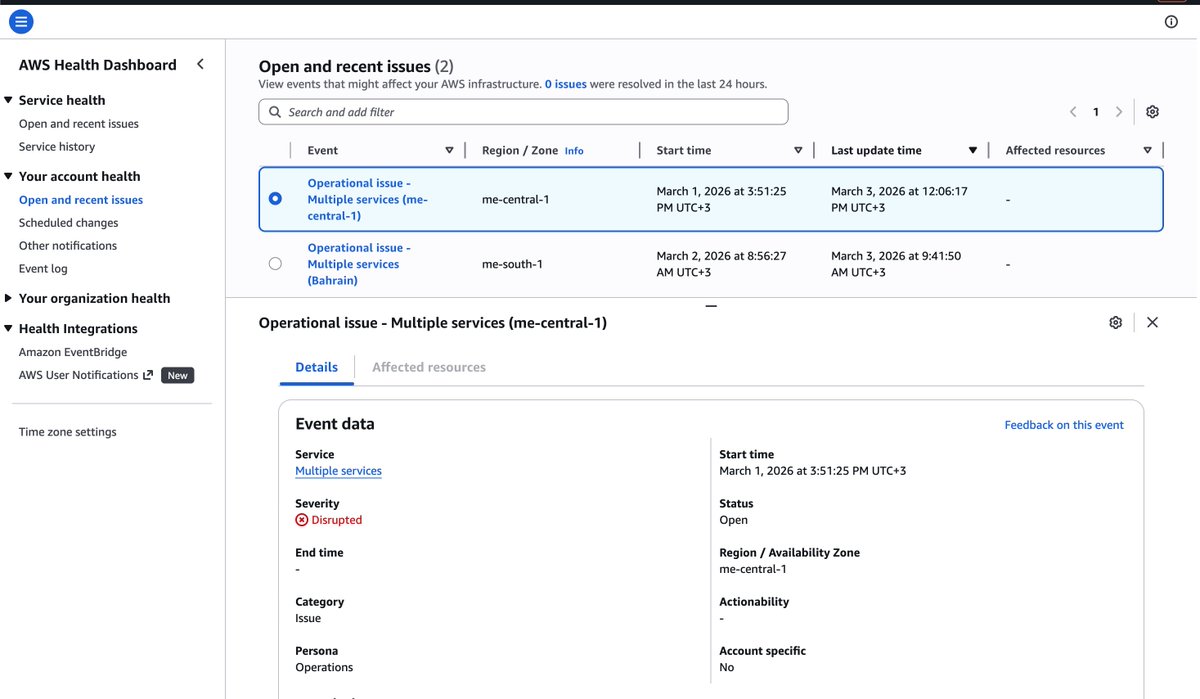
During the recent conflict, AWS data centers in the UAE and Bahrain regions were damaged, and Availability Zones were taken down or impaired.
This is a reminder of why you must architect your AWS solutions for high availability and reliability.
Of course, human lives are infinitely more important than any production workload. Still, as engineers, we must take critical steps to build resilient AWS architectures. 👇
#AWS #CloudArchitecture #HighAvailability #DisasterRecovery
Great additions. The physical=digital security point is exactly why regional selection is so critical now. Regarding the India rethink, are you seeing teams actively shift their ME workloads to Indian AWS regions (Mumbai or Hyderabad) as a safer alternative? Or are they just doing a broader audit of their global geopolitical risks?
Unfortunately, we can't avoid wars, earthquakes, or other physical disasters. But we can build architectural resilience using the right AWS tools.
👨🏫 I will be covering how to configure EC2 Auto Scaling Groups and Elastic Load Balancing in my upcoming AWS Essentials: Amazon EC2 & VPC Networking course.
To join the waitlist and receive AWS, AI, and architecture tips delivered directly to your inbox: https://t.co/6Fyg40LbtC
1️⃣ If you run a workload in an AWS region, always deploy across multiple AZs.
👉 EC2 Auto Scaling Groups, Application Load Balancers, and enabling Multi-AZ features in managed services, such as RDS, are your first line of defense.
2️⃣ If you run a mission-critical application, you must consider a Multi-Region architecture. For example, spanning a region in the Middle East and another continent.
👉 Depending on your budget and RTO/RPO objectives, you can architect for Backup & Restore, Pilot Light, Warm Standby, or Multi-Site Active/Active.
3️⃣ Monitor the AWS Health Dashboard (like the screenshot above) and use Amazon EventBridge to trigger automated responses to health events like these.
One of the biggest obstacles my students face in the new AI exams is actually the networking foundation.
That’s why I’m prioritizing the EC2 & VPC Essentials course first. You can’t secure Bedrock if you don’t understand the VPC it sits in!
If you're starting from the basics, you can find the first course in my AWS Essentials series on Cloud, IAM, and S3 foundations here: https://t.co/KfVgXA7dM3
Integrating AI into a Solid AWS Foundation ☁️
Maintaining the AWS Solutions Architect – Pro and DevOps Engineer – Pro certs since 2018 (passed 3x each) has taught me one thing: the Cloud never stops changing.
In 2026, the signal is clear: AI isn’t just a trend; it’s the new infrastructure.
To stay at the top of the game, I’m adding these three milestones to my roadmap: 👇 (1/5)
The Pro-level certs are where the real challenge lies, but the foundations are crucial first steps toward them.
I'll be documenting the journey and building new course content as I go.
What are your cert goals for 2026? 🚀 (5/5)