2 recent meta-analyses of mostly observational studies (one published this month!) found a significant *reduction* in mortality with whole blood vs. components https://t.co/J6KfjLRXLC https://t.co/dLBDAskqjl, proving yet again the futility of most observational clinical epi
TOWAR RCT replicates SWIFT finding no benefit of whole blood vs components for trauma shock. Quick meta-analysis of 30d mortality gives RR 1.17 (0.98-1.40), close to showing *harm* by whole blood. Huge credit to those who ran these RCTs; another physiology-based hype cycle falls
Fully agree with this. Sadly the @Royal_College residency program requirements require each resident to make their 'own' research project - mostly low quality single centre observational studies or surveys - rather than encouraging multi centre collaborative RCTs.
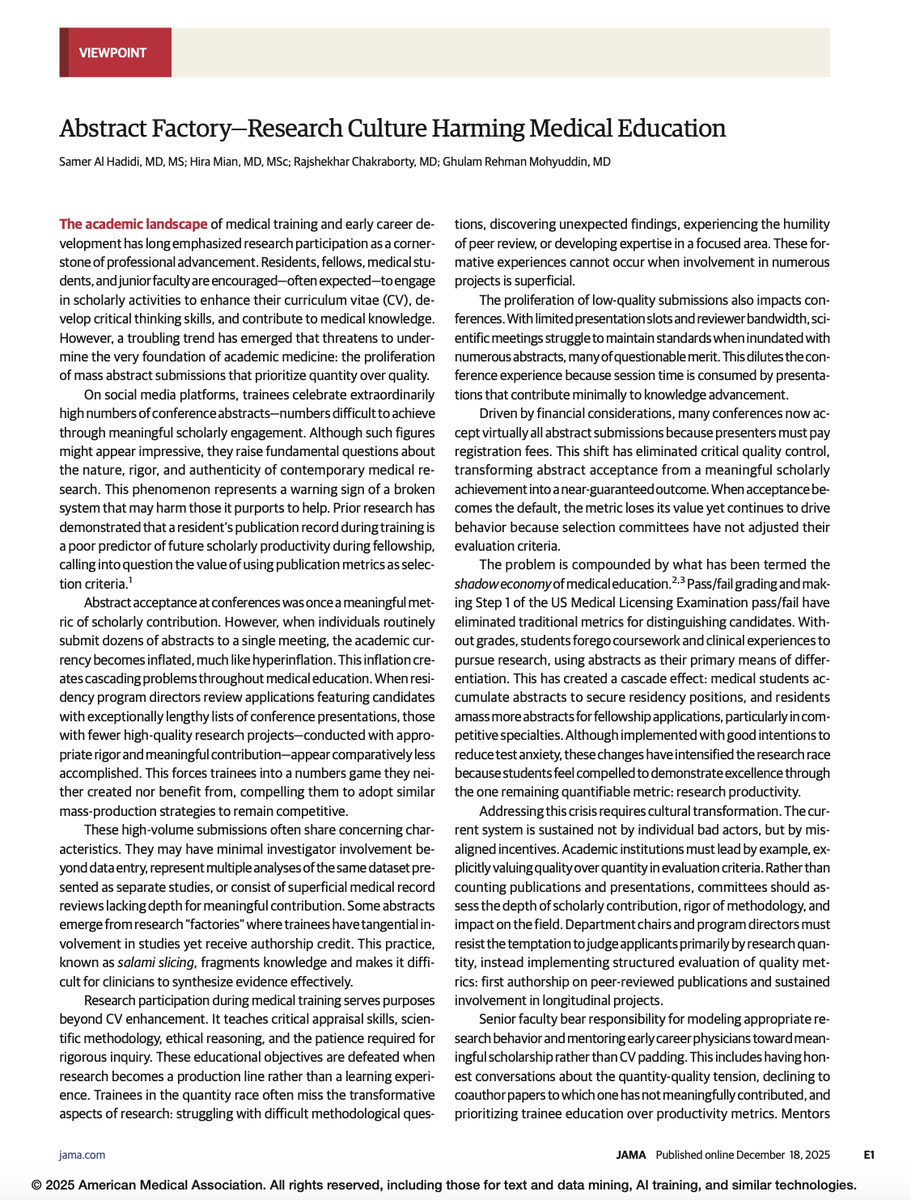
Check our viewpoint published @JAMA_current#MedEd
Abstract Factory—Research Culture Harming Medical Education
The "abstract factory" is destroying medical education. Trainees and junior faculty compete with abstract counts instead of meaningful research. Result: inflated CVs, diluted conferences. We shouldn't celebrate this—you don't need publications to be a great doctor.
➡️https://t.co/IMBhy45L1K
@utswcancer@rajshekharucms@HiraSMian@ManniMD1@HemOncFellows@ASCOTECAG
@nickmmark@pjedmonds The fact that ketamine maintains a 1% mortality benefit (albeit non-significant) despite increased transient post-intubation hypotension suggests etomidate may still be doing something harmful in the days-weeks after.
RSI trial in shows transient post RSI ⬇️BP does *not* lead to increased mortality; the point estimate is in fact in the opposite direction. Using previous RCTs as priors, Bayesian interpretation still favours ketamine as the preferred induction agent. 2/2
Interesting to see people jumping to 'we should use etomidate' based on the RSI trial surrogate 2ry outcome of less post intubation⬇️BP. But we only care about that surrogate outcome based on years of confounded retrospective studies, which RSI study itself has disproven. 1/2
We have a new study in JAMA IM asking: do all 'hypomagnesemic' patients need supplementation? Many reflexively prescribe Mg when the number is below the reference range, but is this indicated? We used a quasi-experimental design to find out. https://t.co/PTMAiBQtyy
All this suggests that routine Mg supplementation of everyone falling below the reference range may be another example of low value care. Very low levels and high-arrythmia risk patients likely still need treatment, but not everyone who's number is red on the EMR. RCTs needed.
In arrest patients brought to ED, already having received multiple doses, focus should be on reversible causes and/or timely ECMO. Ongoing EpiDOSE RCT of max 2 mg vs max 6 mg epi should provide more definitive evidence on this question.
Another win for less is more. Pre-post study of multi-dose epi in cardiac arrest (Q3-5min i.e. current routine practice) vs. single-dose protocol (1mg x1). Multi dose ⬆️ROSC but not neuro-intact survival. https://t.co/Axh21d3L8D . If age >65, ⬆️ROSC but ⬇️neuro-intact survival.
PARAMEDIC-2 showed epi has a *very* small survival benefit, but half of extra survivors have poor neuro outcome. This study suggests benefit mostly comes from first dose. In older adults especially, extra doses are futile/harmful.
@DrToddLee@giovannilandoni Absolutely. If the optimal target is in fact 60, 55, or even 50, that would lead to a huge decrease in vasopressor, ICU, and hence resource use.
Less is more wins again. RCT of high MAP target in older adults w/sepsis, stopped early for harm, 39% mortality MAP 80-85 vs. 29% mortality MAP 65-70 https://t.co/gd0qQIGV23. Recall also that the 65 Trial hinted that MAP60 may be better than 65. How low can we go?
Epidemiologic methods are increasingly difficult for clinicians and policy makers (and epidemiologists?) to understand. Are they at least getting us closer to uncovering causal relationships? My argument in this new commentary: we don't know, because we haven't checked. 1/2